Athenian Owl Tetradrachm: How Far Did the Design Travel?
Published · Revised
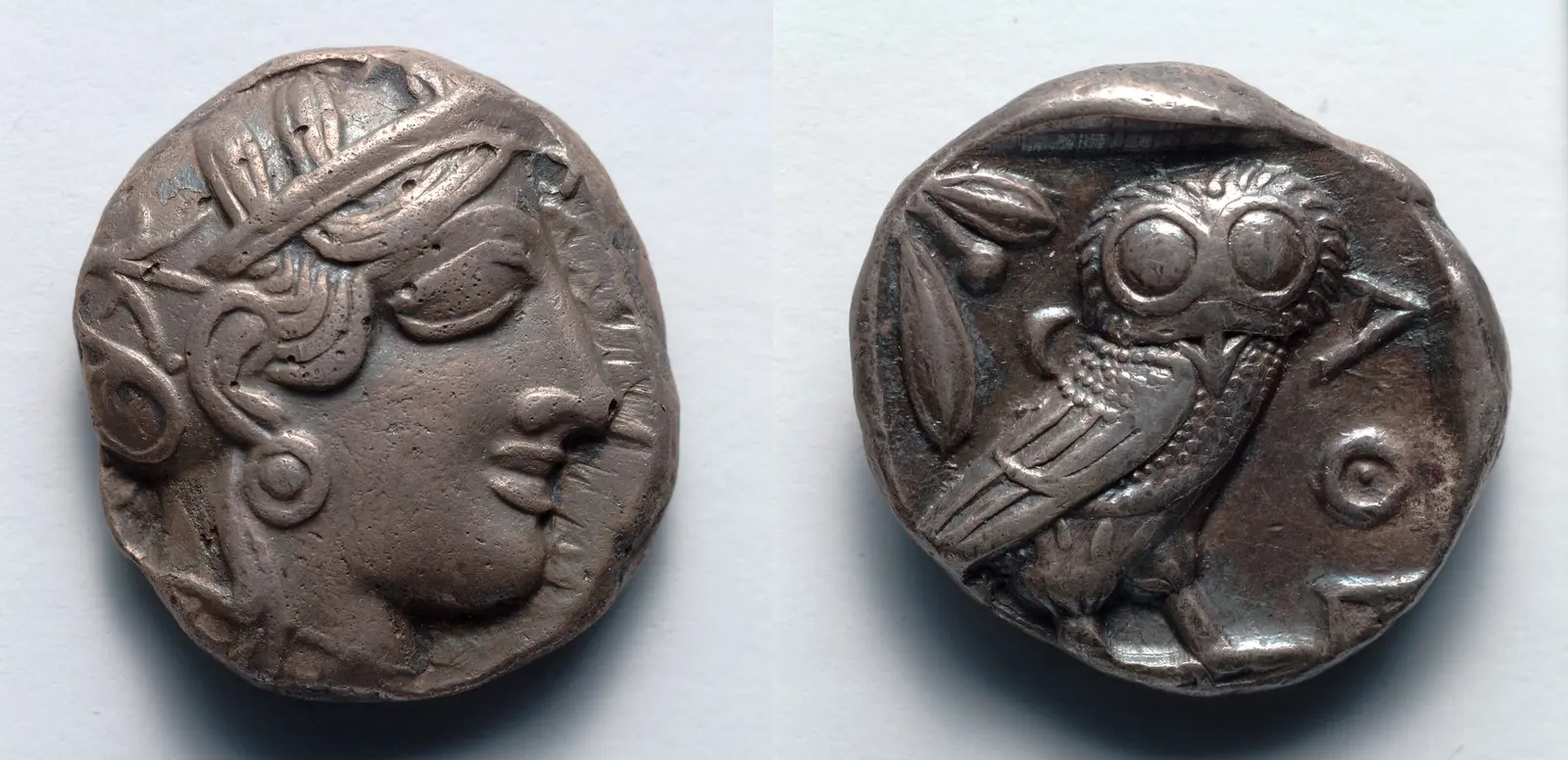
TL;DR: The Athenian owl tetradrachm was a silver coin worth four drachms, with Athena’s head on one side and an owl on the other. Cleveland’s example, dated 480–449 BCE, weighs 17.237 grams. One scholarly review reports its design imitated as far away as south Arabia and Bactria.
Collation: Minted silver: striking method not stated in the record · 17.237 g (0.61 oz); 2.4 cm (15/16 in.) overall · image/text unknown in Cleveland’s record / object 480–449 BCE · Cleveland Museum of Art, 1920.267

Collation card, all fields
- Object
- Tetradrachm: Head of Athena (obverse); Owl (reverse) clevelandart.org
- Type
- coin clevelandart.org
- Process
- Minted silver: striking method not stated in the record clevelandart.org
- Format & size
- 17.237 g (0.61 oz); 2.4 cm (15/16 in.) overall clevelandart.org
- Material
- silver clevelandart.org
- Made
- image/text unknown in Cleveland’s record / object 480–449 BCE clevelandart.org
- Held at
- Cleveland Museum of Art, 1920.267, clevelandart.org clevelandart.org
- Date basis
- Holding record: Cleveland Museum of Art gives the object date; no second catalogue read dates this coin clevelandart.org
Card data (CSV) · Source and license notesData: Cleveland Museum of Art, 1920.267 (CC0), https://www.clevelandart.org/art/1920.267, retrieved 2026-11-07
Look at Athena’s eye. The head faces right in profile, yet the eye is a wide almond, shown as if it looked straight at you. The lump of silver it sits on is 2.4 centimeters across, just under an inch. Cleveland’s record does not explain the eye, so this page starts with two questions the records can address: why Athens kept this face, and how far it traveled.
This page gives no prices and does not judge whether any coin is genuine.
What is an Athenian owl tetradrachm?
Nomisma, a shared vocabulary for coin studies, defines a tetradrachm as a denomination worth four drachms. The word alone does not mean Athens: many cities struck coins of that value, and the Art Institute of Chicago holds tetradrachms attributed to Ephesus and Syracuse. The “owl” is the Athenian kind. Cleveland catalogues this example as Greek, minted at Athens, in silver.
Now turn to the back. Cleveland’s entry for that side names an owl, a crescent moon and an olive branch, and the museum reads the letters ΑΘΕ as the first three letters of the city’s name.
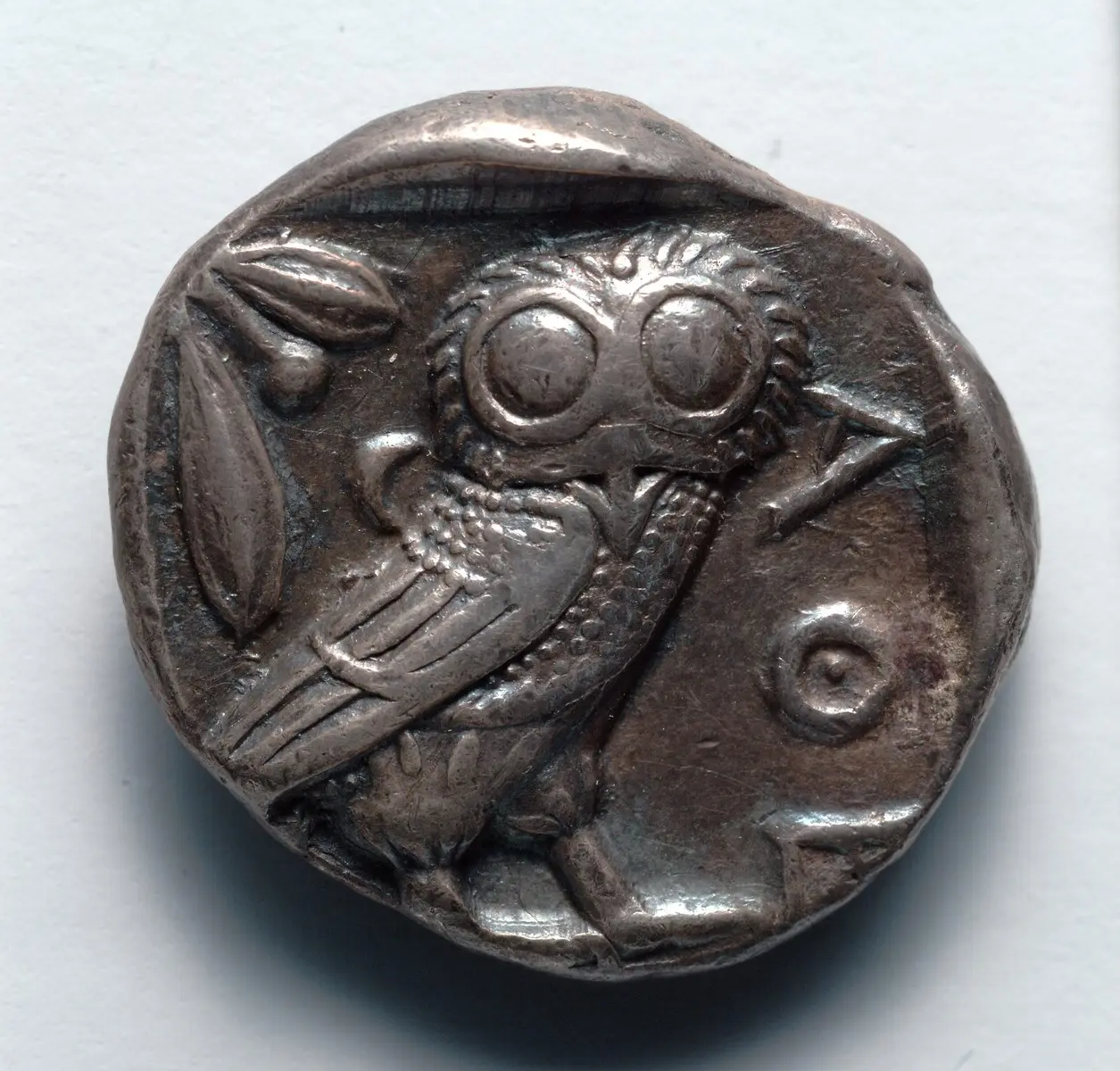
Chicago’s text on a similar coin explains these pictures. Because much of the population could not read, it says, a coin’s images told people where the money came from, and Athena was the city’s guardian goddess. Cleveland adds that few ancient coins were traded as widely or known as well as this type.
Cleveland’s page listed this coin as not on view on 7 November 2026, so its online record is the way to see both faces. The scholarly review discussed below also reports that the fifth-century Athenian tetradrachm came to work as an international currency.
Made: why did the old face stay?
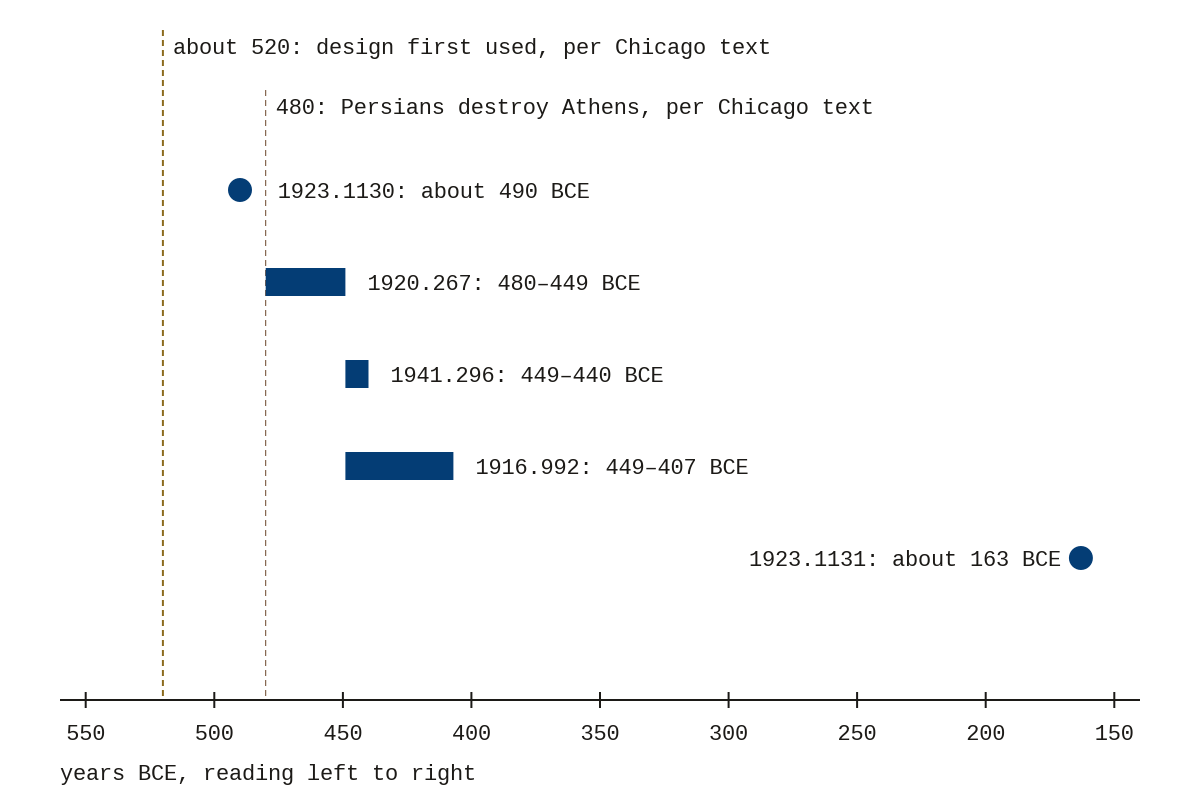
Every coin here carries the double date: one date for the design, another for the metal in hand. Chicago’s text says the Athena profile was first used in about 520 BCE, while Cleveland dates this coin 480–449 BCE, roughly 40 to 70 years later.
Those two figures come from different institutions, and Chicago’s is not about this coin. The object date remains a single museum’s record: no second catalogue read here dates 1920.267 itself. A photograph's dates can split the same way, as the mount of a carte de visite shows: the picture has one date and the physical card another.
Credit line to copy
"Design Date and Object Dates" by Spine & Watermark, https://spineandwatermark.com/money/athenian-owl-tetradrachm/, licensed under CC BY 4.0 (https://creativecommons.org/licenses/by/4.0/).The design did not stand perfectly still. Cleveland says two details date its coins after the Persian Wars: olive leaves on Athena’s helmet and a small crescent behind the owl. Chicago’s text places the Persian destruction of Athens in 480 BCE. A much later Athenian coin in Chicago, dated about 163 BCE, shows a helmet with a flying Pegasus and an owl standing on a vessel inside an olive wreath.
Chicago also offers a reason for the long run: while other cities modernized their coins, it says, Athens held on to its design to emphasize that its currency could be relied on. That explanation is a museum’s interpretation, because no ancient statement of the reason appears in the sources read here.
Cleveland’s record names neither an engraver nor a striking method, so this page does not describe how the design was cut. For a different way a design cut into a hard surface can work, see how intaglio and relief prints differ.
How much did an owl weigh?
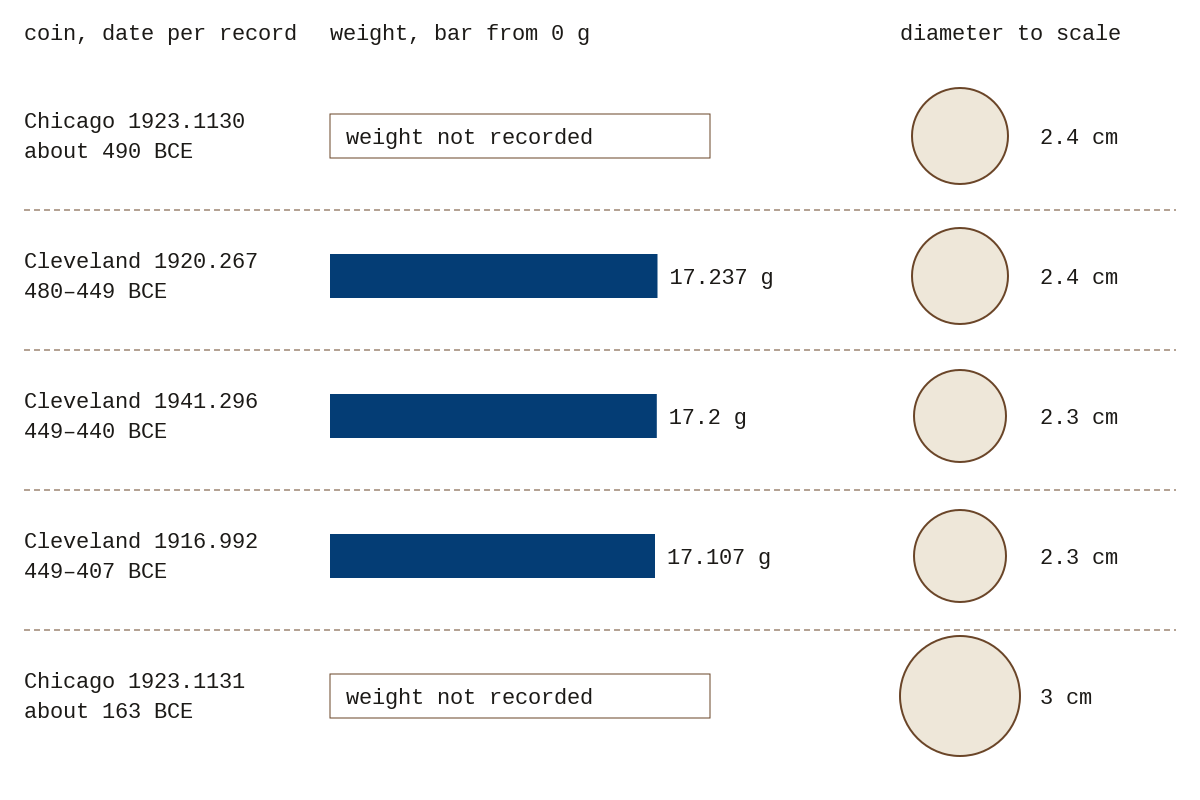
Set the weights side by side. Three Cleveland coins weigh 17.237, 17.2 and 17.107 grams, a spread of 0.13 grams, which is under 1 percent of the heaviest coin’s 17.237 grams (0.61 ounces in Cleveland’s record). Three coins cannot establish a weight standard, and the middle figure is recorded to one decimal place only.
Credit line to copy
"Weight and Diameter of Five Athenian Tetradrachms" by Spine & Watermark, https://spineandwatermark.com/money/athenian-owl-tetradrachm/, licensed under CC BY 4.0 (https://creativecommons.org/licenses/by/4.0/).| Coin | Weight | Diameter | Date, per the record |
|---|---|---|---|
| Chicago 1923.1130 | not recorded | 2.4 cm | about 490 BCE |
| Cleveland 1920.267 | 17.237 g | 2.4 cm | 480–449 BCE |
| Cleveland 1941.296 | 17.2 g | 2.3 cm | 449–440 BCE |
| Cleveland 1916.992 | 17.107 g | 2.3 cm | 449–407 BCE |
| Chicago 1923.1131 | not recorded | 3 cm | about 163 BCE |
Download the data (athenian-owl-weights.csv) · source and license notes
The diameters show a change that the weights cannot. Four coins dated up to 407 BCE stay between 2.3 and 2.4 centimeters, while the one dated about 163 BCE measures 3 centimeters, a quarter wider than the 2.4-centimeter coins. Because no weight is on record for that later coin, these figures cannot say whether a wider coin also held more silver.
Lived: what do the surfaces show?
Look next at a second Cleveland coin, dated 449–440 BCE by the museum. Its edge has a small notch above the owl’s head, and its surface carries dark specks, while the helmet on 1920.267 has dark patches of its own. Neither coin is a neat circle.
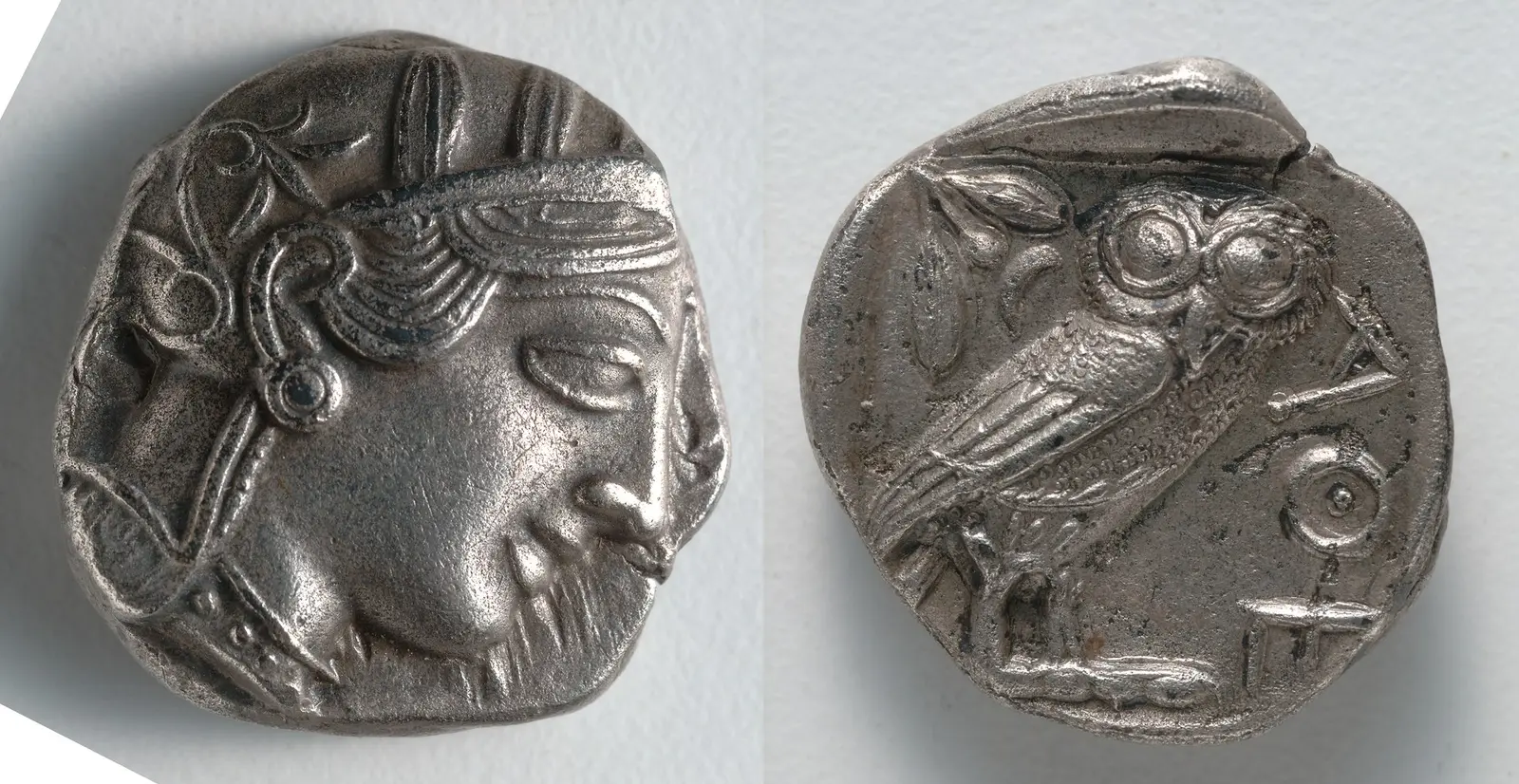
Those marks can be described, but a cause is a separate claim. The handling scar, in this site’s term, is a mark left by use rather than by making, and these records do not say how any of these marks arose. No handling scar can be confirmed from the record, and for the notch: cause not established.
Who copied the owl?
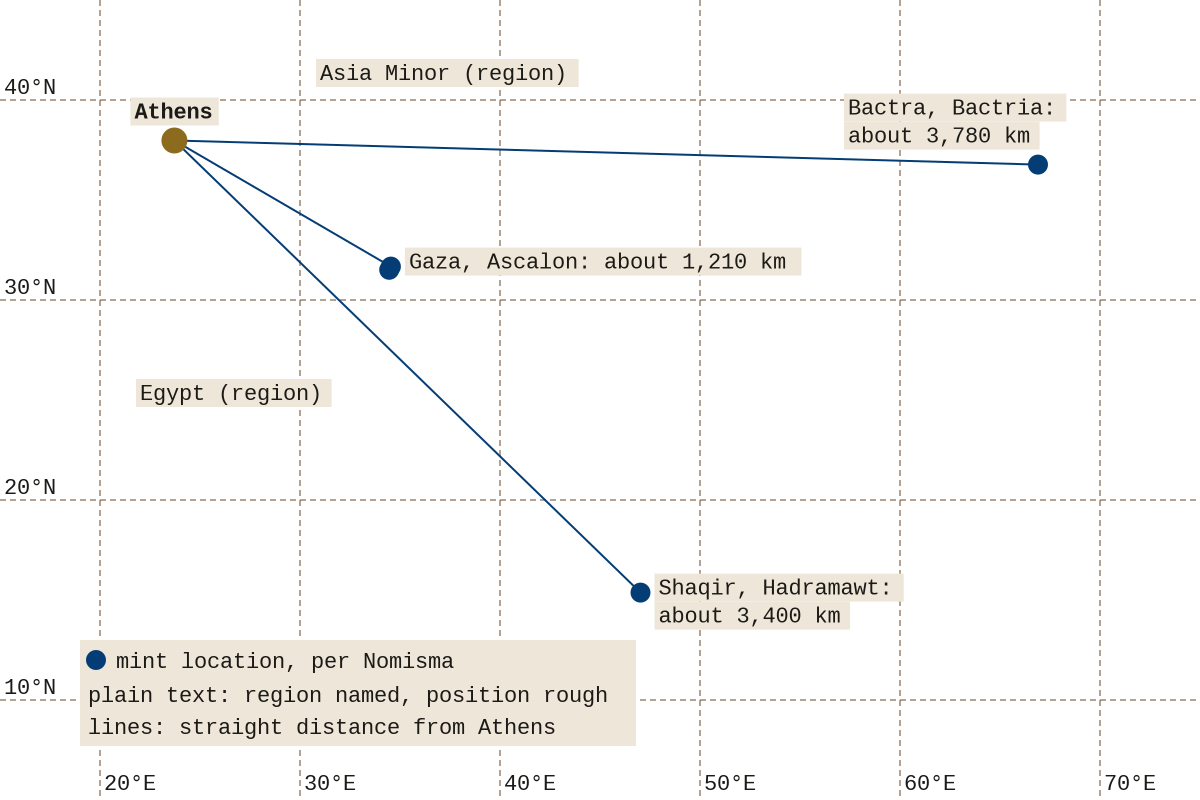
The evidence here is one review, so it reaches this page at second hand. Peter Edwell reviewed a 2010 volume edited by Martin Huth and Peter van Alfen for Bryn Mawr Classical Review in 2012. The book itself was not read for this page. Edwell summarizes Huth’s chapter as reporting owl imitations from the early fourth century BCE in Asia Minor, the Levant and Egypt, and as far as Bactria.
In south Arabia, by his account, coinage itself began with these imitations in the fourth century BCE, in the kingdoms of Saba, Qataban and Hadramawt and the Minaean Federation. He notes especially early evidence of careful copying from about 380 BCE and, per van Alfen, a surge in production in 350–320 BCE. Further north, the ports of Gaza, Ascalon and Ashdod produced Athenian-style coins alongside new designs from about 450 BCE, while northern Arabia made its own imitations especially from the third to the first century BCE.
Credit line to copy
"Where One Review Reports Owl Imitations" by Spine & Watermark, https://spineandwatermark.com/money/athenian-owl-tetradrachm/, licensed under CC BY 4.0 (https://creativecommons.org/licenses/by/4.0/).| Place on the map | What the review reports | Straight distance from Athens |
|---|---|---|
| Gaza and Ascalon | Athenian-style coins from about 450 BCE | about 1,210 km |
| Hadramawt, plotted at Shaqir | coinage begins with owl imitations, fourth century BCE | about 3,400 km |
| Bactria, plotted at Bactra | owl imitations, as far as this | about 3,780 km |
| Asia Minor and Egypt | owl imitations from the early fourth century BCE | regions, not measured |
Arabia is not the outer edge of the reported spread. Bactra lies about 3.1 times as far from Athens as the Philistian ports, and Shaqir about 2.8 times.
Two hoards probably from al-Jawf, one of 20 coins found in 2001 and one of 247 found in 2002, hold the copies the review singles out. Twenty-one coins, it says, appear to have begun as Persian Gulf imitations of Alexander’s coins and were folded and restamped as owl imitations in the third or second century BCE. Edwell takes that to suggest a south Arabian preference for the owl, and he notes that genuine Athenian tetradrachms and Egyptian or Levantine imitations lay in the same hoards, probably buried around 100 BCE.
A copy like that deserves as much attention as an Athenian original, because it records who wanted this design, where and when. Greek words have also survived through later hands, as the page on Sappho sets out. The Cleveland and Chicago records searched for this page turned up no imitation with an open license, so none is pictured here.
Where did the silver come from?
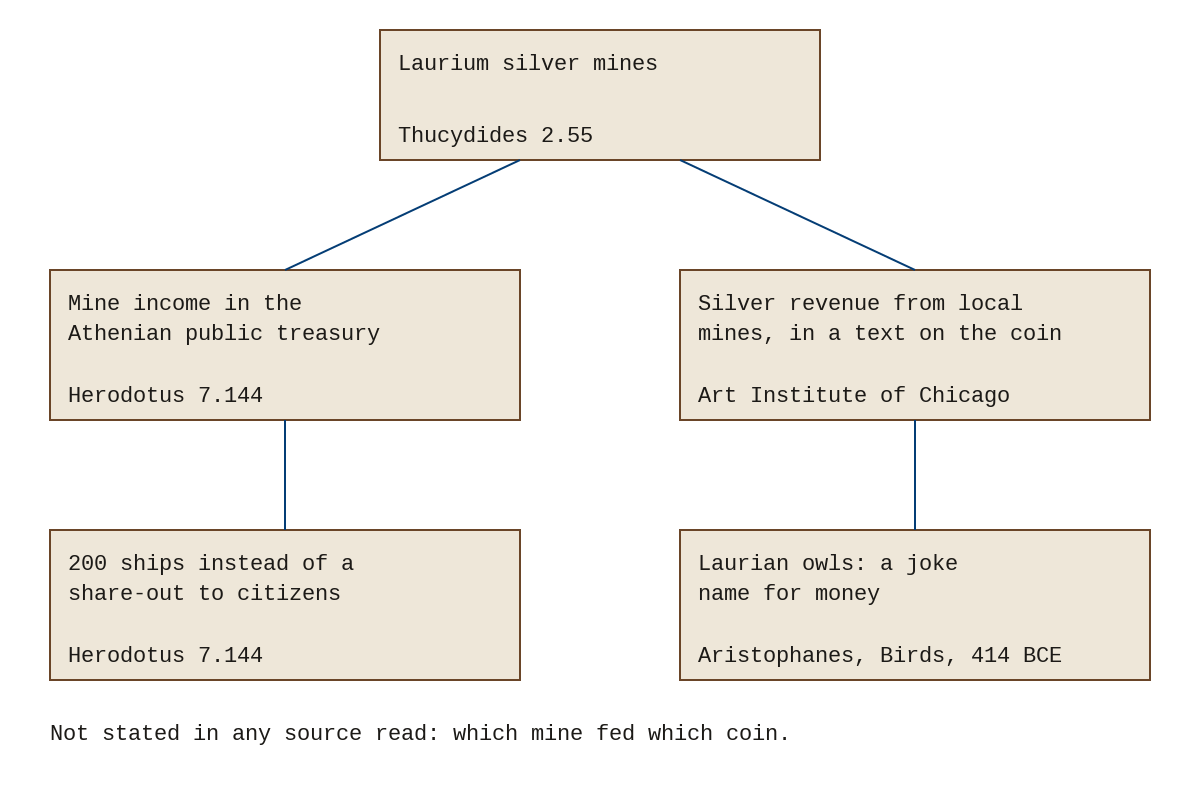
Follow the metal back to a place. Thucydides (2.55) puts the Athenian silver mines at Laurium, and Herodotus (7.144) says the mine income sat in the public treasury until Themistocles persuaded the citizens to build 200 ships instead of sharing it out at ten drachmas each. Chicago’s text says the city’s silver came from local mines and gave it a steady revenue.
Athenian comedy could joke about it. In Aristophanes’ Birds, produced in 414 BCE, the chorus promises the judges that “Laurian owls will never fail you” (literal translation by Spine & Watermark, line 1106 in the Hall and Geldart text). The next lines have the owls nesting in the judges’ purses and hatching small change, so the owls there are money.
Credit line to copy
"What Each Source Connects to the Laurium Silver" by Spine & Watermark, https://spineandwatermark.com/money/athenian-owl-tetradrachm/, licensed under CC BY 4.0 (https://creativecommons.org/licenses/by/4.0/).Those are literary and museum statements, and they speak of Athens in general rather than of any one coin. None of the records read here gives a metal analysis or a find-spot for 1920.267, which Cleveland lists only as a gift of Harold W. Parsons. Where this coin was found, and which mine supplied its silver, remain unread.
Turn it over:
The reverse holds an owl, a crescent moon, an olive branch and ΑΘΕ, per Cleveland’s entry for 1920.267.b.
- Hammered coins: silver struck much later in England, with the dies described: There the Royal Mint Museum’s account says how the two dies worked.
- Maria Theresa Thaler: another silver coin that kept its look: Its date stopped moving while the striking went on.
Sources
- Cleveland Museum of Art, 1920.267, "Tetradrachm: Head of Athena (obverse); Owl (reverse)," with 1920.267.a and 1920.267.b. clevelandart.orgRead: catalogue record: museum page and open-access data
- Cleveland Museum of Art, 1941.296, "Tetradrachm: Head of Athena (obverse); Owl (reverse)." clevelandart.orgRead: catalogue record: museum page and open-access data
- Cleveland Museum of Art, 1916.992, "Tetradrachm: Head of Athena (obverse); Owl (reverse)." clevelandart.orgRead: catalogue record: museum page and open-access data
- Art Institute of Chicago, 1923.1130, "Tetradrachm (Coin) Depicting the Goddess Athena." api.artic.eduRead: catalogue record
- Art Institute of Chicago, 1923.1131, "Tetradrachm (Coin) Depicting the Goddess Athena." api.artic.eduRead: catalogue recordText license: CC BY 4.0 (description field)
- Art Institute of Chicago, 1938.1217, "Tetradrachm (Coin) Depicting the Goddess Athena," description. api.artic.eduRead: catalogue record, description fieldText license: CC BY 4.0 (description field)
- Art Institute of Chicago, 1922.4924 (Ephesus) and 1922.4908 (Syracuse), tetradrachms. api.artic.eduRead: catalogue record
- Nomisma.org, "Tetradrachm." nomisma.orgRead: catalogue record: concept pageText license: CC BY 3.0
- Nomisma.org, mint pages for Gaza, Ascalon, Shaqir and Bactra. nomisma.orgRead: catalogue record: concept pages, coordinatesText license: CC BY 3.0
- Peter Edwell, review of Huth and van Alfen, Coinage of the Caravan Kingdoms, and Huth, Ancient Arabian Coins, Bryn Mawr Classical Review 2012.05.55. bmcr.brynmawr.eduRead: full page: the whole review, paraphrased
- Martin Huth and Peter G. van Alfen, eds., Coinage of the Caravan Kingdoms: Studies in the Monetization of Ancient Arabia, Numismatic Studies 25 (New York: American Numismatic Society, 2010). bmcr.brynmawr.eduRead: bibliography only, as reported by Bryn Mawr Classical Review
- Thucydides, History of the Peloponnesian War, 2.55, translated by Richard Crawley, Project Gutenberg eBook 7142. gutenberg.pglaf.orgRead: section 2.55, paraphrased
- Herodotus, Histories, 7.144, translated by G. C. Macaulay, Project Gutenberg eBook 2456. gutenberg.pglaf.orgRead: section 7.144, paraphrased
- Aristophanes, Birds, lines 1102–1108, in Aristophanis Comoediae, edited by F. W. Hall and W. M. Geldart, Perseus Digital Library canonical-greekLit, tlg0019.tlg006.perseus-grc2, CC BY-SA 4.0. raw.githubusercontent.comRead: section: Greek text of lines 1102–1108Text license: CC BY-SA 4.0
- Aristophanes, The Birds, English translation, translator uncredited, Project Gutenberg eBook 3013. gutenberg.pglaf.orgRead: section: preface sentence on the production date
Image credits
- "Tetradrachm: Head of Athena (obverse); Owl (reverse)" by Unknown maker, minted at Athens — https://commons.wikimedia.org/wiki/File:Greece,_5th_century_BC_-_Athenian_Tetradrachm-_Female_Head_(obverse)_-_1920.267.a_-_Cleveland_Museum_of_Art.jpg — CC0 1.0 (https://creativecommons.org/publicdomain/zero/1.0/); Cleveland Museum of Art, 1920.267; modified: obverse and reverse files placed side by side, obverse left, at equal height; no other change
- "Tetradrachm: Owl, Crescent Moon, Olive Branch (reverse)" by Unknown maker, minted at Athens — https://commons.wikimedia.org/wiki/File:Greece,_5th_century_BC_-_Athenian_Tetradrachm-_Owl_(reverse)_-_1920.267.b_-_Cleveland_Museum_of_Art.tif — CC0 1.0 (https://creativecommons.org/publicdomain/zero/1.0/); Cleveland Museum of Art, 1920.267.b; modified: scaled to 1,200 px high and converted from TIFF to JPEG; no other change
- "Design Date and Object Dates" by Spine & Watermark, https://spineandwatermark.com/money/athenian-owl-tetradrachm/, licensed under CC BY 4.0 (https://creativecommons.org/licenses/by/4.0/).
- "Weight and Diameter of Five Athenian Tetradrachms" by Spine & Watermark, https://spineandwatermark.com/money/athenian-owl-tetradrachm/, licensed under CC BY 4.0 (https://creativecommons.org/licenses/by/4.0/).
- "Tetradrachm: Head of Athena (obverse); Owl (reverse)" by Unknown maker, minted at Athens — https://commons.wikimedia.org/wiki/File:Greece,_Athens,_5th_century_BC_-_Tetradrachm-_Head_of_Athena_(obverse)_-_1941.296.a_-_Cleveland_Museum_of_Art.tif — CC0 1.0 (https://creativecommons.org/publicdomain/zero/1.0/); Cleveland Museum of Art, 1941.296; modified: obverse and reverse files placed side by side, obverse left, at equal height; no other change
- "Where One Review Reports Owl Imitations" by Spine & Watermark, https://spineandwatermark.com/money/athenian-owl-tetradrachm/, licensed under CC BY 4.0 (https://creativecommons.org/licenses/by/4.0/).
- "What Each Source Connects to the Laurium Silver" by Spine & Watermark, https://spineandwatermark.com/money/athenian-owl-tetradrachm/, licensed under CC BY 4.0 (https://creativecommons.org/licenses/by/4.0/).
Cite this page
Spine & Watermark. “Athenian Owl Tetradrachm: How Far Did the Design Travel?.” Spine & Watermark, published November 7, 2026. https://spineandwatermark.com/money/athenian-owl-tetradrachm/. Accessed [date].
How sources are ranked · All corrections · Contact · Report an error (contact@spineandwatermark.com)