Carte de Visite: Its Size Names the Format, Not the Year
Published · Revised
TL;DR: A carte de visite is a small photograph pasted on a card about 4 by 2.5 inches, popular from the late 1850s to about 1910. Its size names the format, and the mount can narrow the date only to a range. Corners, thickness and backs offer tentative clues, mostly from British sources, and a pencilled date is only a claim.
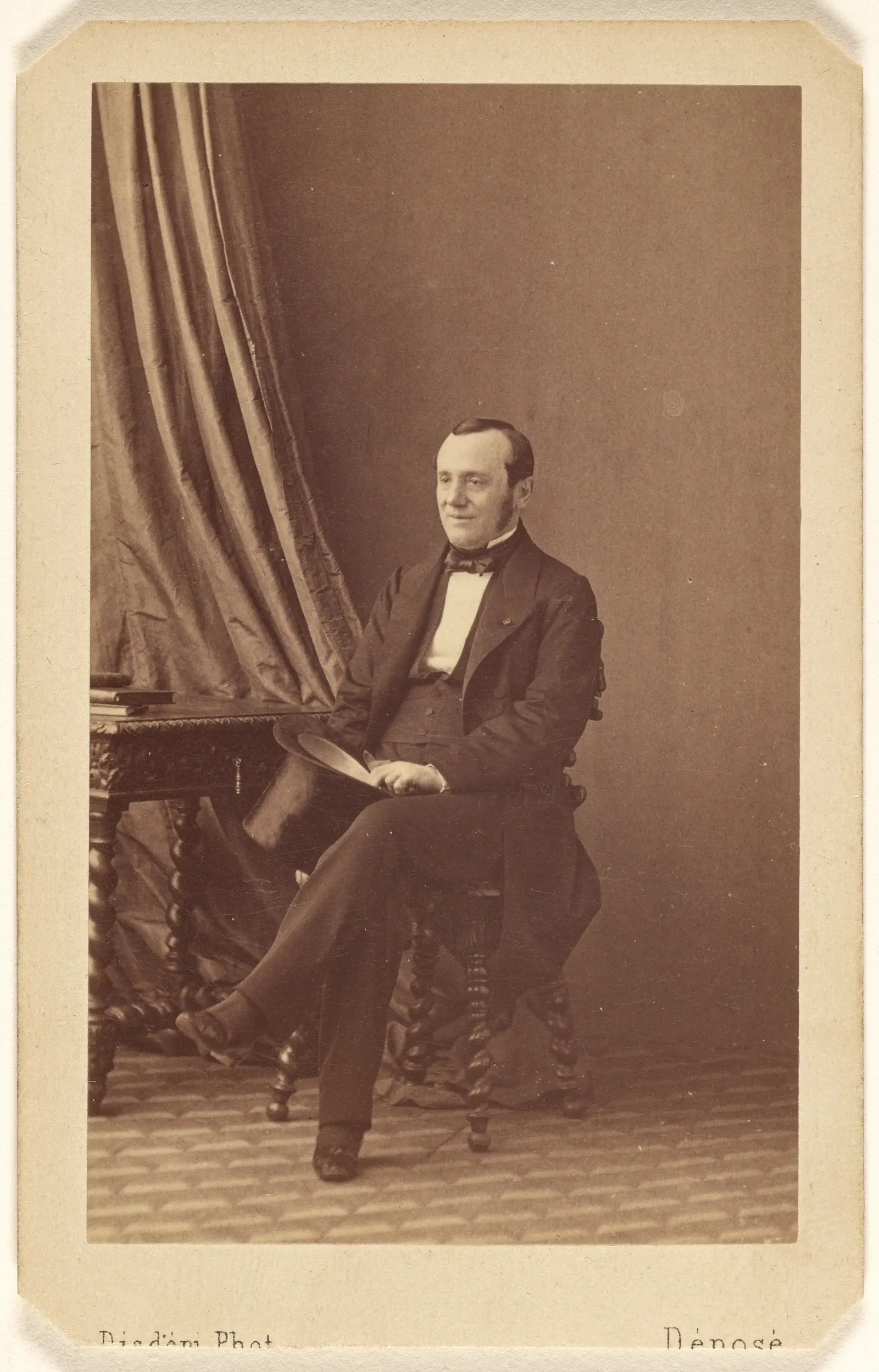
Collation: albumen silver print · carte de visite (Getty: Card Photographs, Cartes-De-Visite); no size in the record read · image 1861–1864 / object 1861–1864 (one date field in the Getty record; it does not date the two separately) · J. Paul Getty Museum, 84.XD.1157.2200

Collation card, all fields
- Object
- [Mr.] Billant getty.edu
- Type
- photograph getty.edu
- Process
- albumen silver print getty.edu
- Format & size
- carte de visite (Getty: Card Photographs, Cartes-De-Visite); no size in the record read getty.edu
- Material
- albumen silver print; mount stock not stated in the record read getty.edu
- Made
- image 1861–1864 / object 1861–1864 (one date field in the Getty record; it does not date the two separately) getty.edu
- Date basis
- Holding record: Getty, 1861–1864 getty.edu
Measure the card, not the picture. In the twelve open museum records tabled below, a carte de visite mount runs 100 to 106 millimeters on its long side, while the print pasted to it varies. This page asks how far the card can narrow a date, and it covers date only: not price, and not any private family photograph.
What does measuring the card tell you?
A carte de visite is a photograph mounted on a card the size of a formal visiting card, which is where the name comes from, according to a 2013 post by Colin Harding of the National Science and Media Museum. He gives about 3.5 by 2 inches for the print and about 4 by 2.5 inches for the mount, and he says that size stayed the same through the format's whole life.
That last point sets the limit of the ruler.
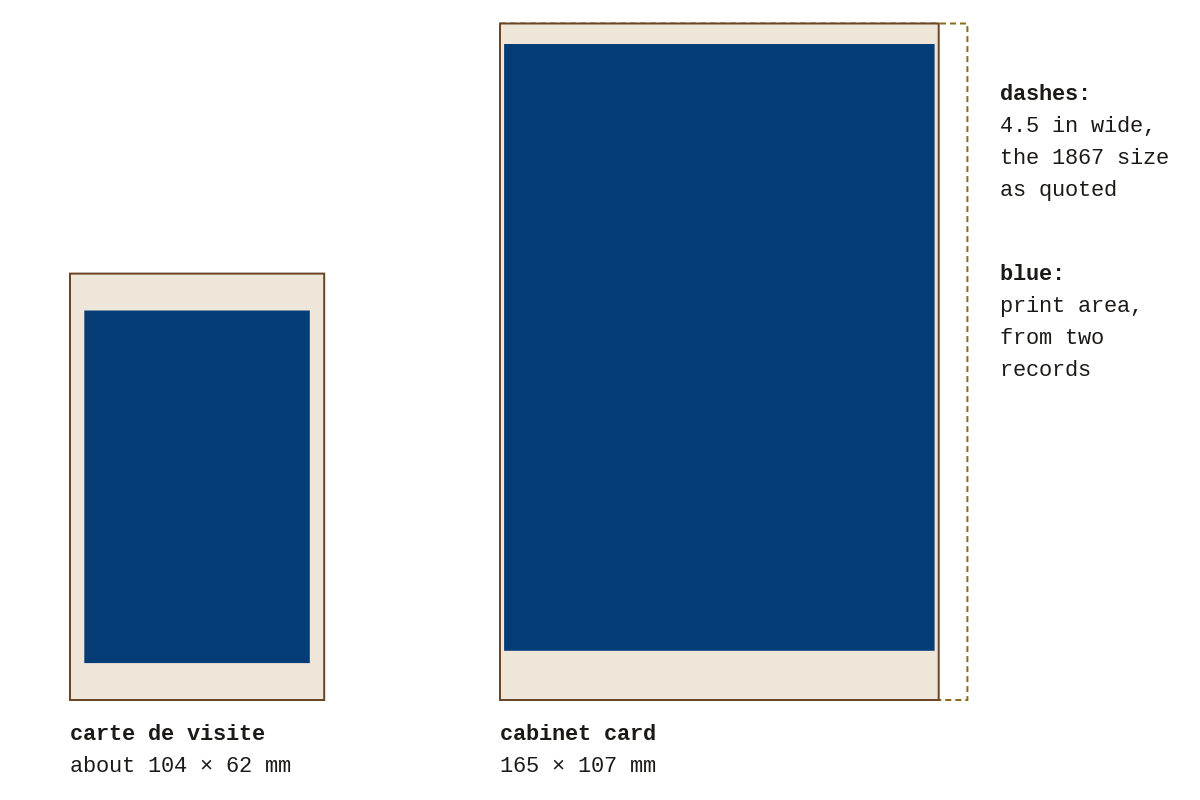
If the size never changed, then measuring identifies the format, not the year. Twelve carte mounts in the table below, from the Rijksmuseum and the Art Institute of Chicago (AIC in the table), measure 100 to 106 mm on the long side and 59 to 64 mm on the short side, or 3.9 to 4.2 inches by 2.3 to 2.5 inches. Their record dates scatter from 1854 to 1889.
Credit line to copy
"Two mount formats to one scale" by Spine & Watermark, https://spineandwatermark.com/photographs/carte-de-visite/, licensed under CC BY 4.0 (https://creativecommons.org/licenses/by/4.0/).The picture is the wrong thing to measure because it varies more than the card does. Fading Images, a research site on Cambridgeshire photographers, suggests that prints on early cards were probably trimmed by hand. It reports a supplier selling pre-cut carte papers in two sizes by 1902, and it describes cards from the 1890s with prints as small as 63 by 37 mm on a standard mount.
The table lists only records that give a mount size, so the Billant card stays out: the Getty record gives no size at all, although the museum classes the card among its cartes de visite. The table is a selection, not a survey. Another Disdéri & Co. record read for this page, RP-F-F15296, gives a mount only 97 mm on its long side.
The dates keep the museums' own terms, including the slash AIC uses for a range, with the Rijksmuseum's 1867-08 written out as August 1867. AIC classes Goat Island only as a card photograph, so its carte label here rests on its size. Sizes run height by width, and the inches are converted from the records’ metric sizes (mm ÷ 25.4, to one decimal place).
| Object | Format | Card, mm (h × w) | Card, in (h × w) | Date in the record | Record |
|---|---|---|---|---|---|
| Unknown man, named as Mr Brown | carte de visite | 104 × 61 | 4.1 × 2.4 | 1854 – 1889 | Rijksmuseum RP-F-F15289 |
| Unknown woman behind a chair | carte de visite | 104 × 61 | 4.1 × 2.4 | 1854 – 1889 | Rijksmuseum RP-F-F15291 |
| Unknown woman with a closed fan | carte de visite | 104 × 63 | 4.1 × 2.5 | 1854 – 1889 | Rijksmuseum RP-F-F15298 |
| Cartes-de-visite | carte de visite | 105 × 64 | 4.1 × 2.5 | 1854 – 1889 | Rijksmuseum RP-F-F15299 |
| Abd el-Kader | carte de visite | 105 × 62 | 4.1 × 2.4 | 1860 – 1870 | Rijksmuseum RP-F-F00674-AF |
| Napoleon III | carte de visite | 103 × 62 | 4.1 × 2.4 | c. 1863 – c. 1880 | Rijksmuseum RP-F-F00674-B |
| Unknown woman with a chair | carte de visite | 100 × 59 | 3.9 × 2.3 | 1864 – 1875 | Rijksmuseum RP-F-F23466 |
| Standing young woman | carte de visite | 106 × 64 | 4.2 × 2.5 | August 1867 | Rijksmuseum RP-F-F00747-N |
| “I Sell the Shadow to Support the Substance” | carte de visite | 100 × 62 | 3.9 × 2.4 | 1864-65 | AIC 2016.468 |
| Brahms | carte de visite | 103 × 63 | 4.1 × 2.5 | 1862/80 | AIC 1965.659 |
| George Cruikshank | carte de visite | 102 × 62 | 4.0 × 2.4 | 1860/69 | AIC 1970.624 |
| Goat Island, Lighthouse | card photograph per AIC; carte de visite by size | 61 × 101 | 2.4 × 4.0 | 1864/67 | AIC 1970.195 |
| Alice Dunning Lingard | cabinet card | 165 × 107 | 6.5 × 4.2 | 1870 – 1900 | Rijksmuseum RP-F-F01171-W |
| Unknown man with a cap | cabinet card | 165 × 108 | 6.5 × 4.3 | c. 1875 – c. 1899 | Rijksmuseum RP-F-F18768 |
| Wagner | cabinet card | 165 × 107 | 6.5 × 4.2 | 1877 | AIC 1965.658 |
| Miss Constance MacDonald Gilchrist | cabinet card | 157 × 109 | 6.2 × 4.3 | April 15, 1877 | AIC 1968.522 |
Download the data (card-mount-examples.csv) · source and license notes
How did one plate become many cards?
Harding credits André Adolphe-Eugène Disdéri with patenting the format in 1854, at a time when most professional portraits were unique objects that were hard to copy. The saving came from taking several portraits on one photographic plate, and some special cameras could give 4 or 8 pictures on it; the prints from such a plate were then cut apart and pasted to cards.
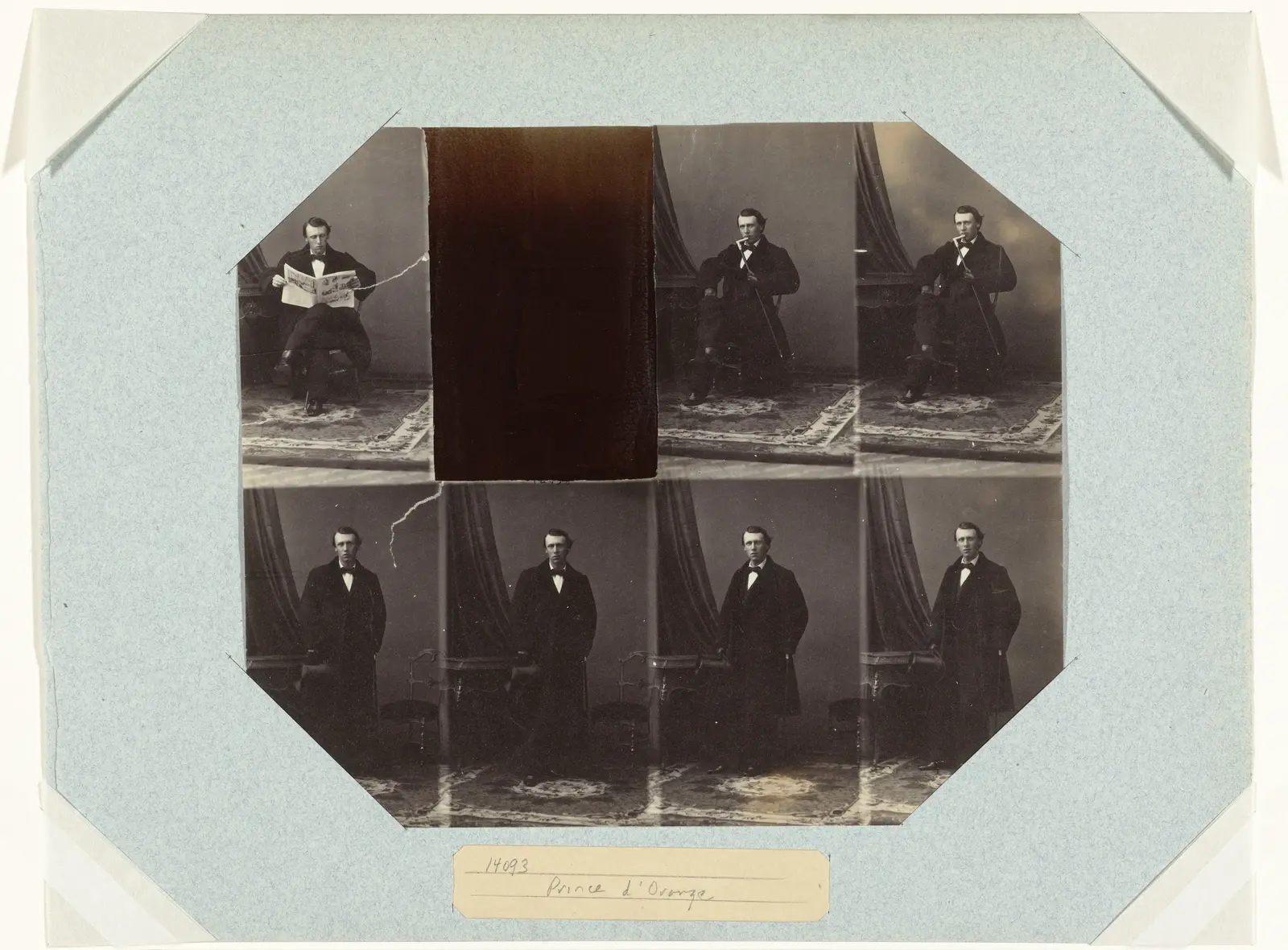

Rijksmuseum RP-F-1996-274 shows the stage before the card. The record calls it a sheet of uncut portraits for cartes de visite and says that one of the original eight was cut away, without giving a reason, so the cause is not established. Its photograph measures 199 by 234 mm, which makes one of eight spaces about 100 by 58.5 mm, a little larger than the 86 by 55 mm print on RP-F-F00674-B.
A patent year isn't a local start date, which matters when you set the early end of any range. Harding says the format reached England in 1857 and that its popularity there soared after J. E. Mayall's portraits of the royal family were published in 1860. He places the peak of album collecting in the 1860s, while the format stayed popular until the start of the 20th century.
What the mount can't date
The printed number 14093 on that sheet also appears on a second sheet of the same sitter, RP-F-1996-6. Both records give 1859–1860. The text in both records says Disdéri's camera caught eight poses on one negative, that he took two shots of the prince, and that contact sheets let dealers and private buyers order prints. Ordering suggests that prints could follow the sitting, even though these two records don't separate the printings.
That gap is what this site calls the double date: the image has one date, and the physical object has another. A mount belongs to the object side, so it can suggest when a card was finished without saying when the plate was exposed. The Billant card shows the limit of a record too: the Getty gives a single date, 1861–1864, and doesn't separate the two.
Do square corners mean the 1860s?
Now look at the four corners, and write down the shape before you think about a year. Two sources take up this clue, and they don't line up neatly.
Harding says early cartes of the 1860s usually have square corners, and that mounts with rounded corners were introduced in the 1870s. Fading Images starts from the same conventional view and then pushes back: it reports an 1870 advertisement by the London firm Schmerl and Ellis for round-corner carte mounts, which it reads as an earlier start than the usual account suggests.
An advert says when a dealer offered a mount, not when the first such mount appeared or when any one card was made.
Full credit
"Portrait of an unknown man, named as Mr Brown" by Disdéri & Co. — https://commons.wikimedia.org/wiki/File:Portret_van_de_heer_Brown,_RP-F-F15289.jpg — Public domain (Photographer: Disdéri & Co., the firm of A.-A.-E. Disdéri, who died in 1889 (Getty record dates); record date 1854–1889. Other partners of the firm not checked. United States: published before 1931. European Union: author dead more than 70 years.); Rijksmuseum, RP-F-F15289
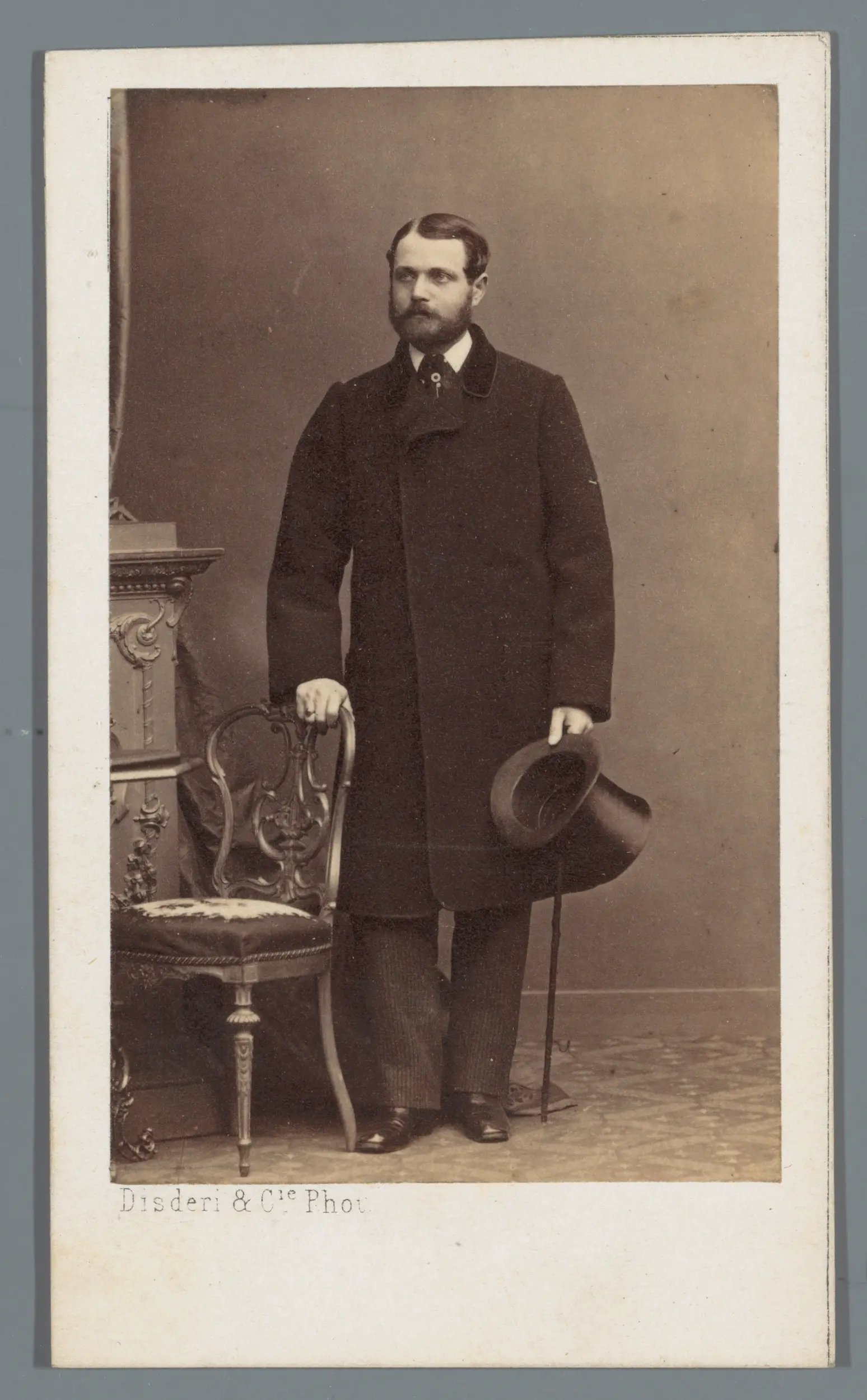
Two Rijksmuseum cards show how little a museum may rest on corners: RP-F-F15289 has square corners in the museum image, while RP-F-F15298, in the next section, has rounded ones. Both name Disdéri and both carry the same record date, 1854–1889, so in these two records the corners haven't narrowed anything.
The Billant card adds a shape that neither source discusses: its four corners look clipped on the diagonal in the Getty image, on a card the record dates 1861–1864. Whether they were cut at the making or later, the cause is not established. That is the first layer of the handling scar, where you can describe the visible shape but need a record before you name the cause.
So treat rounded corners as a lean, not a rule: usually about 1870 or later, according to these two sources. Treat square corners as weaker evidence still, because neither source says when square mounts stopped being sold.
What do thickness and borders add?
Thickness works only as a comparison. Harding says that, generally, a thinner mount means an earlier photograph, and he frames this as a test for several cards side by side. A single card gives you nothing to compare it with.
Fading Images raises a problem with that test: studios ran finished cards through a rolling press, and the site suggests that the press setting could change the final thickness whatever the blank mount measured. It proposes a study with a digital micrometer without reporting one, and none of the 16 records in the table above gives a thickness either.
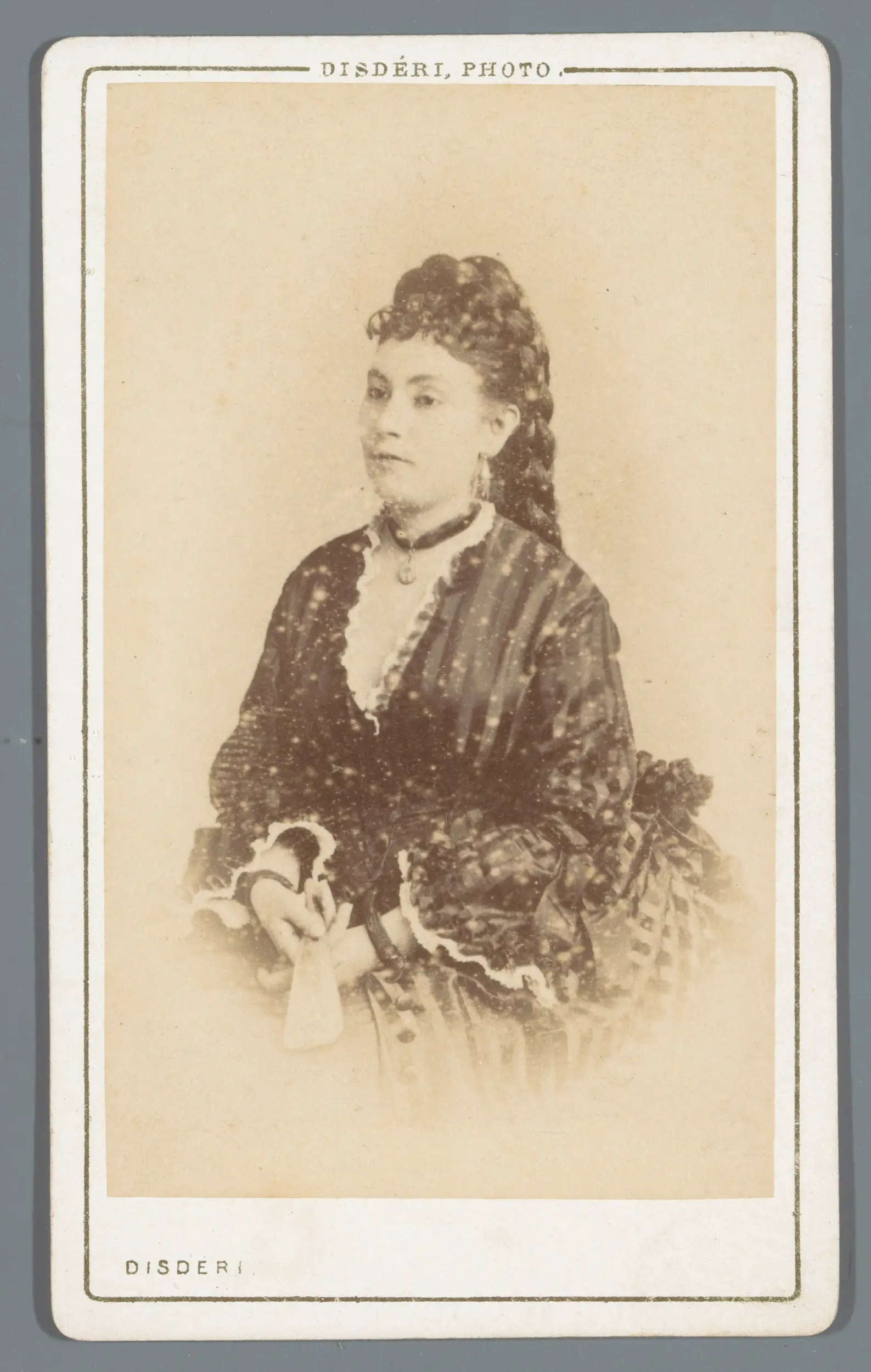

Borders, colors and edges are looser clues than they look. RP-F-F15298 has a thin line around the print, with the studio name set into it. Fading Images lists the usual beliefs, such as darker and glossier mounts being later, and then counters them with period advertisements: printed borders by about 1870, enamelled mounts in the 1860s, and a great variety of edge treatments among cards of the 1860s and 1870s.
If you find a gilt edge, record the words “gilt edge” and move on. On these two sources it doesn't carry a date by itself.
What can the printed back tell you?
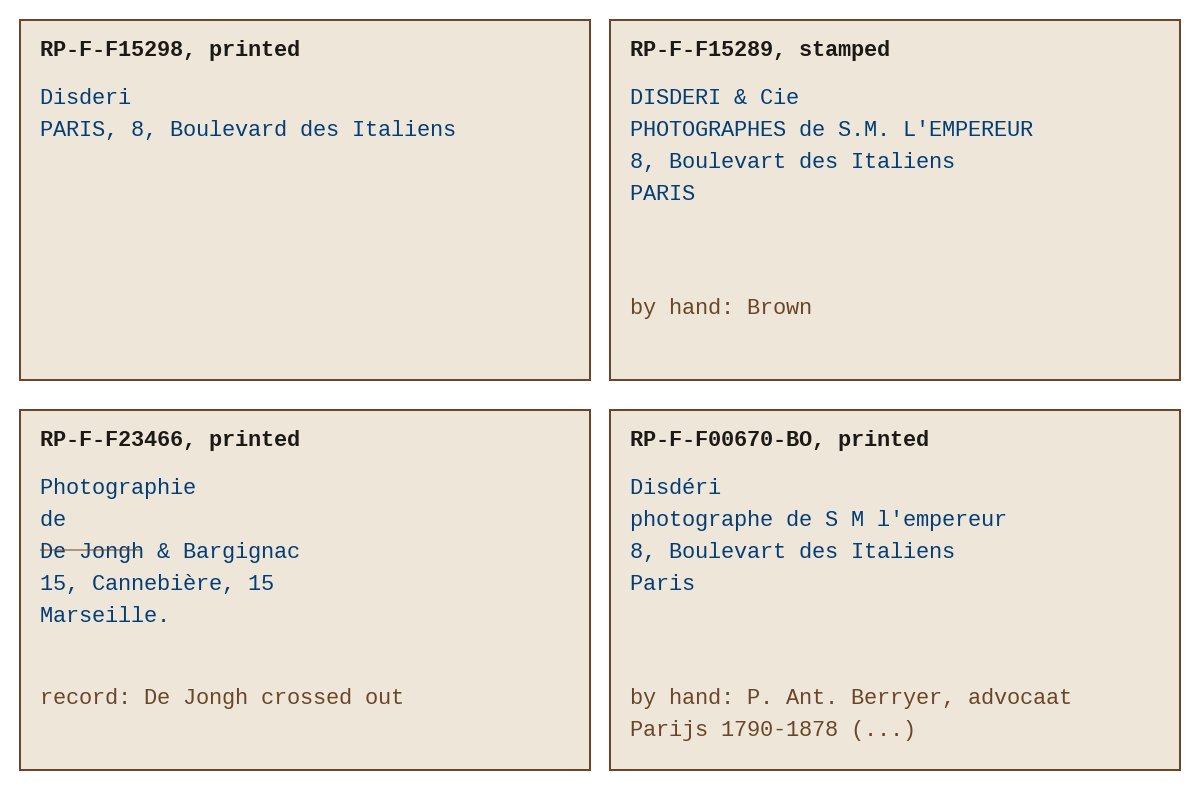
Harding says the photographer's name and address, often printed on the back, can be very helpful. The Rijksmuseum transcribes those backs in its records, even though the images used on this page show only the front, and the figure below sets four of those transcriptions side by side.
Credit line to copy
"Four card backs as records transcribe them" by Spine & Watermark, https://spineandwatermark.com/photographs/carte-de-visite/, licensed under CC BY 4.0 (https://creativecommons.org/licenses/by/4.0/).The transcriptions show why an address is a useful lead: Disdéri cards in this set give 8, Boulevard des Italiens, while a Disdéri card of Mohammed III as-Sadiq adds a London address at 4 Brook Street. On RP-F-F23466, the printed line names De Jongh & Bargignac of Marseille, and the record adds that De Jongh is crossed out, without saying who crossed it out or when.
A studio directory or local archive may be able to say when a studio worked at an address, and that is also the place to ask about a family photograph, because this page doesn't assess private photographs. Don't try to lift a card from an album, clean it or repair it. Take that work to a professional conservator, starting from the American Institute for Conservation.
A printed back has limits of its own: Fading Images reports that printers kept the plates for customers' designs, and that one firm bought another's stock of engraved plates in 1870, so a design could outlive its first order. Those backs were printed work in their own right, and the engraved plates behind them raise the difference between intaglio and relief printing.
The maker's name on a mount can mislead in the same way. Fading Images notes that Marion mounts were probably available throughout the 19th century, so that name alone narrows very little. The site treats the punctuation code around the name as a probable sign of production date, not a settled one.
Can you trust the writing on the back?
Treat handwriting as testimony, and hear it last. First set a range from the card, the printed back and any process a record names, and only then ask whether “Grandma, 1890” fits inside that range. A note can be correct and still be the weakest evidence on the card, because anyone can add one at any later time.
One Rijksmuseum record makes the case by itself: for RP-F-F00670-BO, a Disdéri portrait of Pierre-Antoine Berryer kept in an album, it lists two handwritten notes on his life dates, with 1790–1868 on the front and 1790–1878 on the back.
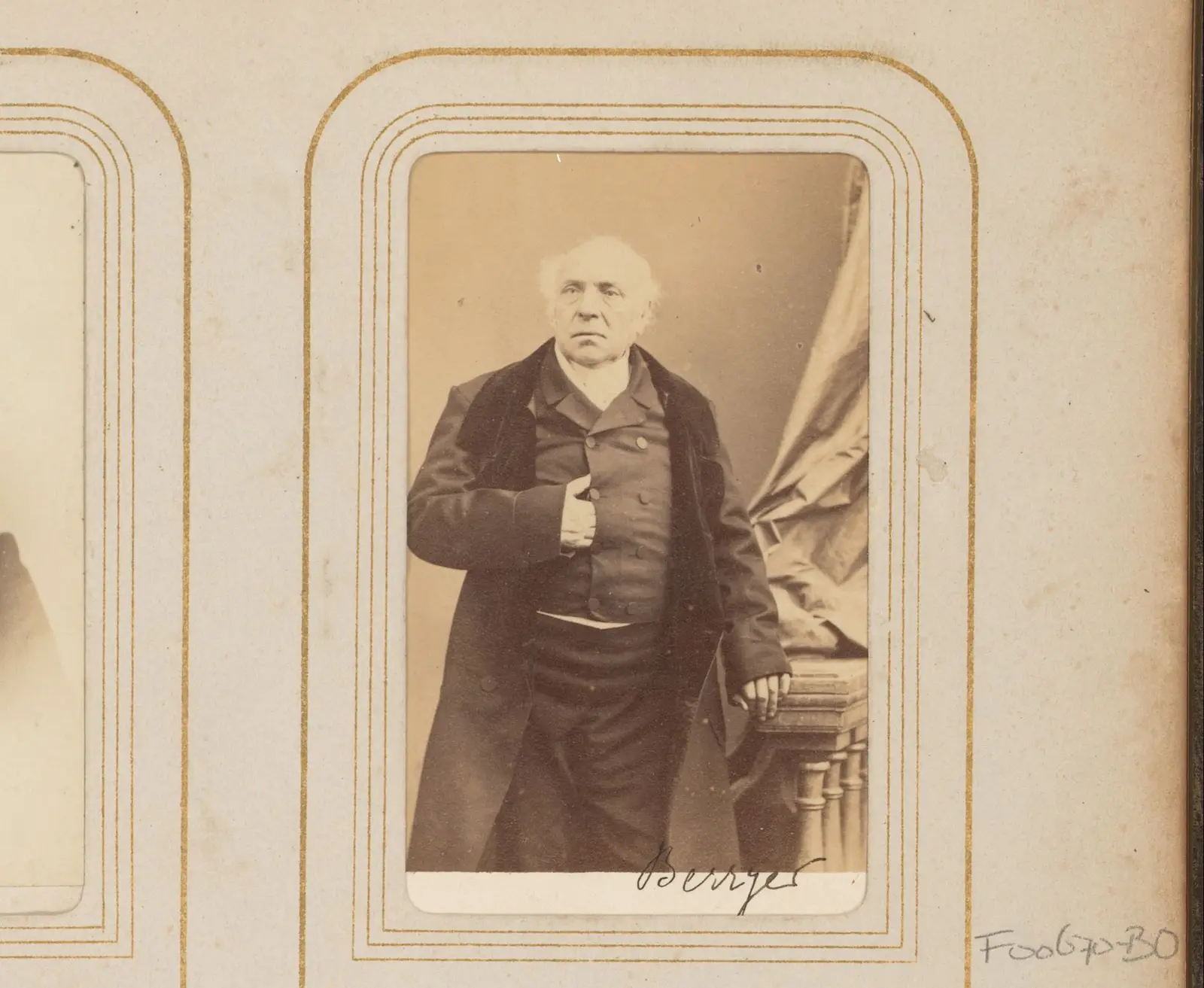

The two notes differ by ten years for the same man. The record doesn't say whether the front note sits on the card or on the album page. Its date for the card ends in 1868, which agrees with the front note and not the back one, but the record doesn't explain its reasoning, so this page doesn't claim the front note settled it.
The Rijksmuseum shows the same caution in a title: RP-F-F15289 is an unknown man “aangeduid als” Mr Brown, roughly “referred to as,” and the record lists a handwritten “Brown” on the back. The note gives the sitter a name, while the title keeps its distance from that name.
A note can still earn a place in the argument. RP-F-F00747-N has “Agto 1867” written on the front, and its record date is August 1867. The note doesn't say whether that month marks the sitting, the printing or a gift. Keep that question open for any dated note: claim first, then the test.
How wide are the museums' own date ranges?
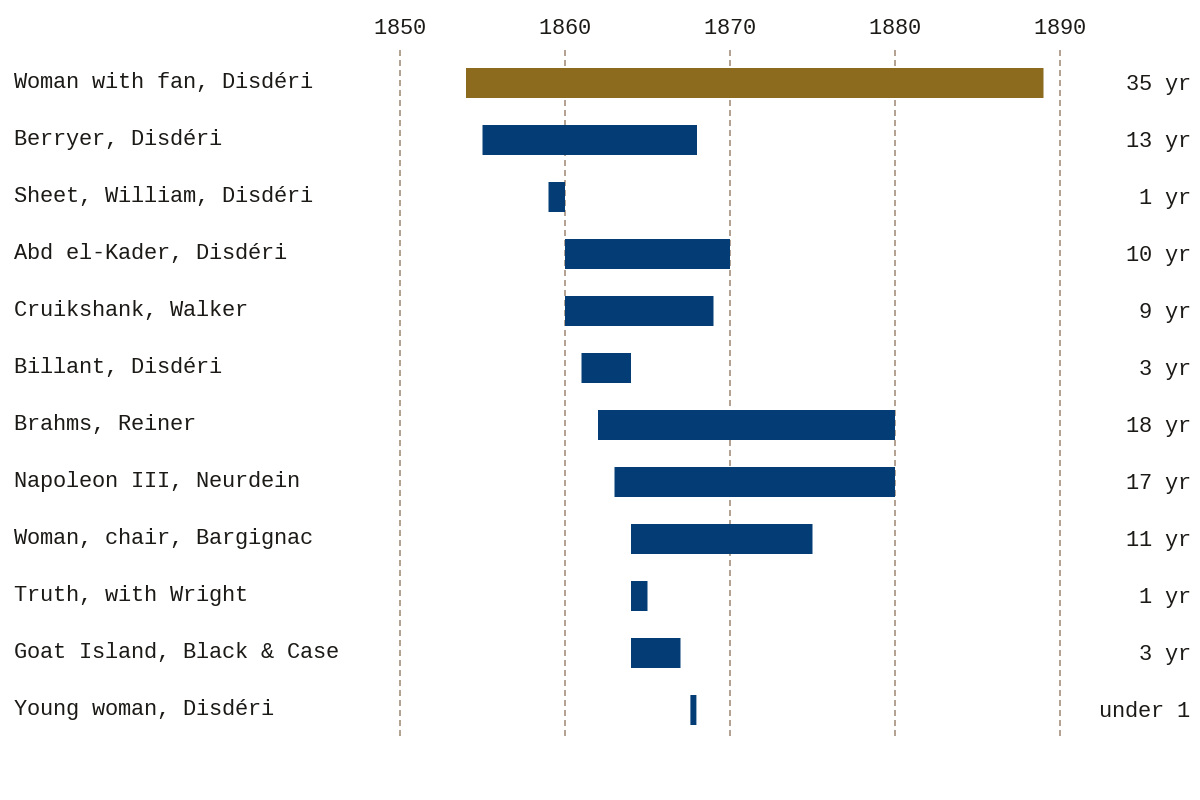
Set your expectations by what the holding museums themselves write; the chart takes twelve records read for this page and draws each date exactly as the record gives it.
Credit line to copy
"Date spans in twelve museum records" by Spine & Watermark, https://spineandwatermark.com/photographs/carte-de-visite/, licensed under CC BY 4.0 (https://creativecommons.org/licenses/by/4.0/).The spans run from under a year to 35 years, and the widest is 1854–1889, which the Rijksmuseum gives RP-F-F15298 and three other cards in the table. Those two years match the patent date in Harding's post and the death year the Getty gives for Disdéri, though the records don't say that is the reason.
The short spans depend on evidence the card alone doesn't hold. The Rijksmuseum dates the crown prince sheet 1859–1860, and its record places his visit to Disdéri's Paris studio in 1859; the Art Institute of Chicago dates its Sojourner Truth card 1864-65 without saying why in the fields read for this page. If a museum holding a card with a studio's name can land on 35 years, a one-year answer from a mount alone should make you suspicious.
How does a cabinet card differ?
A cabinet card is the larger format. Fading Images cites the Yearbook of Photography for 1867 on cabinet portraits as an 1866 novelty, with a mount of 6½ by 4½ inches, and it adds that the usual view has them rising as the carte declined and becoming most popular toward the end of the century.
Four cabinet mounts in the table measure 157 to 165 mm long and 107 to 109 mm wide, about 6.2 to 6.5 inches by 4.2 to 4.3 inches. Those widths fall short of the quoted 4½ inches, which would be about 114 mm; on average these mounts cover about 2.7 times the area of the twelve carte mounts, so a ruler separates the two formats at once.
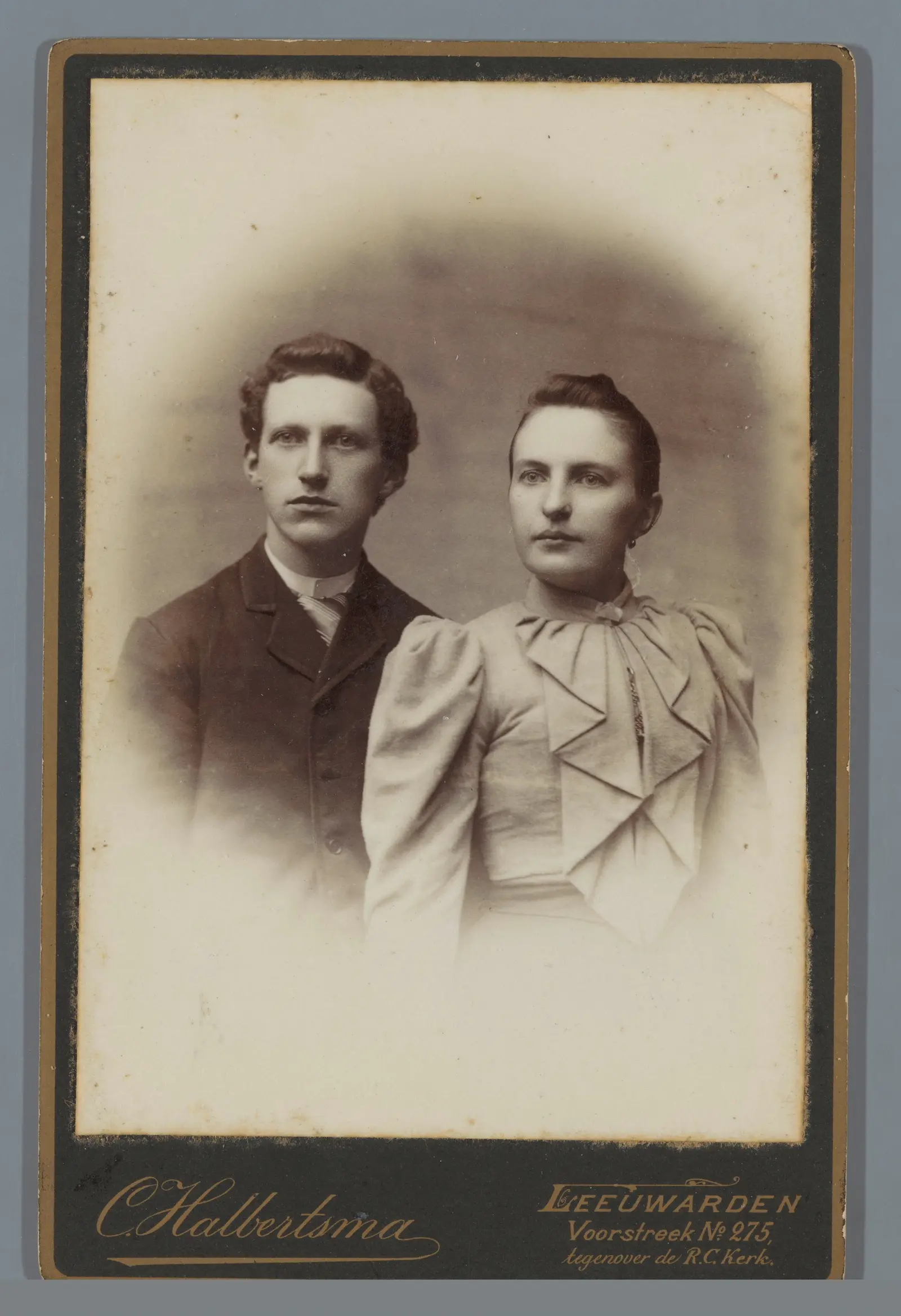

The Halbertsma card raises the same questions at the larger size: its record gives c. 1891 to c. 1901 and measures only the photograph, at 140 by 96 mm, so it stays out of the mount table. The studio name sits on the dark front of the mount. According to the record, the two sitters' names are handwritten on the back, which makes them a claim like any other.
Use the same steps below for cabinet cards. The corner and thickness advice above comes from sources writing mainly about cartes, and this page doesn't stretch it into a separate cabinet timeline.
Steps: from the card to a date range
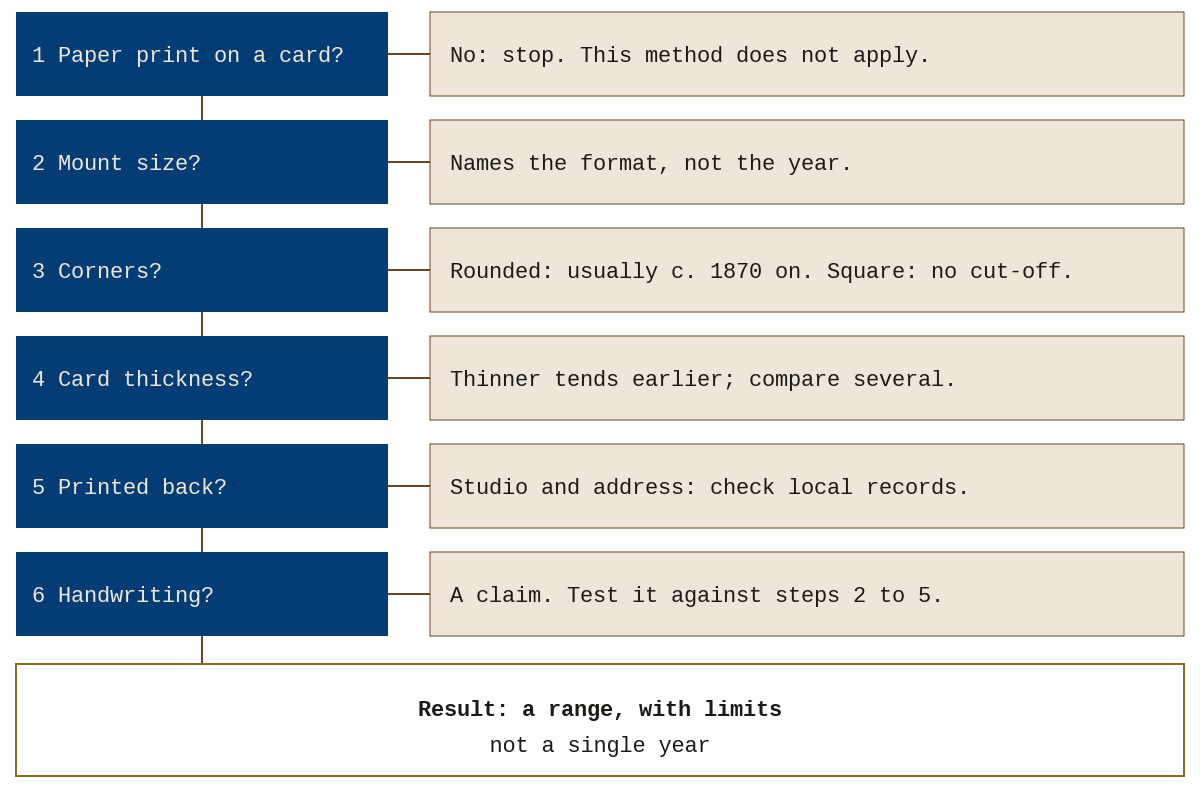
These steps are this page's own order, built from the sources above, not copied from any published dating table. The figure and the numbered list say the same thing.
Credit line to copy
"Six checks for a date range" by Spine & Watermark, https://spineandwatermark.com/photographs/carte-de-visite/, licensed under CC BY 4.0 (https://creativecommons.org/licenses/by/4.0/).- Check the object. Is it a paper print pasted to a card mount? If it isn't, stop here and read the next section.
- Measure the mount. About 100 to 106 by 59 to 64 mm, the spread in the table, points to a carte de visite, with Harding's overall span of the late 1850s to about 1910. About 157 to 165 by 107 to 109 mm points to a cabinet card, from 1866 on according to Fading Images. Size gives you the format and no more.
- Read the corners. Rounded corners lean toward about 1870 or later, since Harding says the 1870s and Fading Images cites an 1870 advertisement. Square corners set no end date. For clipped corners, note the shape, because neither source covers it.
- Compare thickness. Do this only if you have several cards to compare. Thinner tends to be earlier according to Harding, and the rolling press may blur that according to Fading Images.
- Read the printed back. Note the studio name and address, then check local directories or ask an archive, remembering that a back design can outlive its first order.
- Read the handwriting last. Test any name or year against the range you already have, and report it as a note and not as a finding.
- Write a range, with limits. Give the first and last years, say which clue set each one, and say what you couldn't check. A single year isn't a fair result from these steps.
Two museum cards through the steps
Take RP-F-F15298, the rounded card above. Its mount of 104 by 63 mm points to a carte de visite, its corners lean toward about 1870 or later, and its printed back gives a Paris address. So the steps alone only lean toward about 1870 to about 1910, on clues drawn mainly from British sources. The museum's own 1854–1889 is a different kind of answer, and the two overlap from 1870 to 1889, which shows how much room remains.
The Billant card shows what happens when the clues run short: the record read for this page gives no size, its corners fall outside both sources, and its back wasn't read here, so the steps return only the carte's overall span. The Getty's 1861–1864 is far narrower, and the record's fields read here don't say what supports it.
Neither result says who sat for the picture or what a card might sell for, because this method gives a range for the object and nothing else.
When does this method not apply?
Stop or lower your confidence in these cases:
- No card mount. Photographs on glass or metal, and loose prints with no mount, give the steps above nothing to measure.
- An album window. The album frame can hide corners and edges, as on the Abd el-Kader page below, and the back stays out of view unless a record transcribes it.
- A trimmed or remounted card. A later hand changes the very features the steps read.
- A copy print. RP-F-F00674-Z is a photographic copy of what the record calls a probable drawing, dated 1870–1880, so the card can speak only for the copy.
- One card alone. Thickness needs company.
- Places beyond the evidence. Harding writes from a British museum, and the mount clues in Fading Images rest largely on British advertisements, so the sizes in the table reach further than the dating advice does.
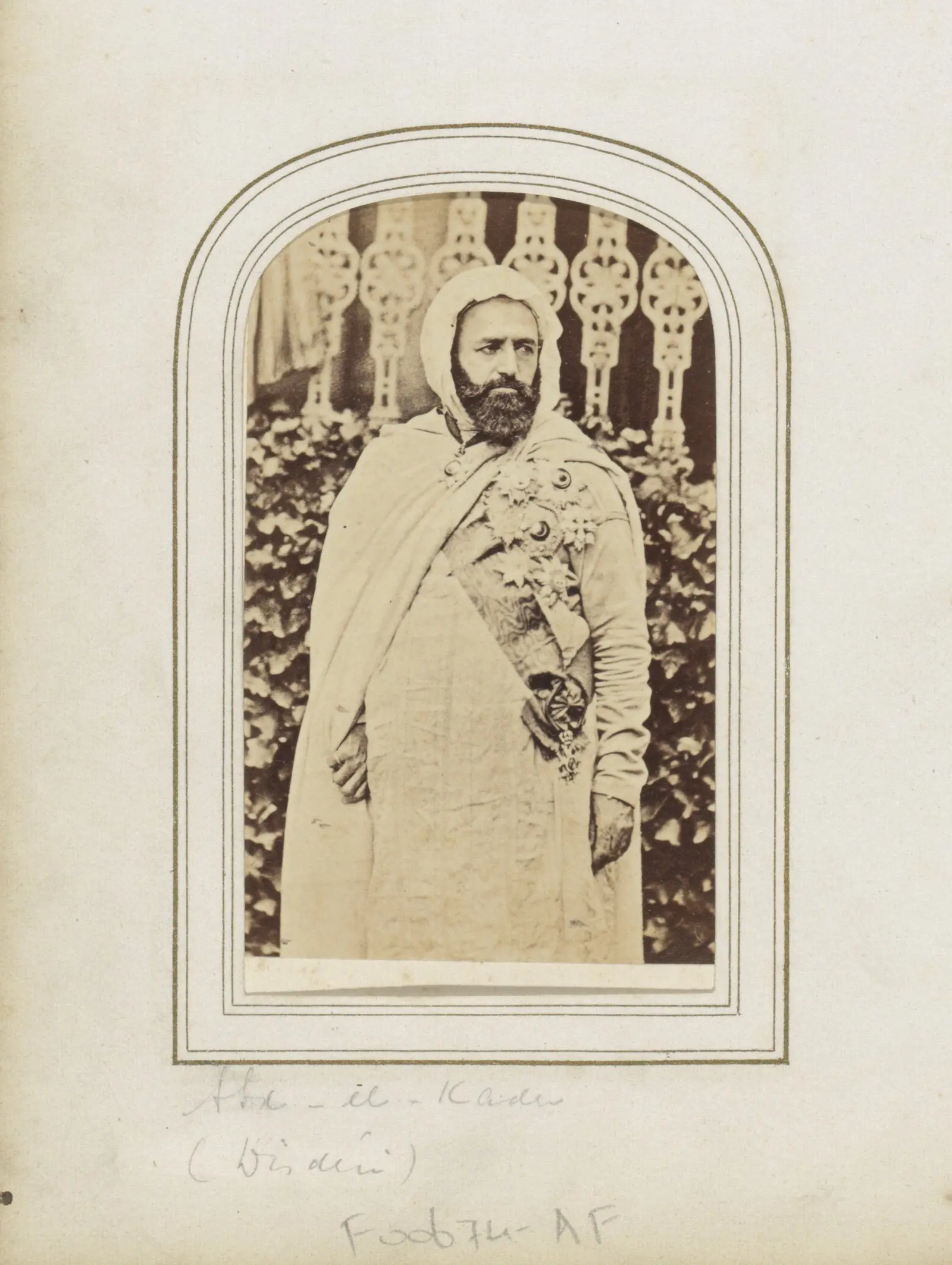

An album doesn't date its contents either. One Rijksmuseum album holds 123 cartes de visite, and the four of its cards listed on this page or in its sources carry separate record dates of 1859–1882, 1860–1870, c. 1863–c. 1880 and 1870–1880. Those ranges overlap and don’t show when each card was made, so a date for the album would tell you little about any one card inside it.
Clothing is a separate line of evidence, and Harding names it as helpful alongside the printed address. This page leaves it out on purpose, because it works from what records state about the object and doesn't read dates from a sitter's dress.
 Illustration
Two titles for further reading are William C. Darrah's Cartes de Visite in Nineteenth Century Photography (1981) and O. Henry Mace's Collector's Guide to Early Photographs (1990). Neither was read for this page, and nothing here draws on them.
What the card still holds back is measurable. No record read for this page gives a thickness or a corner shape, so these records can't test the claims above against securely dated cards. A table of corner radius and thickness, taken from cards with independent dates, is the piece still missing.
Turn it over:
The Getty record lists a verso view of the Billant card, but this page read only the record text and not that image, so its back goes undescribed here. On other cards, a printed name can point to a studio, and handwriting can only make a claim.
- View From the Window at Le Gras: a photograph with no card to read: Without a mount, the size, corner and thickness clues on this page fall away.
- Cyanotype: a photographic object made without a camera: Here the date questions start from a book of sun prints.
Sources
- Colin Harding, "How to spot a carte de visite (late 1850s–c.1910)," National Science and Media Museum blog, 27 June 2013. blog.scienceandmediamuseum.org.ukRead: full post, 2026-11-06; paraphrased only
- Fading Images, "Old Photographs - Some thoughts on card mounts and dating," Cambridgeshire Photographers. fadingimages.ukRead: full page, 2026-11-06; paraphrased only
- J. Paul Getty Museum, André Adolphe-Eugène Disdéri, [Mr.] Billant, 1861–1864, 84.XD.1157.2200, object record. getty.eduRead: record text and structured data, 2026-11-07; the listed verso image not read
- Rijksmuseum, André-Adolphe-Eugène Disdéri, Portraits of Crown Prince William of Orange, 1859–1860, RP-F-1996-274, object record. hdl.handle.netRead: catalogue record in the museum's open data, 2026-11-07
- Rijksmuseum, André-Adolphe-Eugène Disdéri, Portraits of Crown Prince William of Orange, 1859–1860, RP-F-1996-6, object record. hdl.handle.netRead: catalogue record in the museum's open data, 2026-11-07
- Rijksmuseum, Disdéri & Co., Portrait of an unknown man, named as Mr Brown, 1854–1889, RP-F-F15289, object record. hdl.handle.netRead: catalogue record in the museum's open data, 2026-11-07
- Rijksmuseum, André-Adolphe-Eugène Disdéri, Portrait of an unknown woman with a closed fan, 1854–1889, RP-F-F15298, object record. hdl.handle.netRead: catalogue record in the museum's open data, 2026-11-07
- Rijksmuseum, Disdéri & Co., Portrait of an unknown woman behind a chair, 1854–1889, RP-F-F15291, object record. hdl.handle.netRead: catalogue record in the museum's open data, 2026-11-07
- Rijksmuseum, André-Adolphe-Eugène Disdéri, Cartes-de-visite, 1854–1889, RP-F-F15299, object record. hdl.handle.netRead: catalogue record in the museum's open data, 2026-11-07
- Rijksmuseum, Disdéri & Co., Portrait of an unknown boy sitting on a table with an open book, 1854–1889, RP-F-F15296, object record. hdl.handle.netRead: catalogue record in the museum's open data, 2026-11-07
- Rijksmuseum, Bargignac, Portrait of an unknown woman with a chair, 1864–1875, RP-F-F23466, object record. hdl.handle.netRead: catalogue record in the museum's open data, 2026-11-07
- Rijksmuseum, André-Adolphe-Eugène Disdéri, Portrait of Pierre-Antoine Berryer, 1855–1868, RP-F-F00670-BO, object record. hdl.handle.netRead: catalogue record in the museum's open data, 2026-11-07
- Rijksmuseum, André-Adolphe-Eugène Disdéri, Portrait of Mohammed III as-Sadiq, 1859–1882, RP-F-F00674-AD, object record. hdl.handle.netRead: catalogue record in the museum's open data, 2026-11-07
- Rijksmuseum, André-Adolphe-Eugène Disdéri, Portrait of a standing young woman, August 1867, RP-F-F00747-N, object record. hdl.handle.netRead: catalogue record in the museum's open data, 2026-11-07
- Rijksmuseum, André-Adolphe-Eugène Disdéri, Portrait of Abd el-Kader, 1860–1870, RP-F-F00674-AF, object record. hdl.handle.netRead: catalogue record in the museum's open data, 2026-11-07
- Rijksmuseum, Étienne Neurdein, Portrait of Napoleon III, c. 1863–c. 1880, RP-F-F00674-B, object record. hdl.handle.netRead: catalogue record in the museum's open data, 2026-11-07
- Rijksmuseum, Cornelis Halbertsma, Double portrait of J. de Roos and Neeltje Sinnema, c. 1891–c. 1901, RP-F-F18927, object record. hdl.handle.netRead: catalogue record in the museum's open data, 2026-11-07
- Rijksmuseum, person record for Cornelis Halbertsma (1859–1935), 21062990. data.rijksmuseum.nlRead: catalogue record for the person in the museum's open data, 2026-11-07
- Rijksmuseum, Napoleon Sarony, Portrait of Alice Dunning Lingard, 1870–1900, RP-F-F01171-W, object record. hdl.handle.netRead: catalogue record in the museum's open data, 2026-11-07
- Rijksmuseum, James F. Goch, Portrait of an unknown man with a cap, c. 1875–c. 1899, RP-F-F18768, object record. hdl.handle.netRead: catalogue record in the museum's open data, 2026-11-07
- Rijksmuseum, André-Adolphe-Eugène Disdéri, Photographic copy of a probably drawn portrait of the Count of Chambord, 1870–1880, RP-F-F00674-Z, object record. hdl.handle.netRead: catalogue record in the museum's open data, 2026-11-07
- Art Institute of Chicago, Sojourner Truth with S. C. Wright, Untitled ("I Sell the Shadow to Support the Substance"), 1864-65, 2016.468, object record. api.artic.eduRead: catalogue record fields for title, artist, date, medium, dimensions, classification and reference number, 2026-11-07
- Art Institute of Chicago, Johann Reiner, Portrait of Brahms, 1862/80, 1965.659, object record. api.artic.eduRead: catalogue record fields for title, artist, date, medium, dimensions, classification and reference number, 2026-11-07
- Art Institute of Chicago, W. Walker & Sons, George Cruikshank, 1860/69, 1970.624, object record. api.artic.eduRead: catalogue record fields for title, artist, date, medium, dimensions, classification and reference number, 2026-11-07
- Art Institute of Chicago, Black & Case, Goat Island, Lighthouse, 1864/67, 1970.195, object record. api.artic.eduRead: catalogue record fields for title, artist, date, medium, dimensions, classification and reference number, 2026-11-07
- Art Institute of Chicago, Elliott and Fry, Portrait of Wagner, 1877, 1965.658, object record. api.artic.eduRead: catalogue record fields for title, artist, date, medium, dimensions, classification and reference number, 2026-11-07
- Art Institute of Chicago, Elliott & Fry, Portrait of Miss Constance MacDonald Gilchrist, April 15, 1877, 1968.522, object record. api.artic.eduRead: catalogue record fields for title, artist, date, medium, dimensions, classification and reference number, 2026-11-07
- American Institute for Conservation, "Find a Professional Member." culturalheritage.orgRead: page read for the referral link, 2026-11-07
- William C. Darrah, Cartes de Visite in Nineteenth Century Photography (Gettysburg, PA, 1981). find.library.upenn.eduRead: bibliography only; the book was not read
- O. Henry Mace, Collector's Guide to Early Photographs (Radnor, PA: Wallace-Homestead, 1990). cca.qc.caRead: bibliography only; the book was not read
Image credits
- "[Mr.] Billant" by André Adolphe-Eugène Disdéri — https://commons.wikimedia.org/wiki/File:Mr._Billant,_by_Andr%C3%A9-Adolphe-Eug%C3%A8ne_Disd%C3%A9ri_(Getty_107JYQ).jpg — CC0 1.0 (https://creativecommons.org/publicdomain/zero/1.0/); J. Paul Getty Museum, 84.XD.1157.2200
- "Two mount formats to one scale" by Spine & Watermark, https://spineandwatermark.com/photographs/carte-de-visite/, licensed under CC BY 4.0 (https://creativecommons.org/licenses/by/4.0/).
- "Portraits of Crown Prince William of Orange" by André-Adolphe-Eugène Disdéri — https://commons.wikimedia.org/wiki/File:Vel_met_7_portretten_van_kroonprins_Willem_(%C3%A9%C3%A9n_van_de_8_is_weggesneden),_RP-F-1996-274.jpg — Public domain (Photographer Disdéri died in 1889 (Getty record dates); made 1859–1860. United States: published before 1931. European Union: author dead more than 70 years.); Rijksmuseum, RP-F-1996-274
- "Portrait of an unknown man, named as Mr Brown" by Disdéri & Co. — https://commons.wikimedia.org/wiki/File:Portret_van_de_heer_Brown,_RP-F-F15289.jpg — Public domain (Photographer: Disdéri & Co., the firm of A.-A.-E. Disdéri, who died in 1889 (Getty record dates); record date 1854–1889. Other partners of the firm not checked. United States: published before 1931. European Union: author dead more than 70 years.); Rijksmuseum, RP-F-F15289
- "Portrait of an unknown woman with a closed fan" by André-Adolphe-Eugène Disdéri — https://commons.wikimedia.org/wiki/File:Portret_van_een_vrouw,_RP-F-F15298.jpg — Public domain (Photographer Disdéri died in 1889 (Getty record dates); record date 1854–1889. United States: published before 1931. European Union: author dead more than 70 years.); Rijksmuseum, RP-F-F15298
- "Four card backs as records transcribe them" by Spine & Watermark, https://spineandwatermark.com/photographs/carte-de-visite/, licensed under CC BY 4.0 (https://creativecommons.org/licenses/by/4.0/).
- "Portrait of Pierre-Antoine Berryer" by André-Adolphe-Eugène Disdéri — https://commons.wikimedia.org/wiki/File:Portret_van_Pierre-Antoine_Berryer,_RP-F-F00670-BO.jpg — Public domain (Photographer Disdéri died in 1889 (Getty record dates); record date 1855–1868. United States: published before 1931. European Union: author dead more than 70 years.); Rijksmuseum, RP-F-F00670-BO
- "Date spans in twelve museum records" by Spine & Watermark, https://spineandwatermark.com/photographs/carte-de-visite/, licensed under CC BY 4.0 (https://creativecommons.org/licenses/by/4.0/).
- "Double portrait of J. de Roos and Neeltje Sinnema" by Cornelis Halbertsma — https://commons.wikimedia.org/wiki/File:Dubbelportret_van_J._de_Roos_en_Neeltje_Sinnema,_RP-F-F18927.jpg — Public domain (Photographer Cornelis Halbertsma, 1859–1935 (Rijksmuseum person record 21062990); record date c. 1891–c. 1901. United States: published before 1931. European Union: author dead more than 70 years.); Rijksmuseum, RP-F-F18927
- "Six checks for a date range" by Spine & Watermark, https://spineandwatermark.com/photographs/carte-de-visite/, licensed under CC BY 4.0 (https://creativecommons.org/licenses/by/4.0/).
- "Portrait of Abd el-Kader" by André-Adolphe-Eugène Disdéri — https://commons.wikimedia.org/wiki/File:Portret_van_Abd_el-Kader,_Algerijns_vrijheidsstrijder,_RP-F-F00674-AF.jpg — Public domain (Photographer Disdéri died in 1889 (Getty record dates); record date 1860–1870. United States: published before 1931. European Union: author dead more than 70 years.); Rijksmuseum, RP-F-F00674-AF
- Illustration: Spine & Watermark. Generated schematic illustration — not a photograph or historical record. © Spine & Watermark, all rights reserved; not licensed for reuse (see /image-use/).
Cite this page
Spine & Watermark. “Carte de Visite: Its Size Names the Format, Not the Year.” Spine & Watermark, published November 7, 2026. https://spineandwatermark.com/photographs/carte-de-visite/. Accessed [date].
How sources are ranked · All corrections · Contact · Report an error (contact@spineandwatermark.com)