Intaglio vs Relief Printing: Lithographs Fit Neither Side
Published · Revised
TL;DR: Relief prints carry ink on raised surfaces, intaglio prints hold it in cut or etched grooves, and lithographs print from a flat surface, so they fit neither side. A dent around the image suggests an intaglio plate. It's a clue, so check the holding record's process label too.
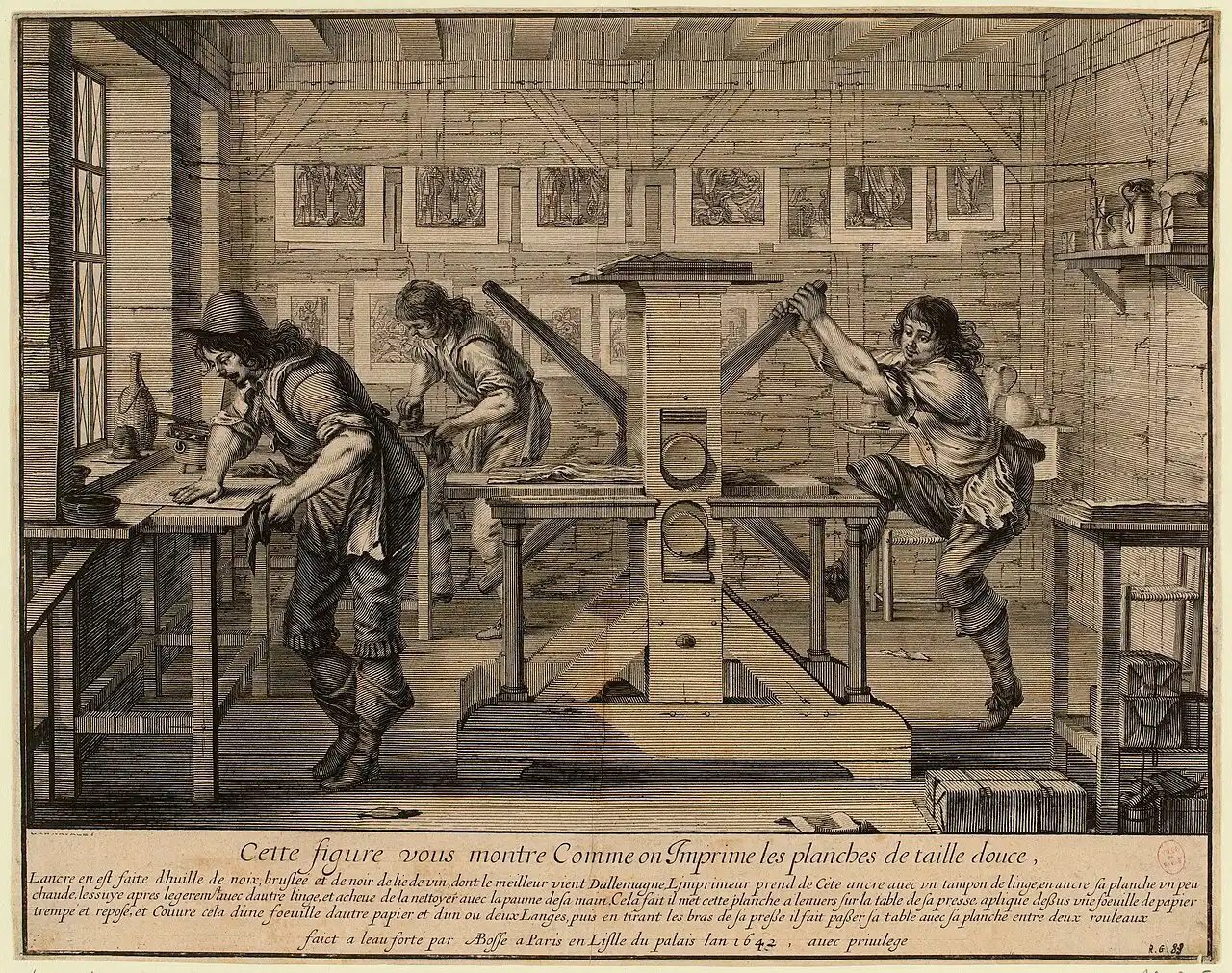
Collation: etching (eau-forte), per the record · 25.2 × 32 cm (9.9 × 12.6 in., computed) · image 1642 / object 1642 (one date field in the record; it does not date the two separately) · Musée Carnavalet, Paris, G.83

Collation card, all fields
- Object
- Cette figure vous montre comme on imprime les planches de taille douce commons.wikimedia.org
- Type
- print commons.wikimedia.org
- Process
- etching (eau-forte), per the record commons.wikimedia.org
- Format & size
- 25.2 × 32 cm (9.9 × 12.6 in., computed) commons.wikimedia.org
- Material
- not named in the record's materials line; the print's own caption describes a sheet of paper commons.wikimedia.org
- Made
- image 1642 / object 1642 (one date field in the record; it does not date the two separately) commons.wikimedia.org
- Held at
- Musée Carnavalet, Paris, G.83, commons.wikimedia.org commons.wikimedia.org
- Date basis
- Holding record: Paris Musées text as reproduced on the Commons file page; holding page not readable, not traced back, 2026-11-07 commons.wikimedia.org

Look in the margin for a dent around the picture. On Félix Buhot's etching The Donkeys at the Hill of the Cailles, the Cleveland Museum of Art records a platemark of 7.2 × 11.6 cm on a sheet of 17.1 × 26.6 cm, so the plate covers about 18 percent of the paper. A dent like that points somewhere useful. This page asks how much it can tell you about the way a print was made, and where the evidence runs out.
Where does the ink sit in each process?
Start with the printing surface, not the picture, because the three main families of printmaking differ in where the ink waits before it reaches the paper. Getty's Art & Architecture Thesaurus (AAT) sorts prints that way, and this page adopts its terms. In a relief print the ink sits on the surface left standing. In an intaglio print it sits in recessed areas that were cut or etched; in a planographic print, on a flat surface.
Two of those families are near opposites, which explains why people ask about relief vs intaglio as a pair. The third is the catch. A lithograph has neither a raised line nor a groove to compare, and a two-way test has no place to put it.
| Process | Where the ink sits | Trace on paper | Common exception | Example |
|---|---|---|---|---|
| woodcut | Relief: on the design left on the block's surface after the white areas are carved away | Library of Congress: the plate-edge impression is a way to separate an engraving from a woodcut, so none is the expected sign | Cleveland gives a platemark size on some woodcut records, including 1966.410 | The Rabbits, Henri Charles Guérard, 1893 (Cleveland Museum of Art, 1992.243) |
| wood engraving | Relief: on the block's surface, so the engraved lines print white | Not stated in the sources read | The word engraving appears in the name of a relief process | Unloaders of Plaster (Canal St. Martin), Auguste Louis Lepère, 1890 (Cleveland Museum of Art, 2007.252) |
| engraving | Intaglio: in grooves cut into a metal plate with a burin; surface wiped clean | Impression at the plate edge, per Library of Congress | A narrow margin leaves little room: 1969.48 has a sheet 0.4 cm larger than its platemark in each dimension | Apollo, Hendrick Goltzius, 1588 (Cleveland Museum of Art, 1969.48) |
| etching | Intaglio: in grooves bitten by acid where a wax or varnish ground was scraped away; surface wiped clean | Impression at the plate edge; printed in the same manner as engraving, per Library of Congress | 1953.157 has image and sheet both 13.9 x 21 cm and no plate size in the record | The Donkeys at the Hill of the Cailles, Félix Hilaire Buhot, c. 1875 (Cleveland Museum of Art, 1998.331) |
| lithograph | Planographic: on the greasy drawn areas of a stone, while water holds on the bare stone | The sources read give no plate-edge test for lithographs | Cleveland gives a plate or platemark size on 42 of 963 lithograph records with measurements, including this example | Souvenirs: Souvenir of Brittany, Plate 5, Eugène Isabey, 1832 (Cleveland Museum of Art, 2007.241) |
| relief halftone | Relief photomechanical (Getty AAT term) | Not stated in the records read | Filed under photomechanical processes in Getty AAT | No example record read for this page (None read) |
Download the data (print-process-comparison.csv) · source and license notes Data: Getty Art & Architecture Thesaurus, ODC-By 1.0, https://opendatacommons.org/licenses/by/1-0/, https://www.getty.edu/research/tools/vocabularies/, retrieved 2026-11-07
Read the table one row at a time, because each process has its own source and its own exception. The CSV carries the same six rows for anyone who wants to reuse them. The right-hand examples come from records that name the process, not from a judgment made by looking at the picture.
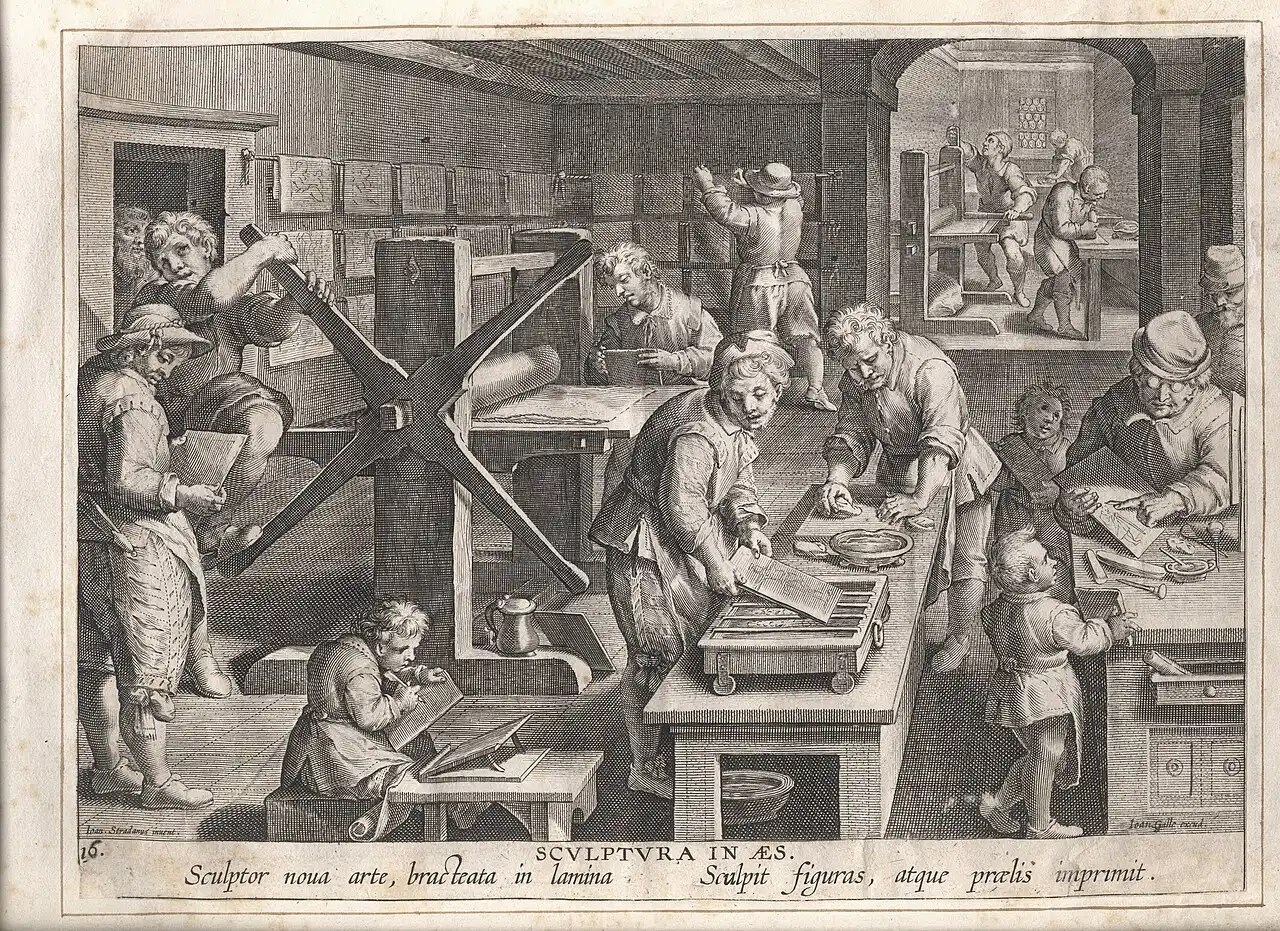

The record's title for this print claims an invention. AAT is more careful, placing the development of engraving in early 15th-century Germany and calling goldsmiths the probable source. A workshop scene like this one shows how the trade was pictured. It isn't evidence of how any particular sheet was made, so the rest of this page keeps returning to records.
Relief: why a woodblock prints from what's left
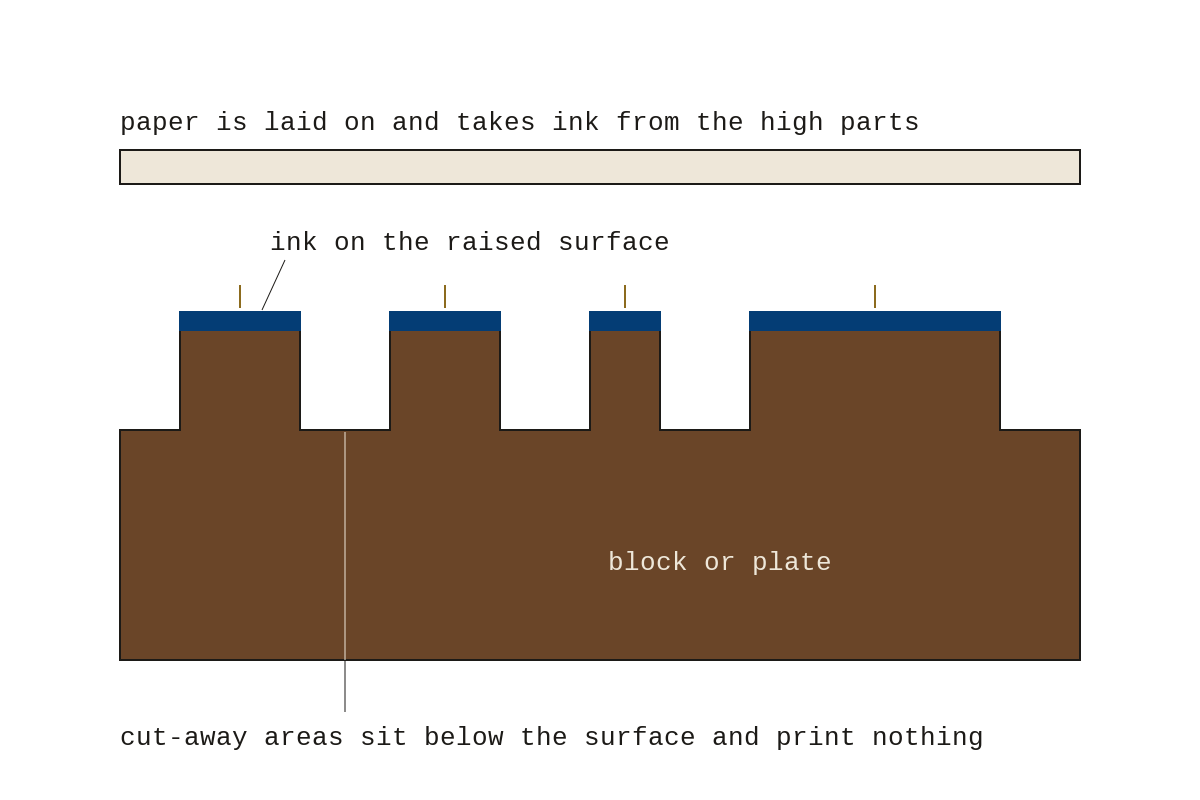
AAT describes relief printing as carving, engraving or etching away the areas that won't print, which leaves the original surface raised to take the ink. A woodblock counts as relief for that reason: the carver removes everything meant to stay white, and the wood left at the top carries the design. The Library of Congress puts it the same way: the carved spaces are the negative, white area of the illustration.
Credit line to copy
"Relief section" by Spine & Watermark, https://spineandwatermark.com/print/intaglio-vs-relief-printing/, licensed under CC BY 4.0 (https://creativecommons.org/licenses/by/4.0/).For early printed books, the Library of Congress adds a practical detail: a woodblock started at the height of a piece of metal type, so the printer could lock it into the same forme as the text and ink both together. Words and pictures could share a single pass through the press. An intaglio plate needed a press of its own, as the next section explains. Letterpress prints from raised metal type on the same principle, while the Great Wave off Kanagawa is a color print from woodblocks.
The trap here sits in the vocabulary, not the wood. AAT's note on engraving says that wood engraving is a process for relief printing, so the word engraving turns up on both sides of this comparison. Cleveland's note on Auguste Lepère's Paris under Snow (1947.138) shows the relief logic at work: the surface of the block takes the ink, so the engraved lines come out white.
The word etching turns up on both sides too, since AAT's relief definition includes plates that are etched away. Cleveland catalogues José Guadalupe Posada's The Skeleton of the Buses (2000.97) as “relief etching and letterpress.”
Don't sort a print by a single word in its name.
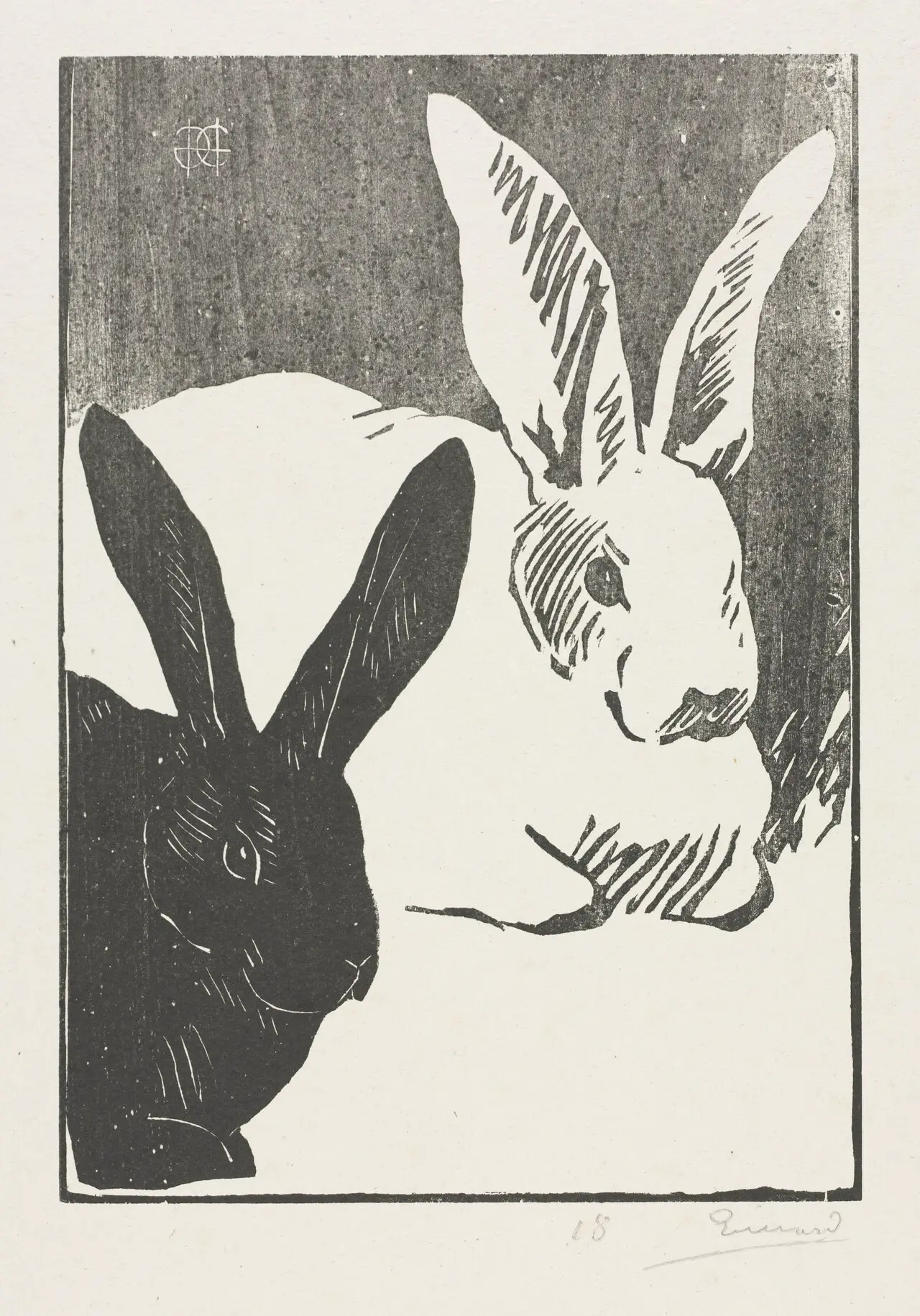
Cleveland's record for The Rabbits calls it a woodcut, with an image of 33 × 23.1 cm on a sheet of 59.5 × 42.2 cm, and it gives no plate size. Look at the gray ground in the photograph, where fine streaks run from top to bottom. They could come from the wood's grain. The record doesn't say so, and this page describes them and leaves their cause open.
Intaglio: the ink waits in the grooves
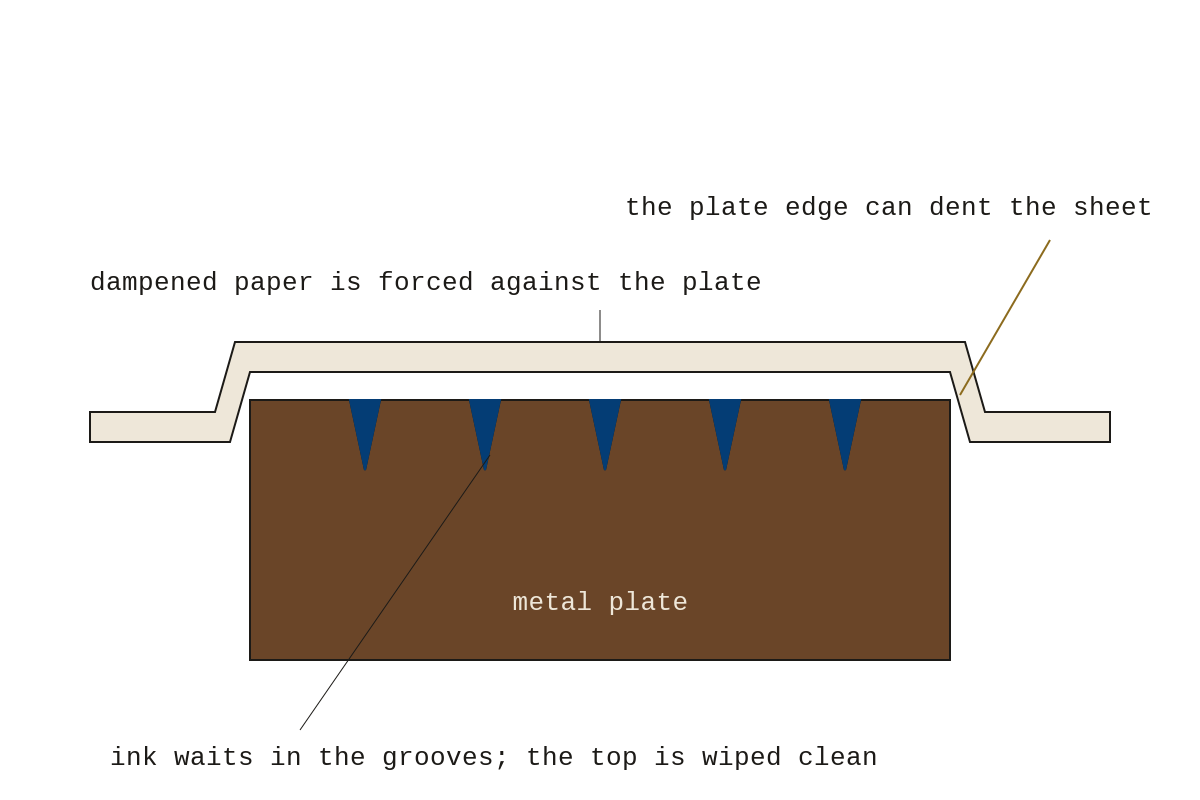
An intaglio plate works the other way round. The Library of Congress describes the sequence for engraving: a leather dauber pushes ink into the grooves in the metal, the surface is wiped clean, and paper and plate roll together under heavy pressure, which forces the ink out of the grooves. The Library adds that a deeper groove gives a darker line, and that cross-hatching builds up tone.
Credit line to copy
"Intaglio section" by Spine & Watermark, https://spineandwatermark.com/print/intaglio-vs-relief-printing/, licensed under CC BY 4.0 (https://creativecommons.org/licenses/by/4.0/).Bosse's print at the top of this page said much the same thing in 1642. The Paris Musées record, as reproduced on the Commons file page, transcribes the caption, which has the printer lay a soaked sheet on the plate. Then comes the last step: “pulling the arms of his press, he passes his table with his plate between two rollers” (literal translation by Spine & Watermark). The record lists the print's own technique as eau-forte, or etching.
This is an intaglio print about intaglio printing, plate 4 of a set of four, and the card above draws on that record. Think of the plate as a mold for thin lines of ink, with the paper pressed in to collect them.
Because these plates needed a different press from text and woodcuts, the Library of Congress says such pages were usually printed in another shop and added later. Folio, quarto and octavo name the folds in a sheet, and a plate page added to those sheets has a printing history of its own. The Library's post shows a copperplate image printed on top of a page's text, the kind of mistake that exposes the two separate pressings.
What's the difference between etching and engraving?
Both are intaglio, and the difference lies in how the groove gets made. In engraving, per AAT, a burin held in the palm is pushed through a plate, usually copper, to cut V-shaped lines. In etching, the design is worked through an acid-resistant coating, and acid bites the metal wherever the coating has been opened.
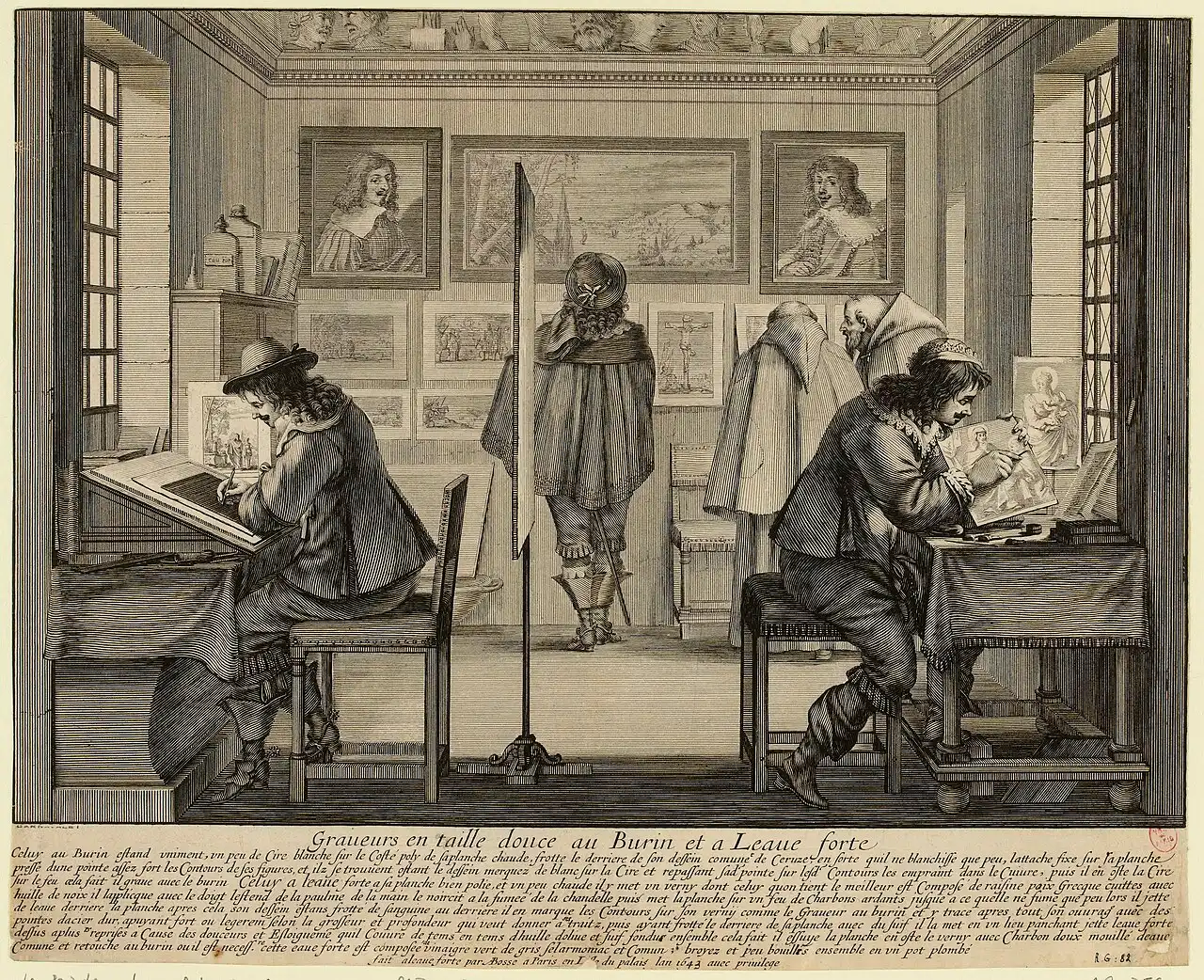

Bosse's title for plate 3 of the same set names both trades, the burin and l'eau forte. The Library of Congress says etching can give smoother, rounder lines and that the printing afterward runs the same way as engraving, so the press can't separate them for you. Cleveland catalogues 132 print records as “etching and engraving,” so a single plate need not choose between them.
Where do drypoint and aquatint fit?
They are intaglio as well, which matters if you came here looking for a list of the types of printmaking. AAT describes drypoint as a sharp needle scratching the plate and raising a burr that gives a soft line. It describes aquatint as an etching technique that uses powdered resin to leave fine pockmarks in the plate, and it credits the method to J.B. LePrince in the 1760s. Both words belong in the intaglio row, whatever else appears beside them on a label.
Lithography: not raised, not cut
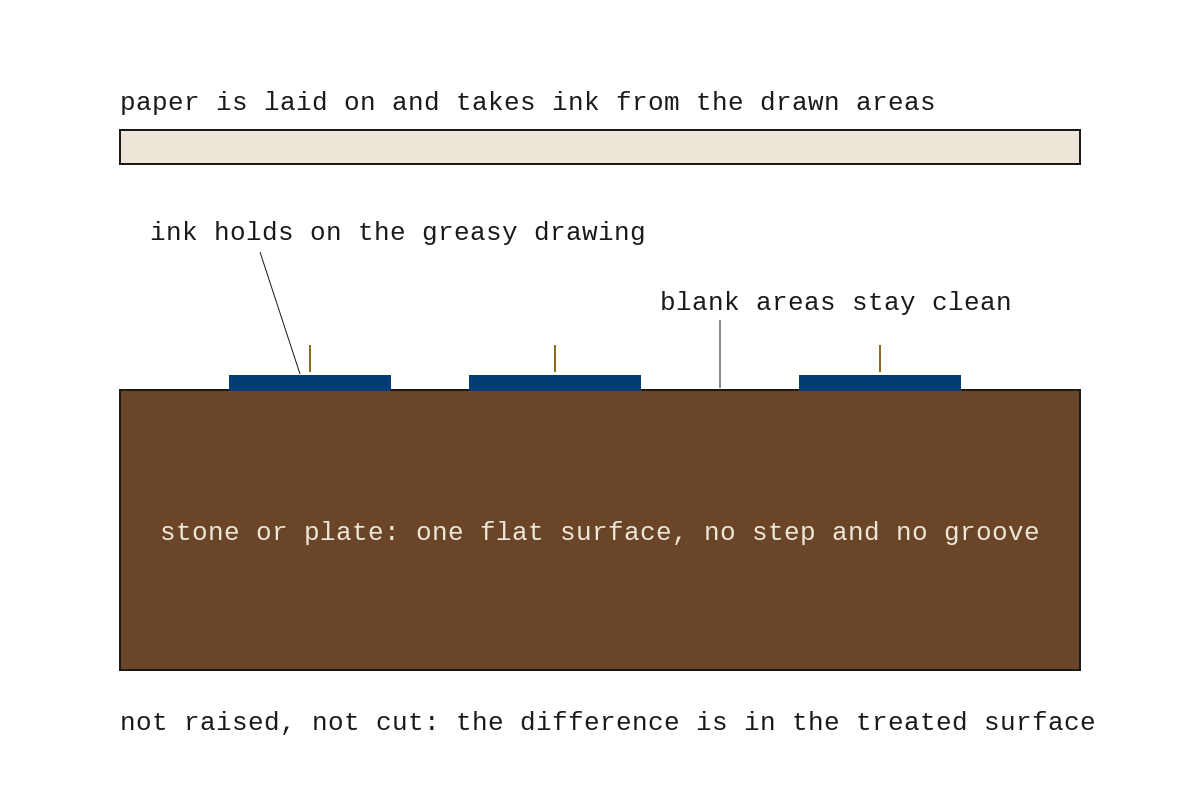
AAT defines lithography as a planographic process. A design goes onto a stone or plate in a greasy substance, and the surface is treated so that it accepts ink only in the greasy areas. Cleveland's note on a color lithograph (1944.14) gives the same idea in working terms: water holds on the bare stone, and ink clings to the greasy areas. There's no ridge and no groove anywhere on the printing surface, because the difference between printing and not printing lies in how that surface has been prepared.
Credit line to copy
"Planographic section" by Spine & Watermark, https://spineandwatermark.com/print/intaglio-vs-relief-printing/, licensed under CC BY 4.0 (https://creativecommons.org/licenses/by/4.0/).That's the sense in which lithographs fit neither side, and it's why a question like “is this lithograph relief or intaglio?” has no good answer. Cleveland's page for a set of early lithographs credits Alois Senefelder with inventing the medium in Munich in 1798, and it dates the first portfolio of artists' lithographs to 1803, five years later. Its records use labels like “pen lithograph” and “color lithograph,” and they all stay in this one family because the label describes the drawing or the color and not the printing surface.
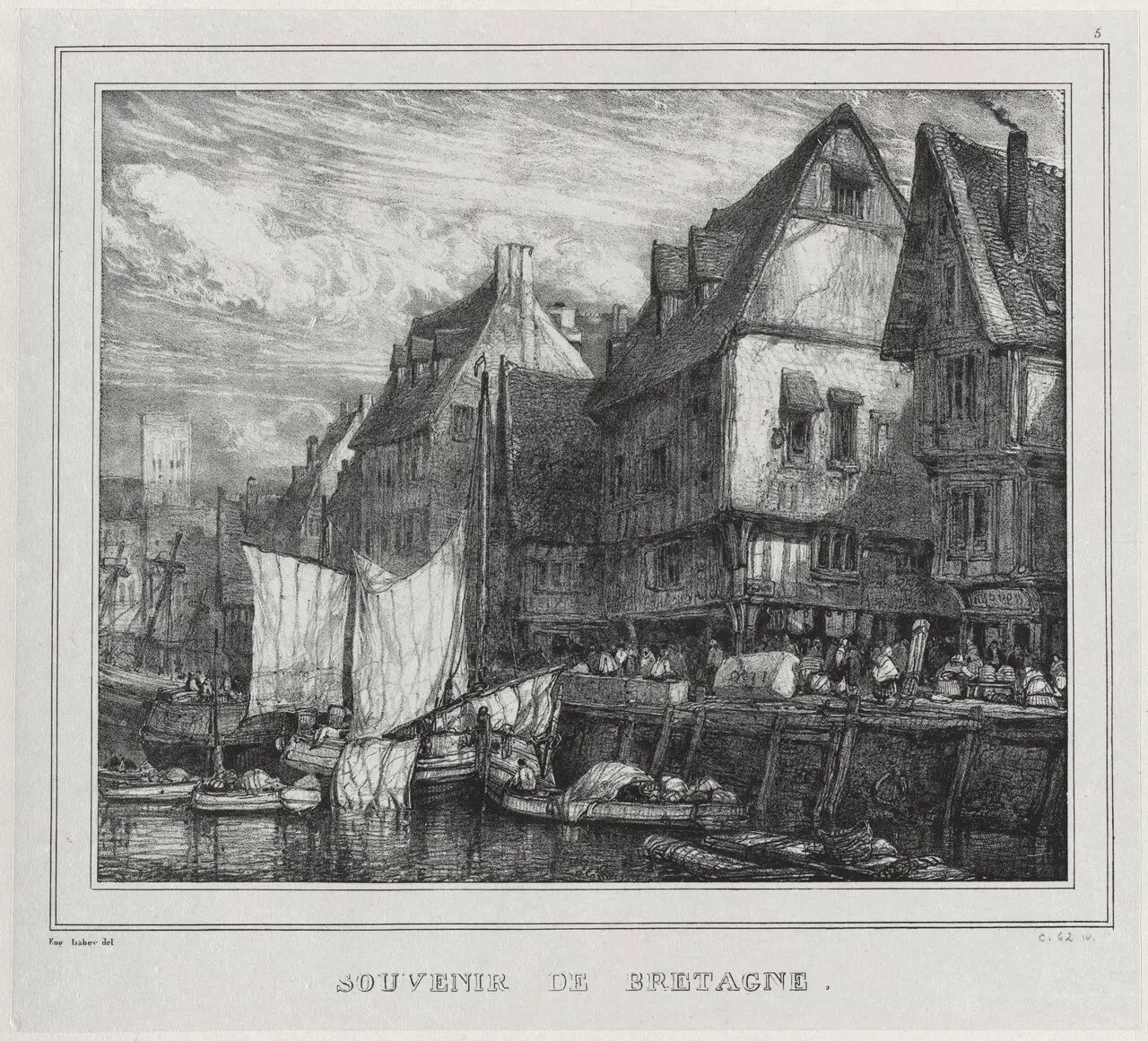
Cleveland's process line for this sheet reads “lithograph on chine collé,” with lithograph as the process word. The same record gives a platemark of 26.2 × 28.6 cm on a sheet of 33.4 × 46.2 cm. Now look at the photograph: its proportions sit close to that platemark size and not to the sheet, so the outer margin isn't in view. A platemark is the trace the opening of this page told you to look for, and here the record attaches one to a print from a flat surface.
What does a plate mark actually prove?
A plate mark is the dent left in the paper at the edge of an intaglio plate. The Library of Congress says the pressure leaves an impression where the plate pressed into the paper, and that looking or feeling for it is one easy way to tell an engraving from a woodcut. That's useful advice for that pair of processes. As a general rule it's weaker, for three reasons the records themselves can show.
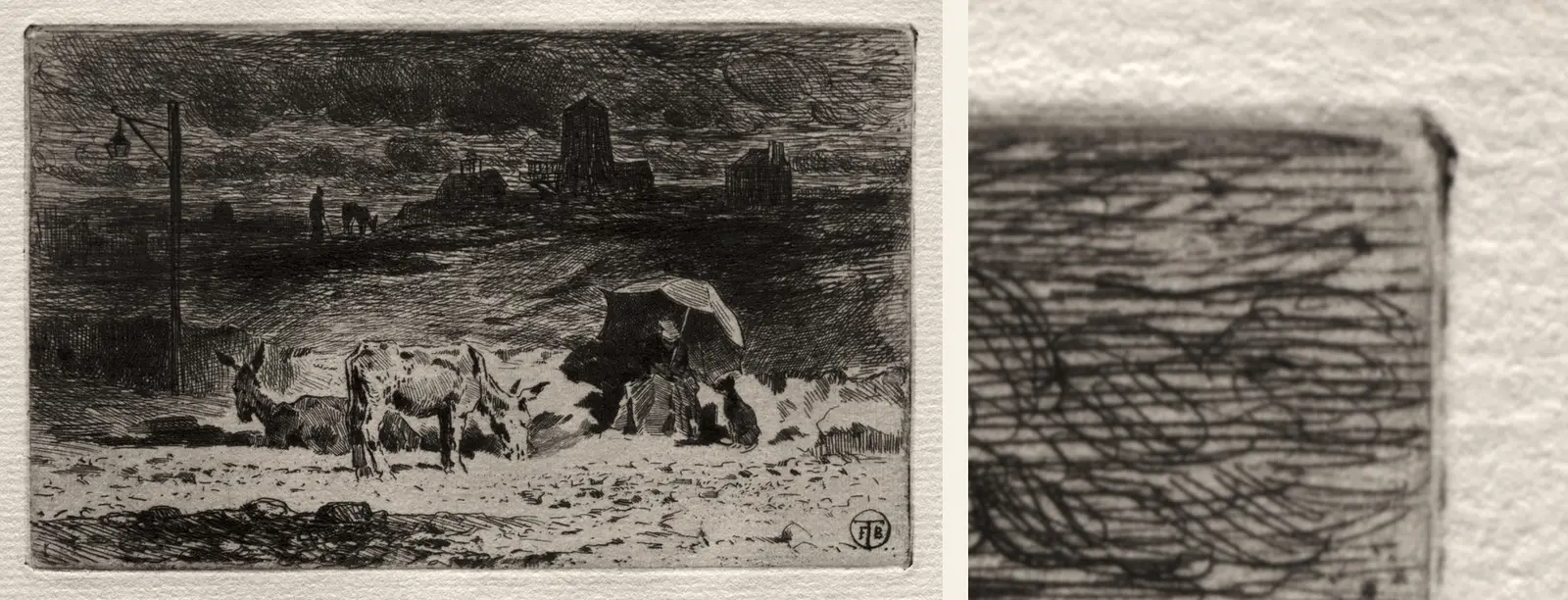

First, a dent needs paper around it. Cleveland measures Cornelis Bega's etching 1943.543 at 15.6 × 12.1 cm for the sheet and 15.4 × 12 cm for the platemark, which leaves a gap of only 0.2 and 0.1 cm. Augustin Hirschvogel's etching 1953.157 has image and sheet both at 13.9 × 21 cm and no plate size, while his 1951.491 records a platemark only 0.4 cm smaller than the sheet each way. The records don't say why the margins are narrow, and this page doesn't guess at a trimming story.
Second, a plate label doesn't always sit on an intaglio print. Isabey's lithograph carries that platemark line even though its own record names a flat-surface process. The record doesn't say what was measured, so the meaning of the line is not established. A dent suggests an intaglio plate, and that verb is as far as this page will go.
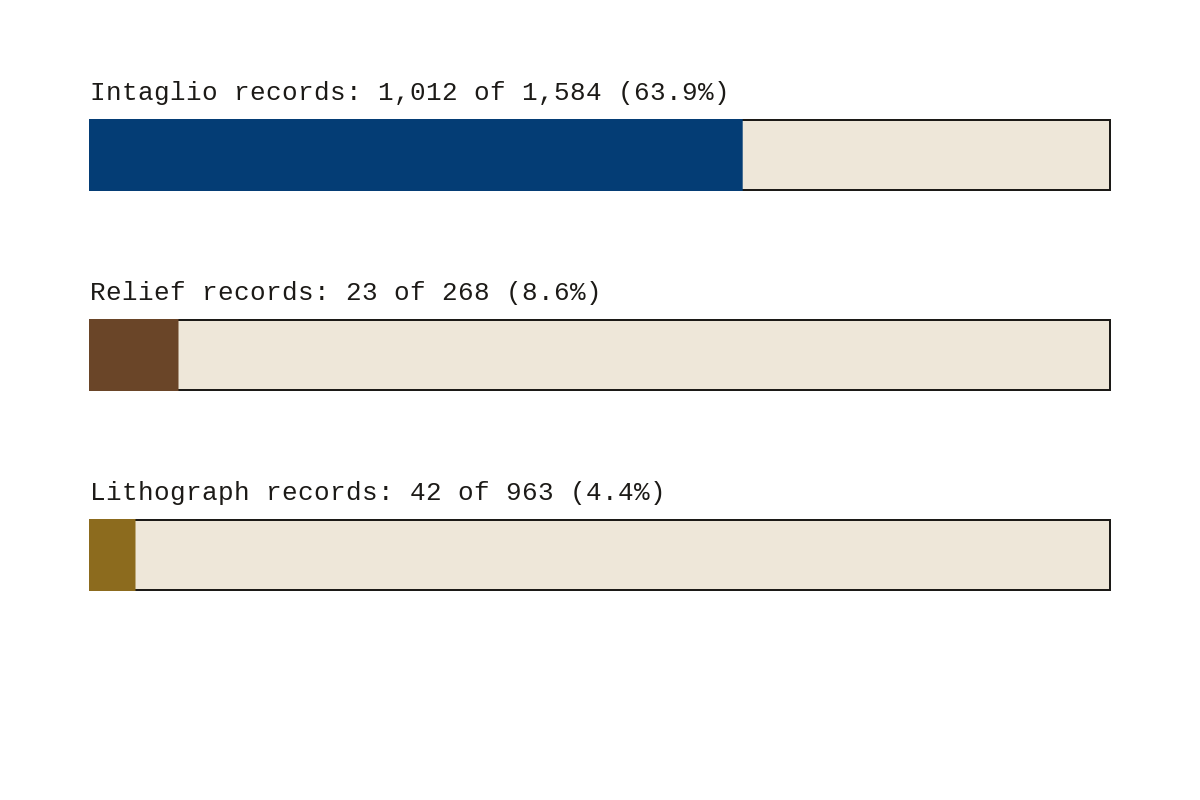
Third, the catalogue field doesn't sort the families cleanly across a whole collection. For this page, 9,933 of Cleveland's open records for prints were read under six process words, and each was sorted into a family by its own technique line. Only some of those records carry measurements at all, so the count below uses that smaller group as its base. Plate or platemark sizes are common on intaglio records, yet they also appear on woodcuts and lithographs.
Credit line to copy
"Plate-size labels in Cleveland print records" by Spine & Watermark, https://spineandwatermark.com/print/intaglio-vs-relief-printing/, licensed under CC BY 4.0 (https://creativecommons.org/licenses/by/4.0/).| Family, by the record's technique line | Records read | With measurements | With a plate or platemark size | Share of measured | Scope |
|---|---|---|---|---|---|
| Intaglio | 5,786 | 1,584 | 1,012 | 63.9% | Cleveland CC0 records matching six process words, read 2026-11-07 |
| Relief (woodcut, wood engraving) | 1,396 | 268 | 23 | 8.6% | Cleveland CC0 records matching six process words, read 2026-11-07 |
| Lithograph | 2,708 | 963 | 42 | 4.4% | Cleveland CC0 records matching six process words, read 2026-11-07 |
Download the data (cleveland-plate-label-counts.csv) · source and license notes Data: Cleveland Museum of Art, open-access records for prints, CC0 1.0, https://creativecommons.org/publicdomain/zero/1.0/, https://openaccess-api.clevelandart.org/api/artworks/, retrieved 2026-11-07
The 42 lithograph records with such a size include George Bellows's Splinter Beach (1936.582) and Isabey's sheet above, and Michael Wolgemut's 1493 woodcut The Emblem (1966.410) gives one too. The records don't say what was measured or who measured it. Don't read a size as proof of a dent. A missing size doesn't prove the absence of one either, because 572 of the 1,584 measured intaglio records give no plate size at all.
The counts describe one museum's cataloguing and not the prints of the world. They come from CC0 records that matched the six words, so a process catalogued under another word isn't in them, and the shares would shift with a different museum or a different search.
How to read a print in five steps
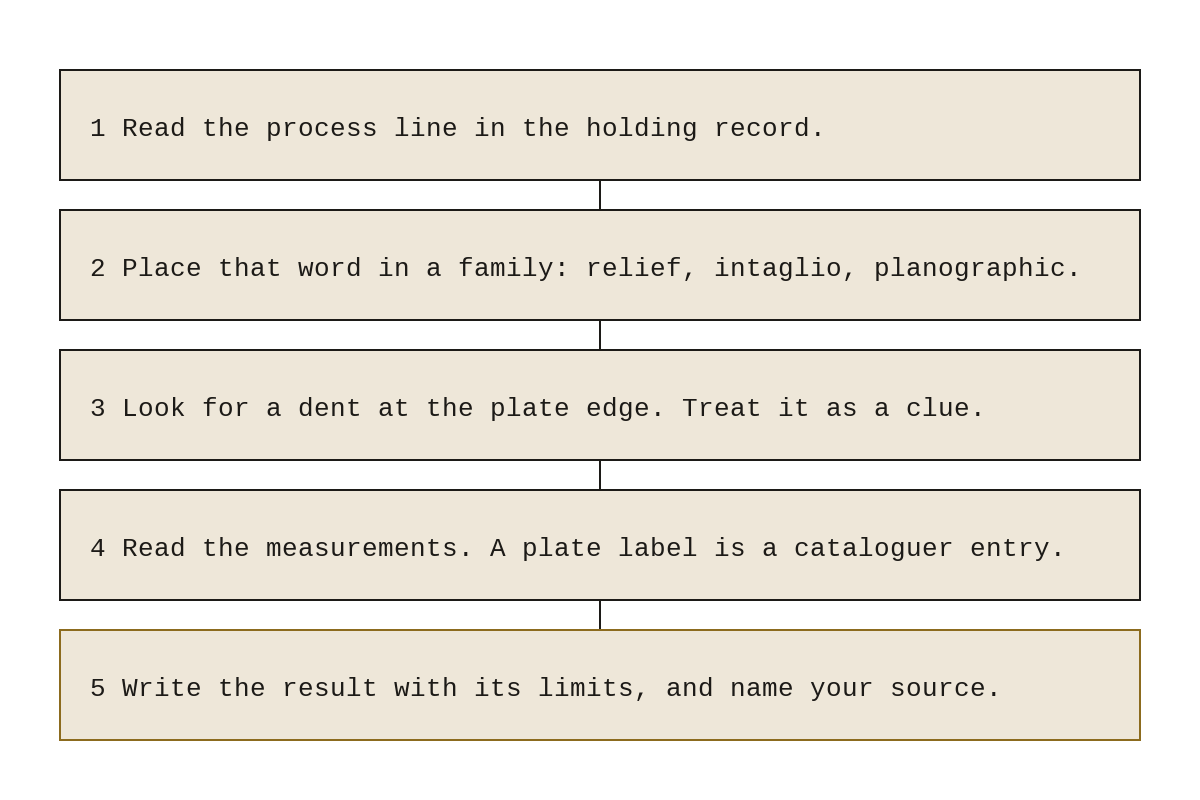
These steps move from what's written about a print to what's visible on it, and they end with a statement of the limits, not a verdict.
Credit line to copy
"Five steps for reading a print" by Spine & Watermark, https://spineandwatermark.com/print/intaglio-vs-relief-printing/, licensed under CC BY 4.0 (https://creativecommons.org/licenses/by/4.0/).- Read the process line in the holding record, since a museum's label such as “etching” or “lithograph” is the claim to start from.
- Place that word in a family with the table above, and watch for wood engraving, which is relief, and for labels that name two processes.
- Look for a dent at the plate edge, which the Library of Congress suggests looking or feeling for around the image. Leave any cleaning or repair of the sheet to a professional conservator (the American Institute for Conservation is a starting point).
- Read the measurements, keeping in mind that a platemark line records what a cataloguer entered and can't stand in for a look at the sheet.
- Write the result with its limits, such as “lithograph, per the record” or “dent visible, process not recorded, so possibly intaglio.”
A label may not be in English at all. The Paris Musées record says eau-forte, and AAT lists Tiefdruckverfahren in German and diepdrukprocedés in Dutch for intaglio processes, gravures en relief in French and hoogdruk in Dutch for relief prints, and vlakdruk in Dutch for planographic ones. Looking up an unfamiliar label in the thesaurus is safer than guessing from its sound, because the record shows which family the word belongs to.
The double date belongs in that last step, since every document object has the date of its content and the date the physical thing was made. Cleveland dates its impression of a Goya bullfight (1923.547) “1816, printed 1876,” and a Hans Burgkmair woodcut (1951.278) “1525, printed later.” The process label holds for both sheets, but it says nothing about which decade pulled them from the plate or block.
What can the process say about a date?
A process label can set an earliest likely date for a sheet, though it can't set a latest one, and the limit is only as good as the label. Cleveland's page puts the invention of lithography in 1798, while the Art Institute of Chicago's note on a Senefelder portrait says only that he's credited with it in the final years of the 1700s, so a sheet correctly labeled a lithograph shouldn't be older than the late 1700s.
AAT credits William Henry Fox Talbot with suggesting the principle of the relief halftone in 1852, and says it was developed commercially in the 1880s. It dates aquatint's invention to the 1760s and notes that aquatints were popular until the late 1830s, but the Rijksmuseum's record for a Jan van de Velde (IV) portrait of Christina of Sweden (RP-P-1903-A-23012) lists aquatint among its techniques and gives the dates 1650–1656 and 1664. Those sources don't agree, so this page leaves aquatint's earliest edge open.
The later limit is much weaker, because popular doesn't mean finished, and because plates and blocks can go on printing long after they're made, as the Goya and Burgkmair records show. Treat a process date as one edge of a range. A second edge has to come from something else, such as a dated inscription, a publication record or a watermark that a holding record has already described. A sheet without any of those stays open at the later end.
Three sheets, read the same way
Try the steps on the three Cleveland prints shown on this page. Buhot's print is labeled an etching, which places it in the intaglio family; the record gives a platemark, and a dent seems to show at the corner in the photograph. The written result is “etching, per the record, with a platemark recorded.”
Guérard's print is labeled a woodcut, which places it in the relief family. The record gives image and sheet sizes with no plate size. The result is “woodcut, per the record, with no plate size recorded,” and that second clause is a statement about the record, not a claim about the paper.
The Isabey sheet is the awkward one. Its label places it in the planographic family, the record gives a platemark, and the photograph doesn't reach the sheet's edge. The result is “lithograph, per the record, with a platemark line of unexplained meaning,” and the label outranks the line because no source read here says what a platemark means on a lithograph.
When this method doesn't apply
The three-way sort suits prints made from a block, plate or stone that a person cut, bit or drew on. Several cases fall outside it, or at least need a second reading.
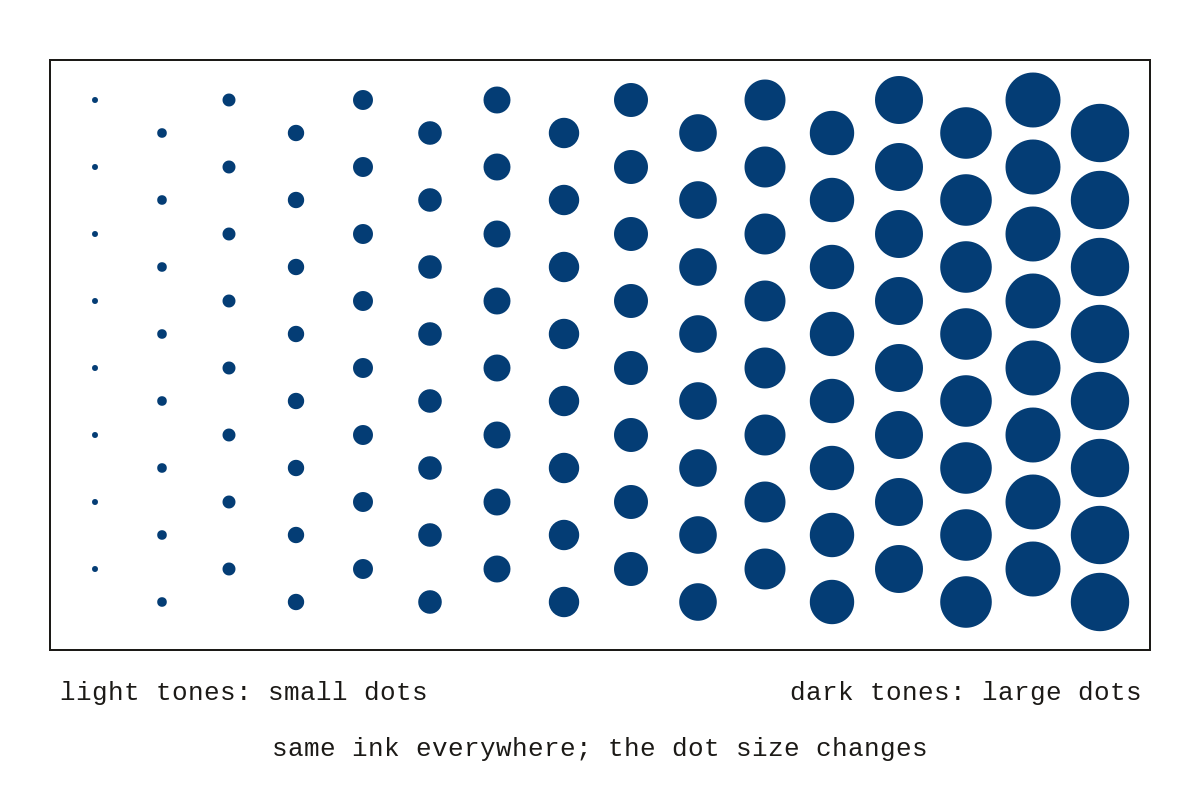
- Photomechanical prints. AAT describes relief halftone as using small raised dots of varying size, mainly for photographs between the 1880s and the 1950s, and it describes photogravure as an intaglio process combining photography and etching. The family word still holds, but the image wasn't cut by hand.
- Screenprints. AAT calls screen printing a stencil technique, with ink forced through a mesh, so it belongs to none of the three, and a First World War poster recorded as a screenprint with halftone needs its own process record.
- Mixed labels. Cleveland's lines include “etching and aquatint” and “color woodcut and lithograph,” and no single family word can carry the second of those.
- Photographs of prints. A museum photograph may not show a shallow dent, and you can't feel a screen, so go by the record and treat what you see as description.
Credit line to copy
"Halftone dots, enlarged" by Spine & Watermark, https://spineandwatermark.com/print/intaglio-vs-relief-printing/, licensed under CC BY 4.0 (https://creativecommons.org/licenses/by/4.0/).Two more questions come up beside this one, and the process can't answer either. The first is whether a print is an original: AAT advises against the phrase “original prints” outside discussions of the phrase itself, and a process label doesn't test authenticity. The second is value: this page gives no prices, so it can't tell you what a lithograph is worth beside an etching. Continental Currency shows a different reason to care about process: the Library of Congress calls its leaf print an anti-counterfeiting tactic.
The method still leaves one question unread. Cleveland's 42 lithograph records with a plate or platemark size might be noting a stone's edge, a press mark or a cataloguing habit, and no record read for this page says which. Isabey's 26.2 × 28.6 cm could belong with any of those, and its photograph can't decide the matter. Until those sheets are compared side by side, the field and the dent remain two separate pieces of evidence.
Turn it over:
The record shows no reverse for Bosse's print, and the marks in the Commons text, its stamps and inventory number, are all on the front.
- Great Wave off Kanagawa: relief printing from woodblocks, in color: Eight impressions compared across three museums, and no single original.
- Letterpress: relief printing with metal type: The raised-surface idea again, this time cast in metal.
Sources
- Cleveland Museum of Art, Félix Hilaire Buhot, "The Donkeys at the Hill of the Cailles," c. 1875, 1998.331, collection data. CC0. clevelandart.orgRead: full data record
- Getty Research Institute, Art & Architecture Thesaurus, "relief prints," ID 300041391. getty.eduRead: full record
- Getty Research Institute, Art & Architecture Thesaurus, "intaglio printing processes," ID 300199636. getty.eduRead: full record
- Getty Research Institute, Art & Architecture Thesaurus, "planographic prints," ID 300178376. getty.eduRead: full record
- Getty Research Institute, Art & Architecture Thesaurus, "lithography," ID 300053271. getty.eduRead: full record
- Getty Research Institute, Art & Architecture Thesaurus, "engraving (printing process)," ID 300053225. getty.eduRead: full record
- Getty Research Institute, Art & Architecture Thesaurus, "etching (printing process)," ID 300053241. getty.eduRead: full record
- Patrick Hastings, "Printing Illustrations," Bibliomania, Library of Congress, August 7, 2025. blogs.loc.govRead: full post
- Getty Research Institute, Art & Architecture Thesaurus, "drypoint (printing process)," ID 300053228. getty.eduRead: full record
- Getty Research Institute, Art & Architecture Thesaurus, "aquatint (printing process)," ID 300053242. getty.eduRead: full record
- Abraham Bosse, "Cette figure vous montre comme on imprime les planches de taille douce," 1642, Musée Carnavalet, Paris, G.83. Paris Musées record text as reproduced on the Wikimedia Commons file page. commons.wikimedia.orgRead: record text on the file page; holding page not readable
- Abraham Bosse, "Graueurs en taille douce au Burin et a Leaue forte," 1643, Musée Carnavalet, Paris, G.82. Paris Musées record text as reproduced on the Wikimedia Commons file page. commons.wikimedia.orgRead: record text on the file page; holding page not readable
- Unknown engraver after Stradanus, "De uitvinding van de kopergravure" (The invention of copper engraving), published by Jan Galle, Museum Plantin-Moretus, Antwerp, PK OPB 0186 017. Record text on the Wikimedia Commons file page. commons.wikimedia.orgRead: record text on the file page; holding page not read
- Cleveland Museum of Art, Henri Charles Guérard, "The Rabbits," 1893, 1992.243, collection data. CC0. clevelandart.orgRead: full data record
- Cleveland Museum of Art, Eugène Isabey, "Souvenirs: Souvenir of Brittany, Plate 5," 1832, published by V. Morlot and McLean, 2007.241, collection data. CC0. clevelandart.orgRead: full data record
- Cleveland Museum of Art, Anton Carl Rahn, "Flowers and Vegetables," 1800s, 1944.14, collection data. CC0. clevelandart.orgRead: full data record, description field
- Cleveland Museum of Art, Auguste Louis Lepère, "Paris under Snow," 1890, 1947.138, collection data. CC0. clevelandart.orgRead: full data record, description field
- Cleveland Museum of Art, "Specimens of Polyautography: Landscape with an Oak Tree," 1803, 1940.1124, collection page. clevelandart.orgRead: full collection page
- Cleveland Museum of Art, Open Access API, CC0 print records matching engraving, etching, drypoint, lithograph, woodcut and wood engraving. CC0. openaccess-api.clevelandart.orgRead: catalogue records: every page of six queries, 9,933 unique records
- Getty Research Institute, Art & Architecture Thesaurus, "relief halftone (process)," ID 300155640. getty.eduRead: full record
- Getty Research Institute, Art & Architecture Thesaurus, "photogravure (process)," ID 300053207. getty.eduRead: full record
- Getty Research Institute, Art & Architecture Thesaurus, "screen printing," ID 300053281. getty.eduRead: full record
- Getty Research Institute, Art & Architecture Thesaurus, "prints (visual works)," ID 300041273, scope note. getty.eduRead: full record
- Bamber Gascoigne, How to Identify Prints (Thames & Hudson, 2004). blogs.loc.govRead: bibliography only, as listed by the Library of Congress post
- Art Institute of Chicago, "Portrait of Senefelder," 1818, collection data, id 109315. The description text is licensed CC BY 4.0; all other fields CC0. api.artic.eduRead: full data recordText license: CC-BY-4.0 (description field); CC0 (other fields)
- Rijksmuseum, Jan van de Velde (IV), "Portret van Christina, koningin van Zweden," RP-P-1903-A-23012, collection data. data.rijksmuseum.nlRead: full data record
Image credits
- "Cette figure vous montre comme on imprime les planches de taille douce" by Abraham Bosse — https://commons.wikimedia.org/wiki/File:Cette_figure_vous_montre_Comme_on_Imprime_les_planches_de_taille_douce,_G.83.jpg — CC0 1.0 (https://creativecommons.org/publicdomain/zero/1.0/); Musée Carnavalet, Paris, G.83
- "De uitvinding van de kopergravure (The invention of copper engraving)" by Unknown engraver, after Stradanus — https://commons.wikimedia.org/wiki/File:De_uitvinding_van_de_kopergravure,_anoniem,_Museum_Plantin-Moretus,_PK_OPB_0186_017.jpg — CC0 1.0 (https://creativecommons.org/publicdomain/zero/1.0/); Museum Plantin-Moretus, Antwerp, PK OPB 0186 017
- "Relief section" by Spine & Watermark, https://spineandwatermark.com/print/intaglio-vs-relief-printing/, licensed under CC BY 4.0 (https://creativecommons.org/licenses/by/4.0/).
- "The Rabbits" by Henri Charles Guérard — https://commons.wikimedia.org/wiki/File:Henri_Charles_Guérard_-_The_Rabbits_-_1992.243_-_Cleveland_Museum_of_Art.tif — CC0 1.0 (https://creativecommons.org/publicdomain/zero/1.0/); Cleveland Museum of Art, 1992.243
- "Intaglio section" by Spine & Watermark, https://spineandwatermark.com/print/intaglio-vs-relief-printing/, licensed under CC BY 4.0 (https://creativecommons.org/licenses/by/4.0/).
- "Graueurs en taille douce au Burin et a Leaue forte" by Abraham Bosse — https://commons.wikimedia.org/wiki/File:Graueurs_en_taille_douce_au_Burin_et_a_Leaue_forte,_G.82.jpg — CC0 1.0 (https://creativecommons.org/publicdomain/zero/1.0/); Musée Carnavalet, Paris, G.82
- "Planographic section" by Spine & Watermark, https://spineandwatermark.com/print/intaglio-vs-relief-printing/, licensed under CC BY 4.0 (https://creativecommons.org/licenses/by/4.0/).
- "Souvenirs: Souvenir of Brittany, Plate 5" by Eugène Isabey — https://commons.wikimedia.org/wiki/File:Eugène_Isabey_-_Souvenirs-_Souvenir_of_Brittany,_Plate_5_-_2007.241_-_Cleveland_Museum_of_Art.tif — CC0 1.0 (https://creativecommons.org/publicdomain/zero/1.0/); Cleveland Museum of Art, 2007.241
- "The Donkeys at the Hill of the Cailles, with one corner enlarged" by Félix Hilaire Buhot — https://commons.wikimedia.org/wiki/File:Félix_Hilaire_Buhot_(French,_1847-1898)_-_The_Donkeys_at_the_Hill_of_the_Cailles_-_1998.331_-_Cleveland_Museum_of_Art.jpg — CC0 1.0 (https://creativecommons.org/publicdomain/zero/1.0/); Cleveland Museum of Art, 1998.331; modified: one corner enlarged, whole photograph and enlarged corner placed side by side with a paper-colored gap
- "Plate-size labels in Cleveland print records" by Spine & Watermark, https://spineandwatermark.com/print/intaglio-vs-relief-printing/, licensed under CC BY 4.0 (https://creativecommons.org/licenses/by/4.0/).
- "Five steps for reading a print" by Spine & Watermark, https://spineandwatermark.com/print/intaglio-vs-relief-printing/, licensed under CC BY 4.0 (https://creativecommons.org/licenses/by/4.0/).
- "Halftone dots, enlarged" by Spine & Watermark, https://spineandwatermark.com/print/intaglio-vs-relief-printing/, licensed under CC BY 4.0 (https://creativecommons.org/licenses/by/4.0/).
Cite this page
Spine & Watermark. “Intaglio vs Relief Printing: Lithographs Fit Neither Side.” Spine & Watermark, published November 7, 2026. https://spineandwatermark.com/print/intaglio-vs-relief-printing/. Accessed [date].
How sources are ranked · All corrections · Contact · Report an error (contact@spineandwatermark.com)