Coins & Banknotes
Coins and banknotes as historical objects: designs and inscriptions, how coins were struck, note printing and anti-forgery history. No market prices, no valuations, no authentication.
4 entries
-
Coins & Banknotes
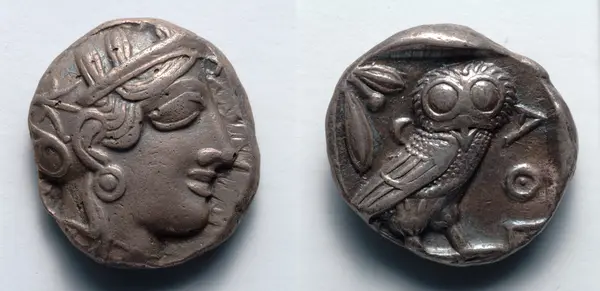
Athenian Owl Tetradrachm: How Far Did the Design Travel?
The Athenian owl tetradrachm, a silver coin worth four drachms, weighs 17.237 grams in Cleveland's example. How far its design was imitated, per one review.
Image credit
"Tetradrachm: Head of Athena (obverse); Owl (reverse)" by Unknown maker, minted at Athens — https://commons.wikimedia.org/wiki/File:Greece,_5th_century_BC_-_Athenian_Tetradrachm-_Female_Head_(obverse)_-_1920.267.a_-_Cleveland_Museum_of_Art.jpg — CC0 1.0 (https://creativecommons.org/publicdomain/zero/1.0/); Cleveland Museum of Art, 1920.267; modified: obverse and reverse files placed side by side, obverse left, at equal height; no other change
-
Coins & Banknotes
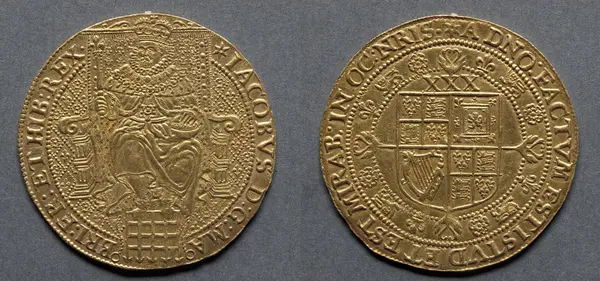
Hammered Coins: In England, How Did Two Dies Make One Coin?
In England, hammered coins were struck between a fixed pile and a hand-held trussel. See why the upper die wore faster, per the Royal Mint and its museum.
Image credit
"Rose Ryal: James I (obverse); Shield of Arms (reverse)" by Unknown maker, England — https://www.clevelandart.org/art/1969.190 — CC0 1.0 (https://creativecommons.org/publicdomain/zero/1.0/); Cleveland Museum of Art, 1969.190; modified: scaled to 1000 px high; no other change
-
Coins & Banknotes
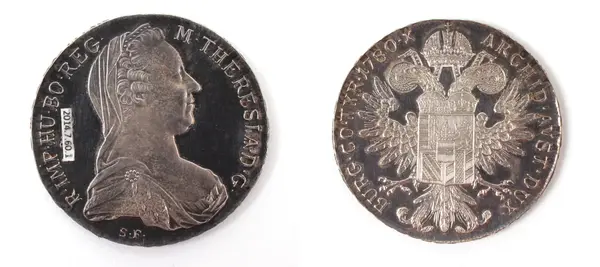
Maria Theresa Thaler: The Coin That Kept Her Death Year
The Maria Theresa thaler carries 1780, the year the empress died. Museum and mint records show why that date alone can’t say when a coin was struck.
Image credit
"Maria Theresa thaler dated 1780, obverse and reverse" by Auckland Museum — https://commons.wikimedia.org/wiki/File:Coin,_award_(AM_2014.7.60-5).jpg — CC BY 4.0 (https://creativecommons.org/licenses/by/4.0/); Auckland War Memorial Museum, 2014.7.60; modified: obverse (AM 2014.7.60-5) and reverse (AM 2014.7.60-3) files placed side by side, obverse left, at equal height; accession label left in place; no other change
-
Coins & Banknotes
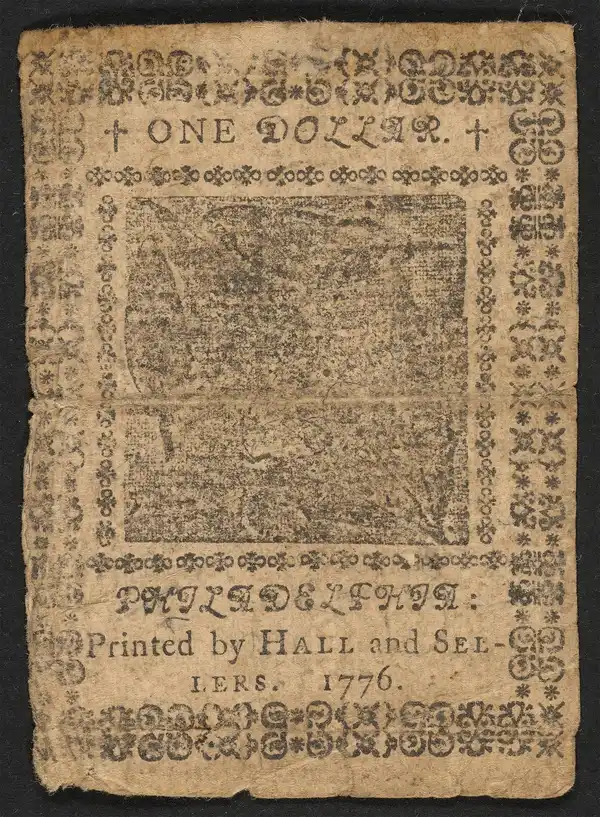
Continental Currency: Some Notes Carry a Leaf on the Back
Some Continental Currency notes carry a leaf on the back. See how the block was cast, why Hall and Sellers are named, and what Franklin is credited with.
Image credit
"The United Colonies, 1 dollar, 1776, verso" by David Hall and William Sellers — https://commons.wikimedia.org/wiki/File:Verso_The_United_Colonies_1_dollar_1776_urn-3_HBS.Baker.AC_1083819.jpeg — Public domain (David Hall (1714–1772) and William Sellers (1725–1804) per the file page, note dated 1776. United States: published before 1931. European Union: both authors dead more than 70 years; faithful reproduction of a two-dimensional work.); Baker Library, Harvard Business School, American Currency Collection, MH:VIA W363108_urn-3:HBS.Baker.AC:1083819; modified: scaled to 1500 px on the long side; no other change