Continental Currency: Some Notes Carry a Leaf on the Back
Published · Revised
TL;DR: Some Continental Currency notes carry a nature print of real leaves on the back, printed by Hall and Sellers of Philadelphia. The Library of Congress calls the leaf an anti-counterfeiting tactic invented by Benjamin Franklin. It says the block was cast in metal from a plaster mold of a leaf, and those veins were hard to engrave.
Full credit
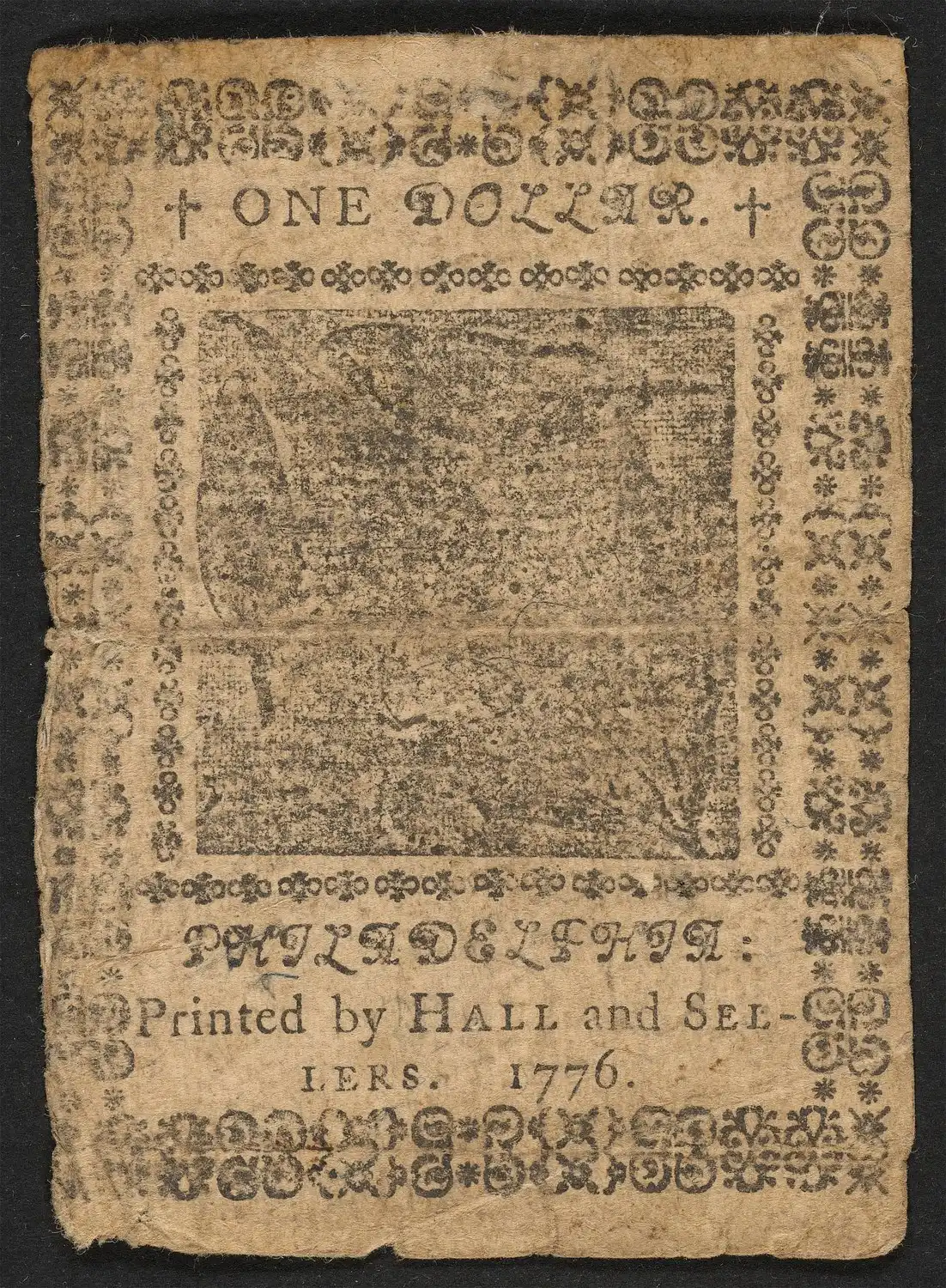
"The United Colonies, 1 dollar, 1776, verso" by David Hall and William Sellers — https://commons.wikimedia.org/wiki/File:Verso_The_United_Colonies_1_dollar_1776_urn-3_HBS.Baker.AC_1083819.jpeg — Public domain (David Hall (1714–1772) and William Sellers (1725–1804) per the file page, note dated 1776. United States: published before 1931. European Union: both authors dead more than 70 years; faithful reproduction of a two-dimensional work.); Baker Library, Harvard Business School, American Currency Collection, MH:VIA W363108_urn-3:HBS.Baker.AC:1083819; modified: scaled to 1500 px on the long side; no other change
Count the veins in the leaf on the back of the note. You won’t get far on this worn one-dollar bill: a crease crosses the dark panel and the fine lines are hard to make out, though the Baker Library record lists three different leaves there. This page explains how a leaf got onto Continental money and who gets the credit, with no prices or recipes and no guide to spotting fakes. The question underneath is why the printers of Congress’s money would put a leaf on a bill.
What is printed on a Continental note?
Continental Currency was the paper money Congress issued to pay for the Revolutionary War, with no gold or silver behind it, per a Library of Congress exhibit. Another Library of Congress page calls such early bills roughly the size of a playing card. The example here, a one-dollar note at Baker Library, Harvard Business School, rests on a single record. Harvard’s own page could not be read, the data comes through the Wikimedia Commons file page, and no second catalogue of this note could be read.
Collation: Nature print: the record says the back carries a nature print of three different leaves · 7.1 × 9.8 cm (2.8 × 3.9 in.) · image/text May 9, 1776, the resolution named on the note / object 1776, the imprint year, no day given · Baker Library, Harvard Business School, American Currency Collection, MH:VIA W363108_urn-3:HBS.Baker.AC:1083818 (face) and 1083819 (back) (per the Baker record on Wikimedia Commons; Harvard page not read, 2026-11-07)
Collation card, all fields
- Object
- The United Colonies, 1 dollar, 1776 (Continental Currency) commons.wikimedia.org
- Type
- banknote commons.wikimedia.org
- Process
- Nature print: the record says the back carries a nature print of three different leaves commons.wikimedia.org
- Format & size
- 7.1 × 9.8 cm (2.8 × 3.9 in.) commons.wikimedia.org
- Material
- ink on paper; the record says the paper contains mica flakes and blue threads commons.wikimedia.org
- Made
- image/text May 9, 1776, the resolution named on the note / object 1776, the imprint year, no day given commons.wikimedia.org
- Held at
- Baker Library, Harvard Business School, American Currency Collection, MH:VIA W363108_urn-3:HBS.Baker.AC:1083818 (face) and 1083819 (back) (per the Baker record on Wikimedia Commons; Harvard page not read, 2026-11-07), id.lib.harvard.edu commons.wikimedia.org
- Date basis
- Inscription: the back reads “Printed by HALL and SELLERS. 1776.”; single Baker Library record read on Commons, Harvard page not read, no second catalogue read commons.wikimedia.org

Full credit
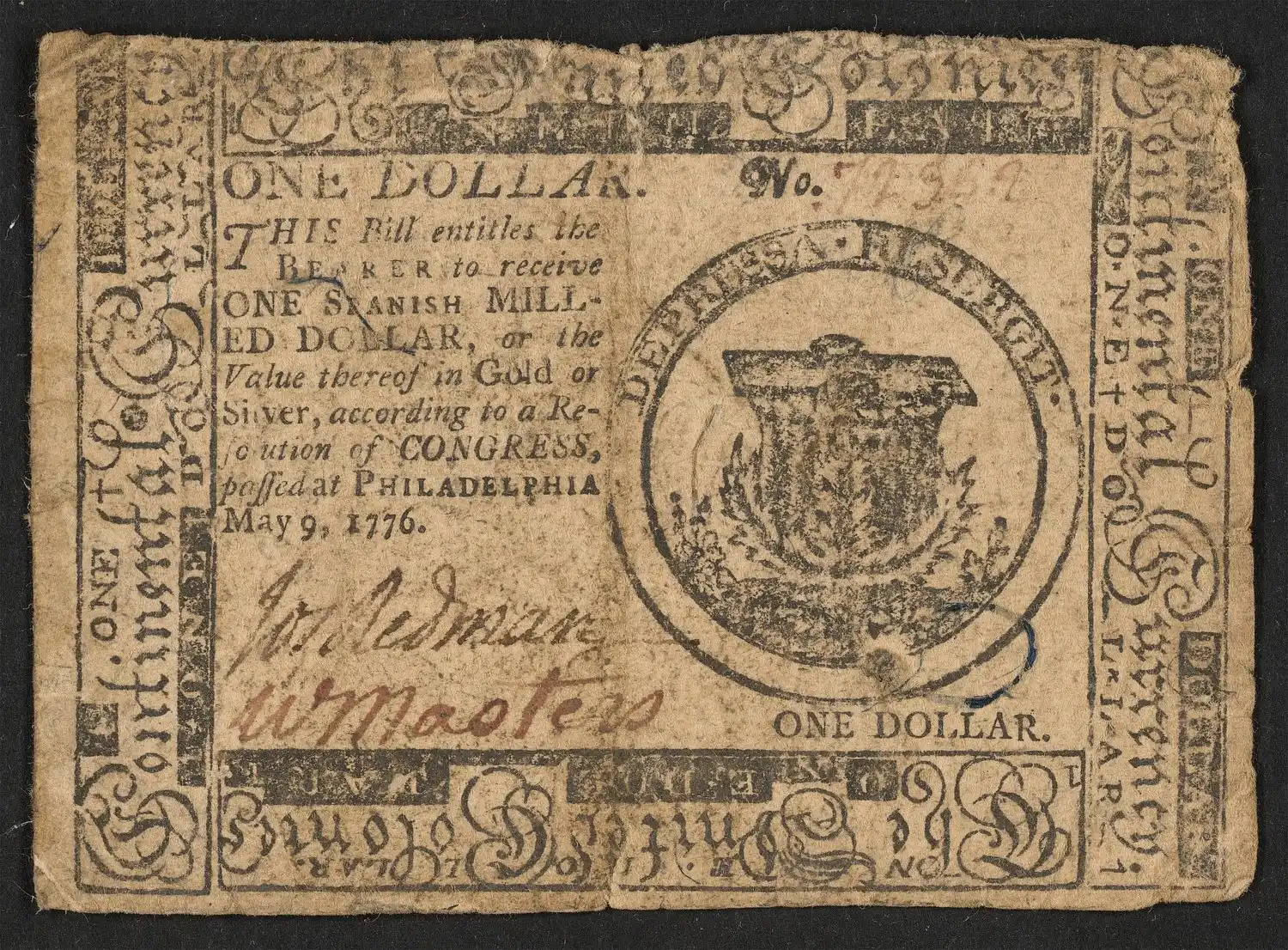
"The United Colonies, 1 dollar, 1776, recto" by David Hall and William Sellers — https://commons.wikimedia.org/wiki/File:Recto_The_United_Colonies_1_dollar_1776_urn-3_HBS.Baker.AC_1083818.jpeg — Public domain (David Hall (1714–1772) and William Sellers (1725–1804) per the file page, note dated 1776. United States: published before 1931. European Union: both authors dead more than 70 years; faithful reproduction of a two-dimensional work.); Baker Library, Harvard Business School, American Currency Collection, MH:VIA W363108_urn-3:HBS.Baker.AC:1083818; modified: scaled to 1500 px on the long side; no other changeRead the face first. The printed promise says the bearer may receive one Spanish milled dollar, or its value in gold or silver, under a resolution of Congress passed at Philadelphia on May 9, 1776. The emblem, in the record’s words, is a basket weighted by a slab on a leafy plant, inside a ring reading DEPRESSA RESURGIT.
That gives the note the double date in a plain form. The text dates from the resolution, May 9, 1776, but the object can only be placed by the imprint on the back, which gives the year and no day. The sources read here don’t say what week this bill came off the press.
Credit line to copy
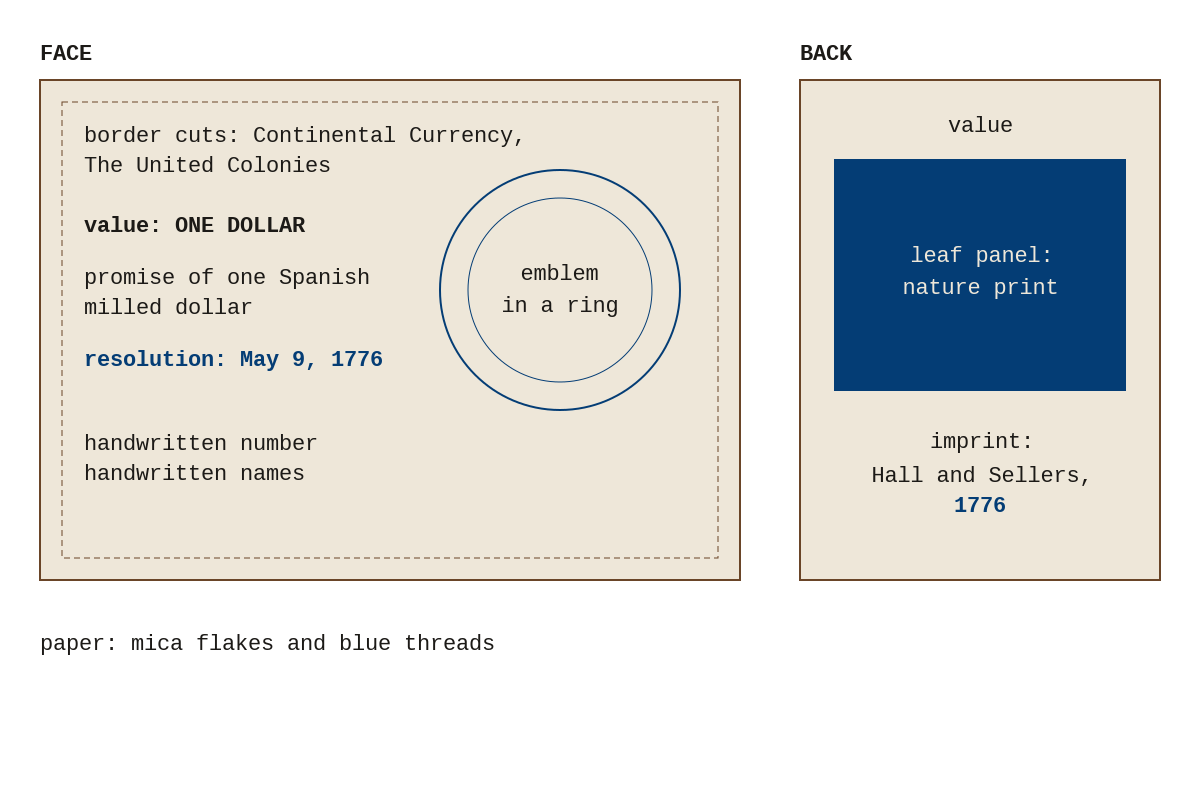
"Parts of the 1776 Continental One-Dollar Note" by Spine & Watermark, https://spineandwatermark.com/money/continental-currency/, licensed under CC BY 4.0 (https://creativecommons.org/licenses/by/4.0/).- Face: border cuts reading “Continental Currency” and “The United Colonies”, the value, the printed promise, the resolution date, the emblem, a handwritten number and handwritten names.
- Back: the value, the leaf panel, and “PHILADELPHIA: Printed by HALL and SELLERS. 1776.”
- Paper: mica flakes and blue threads, per the record.
How did a real leaf become a printing block?
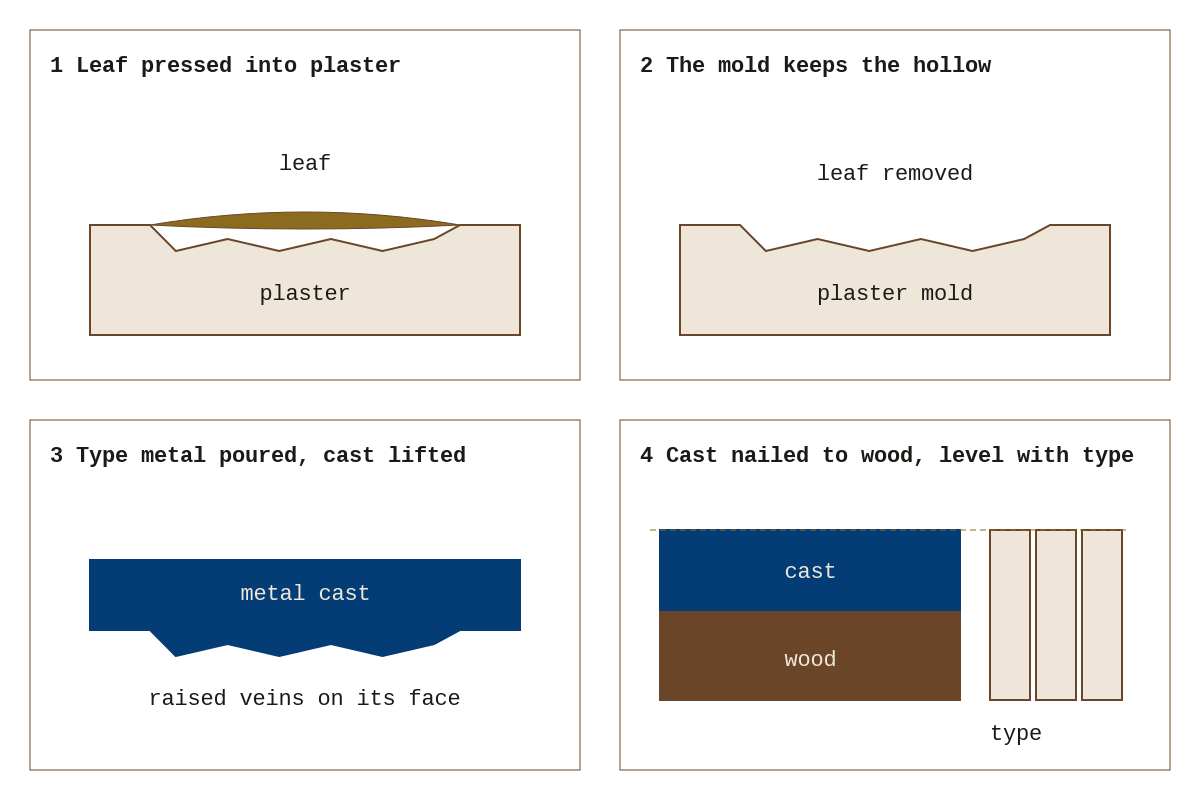
The Library of Congress calls the method double-casting, basing that on a surviving block and on work by James Green of the Library Company of Philadelphia. The steps below are history; the sources read here give no amounts or temperatures. They describe this order:
- Leaf into plaster. A leaf was pressed into plaster; one surviving block, matched below to Delaware money, shows sage, according to a New York Times report reprinted in The E-Sylum.
- The mold. The plaster retained the impression of the veins and stem after the leaf had been removed.
- The metal cast. Type metal, the alloy that printing type is cast from, was poured into the impression, and the cast came out with the leaf’s raised veins and texture.
- Brought to height. The cast was nailed to a piece of wood so that its printing surface stood at the same height as the surrounding type.
Credit line to copy
"From Leaf to Metal Block" by Spine & Watermark, https://spineandwatermark.com/money/continental-currency/, licensed under CC BY 4.0 (https://creativecommons.org/licenses/by/4.0/).For a long time this sequence was an educated guess. The Library of Congress says the method was kept so secret that many early scholars took the prints for hand-engravings, and the 2014 Library Company release says experts had inferred the plaster stage without any block to confirm it.
Because the veins stand up from the metal, this is relief printing, the family letterpress type belongs to, and not the inked grooves of intaglio. Think of the block as a die that the leaf itself helped make.
The leaf never touched the bill, and that separates this print from Anna Atkins’s cyanotypes. Her seaweed cast a shadow on treated paper. This leaf made a metal block, and the block carried the ink.
A 2014 Library Company release, printed by Fine Books & Collections, adds detail from three blocks found at the Delaware County Institute of Science. It says uneven surface heights let some low areas print gray, and that lines were cross-hatched into the metal once it had been cast. It matches the leaf block to currency that the province of Delaware issued in 1760, so that block isn’t Continental. No source read here reports a surviving block for a Continental note.
Did Franklin invent the leaf print?
The Library of Congress says so in plain words, calling the leaf “an anti-counterfeiting tactic invented by Benjamin Franklin.” A 2023 paper in PNAS by Manukyan and colleagues draws a finer line. It says he introduced the method in 1736 to 1739, using “the impression of a leaf” (p. 1). It also credits Leonardo da Vinci with first imprinting botanical forms, and calls Franklin’s invention a way to bring leaf structures into printing (p. 1).
This page sets the two accounts side by side without ruling between them, and the release gives its own span, placing leaf-printed money by Franklin and his successors between 1737 and 1785. One caution on the study’s picture of the pattern: its example is a Pennsylvania note of August 10, 1739 (Fig. 1, p. 2), not a Continental one.
Franklin’s name is not on the back of this note.
The Library of Congress says Franklin, Hall and Sellers printed money from the same shop, and that Hall went on with Sellers after Franklin left for abroad. PNAS makes Hall a partner in 1749 and has him carry on with Sellers from 1764. For the Continental issue of 1775, the study names a committee co-chaired by John Adams and Franklin, with Thomas Wilcox supplying paper and David Hall and William Sellers printing (p. 2).
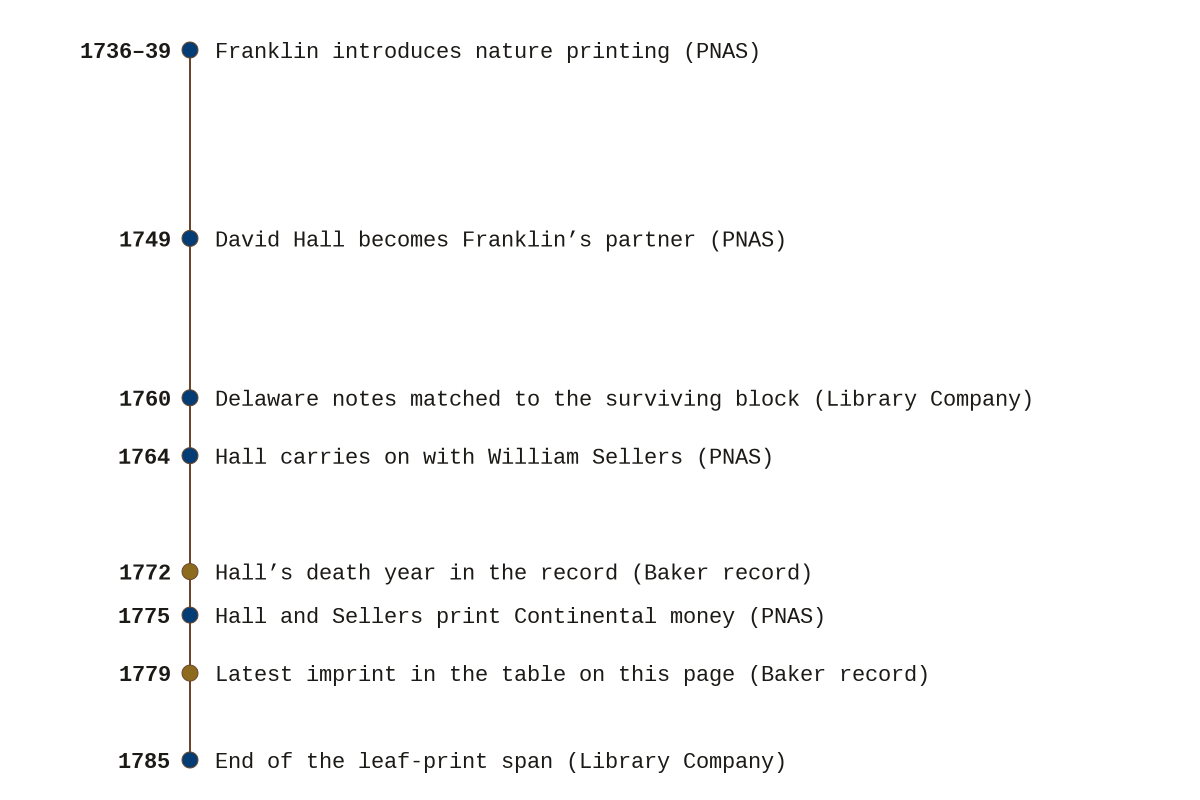
Credit line to copy
"Leaf Printing, Franklin, Hall and Sellers: Dates" by Spine & Watermark, https://spineandwatermark.com/money/continental-currency/, licensed under CC BY 4.0 (https://creativecommons.org/licenses/by/4.0/).| Year | Event | Source |
|---|---|---|
| 1736–39 | Franklin introduces nature printing | PNAS |
| 1749 | David Hall becomes Franklin’s partner | PNAS |
| 1760 | Delaware notes matched to the surviving block | Library Company |
| 1764 | Hall carries on with William Sellers | PNAS |
| 1772 | Hall’s death year in the record | Baker record |
| 1775 | Hall and Sellers print Continental money | PNAS |
| 1779 | Latest imprint in the table on this page | Baker record |
| 1785 | End of the leaf-print span | Library Company |
The Baker record gives David Hall’s dates as 1714–1772, which puts the 1776 imprint four years after his death year and the 1775 printing that PNAS credits to him three years after it. This page leaves both on the record. The imprint keeps his name, but it can’t tell you whose hands worked the press that year. The sources read here don’t say.
The Library Company release also judges that the leaf block it matched to 1760 Delaware money was almost certainly cast by Hall, not Franklin. So “Franklin’s leaf prints” means Franklin’s method, as those sources credit it, while the printers named on these notes are Hall and Sellers.
What did forgers have to beat?
This site reads a banknote with the forger in mind and holds a view you can argue with: the real designer of paper money was the forger. From the 18th century on, the leaves, border cuts and odd type on a note look like ornament, but they’re read here first as defenses. The view covers only notes long out of circulation. It won’t teach anyone to spot a fake.
Unlike a silver coin such as the Athenian owl tetradrachm, paper money had no worth of its own, as PNAS puts it (p. 1). The Library of Congress calls counterfeiting of these early bills rampant from the start, whether by adding a zero to the value or by copying the whole design on a press.
Franklin’s shop used other defenses on colonial bills too. The Library of Congress describes Pennsylvania notes with the colony’s name deliberately misspelled, and combinations of typefaces and printers’ symbols that only that shop possessed, though those examples are not Continental notes.
A leaf made a copy harder. According to the Library of Congress, the detail would have been very hard to reproduce by hand-engraving, and the block itself couldn’t be duplicated without the same leaf and the knowledge of how to make the plaster and the metal. PNAS calls the image “nearly impossible for counterfeiters to copy” (p. 1).
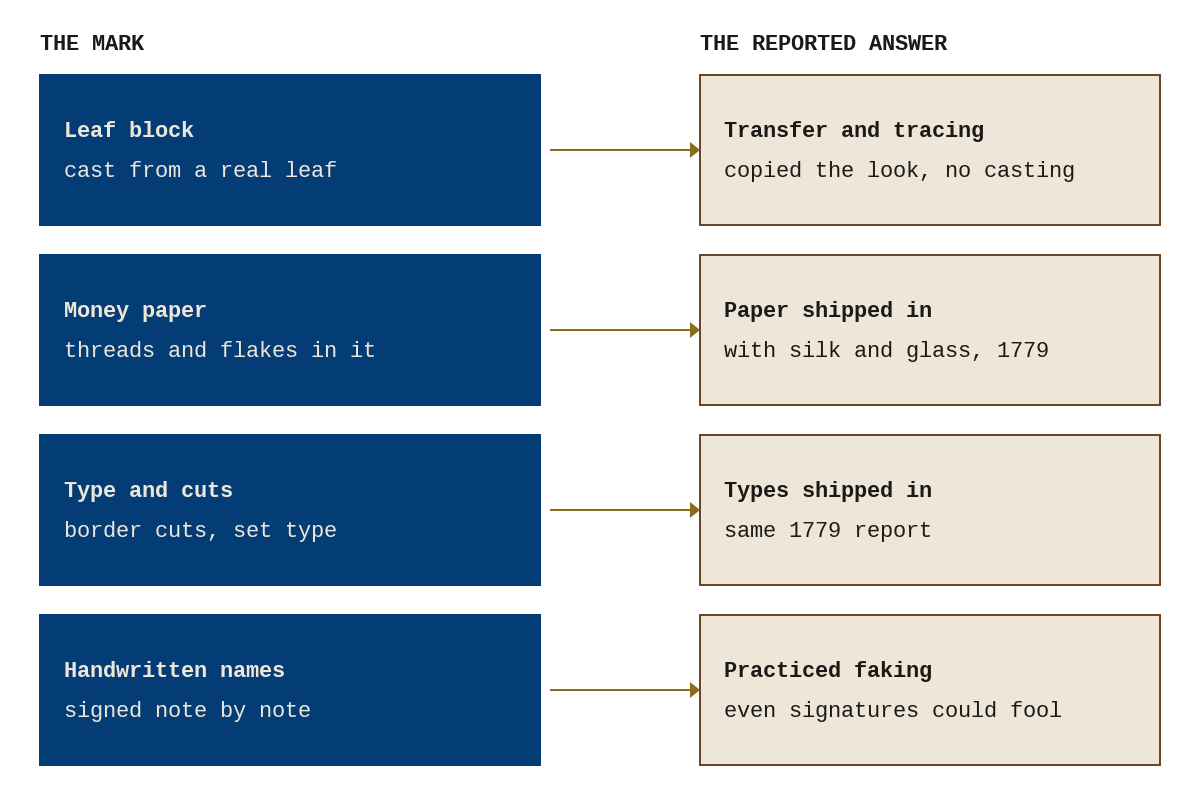
Credit line to copy
"Marks on the Notes and Reported Answers" by Spine & Watermark, https://spineandwatermark.com/money/continental-currency/, licensed under CC BY 4.0 (https://creativecommons.org/licenses/by/4.0/).| The mark | The reported answer | Who reports it |
|---|---|---|
| Leaf block, cast from a real leaf | Transfer and tracing copied the look without casting | Library of Congress |
| Money paper with threads and flakes | Paper “with silk and glass in it” aboard a British ship, 1779 | PNAS, p. 6, citing Commodore Samuel Nicholson |
| Border cuts and set type | Also aboard the same ship: “types” | PNAS, p. 6 |
| Handwritten names | Even signatures could be faked with practice | Library of Congress |
Each row has the same shape: a mark, then an answer to it. That’s the sense in which a forger helped design the note.
The first row also explains a tension between two Library of Congress pages. One calls the leaf images virtually inimitable, and another calls the notes easily counterfeited. Both can stand, on this page’s reading, because a hard-to-copy leaf doesn’t make a whole note hard to fake.
What was the paper doing?
The paper carried a second set of marks that a press alone couldn’t supply. PNAS reports that Franklin’s notes combined colored fibers with translucent muscovite filler, and the Baker Library record describes the 1776 dollar as containing mica flakes and blue threads. The study’s authors presume that the filler served more than one purpose, and they cite a counterfeit New Jersey bill of 1764 that contained none of it (pp. 5–6).
For the Continental issue, PNAS says the sheets came from Thomas Wilcox of the Ivy Mill, a former business partner of Franklin’s (p. 2). The study also notes that the fibers appear in Franklin’s money as early as 1739, long before the 1844 date traditionally given for adding colored thread to banknote paper (p. 5). On a note like the 1776 dollar, that places part of the security inside the sheet itself, before any ink arrived.
The notes lost value fast. The Library’s exhibit ties that to easy counterfeiting and no solid backing, PNAS ties it to British counterfeits (p. 2), and the slang “not worth a Continental” came out of that collapse.
Did every Continental note carry a leaf?
Not in the records read here: one Baker record lists two emblems on the back and names no leaf, and the Library of Congress says only “many” of its bills show one. The table lists seven notes chosen to show the range across three years and eight months, so it isn’t a count of any issue.
| Date on the note or caption | Imprint year | Value | Back of the note | Printer | Holder |
|---|---|---|---|---|---|
| May 10, 1775 (Congress session named) | 1775 | 8 dollars | nature print of three different leaves | Hall and Sellers | Baker Library |
| November 29, 1775 (caption date) | not stated | 8 dollars | nature print of henbit and two buttercups | Hall and Sellers | Library of Congress |
| May 9, 1776 (resolution) | 1776 | 1 dollar | nature print of three different leaves | Hall and Sellers | Baker Library |
| November 2, 1776 (resolution) | not stated | 30 dollars | two emblems; the record names no leaf | Hall and Sellers | Baker Library |
| February 26, 1777 (resolution) | 1777 | 2 dollars | nature print of three different leaves | Hall and Sellers | Baker Library |
| September 26, 1778 (resolution) | 1778 | 20 dollars | nature print of a single leaf | Hall and Sellers | Baker Library |
| January 14, 1779 (resolution) | 1779 | 80 dollars | nature print of a single leaf | Hall and Sellers | Baker Library |
Download the data (continental-note-issues.csv) · source and license notes
Read down the rows and the note keeps changing. The 1775 note cites resolutions of the Congress “held at Philadelphia, the 10th of May, 1775”, so the date in its wording marks the session, and a Library of Congress guide says Congress issued the bills on June 22, 1775.
The resolution on the 1777 note was passed at Baltimore, not Philadelphia, and its border cuts still read “The United Colonies”; on the 1778 note they read “The United States”. The 1779 record sees no mica flakes or blue threads. It lists a watermark and red and black ink instead.
PNAS says the security features were “prevalent in denominations above eight dollars” (p. 6), yet these rows list leaves on low values and, on a 30-dollar bill, emblems with no leaf named. Seven notes can’t test that claim, so both stay on the page.
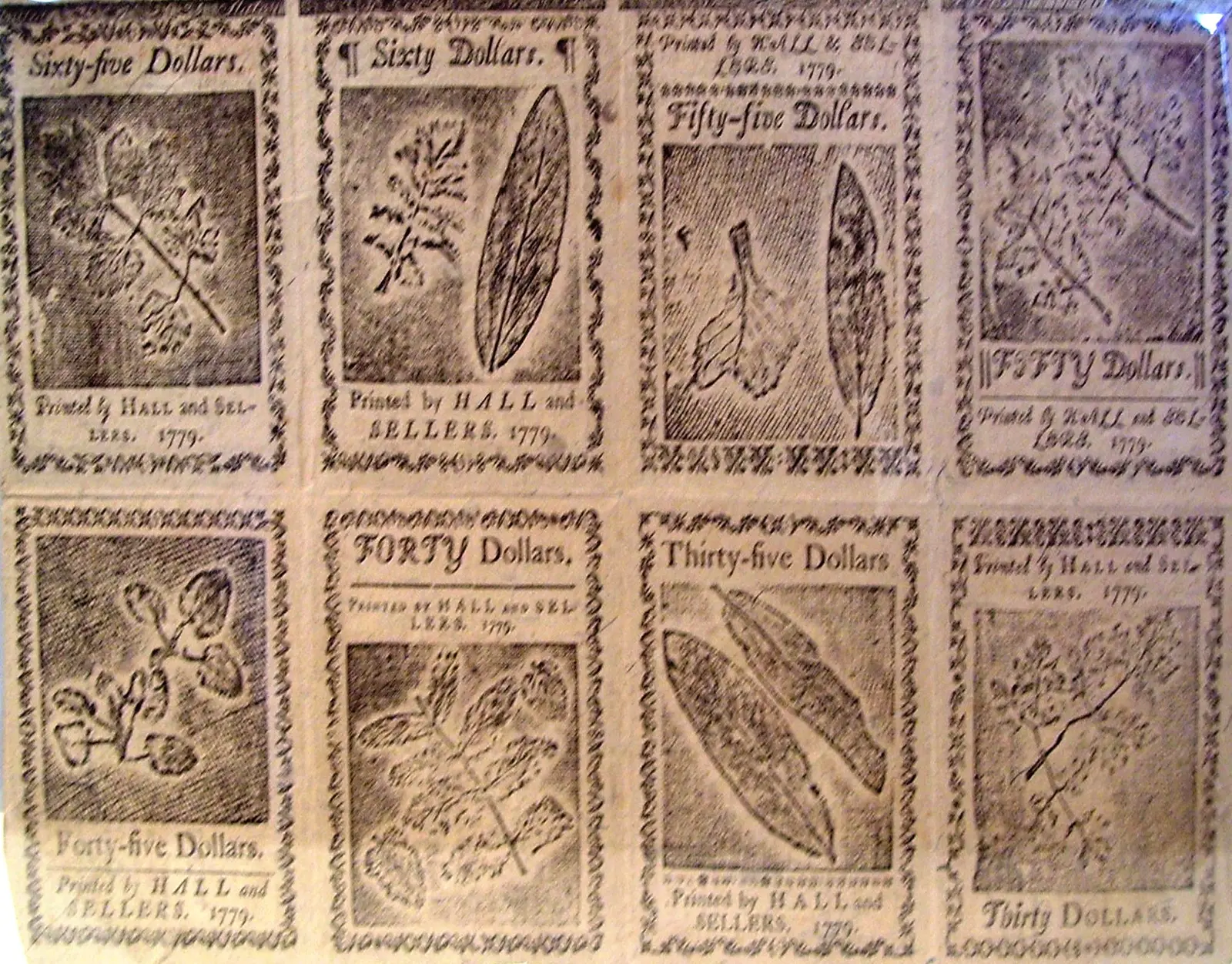

On this sheet you can do the counting the worn bill wouldn’t allow. Eight backs are in view, and the veins show clearly enough to follow. The records read here mostly don’t name the plants: one Library of Congress caption gives henbit and buttercups, and the Baker rows say only “leaves”. Which plant stood behind each block, and who cast the Continental ones, stays open on this page.
Turn it over:
The imprint at the foot of this back names Hall and Sellers. The piece still missing is a block: no surviving block for a Continental note turned up in the sources read here, and Notre Dame’s catalogue of these notes, named in the PNAS paper, couldn’t be reached.
- Maria Theresa Thaler: an 18th-century coin carrying another kind of mark: Its date stays put while the striking goes on.
- Hammered Coins: how metal money was made before machines: There the design came from two dies and a hammer, with no ink at all.
Sources
- Library of Congress, Inside Adams, “The Cost of Independence: Highlights from the Early American Paper Money Collection,” November 2019. blogs.loc.govRead: full page
- Khachatur Manukyan and colleagues, “Multiscale analysis of Benjamin Franklin’s innovations in American paper money,” PNAS 120, no. 30 (2023): e2301856120. https://doi.org/10.1073/pnas.2301856120 doi.orgRead: full article, public-access copy
- Library of Congress, Creating the United States, “Road to the Constitution.” wwws.loc.govRead: full page
- Library of Congress, Research Guides, “Early U.S. Banking History,” in Banking History: Central Banking and the Currency Question in the United States. guides.loc.govRead: full page
- Library Company of Philadelphia release, “Benjamin Franklin Printing Blocks Identified,” Fine Books & Collections, December 15, 2014. finebooksmagazine.comRead: full page
- The E-Sylum 17, no. 52 (December 21, 2014), article 14, reprinting part of a New York Times report on the block. coinbooks.orgRead: full page; New York Times original not read
- Baker Library, Harvard Business School, American Currency Collection, The United Colonies, 1 dollar, 1776, MH:VIA W363108_urn-3:HBS.Baker.AC:1083818 and 1083819. commons.wikimedia.orgRead: catalogue record data on the Commons file page
- Baker Library, Harvard Business School, American Currency Collection, The United Colonies, 8 dollars, 1775, MH:VIA W362987_urn-3:HBS.Baker.AC:1083714. commons.wikimedia.orgRead: catalogue record data on the Commons file page
- Baker Library, Harvard Business School, American Currency Collection, The United Colonies, 30 dollars, 1776, MH:VIA W363073_urn-3:HBS.Baker.AC:1083796. commons.wikimedia.orgRead: catalogue record data on the Commons file page
- Baker Library, Harvard Business School, American Currency Collection, The United Colonies, 2 dollars, 1777, MH:VIA W363366_urn-3:HBS.Baker.AC:1085931. commons.wikimedia.orgRead: catalogue record data on the Commons file page
- Baker Library, Harvard Business School, American Currency Collection, The United States, 20 dollars, 1778, MH:VIA W363454_urn-3:HBS.Baker.AC:1085961. commons.wikimedia.orgRead: catalogue record data on the Commons file page
- Baker Library, Harvard Business School, American Currency Collection, The United States, 80 dollars, 1779, MH:VIA W363585_urn-3:HBS.Baker.AC:1085989. commons.wikimedia.orgRead: catalogue record data on the Commons file page
- “Benjamin Franklin nature printed currency sheet 1779,” Wikimedia Commons file page, photograph credited there to “Beyond My Ken.” commons.wikimedia.orgRead: file page only; uploader’s description, no holding record
- James N. Green, in Annual Report of the Library Company of Philadelphia for 2013, pp. 25–28, as cited by the Library of Congress. blogs.loc.govRead: bibliography only
- Eric P. Newman, The Early Paper Money of America, 5th ed., Krause Publications, 2008, as cited in PNAS 2023. doi.orgRead: bibliography only


Image credits
- "The United Colonies, 1 dollar, 1776, verso" by David Hall and William Sellers — https://commons.wikimedia.org/wiki/File:Verso_The_United_Colonies_1_dollar_1776_urn-3_HBS.Baker.AC_1083819.jpeg — Public domain (David Hall (1714–1772) and William Sellers (1725–1804) per the file page, note dated 1776. United States: published before 1931. European Union: both authors dead more than 70 years; faithful reproduction of a two-dimensional work.); Baker Library, Harvard Business School, American Currency Collection, MH:VIA W363108_urn-3:HBS.Baker.AC:1083819; modified: scaled to 1500 px on the long side; no other change
- "The United Colonies, 1 dollar, 1776, recto" by David Hall and William Sellers — https://commons.wikimedia.org/wiki/File:Recto_The_United_Colonies_1_dollar_1776_urn-3_HBS.Baker.AC_1083818.jpeg — Public domain (David Hall (1714–1772) and William Sellers (1725–1804) per the file page, note dated 1776. United States: published before 1931. European Union: both authors dead more than 70 years; faithful reproduction of a two-dimensional work.); Baker Library, Harvard Business School, American Currency Collection, MH:VIA W363108_urn-3:HBS.Baker.AC:1083818; modified: scaled to 1500 px on the long side; no other change
- "Parts of the 1776 Continental One-Dollar Note" by Spine & Watermark, https://spineandwatermark.com/money/continental-currency/, licensed under CC BY 4.0 (https://creativecommons.org/licenses/by/4.0/).
- "From Leaf to Metal Block" by Spine & Watermark, https://spineandwatermark.com/money/continental-currency/, licensed under CC BY 4.0 (https://creativecommons.org/licenses/by/4.0/).
- "Leaf Printing, Franklin, Hall and Sellers: Dates" by Spine & Watermark, https://spineandwatermark.com/money/continental-currency/, licensed under CC BY 4.0 (https://creativecommons.org/licenses/by/4.0/).
- "Marks on the Notes and Reported Answers" by Spine & Watermark, https://spineandwatermark.com/money/continental-currency/, licensed under CC BY 4.0 (https://creativecommons.org/licenses/by/4.0/).
- "Benjamin Franklin nature printed currency sheet 1779" by Beyond My Ken — https://commons.wikimedia.org/wiki/File:Benjamin_Franklin_nature_printed_currency_sheet_1779.jpg — CC BY-SA 3.0 (https://creativecommons.org/licenses/by-sa/3.0/); no institution recorded
Cite this page
Spine & Watermark. “Continental Currency: Some Notes Carry a Leaf on the Back.” Spine & Watermark, published November 7, 2026. https://spineandwatermark.com/money/continental-currency/. Accessed [date].
How sources are ranked · All corrections · Contact · Report an error (contact@spineandwatermark.com)