Hammered Coins: In England, How Did Two Dies Make One Coin?
Published · Revised
TL;DR: In medieval England, a hammered coin was struck between a lower die fixed in a wood block, the pile, and a hand-held upper die, the trussel. The trussel took the hammer and wore out faster. Dies were made at about two trussels to one pile on average, per the Royal Mint Museum, up to the 1660s.
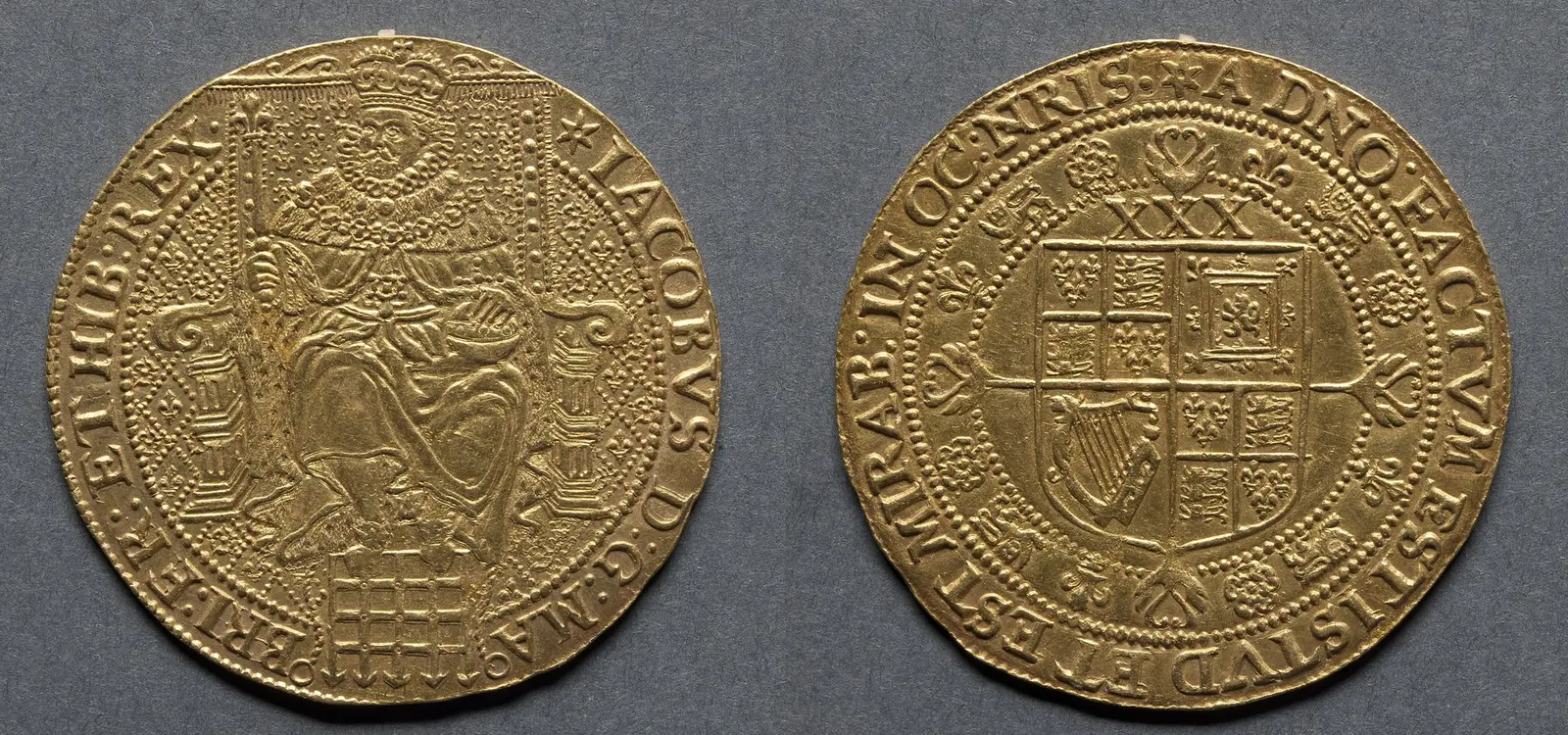
Look for the spot where the design runs off the edge of the coin. This gold rose ryal of James I barely has one, and the Cleveland Museum of Art calls it an excellent example of the fine designs produced on hand-struck hammered coins. The bent and torn silver coins farther down this page look very different.
This page explains how hammered coins were struck in England and why one half of the striking tool wore out before the other, and it gives no prices and no grading.
What does one English penny record say?
For a silver coin with a readable record, turn to a penny at the Rijksmuseum, accession KOG-MP-1-2744, which is on loan from the Koninklijk Oudheidkundig Genootschap. The museum dates it 1279–1377, under Edward I, II or III, and it names London as the place of production and striking as the technique. The coin measures 2 centimeters across and weighs 1.38 grams.
Collation: Struck silver: record names striking, not the hammer · 2 cm (0.79 in.) diameter; 1.38 g (0.05 oz) · image/text unknown: the record gives no separate design date / object 1279–1377, London · Rijksmuseum, KOG-MP-1-2744, on loan from the Koninklijk Oudheidkundig Genootschap
Collation card, all fields
- Object
- Penny, Edward I, II or III, England data.rijksmuseum.nl
- Type
- coin data.rijksmuseum.nl
- Process
- Struck silver: record names striking, not the hammer data.rijksmuseum.nl
- Format & size
- 2 cm (0.79 in.) diameter; 1.38 g (0.05 oz) data.rijksmuseum.nl
- Material
- silver data.rijksmuseum.nl
- Made
- image/text unknown: the record gives no separate design date / object 1279–1377, London data.rijksmuseum.nl
- Held at
- Rijksmuseum, KOG-MP-1-2744, on loan from the Koninklijk Oudheidkundig Genootschap, data.rijksmuseum.nl data.rijksmuseum.nl
- Date basis
- Holding record: Rijksmuseum gives 1279–1377, while its title gives 1272-1377; no second catalogue read dates this coin data.rijksmuseum.nl
The word hammer does not appear in that record. It comes from the histories published by the Royal Mint and its museum, which describe English coins up to the 1660s, a span that takes in this penny’s date. The Royal Mint also places its operation within the Tower of London by around 1279, the year that opens the museum’s date range, although neither record connects the two. The museum’s image of the coin is linked from its record but could not be fetched for this page.
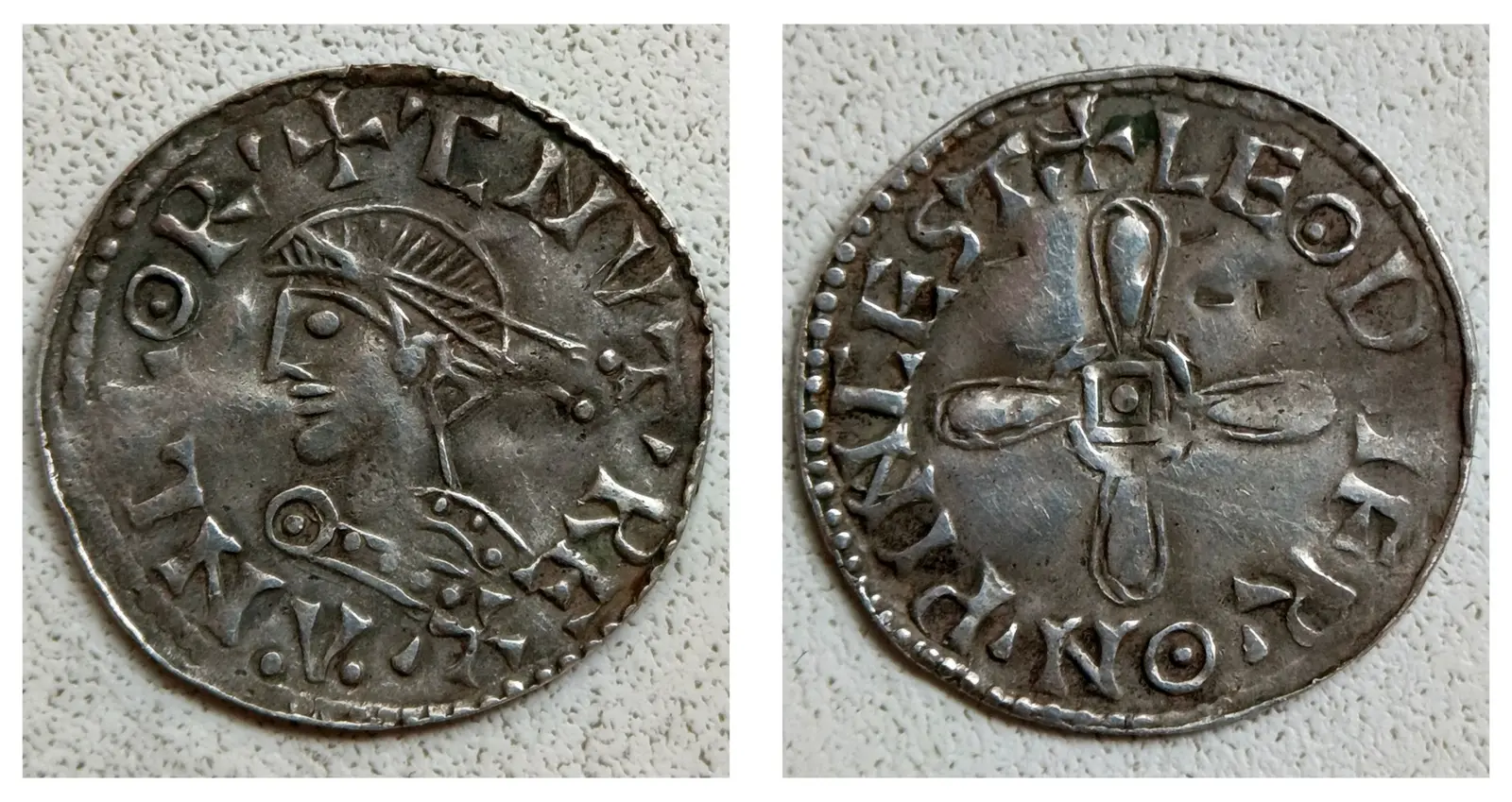

This older penny shows the general look of an English silver coin, with a bust on one face and a cross on the other. Its file description gives Winchester as the mint, Leodmer as the moneyer, a weight of 0.85 grams and a diameter of 18 millimeters. No museum stands behind those details, so read them as the uploader’s account rather than as a catalogue entry.
How was the blank made before the strike?
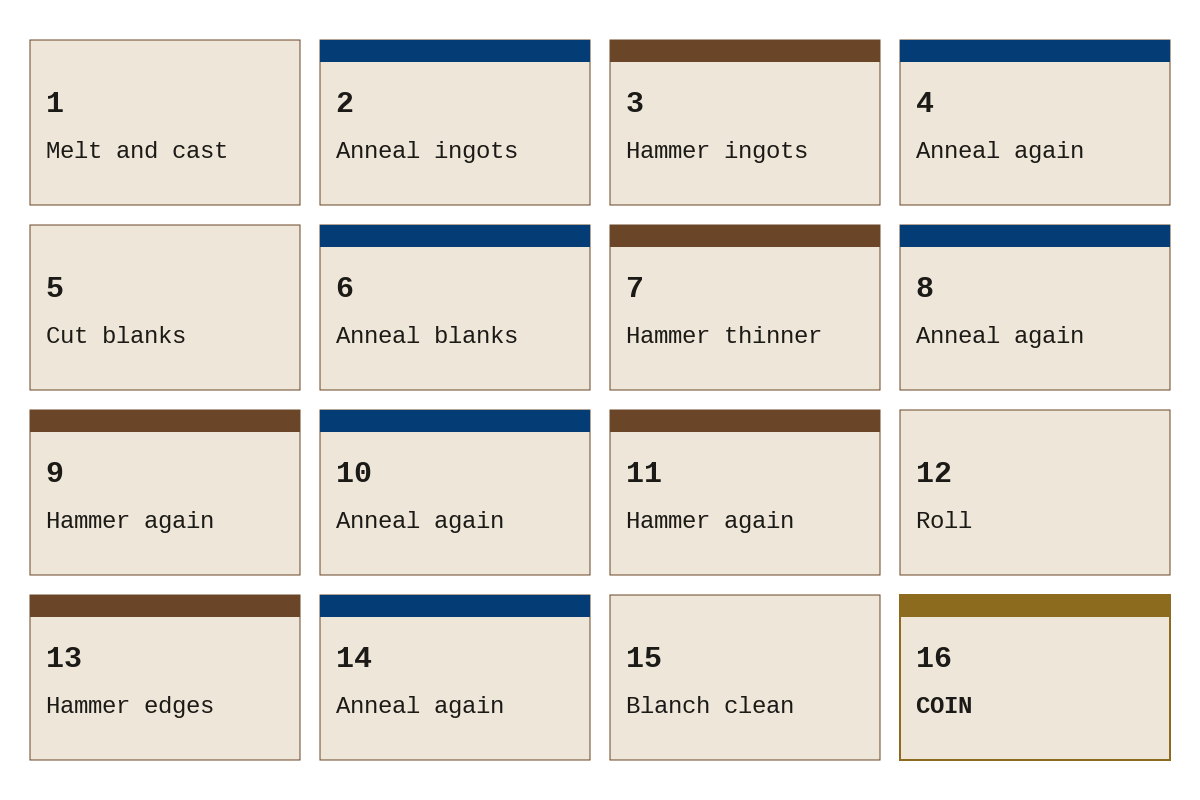
Written accounts of the process are scarce, according to the Royal Mint Museum, but it summarizes a document of 1606 that lists 16 stages before and including the strike. That date is late for a medieval story, so the list records one moment in the history of the process and can’t speak for every earlier century. Shortened, the sequence ran like this:
- The metal was melted and cast into ingots.
- The ingots were annealed, which means heat-treated to soften the metal, then hammered and annealed again.
- The ingots were cut into blanks, and the blanks were annealed.
- The blanks were hammered thinner three times, with annealing between rounds.
- They were rolled, their edges were hammered to make them rounder, and they were annealed once more.
- The blanks were blanched to clean them.
- The coin was struck.
Credit line to copy
"Sixteen Stages in a 1606 Document" by Spine & Watermark, https://spineandwatermark.com/money/hammered-coins/, licensed under CC BY 4.0 (https://creativecommons.org/licenses/by/4.0/).Count the stages and the name starts to look odd, because five of the 16 hammer the metal, six anneal it, and only the last one makes a coin. Every hammering stage named in that list came before any die touched the metal, so the blank had already taken a long beating by the time the strike arrived.
This page explains the history of the work and gives no working instructions, so it should not be treated as a guide to heating or cleaning metal. Any treatment of an old coin is a job for a professional conservator, and the American Institute for Conservation is a starting point.
How did two dies and one hammer make a coin?
Each die carried an engraved design on its working face, and the Royal Mint Museum says even the royal portrait was built up from small chisel-like punches in simple shapes. Cutting a design into metal is also how intaglio printing plates begin, although a print needs ink and a coin needs only force.
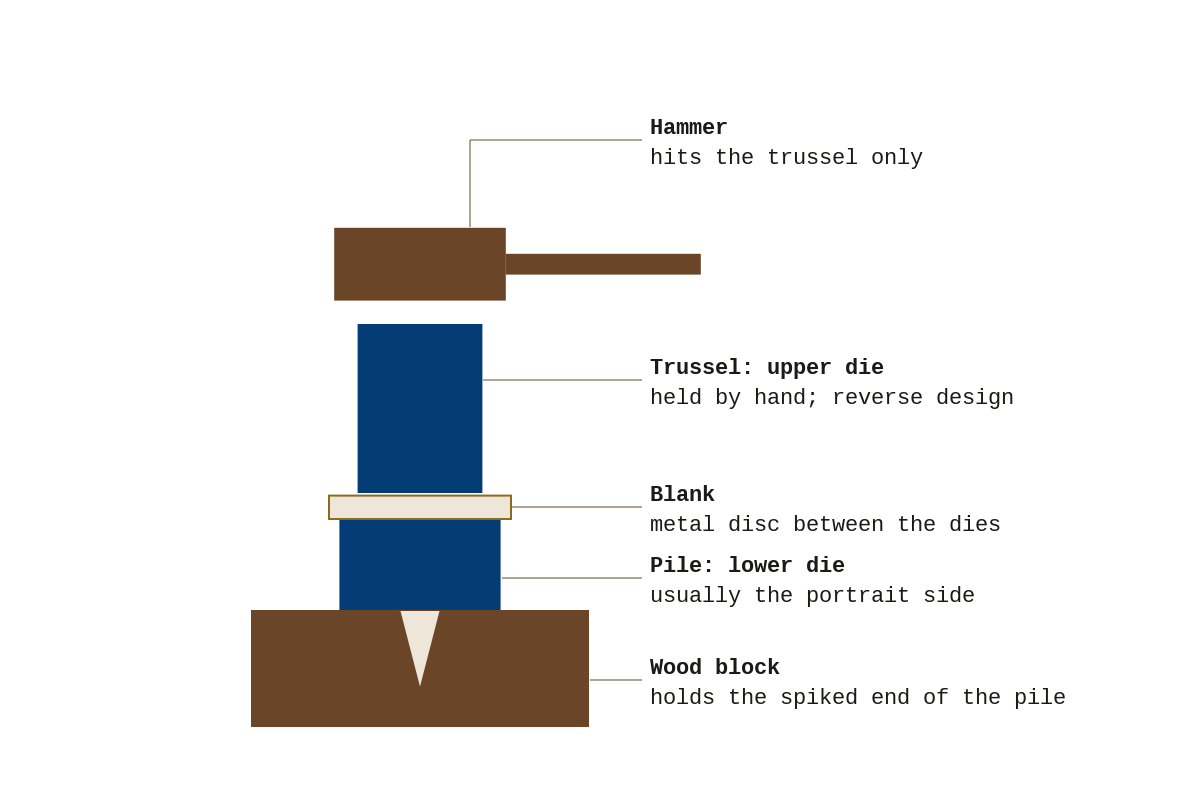
Think of the pair as two stamps facing each other, one fixed to a bench and one held in a fist. The pile, the lower die, had a spiked end that went into a wood block to keep it steady, and the trussel, the upper die, was held above the blank that rested on the pile.
Credit line to copy
"Pile and Trussel in Section" by Spine & Watermark, https://spineandwatermark.com/money/hammered-coins/, licensed under CC BY 4.0 (https://creativecommons.org/licenses/by/4.0/).The strike itself took four moves:
- The blank went on. The prepared blank was placed on top of the pile.
- The trussel was held. The upper die was held over the blank.
- The hammer fell. The hammer hit the trussel, and both dies pressed their designs into the blank.
- The coin came off. The die was lifted and the struck coin was removed.
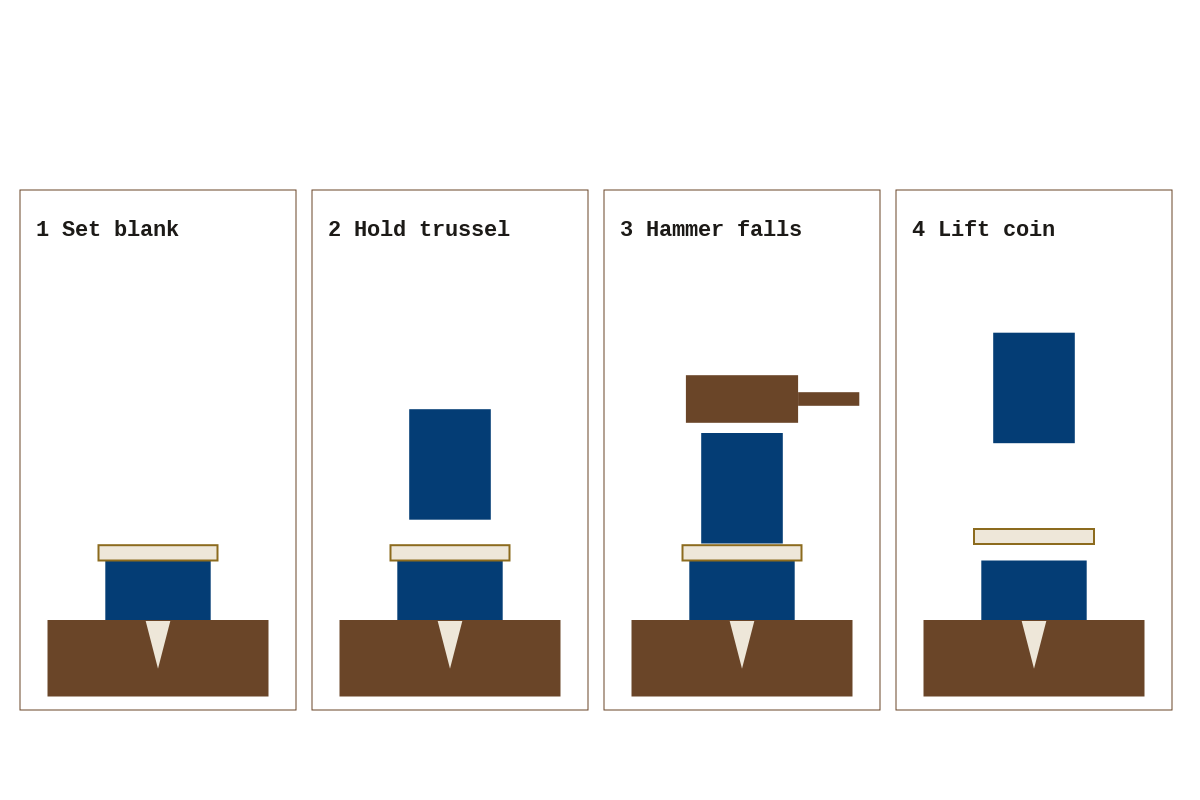
Credit line to copy
"Four Moves of a Strike" by Spine & Watermark, https://spineandwatermark.com/money/hammered-coins/, licensed under CC BY 4.0 (https://creativecommons.org/licenses/by/4.0/).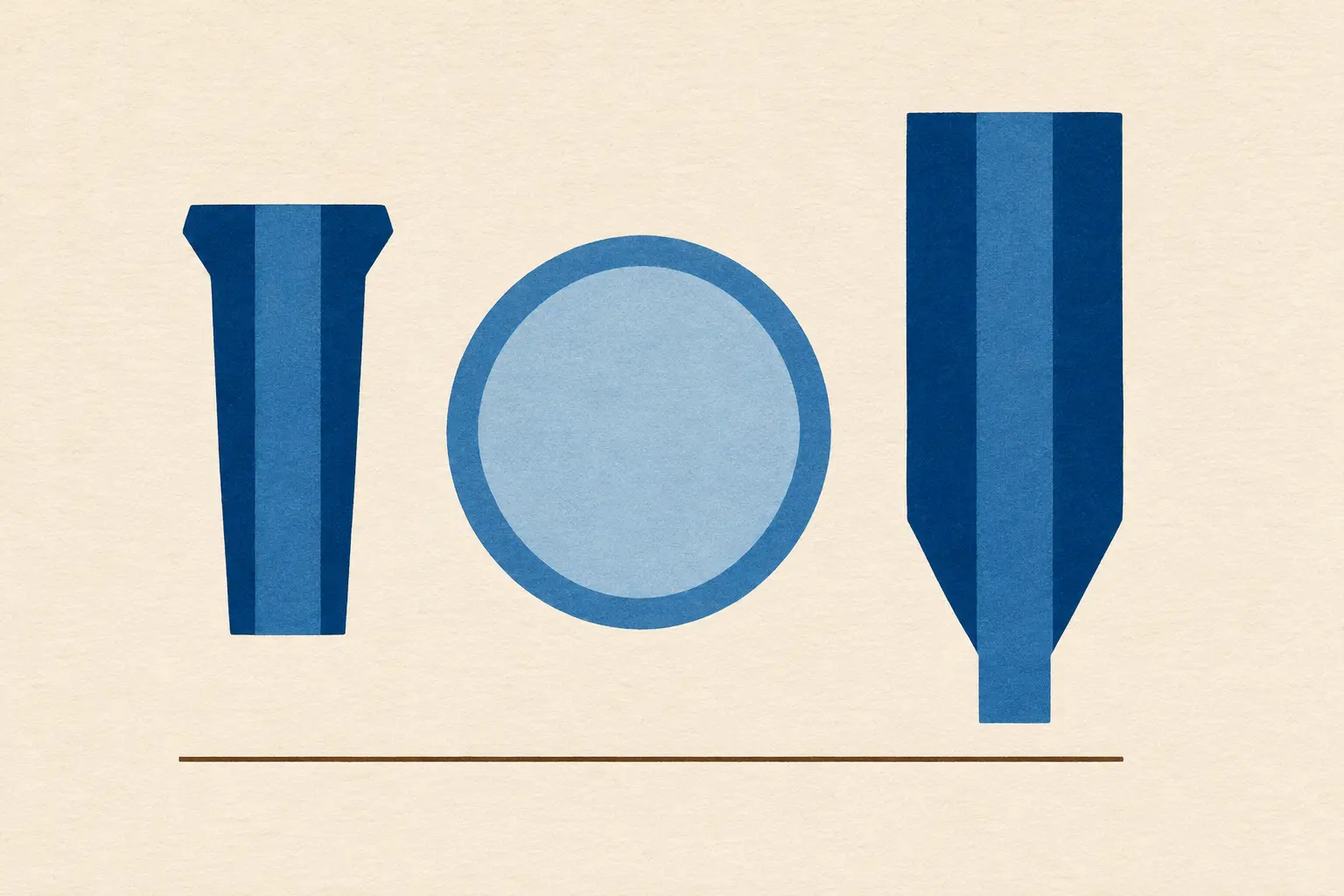 Illustration
Why did the upper die wear out faster?
The hammer never touched the pile.
The Royal Mint says that the trussel wore out faster from the hammer blows. The Royal Mint Museum makes the same point, tying the greater wear to the direct blows, and it puts production at about two trussels to one pile, on average. That rate is a museum’s summary for English coins up to the 1660s, and no mint account or die count behind it was read for this page. The English arrangement also shouldn’t be read as a rule for every coin struck anywhere.
The wear also shaped the design of the coin. Both accounts say the trussel carried the reverse because that side was easier to replace than a royal portrait, which normally appeared on the obverse. The museum then qualifies this: even the portrait may not have been so difficult to reproduce, given those punches.
Why aren't hammered coins round?
Roundness took work. The 1606 list has a stage for hammering the edges to make the blanks rounder, which suggests that a blank didn’t start out neat. The Cleveland Museum of Art describes what a later machine setup added in the 1630s: even pressure from a screw press, a blank from the rolling mill, and a collar to stop the metal flowing unevenly. Together they produced a neat round coin.
Hand striking could still go well. The rose ryal at the top of this page measures 4.3 centimeters across, and Cleveland’s record calls it hand-struck, so a tidy coin doesn’t rule out the hammer.
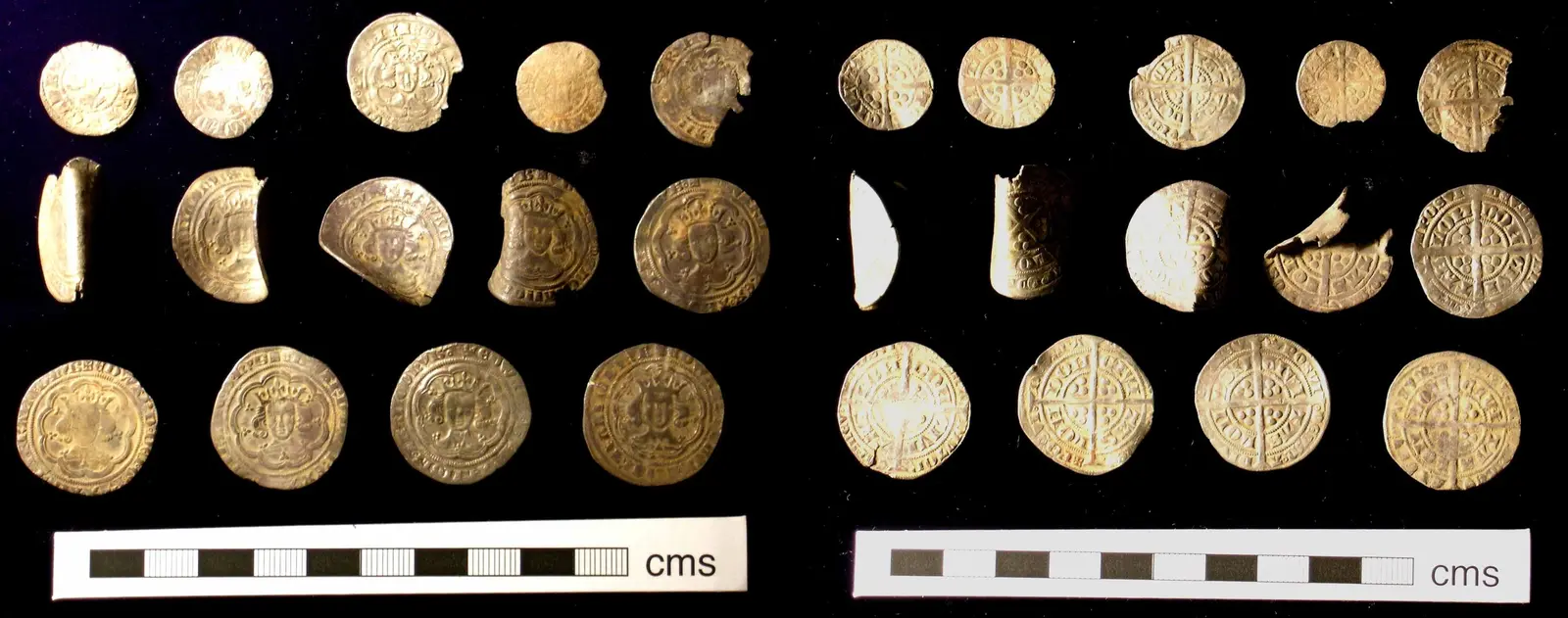

In this group of 14 silver coins, the beaded rings and lettering stop short at several rims, while some of the coins are folded or torn. The file for these photographs says medieval silver coins and little more, and the scheme’s own record could not be read for this page, so their type, date and striking method stay unconfirmed. They show what to look for, but this page doesn’t claim that these particular coins were hammered.
None of the sources read here explains, for any individual coin, a design that runs off the edge. The arrangement leaves room for it, since the blank was placed and the die was held by hand, and neither mint account describes a guide that kept the two aligned. That is this page’s inference, not a finding from either account.
The bends and tears in the Rogate photographs raise a separate question. A handling scar is a mark left by use rather than by making, and only a record or a study can say which marks qualify. No handling scar can be confirmed from the record here, so for those folds and tears: cause not established.
This page doesn’t price or authenticate coins, and it doesn’t say whether an off-center strike changes what a coin is worth; it reads an off-center design as a question about making, not as evidence about value.
How big was a hammered penny?
The Rijksmuseum’s open records give five comparable English silver pennies, each with its own diameter and weight. Only the first two fall inside the hammered period, because Cleveland says that all coins were produced by mill and screw press from 1662, and the last three are dated after that.
| Coin | Date per record | Diameter | Weight | Accession |
|---|---|---|---|---|
| Penny, Edward I, II or III | 1279–1377 | 20 mm (0.79 in.) | 1.38 g | KOG-MP-1-2744 |
| Penny, Edward I, II or III | 1279–1377 | 20 mm (0.79 in.) | 1.34 g | KOG-MP-1-2745 |
| Penny, William and Mary | 1693 | 13 mm (0.51 in.) | 0.57 g | KOG-MP-1-2765A |
| Penny, George II | 1737 | 13 mm (0.51 in.) | 0.48 g | KOG-MP-1-2788 |
| Penny, George III | 1772 | 13 mm (0.51 in.) | 0.48 g | KOG-MP-1-2797 |
Download the data (english-penny-sizes.csv) · source and license notes
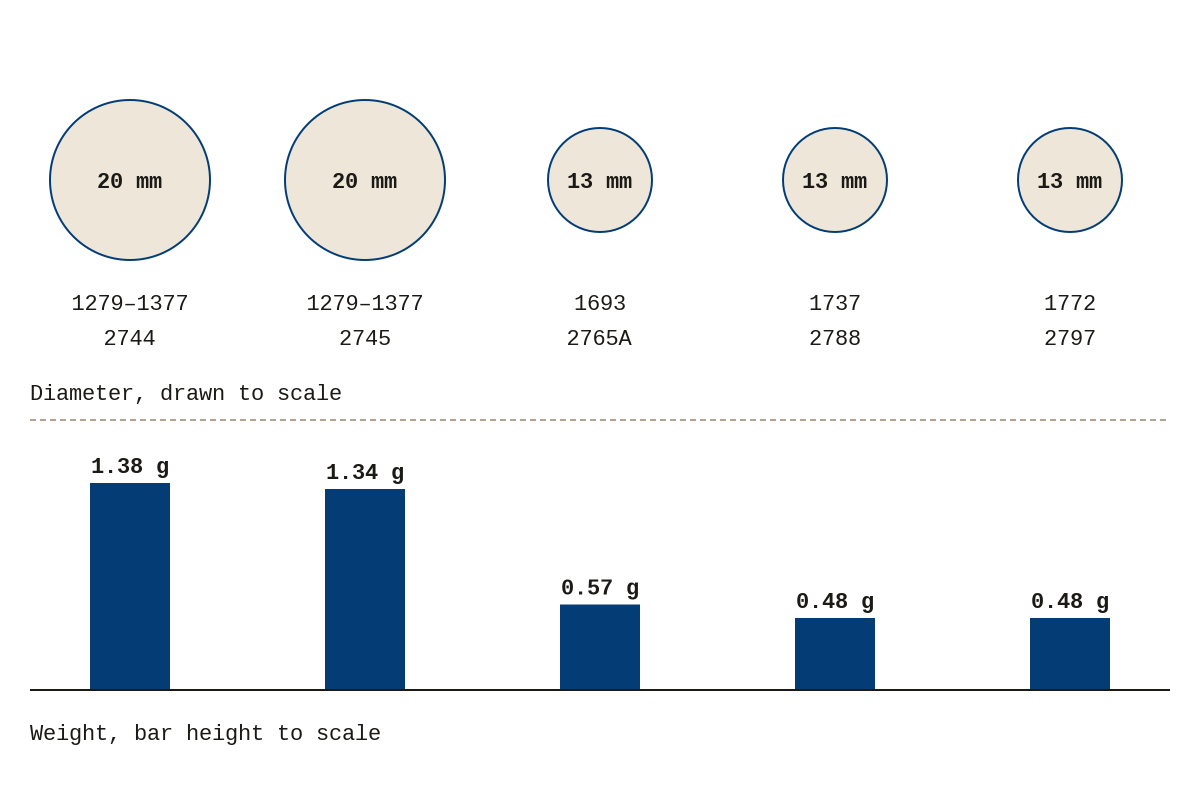
Credit line to copy
"Five English Silver Pennies" by Spine & Watermark, https://spineandwatermark.com/money/hammered-coins/, licensed under CC BY 4.0 (https://creativecommons.org/licenses/by/4.0/).The two medieval pennies average 1.36 grams, about 2.7 times the 0.51-gram average of the three later ones, and their 20-millimeter diameter is about 1.5 times the later 13. These records don’t say why, and five coins from one museum aren’t a series, so the gap doesn’t show that machines shrank the penny. Each date here comes from a single record, with no second catalogue read.
For a comparison within this site, Cleveland’s Athenian owl tetradrachm 1920.267 weighs 17.237 grams, about 12.5 times the first penny in the table.
What can a shared die show?
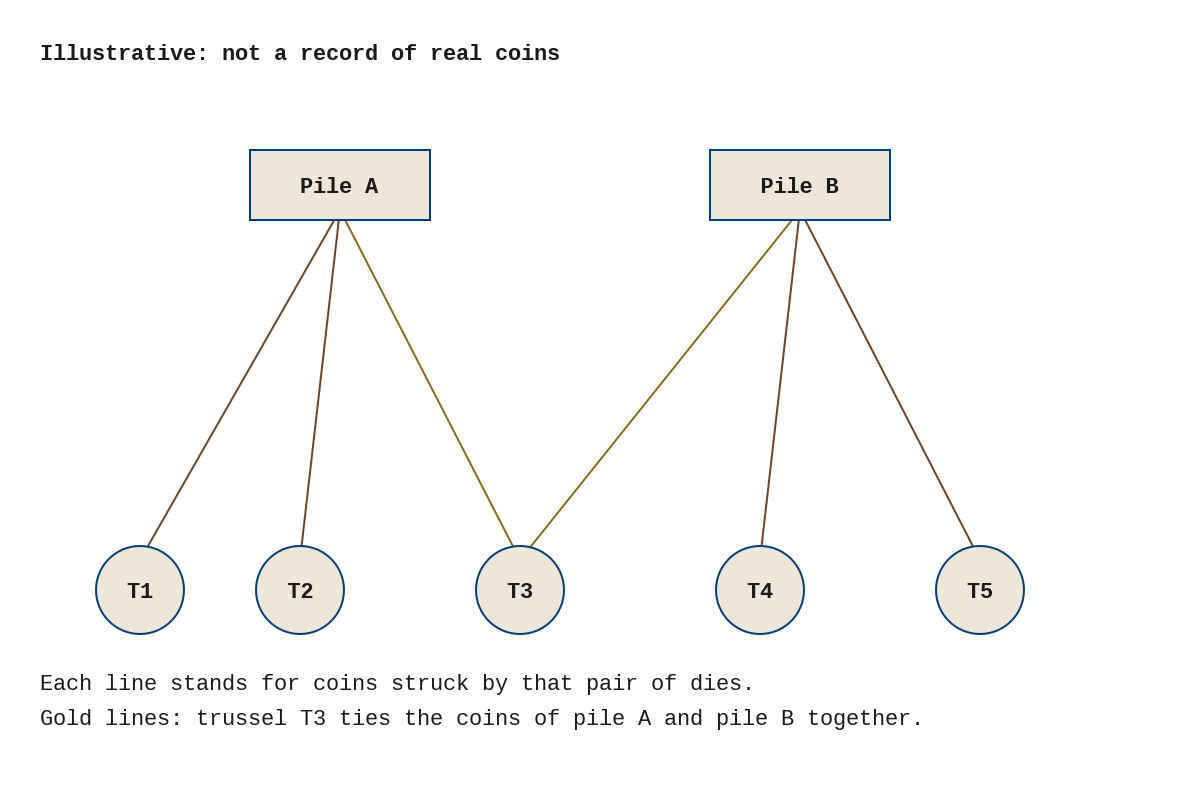
Map which coins share which die, and one shared die can tie two groups of coins together.
Credit line to copy
"Illustrative Shared Die" by Spine & Watermark, https://spineandwatermark.com/money/hammered-coins/, licensed under CC BY 4.0 (https://creativecommons.org/licenses/by/4.0/).A two-to-one rate would make that shape plausible, since one pile would on average outlast more than one trussel. That reasoning follows from the museum’s average, and this page read no die study of English pennies that tests it.
Cleveland’s English records show how much a single die can reveal: the museum notes that some early nobles of Richard II were struck from dies of Edward III. On an Elizabethan sovereign, accession 1969.181, it reads a crosslet mark as dating the die to 1560–61, with an A mark of 1583–85 stamped over it, which it takes as evidence that the die was reused.
A shared die ties two coins together, but on its own it doesn’t date them.
When did machines replace the hammer?
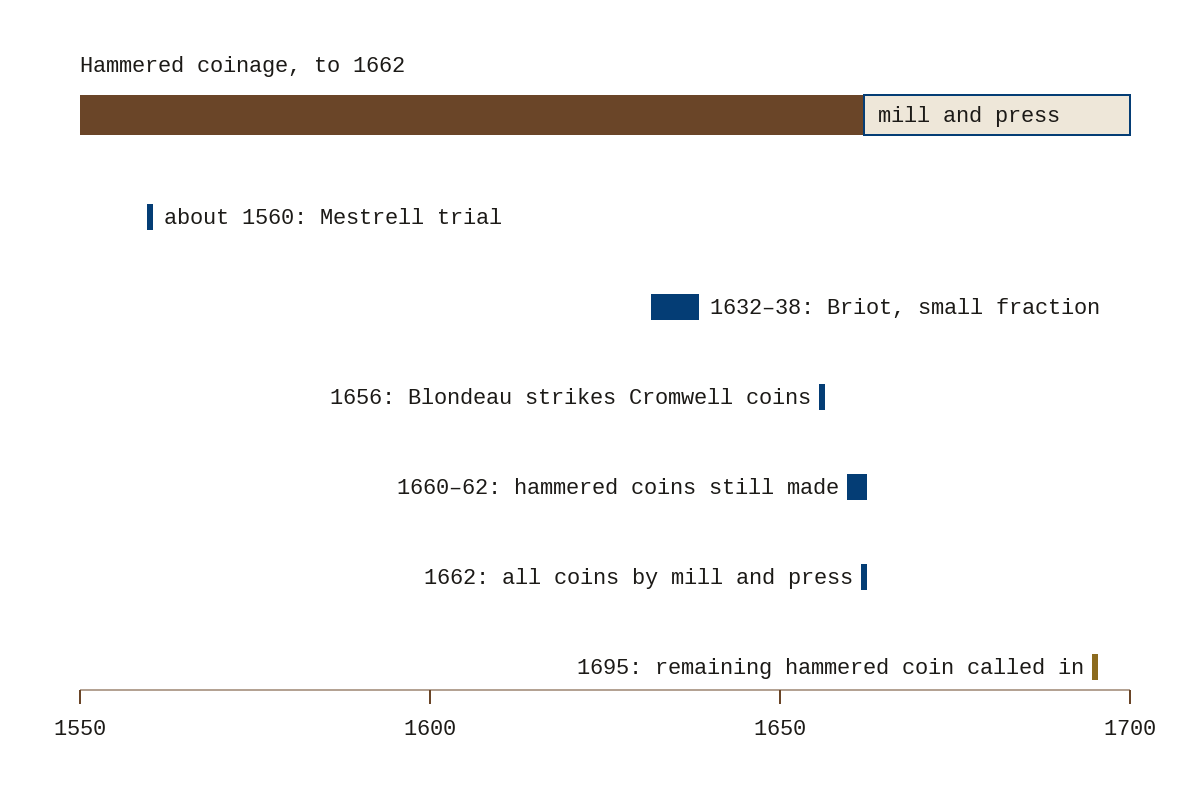
The Royal Mint Museum says that minting in England was finally mechanized in the early 1660s, and the Royal Mint gives the same period. Cleveland’s coin records add the earlier attempts and the long ending:
- About 1560: Eloye Mestrell brought a French screw press, and the workers objected. Cleveland says no more is heard of the press until Charles I.
- 1632–38: Nicholas Briot used a machine for only a small part of the gold and silver coinage, after a royal commission examined his results in 1631.
- 1656: Peter Blondeau used the mill and screw press for coins showing Cromwell, which were not put into circulation.
- 1660–62: The Mint went on making hammered coins during its reform.
- 1662: All coins from this year on were produced by mill and screw press.
- 1695: The government called in the remaining hammered pieces, since they were still circulating alongside mill coins.
Credit line to copy
"Hammer and Machine in England, 1550–1700" by Spine & Watermark, https://spineandwatermark.com/money/hammered-coins/, licensed under CC BY 4.0 (https://creativecommons.org/licenses/by/4.0/).So “up to the 1660s” needs a footnote, because machines had been tried a century earlier and old hammered coin stayed in circulation for about 33 years after the hammer stopped.
Cleveland gives one motive for the change: mill coins were more exactly shaped, and the larger ones were thick enough to carry an edge legend, which helped in the long fight against clippers, who shaved precious metal off coins for profit. On speed, the Royal Mint Museum says that a screw press could strike a blank every two seconds, though the workmen pulling its bar could not keep going for long. For money made with ink rather than dies, see the page on Continental Currency.
Much of this story still rests on institutional summaries. The accounts behind the two-to-one average were not read, the Rogate hoard’s own record stayed closed, and no die study of the Rijksmuseum pennies turned up in the sources available here.
Turn it over:
A shared die shows only that two coins met the same tool. This page read no study that uses shared dies to order English coins, and the mint accounts behind the two-to-one average remain unread here.
- Athenian Owl Tetradrachm: an older silver coin with its own open records: Its Cleveland record doesn’t state the striking method.
- Maria Theresa Thaler: a later coin whose date no longer tracks its striking: The date stays put while the striking goes on.
Sources
- Royal Mint Museum, "Making Money." royalmintmuseum.org.ukRead: full page
- The Royal Mint, "The Evolution of Coinage." royalmint.comRead: full page
- Rijksmuseum, KOG-MP-1-2744, penny of Edward I/II/III, on loan from the Koninklijk Oudheidkundig Genootschap. data.rijksmuseum.nlRead: catalogue record: museum open data
- Rijksmuseum, KOG-MP-1-2745, penny of Edward I/II/III, on loan from the Koninklijk Oudheidkundig Genootschap. data.rijksmuseum.nlRead: catalogue record: museum open data
- Rijksmuseum, KOG-MP-1-2765A, penny of William and Mary, 1693, on loan from the Koninklijk Oudheidkundig Genootschap. data.rijksmuseum.nlRead: catalogue record: museum open data
- Rijksmuseum, KOG-MP-1-2788, penny of George II, 1737, on loan from the Koninklijk Oudheidkundig Genootschap. data.rijksmuseum.nlRead: catalogue record: museum open data
- Rijksmuseum, KOG-MP-1-2797, penny of George III, 1772, on loan from the Koninklijk Oudheidkundig Genootschap. data.rijksmuseum.nlRead: catalogue record: museum open data
- Cleveland Museum of Art, 1969.190, "Rose Ryal: James I (obverse); Shield of Arms (reverse)." clevelandart.orgRead: full open-access record, including descriptionText license: CC0
- Cleveland Museum of Art, 1969.194, "Unite: Charles I (obverse); Crowned Shield (reverse)." clevelandart.orgRead: full open-access record, including descriptionText license: CC0
- Cleveland Museum of Art, 1969.187, "Half Pound: Elizabeth I (obverse); Crowned Shield of Arms (reverse)." clevelandart.orgRead: full open-access record, including descriptionText license: CC0
- Cleveland Museum of Art, 1969.197, "Broad: Oliver Cromwell Lord Protector (obverse); Crowned Shield of Arms (reverse)." clevelandart.orgRead: full open-access record, including descriptionText license: CC0
- Cleveland Museum of Art, 1969.198, "Broad: Charles II (obverse); Shields (reverse)." clevelandart.orgRead: full open-access record, including descriptionText license: CC0
- Cleveland Museum of Art, 1969.199, "Five Guineas: Charles II (obverse); Four Shields (reverse)." clevelandart.orgRead: full open-access record, including descriptionText license: CC0
- Cleveland Museum of Art, 1969.202, "Five Guineas: William III (obverse); Four Shields and Lion of Nassau (reverse)." clevelandart.orgRead: full open-access record, including descriptionText license: CC0
- Cleveland Museum of Art, 1969.162, "Noble: Richard II Standing on Ship with Shield of Arms (obverse); Ornamental Cross with Lis Terminals (reverse)." clevelandart.orgRead: full open-access record, including descriptionText license: CC0
- Cleveland Museum of Art, 1969.181, "Sovereign of Thirty Shillings: Elizabeth I (obverse); Shield of Arms on Tudor Rose (reverse)." clevelandart.orgRead: full open-access record, including descriptionText license: CC0
- Cleveland Museum of Art, 1920.267, "Tetradrachm: Head of Athena (obverse); Owl (reverse)," with 1920.267.a and 1920.267.b. clevelandart.orgRead: catalogue record: museum page and open-access data
- Martin Allen, Mints and Money in Medieval England, Cambridge University Press, 2012. doi.orgRead: bibliography only
- Portable Antiquities Scheme, obverse photograph of hoard 2002T296, Rogate, West Sussex, on Wikimedia Commons. commons.wikimedia.orgRead: file pages only; the scheme’s own record could not be read
- Portable Antiquities Scheme, reverse photograph of hoard 2002T296, Rogate, West Sussex, on Wikimedia Commons. commons.wikimedia.orgRead: file page only; the scheme’s own record could not be read
- DmVlKam, "Cnut (1016-1035), Silver Penny, Jewel Cross type, Posthumous issue (c. 1036-1038)," Wikimedia Commons. commons.wikimedia.orgRead: file page only; uploader’s description, no holding record

Image credits
- "Rose Ryal: James I (obverse); Shield of Arms (reverse)" by Unknown maker, England — https://www.clevelandart.org/art/1969.190 — CC0 1.0 (https://creativecommons.org/publicdomain/zero/1.0/); Cleveland Museum of Art, 1969.190; modified: scaled to 1000 px high; no other change
- "Cnut (1016-1035), Silver Penny, Jewel Cross type, Posthumous issue (c. 1036-1038)" by DmVlKam — https://commons.wikimedia.org/wiki/File:Cnut_(1016-1035),_Silver_Penny,_Jewel_Cross_type,_Posthumous_issue_(c._1036-1038).jpg — CC BY-SA 4.0 (https://creativecommons.org/licenses/by-sa/4.0/); no institution recorded; modified: scaled to 1000 px high; no other change
- "Sixteen Stages in a 1606 Document" by Spine & Watermark, https://spineandwatermark.com/money/hammered-coins/, licensed under CC BY 4.0 (https://creativecommons.org/licenses/by/4.0/).
- "Pile and Trussel in Section" by Spine & Watermark, https://spineandwatermark.com/money/hammered-coins/, licensed under CC BY 4.0 (https://creativecommons.org/licenses/by/4.0/).
- "Four Moves of a Strike" by Spine & Watermark, https://spineandwatermark.com/money/hammered-coins/, licensed under CC BY 4.0 (https://creativecommons.org/licenses/by/4.0/).
- Illustration: Spine & Watermark. Generated schematic illustration — not a photograph or historical record. © Spine & Watermark, all rights reserved; not licensed for reuse (see /image-use/).
- "Hoard of 14 medieval silver coins, obverse and reverse" by Portable Antiquities Scheme — https://commons.wikimedia.org/wiki/File:Hoard_of_14_Medieval_silver_coins_obverse.jpg — CC BY 2.0 (https://creativecommons.org/licenses/by/2.0/); Portable Antiquities Scheme, 2002T296; modified: obverse and reverse files placed side by side, obverse left, at equal height; no other change
- "Five English Silver Pennies" by Spine & Watermark, https://spineandwatermark.com/money/hammered-coins/, licensed under CC BY 4.0 (https://creativecommons.org/licenses/by/4.0/).
- "Illustrative Shared Die" by Spine & Watermark, https://spineandwatermark.com/money/hammered-coins/, licensed under CC BY 4.0 (https://creativecommons.org/licenses/by/4.0/).
- "Hammer and Machine in England, 1550–1700" by Spine & Watermark, https://spineandwatermark.com/money/hammered-coins/, licensed under CC BY 4.0 (https://creativecommons.org/licenses/by/4.0/).
Cite this page
Spine & Watermark. “Hammered Coins: In England, How Did Two Dies Make One Coin?.” Spine & Watermark, published November 7, 2026. https://spineandwatermark.com/money/hammered-coins/. Accessed [date].
How sources are ranked · All corrections · Contact · Report an error (contact@spineandwatermark.com)