Maria Theresa Thaler: The Coin That Kept Her Death Year
Published · Revised
TL;DR: The Maria Theresa thaler is a silver coin whose restrikes, later strikings of the design, bear the date 1780, the year the empress died. The Austrian Mint says re-striking has run continuously since 1857, and the Rijksmuseum dates one example 1780–1975. So 1780 belongs to the design; when a given coin was struck is a separate question.
Collation: Not named by Auckland; Rijksmuseum records striking for its own example of the type · 42.2 mm (1.66 in.) diameter; 2.3 mm (0.09 in.) thick; weight not given · image/text dated 1780 / object unknown: Auckland’s description gives no striking date · Auckland War Memorial Museum Tāmaki Paenga Hira, 2014.7.60 (catalogue page not readable, not traced back, 2026-11-07)
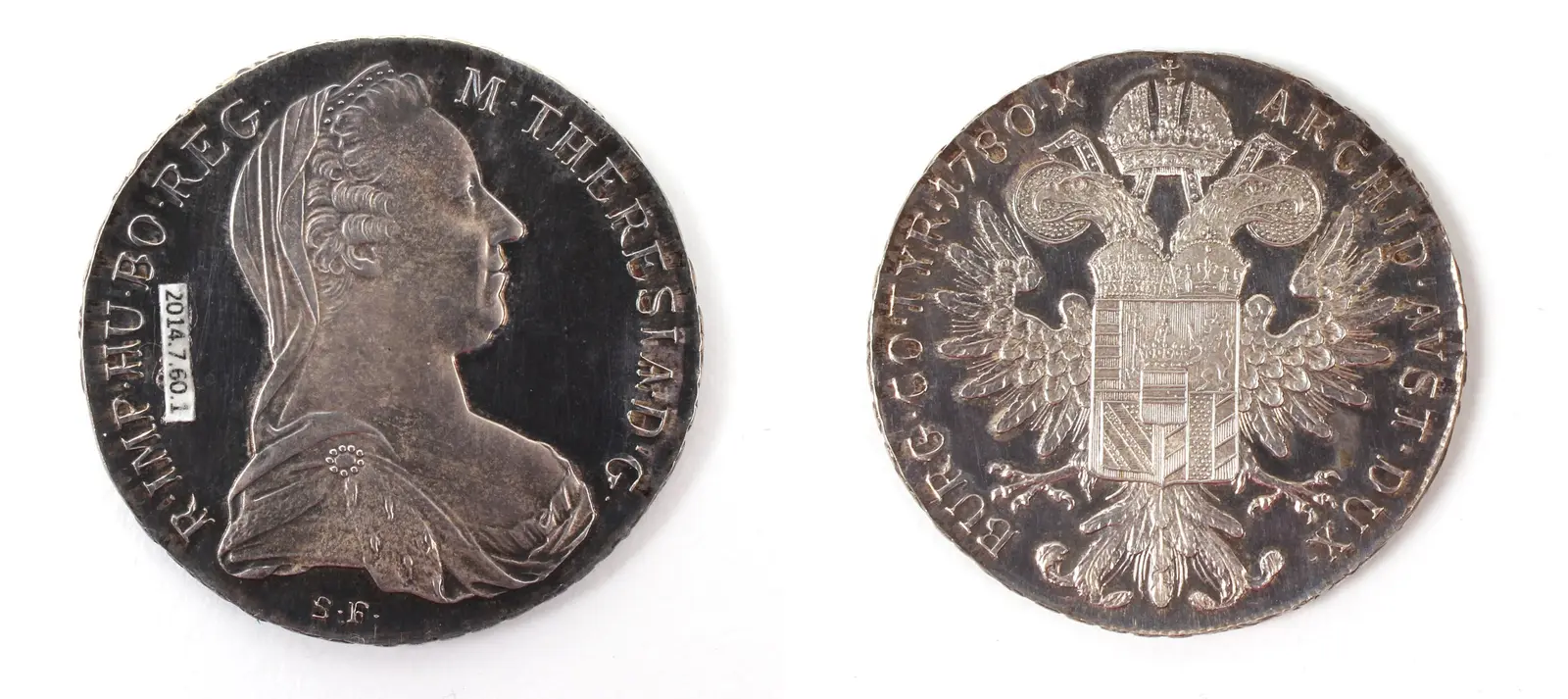
Full credit
"Maria Theresa thaler dated 1780, obverse and reverse" by Auckland Museum — https://commons.wikimedia.org/wiki/File:Coin,_award_(AM_2014.7.60-5).jpg — CC BY 4.0 (https://creativecommons.org/licenses/by/4.0/); Auckland War Memorial Museum, 2014.7.60; modified: obverse (AM 2014.7.60-5) and reverse (AM 2014.7.60-3) files placed side by side, obverse left, at equal height; accession label left in place; no other change
Collation card, all fields
- Object
- Austria Maria Theresa Thaler silver coin, dated 1780 commons.wikimedia.org
- Type
- coin commons.wikimedia.org
- Process
- Not named by Auckland; Rijksmuseum records striking for its own example of the type data.rijksmuseum.nl
- Format & size
- 42.2 mm (1.66 in.) diameter; 2.3 mm (0.09 in.) thick; weight not given commons.wikimedia.org
- Material
- silver commons.wikimedia.org
- Made
- image/text dated 1780 / object unknown: Auckland’s description gives no striking date commons.wikimedia.org
- Held at
- Auckland War Memorial Museum Tāmaki Paenga Hira, 2014.7.60 (catalogue page not readable, not traced back, 2026-11-07), aucklandmuseum.com commons.wikimedia.org
- Date basis
- Inscription: dated 1780, as Auckland’s description reads it; Holding record: Auckland’s description, by way of Wikimedia Commons, gives no striking date commons.wikimedia.org
Read the date on the coin, then ask when it was struck. This silver thaler measures 42.2 millimeters across, about twice the width of the 2-centimeter penny on the hammered coins page, and Auckland War Memorial Museum describes it as “Dated 1780.” That phrase tells you what the coin says. Does it tell you when this piece of metal was made?
This page follows that one question through a few records, and along the way it gives no prices and doesn’t judge whether any coin is genuine.
Why does the coin say 1780?
The Austrian Mint, which still makes the coin and spells it taler, says the first one was struck in 1741, so 1780 isn’t where the coin begins. The Mint connects the present design, with the empress in her later years, to 1780, the year she died, and says plainly that the restrikes bear that year.
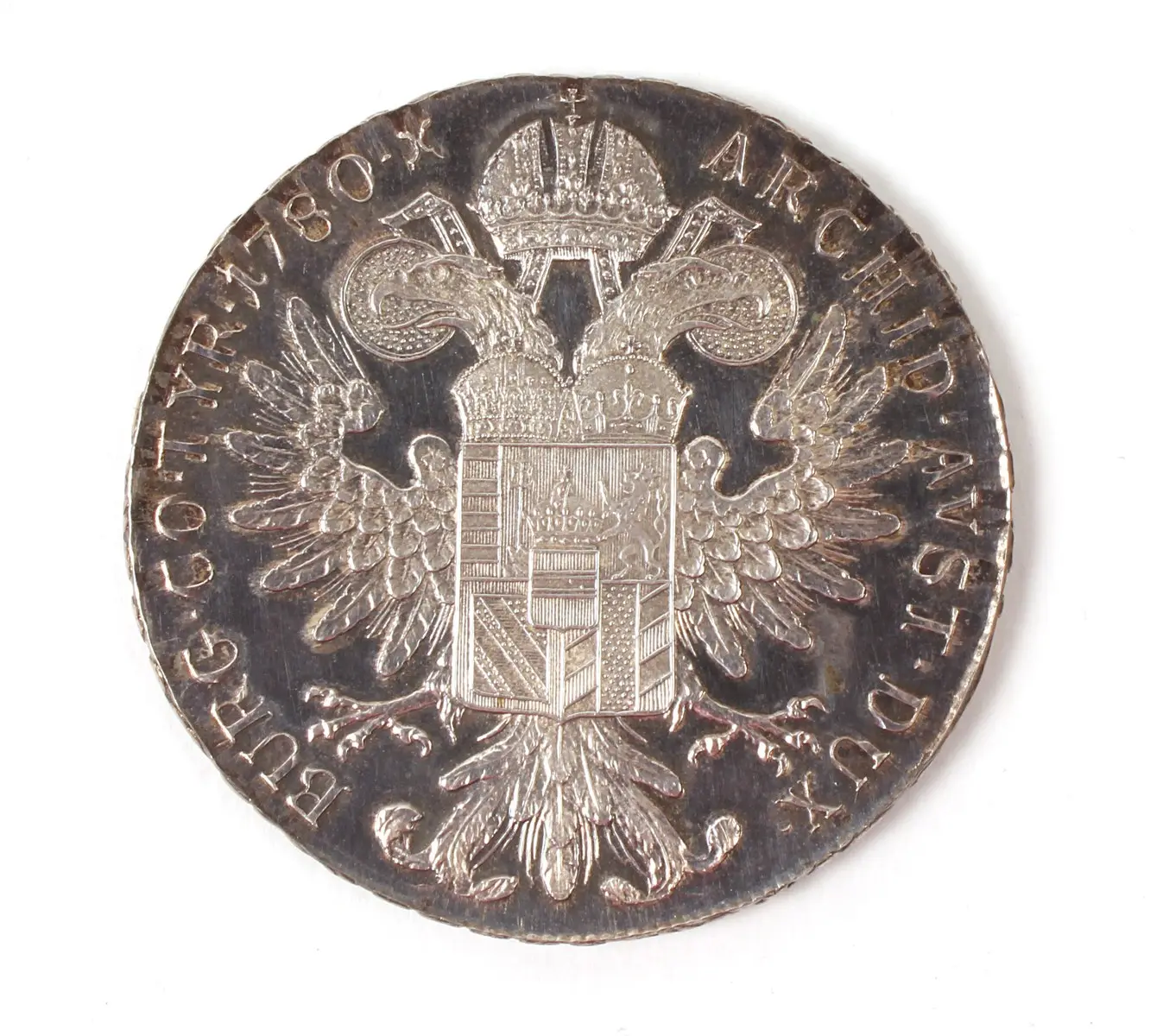

Look for the date on the reverse. The Rijksmuseum’s record of its own example, KOG-MP-1-5061A, puts it at the end of the lettering, followed by a cross of knotted sticks. That record calls 1780 a “frozen date” (bevroren jaartal, in a literal translation by Spine & Watermark).
An inscription records what the object says, which may not be when the object was made. A 2010 University of Exeter notice gives a reason for keeping this one: the coin’s popularity at her death. The Vienna Mint, it says, agreed to keep striking it for trade, still carrying 1780. The notice names no document for that agreement, and no other page read here gives a reason.
Made: how does the double date work on this coin?
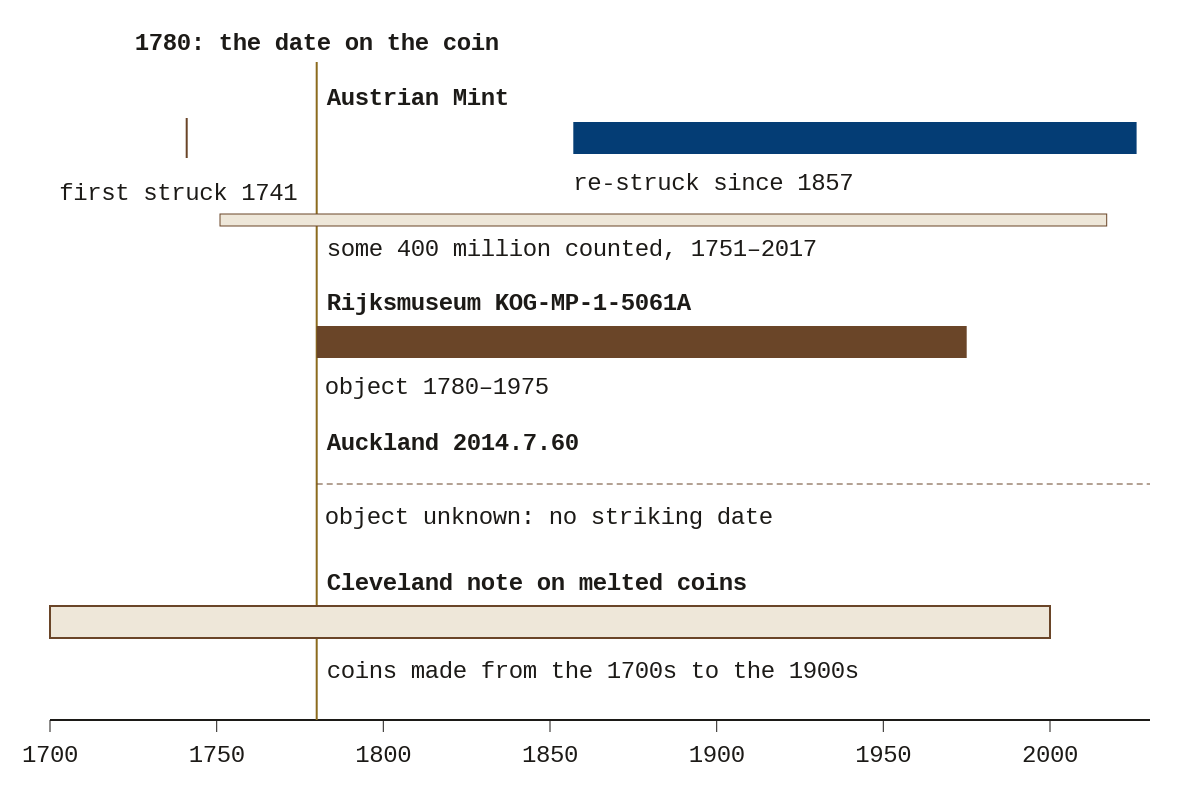
This site calls the split the double date: every document object has the date its content was created and the date the physical thing was made. A thaler pulls the two apart more plainly than most objects, because one date is on the coin and the other has to come from a record. Three records show how the pair gets written:
| Record | image/text | object | Basis |
|---|---|---|---|
| Auckland 2014.7.60 | dated 1780 | unknown | Museum description, by way of Commons; no striking date given |
| Rijksmuseum KOG-MP-1-5061A | frozen date 1780 | 1780–1975 | Museum record, which titles the coin a restrike |
| Austrian Mint, current coin | restrikes bear 1780 | re-struck continuously since 1857 | The Mint’s own pages, for the type and not for one coin |
Credit line to copy
"The Date on the Coin and the Date of the Object" by Spine & Watermark, https://spineandwatermark.com/money/maria-theresa-thaler/, licensed under CC BY 4.0 (https://creativecommons.org/licenses/by/4.0/).The Rijksmuseum row shows the full pattern. Its title translates as a restrike of a Maria Theresa thaler with the date 1780, intended for north-east Africa, and its production date runs 1780–1975, a span of 195 years. The design side has one year. The object side has a window, and the record doesn’t narrow it.
Auckland’s row is where the method stops. Its description gives the date on the coin and no year of striking, so the card writes unknown, because an exact year is never made up to complete the pair. If the two dates matched, the card would say same. The split also shows up in photographs, where a carte de visite can carry an image date and a mount date.
These two museums hold two different coins, so treat the comparison with care. Their records agree on what the type says, but neither can check the other’s striking date. For the Auckland coin itself this is a single record, and its catalogue page could not be read for this page.
The year on the metal and the year of the metal are two separate claims.
When were they actually struck?
No single year answers this for the type, and the three windows below don’t measure the same thing. The Mint says the coin has been re-struck continuously since 1857, and puts the total minted worldwide between 1751 and 2017 at some 400 million; the Exeter notice also says over 400 million. The Rijksmuseum gives its one coin 1780–1975. Cleveland’s note on Ethiopian silver speaks of thalers made from the 1700s to the 1900s.
This page doesn’t choose among them, although the distances are worth noting: the Mint’s 2017 falls 237 years after the date on the coin, and the Rijksmuseum’s 1975 falls 195 years after it.
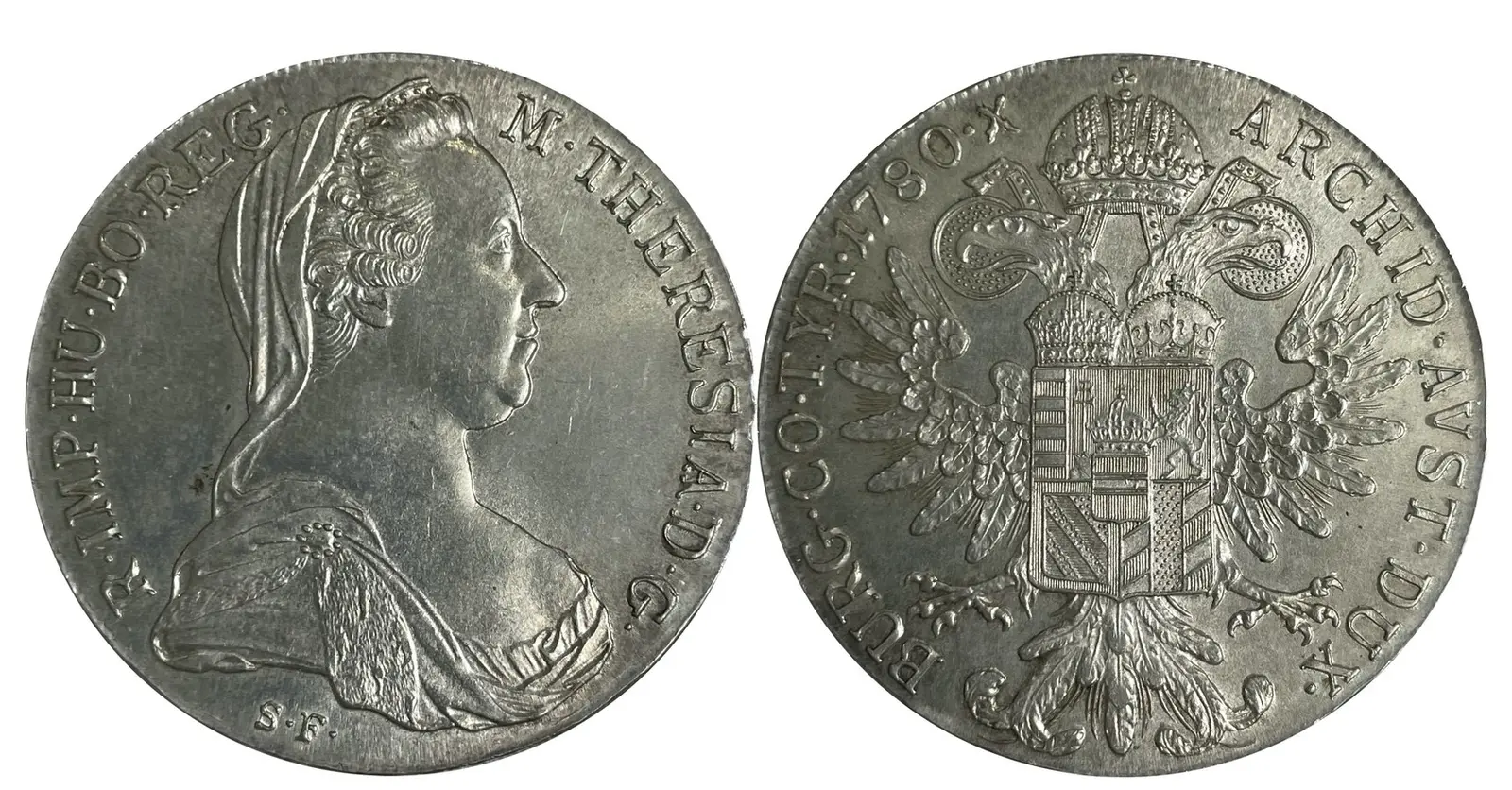

Set a third coin beside the first two. This file’s title also says 1780, and its one other date, April 2021, belongs to the upload. No museum stands behind it. So it shows the type and tells you nothing about when this example was struck.
Place is just as slippery, since the Rijksmuseum reads the letters S and F under the bust as marks of mint masters at Günzburg, in Austrian territory near Ulm, and then says these restrikes were mostly struck in Vienna. That is one catalogue’s statement. A 2006 review in The Guardian of Clara Semple’s book A Silver Legend, reprinted in The E-Sylum, goes wider, saying coins with this date could have come from Birmingham in the 1950s, or earlier from Brussels, London, Paris, Bombay, Rome or Vienna. That is a reviewer’s summary of a book not read here, so the Auckland card leaves the place out.
The date won’t tell one striking from another. Go to the record instead and see whether it says restrike, as the Rijksmuseum’s does and Auckland’s description doesn’t. This page offers no test beyond that, because its subject is what records say and it doesn’t authenticate coins.
How much silver is in a Maria Theresa thaler?
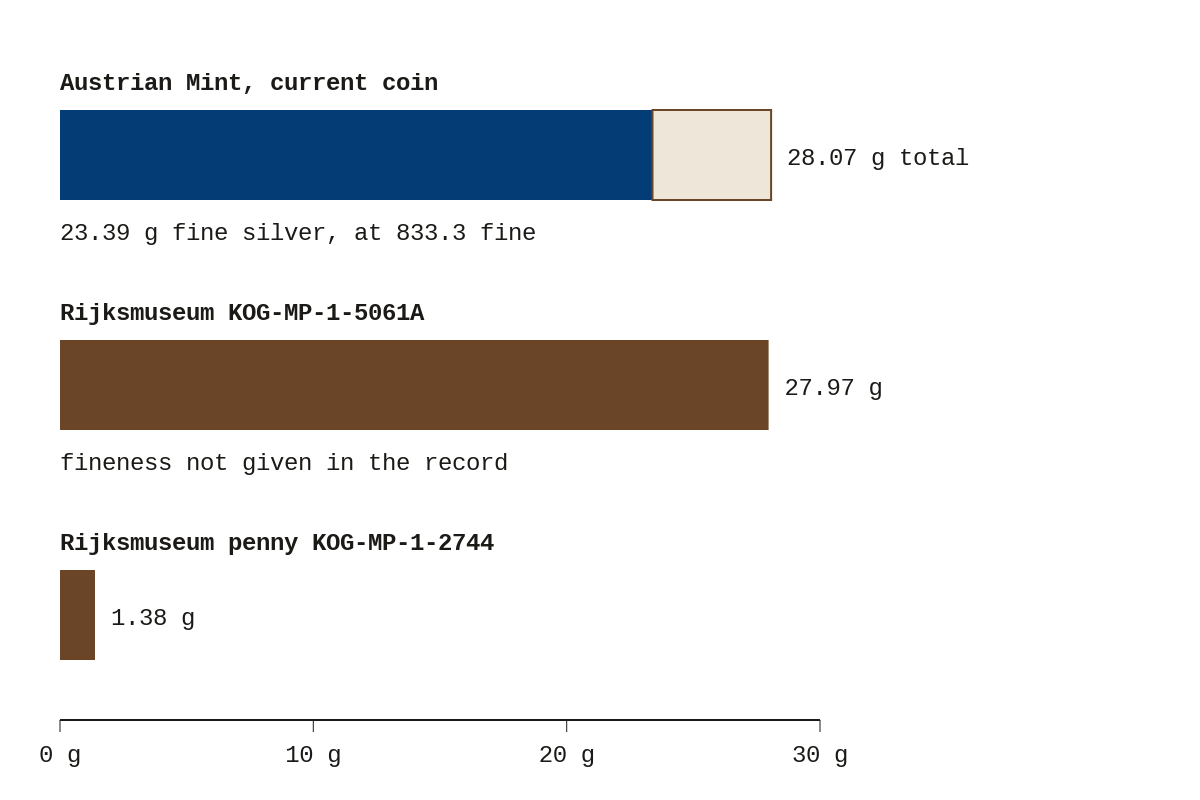
For the coin it sells today, the Austrian Mint lists a total weight of 28.07 grams, a fine weight of 23.39 grams, a fineness of 833.3, meaning 833.3 parts of silver in 1,000, and a diameter of 42 millimeters. The numbers agree: 28.07 × 0.8333 gives 23.39. The penny mentioned above weighs 1.38 grams; this coin is about 20 times as heavy and about twice as wide.
Credit line to copy
"Thaler Weight and Fine Silver" by Spine & Watermark, https://spineandwatermark.com/money/maria-theresa-thaler/, licensed under CC BY 4.0 (https://creativecommons.org/licenses/by/4.0/).The older records say less. The Rijksmuseum’s example weighs 27.97 grams, 0.10 grams lighter than the Mint’s figure, with a diameter given as 4 centimeters and no fineness stated. Auckland’s description gives size only, so no weight can be given for its coin here.
One weight doesn’t make a series, so this page draws no conclusion from that gap and offers no data file. These grams measure metal. They aren’t a guide to what any coin would sell for. How the dies were cut isn’t in these records either, although intaglio printing plates start from a similar step, a design cut into metal.
Lived: what does this coin’s record keep?
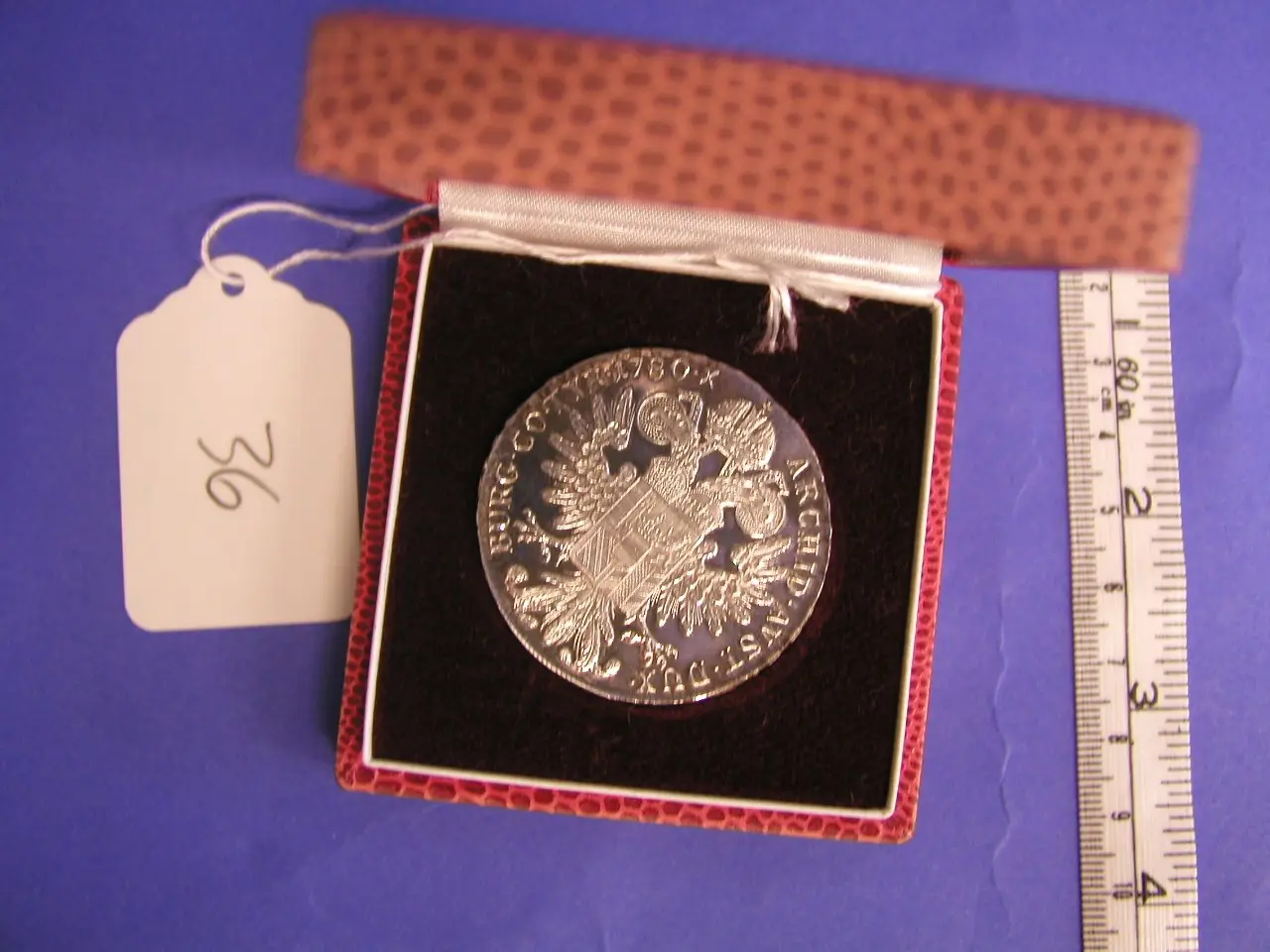

Auckland’s description says the coin came in the card box it was issued in, and this photograph shows it in the box, beside a numbered tag and a ruler. The closed box measures about 70 millimeters across and 26.3 millimeters high. The file page’s title calls the object an award coin without saying what the award was. Its credit line records a gift.
A box might seem like a clue to the object date, but the description names no issuer and no year for it, so it stays a fact about how the coin was kept, and the object side of the card stays unknown.
Turn next to the surfaces, where the museum’s photographs show an obverse, or portrait side, darker than the reverse and small nicks along the rim. This site keeps the handling scar for a mark left by use rather than by making. No handling scar can be confirmed from the record, so for both: cause not established. Any treatment of an old coin is a job for a professional conservator, and the American Institute for Conservation is a place to start.
Where did the coin go?
The Mint says the coin was especially popular in the Arab world, Ethiopia and India, and that it was legal tender in Austria only until 1858, one year after the 1857 start it gives for continuous re-striking. It adds that the coin was still legal tender in many African countries during the Second World War. Tschoegl’s 2001 article, read here only in its abstract, describes it circulating in Africa, the Levant and Arabia until governments, one by one, established national currencies.
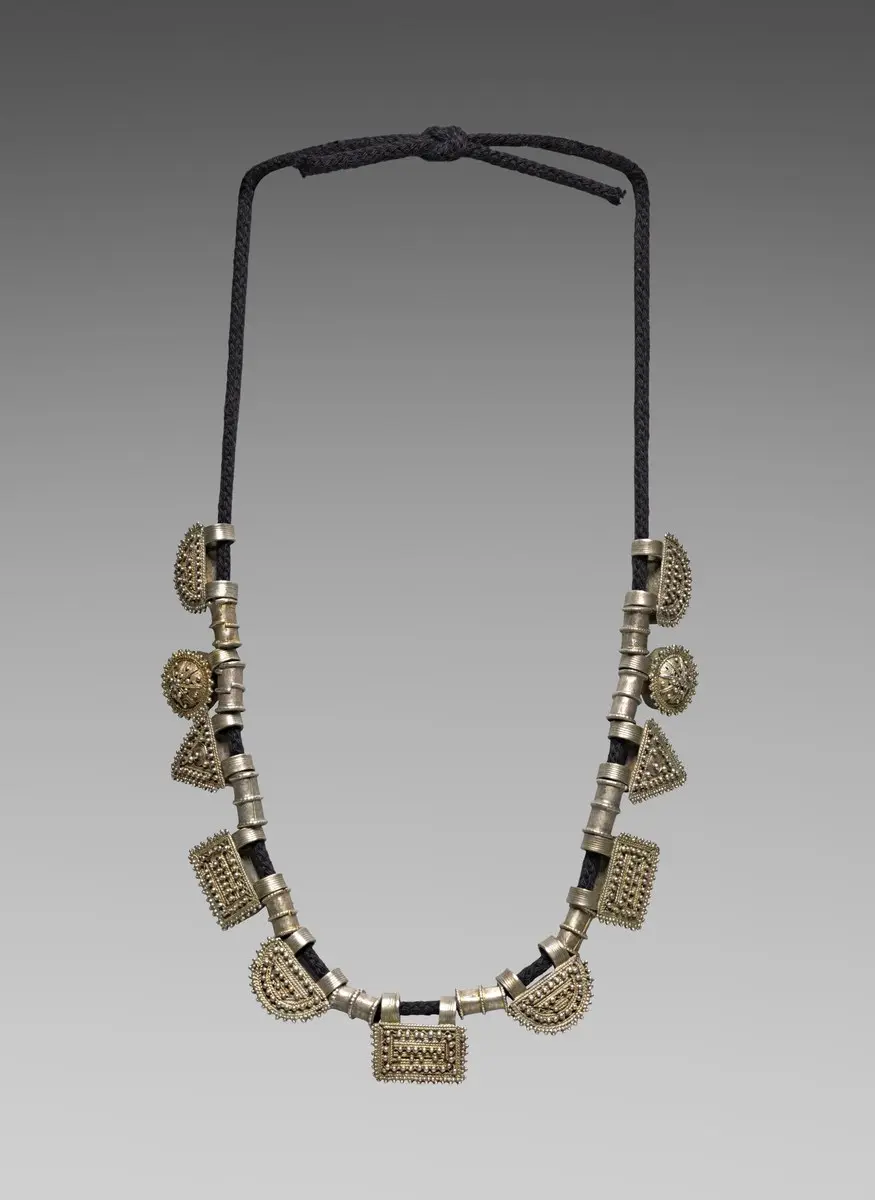
Some of that silver stopped being money, as the Cleveland Museum of Art’s record of this necklace notes. It says makers of Ethiopian silver jewelry melt high-purity Maria Theresa thalers, and it dates the piece to the late 1800s or early 1900s. The Exeter notice describes jewelry made from melted thalers as well. Cleveland’s record doesn’t say whether thalers went into this piece, or which ones, and a melted thaler leaves no date to read.
Paper money of the same century had its own marks and makers, as the page on Continental Currency shows. For this coin, the open question is still the first one: what document records the Vienna Mint’s agreement, and when did it take effect? Tschoegl’s full paper and Semple’s book are the obvious places to look, and neither could be read for this page. The Auckland coin’s own year of striking also remains unrecorded here.
Turn it over:
The reverse carries a crowned double-headed eagle and the frozen date, and the Rijksmuseum also notes edge lettering on its example, but Auckland’s description gives no reading of either face or the edge.
- Hammered Coins: how silver was struck before machines: There the Royal Mint Museum’s account describes the dies, which this coin’s records don’t.
- Athenian Owl Tetradrachm: another silver coin kept looking the same: Its design date and its object date part ways too.
Sources
- Auckland Museum, "Coin, award (AM 2014.7.60-5)," obverse photograph with museum description, on Wikimedia Commons. commons.wikimedia.orgRead: file page with the museum description, size and credit line; the catalogue page could not be read
- Auckland Museum, "Coin, award (AM 2014.7.60-3)," reverse photograph, on Wikimedia Commons. commons.wikimedia.orgRead: file page only; the catalogue page could not be read
- Auckland Museum, "Coin, award (AM 2014.7.60-19)," photograph of the coin in its box, on Wikimedia Commons. commons.wikimedia.orgRead: file page only; the catalogue page could not be read
- Auckland War Memorial Museum Tāmaki Paenga Hira, catalogue record for 2014.7.60 (not read). aucklandmuseum.comRead: catalogue record: could not be read
- Rijksmuseum, KOG-MP-1-5061A, restrike of a Maria Theresa thaler dated 1780, on loan from the Koninklijk Oudheidkundig Genootschap. data.rijksmuseum.nlRead: catalogue record: museum open data, in Dutch; translations by Spine & Watermark
- Münze Österreich (Austrian Mint), "Historical Gold and Silver Re-Strikes." muenzeoesterreich.comRead: full page, the Maria Theresa Taler passage
- Münze Österreich (Austrian Mint), "Maria Theresa Taler Silver Uncirculated." muenzeoesterreich.comRead: full page, description and specifications
- Cleveland Museum of Art, 2025.152, Necklace (ashän ketab) with amulet pendants (tälsäm), late 1800s or early 1900s. clevelandart.orgRead: catalogue record: museum open data, CC0
- Adrian Tschoegl, "Maria Theresa's Thaler: A Case of International Money," Eastern Economic Journal 27, no. 4 (2001), 443–462. econpapers.repec.orgRead: abstract and bibliographic record only; the full paper could not be read
- University of Exeter, "All that glitters is not gold," news archive, February 2010. news-archive.exeter.ac.ukRead: full page
- Clara Semple, A Silver Legend: The Story of the Maria Theresa Thaler (Barzan Publishing), not read; title and review as reprinted in The E-Sylum 9, no. 3 (January 15, 2006), article 10. coinbooks.orgRead: bibliography only; the book was not read, and the linked page reprints a review
- Windrain, "1 thaler Maria Theresia 1780," Wikimedia Commons. commons.wikimedia.orgRead: file page only; uploader title, no holding record
- Rijksmuseum, KOG-MP-1-2744, penny of Edward I/II/III, on loan from the Koninklijk Oudheidkundig Genootschap. data.rijksmuseum.nlRead: catalogue record: museum open data
Image credits
- "Maria Theresa thaler dated 1780, obverse and reverse" by Auckland Museum — https://commons.wikimedia.org/wiki/File:Coin,_award_(AM_2014.7.60-5).jpg — CC BY 4.0 (https://creativecommons.org/licenses/by/4.0/); Auckland War Memorial Museum, 2014.7.60; modified: obverse (AM 2014.7.60-5) and reverse (AM 2014.7.60-3) files placed side by side, obverse left, at equal height; accession label left in place; no other change
- "Maria Theresa thaler dated 1780, reverse" by Auckland Museum — https://commons.wikimedia.org/wiki/File:Coin,_award_(AM_2014.7.60-3).jpg — CC BY 4.0 (https://creativecommons.org/licenses/by/4.0/); Auckland War Memorial Museum, 2014.7.60; modified: scaled to 1200 px high; no other change
- "The Date on the Coin and the Date of the Object" by Spine & Watermark, https://spineandwatermark.com/money/maria-theresa-thaler/, licensed under CC BY 4.0 (https://creativecommons.org/licenses/by/4.0/).
- "1 thaler Maria Theresia 1780" by Windrain — https://commons.wikimedia.org/wiki/File:1_thaler_Maria_Theresia_1780.png — CC BY-SA 4.0 (https://creativecommons.org/licenses/by-sa/4.0/); no institution recorded; modified: scaled to 900 px high and saved as JPEG; no other change
- "Thaler Weight and Fine Silver" by Spine & Watermark, https://spineandwatermark.com/money/maria-theresa-thaler/, licensed under CC BY 4.0 (https://creativecommons.org/licenses/by/4.0/).
- "Maria Theresa thaler dated 1780, in its card box" by Auckland Museum — https://commons.wikimedia.org/wiki/File:Coin,_award_(AM_2014.7.60-19).jpg — CC BY 4.0 (https://creativecommons.org/licenses/by/4.0/); Auckland War Memorial Museum, 2014.7.60; modified: re-encoded at the original 1280 x 960; no other change
- "Necklace (ashän ketab) with amulet pendants (tälsäm)" by Unknown silversmith, Ethiopia — https://www.clevelandart.org/art/2025.152 — CC0 1.0 (https://creativecommons.org/publicdomain/zero/1.0/); Cleveland Museum of Art, 2025.152; modified: scaled to 1200 px high; no other change
Cite this page
Spine & Watermark. “Maria Theresa Thaler: The Coin That Kept Her Death Year.” Spine & Watermark, published November 7, 2026. https://spineandwatermark.com/money/maria-theresa-thaler/. Accessed [date].
How sources are ranked · All corrections · Contact · Report an error (contact@spineandwatermark.com)