Cyanotype: How Could Seaweed Make a Picture With No Camera?
Published · Revised
TL;DR: A cyanotype is a photographic print made on iron-treated paper by sunlight, and it needs no camera when an object is laid directly on the sheet. John Herschel named the process in 1842. Anna Atkins began her algae book with it in 1843, per the Cleveland Museum of Art.
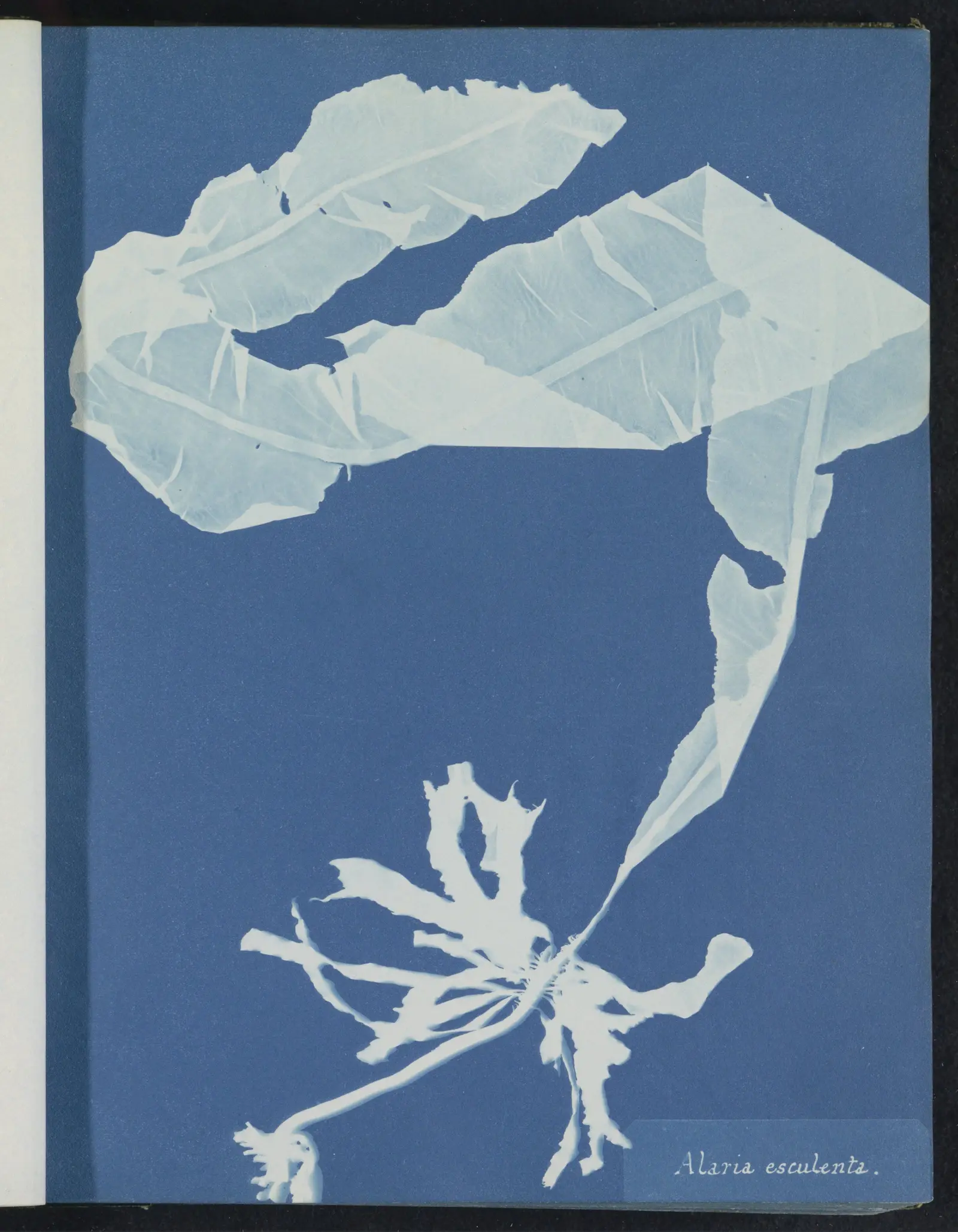

Count the colors on this page. One blue ground, one pale seaweed and a small name label fill a sheet of 250 by 200 millimeters. This page explains how that blue was made in the 1840s; it doesn't teach mixing or coating, and it gives no formula. How did a seaweed picture itself with no camera involved?
What is on the Alaria esculenta leaf?
Rijksmuseum RP-F-2016-133-2 is one page of seaweed, catalogued as a photograph on photographic paper. The museum names Anna Atkins as the maker, places the work in the United Kingdom and dates it about 1843 to about 1853. The ten-year range is the record's own; which year produced this leaf, the record doesn't say. At 250 by 200 millimeters (9.8 by 7.9 inches), the page is shorter and narrower than a US Letter sheet (279 by 216 millimeters).
Collation: cyanotype · page 250 × 200 mm (9.8 × 7.9 in) · image c. 1843–1853 / object same · Rijksmuseum, RP-F-2016-133-2
Collation card, all fields
- Object
- Alaria esculenta hdl.handle.net
- Type
- photograph hdl.handle.net
- Process
- cyanotype hdl.handle.net
- Format & size
- page 250 × 200 mm (9.8 × 7.9 in) hdl.handle.net
- Material
- photographic paper hdl.handle.net
- Made
- image c. 1843–1853 / object same hdl.handle.net
- Held at
- Rijksmuseum, RP-F-2016-133-2, hdl.handle.net hdl.handle.net
- Date basis
- Holding record: Rijksmuseum, ca. 1843 – ca. 1853 hdl.handle.net
The card uses the double date, this site's habit of dating content and object apart. Here the two collapse into one, because a picture made by direct contact and the paper that holds it come into being together. The seaweed is a third date, and the record text read for this page gives no date or place for its gathering.
The word cyanotype on that card comes from the museum's own process field, which reads cyanotype in English and cyanotypie in Dutch. A blue picture alone does not prove the process, so the name here comes from the label and not from any judgment of the color.
How was a cyanotype made in the 1840s?
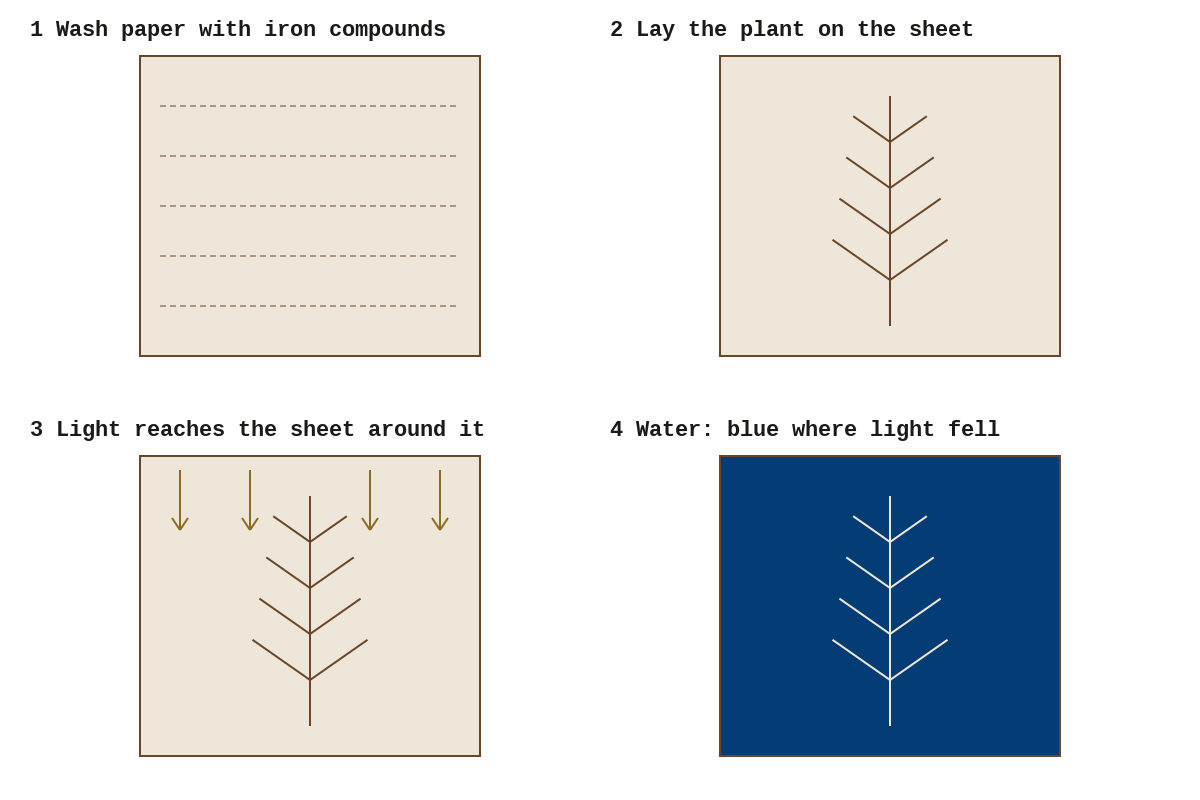
The steps below combine John Herschel's 1842 paper with the Cleveland Museum of Art's account of how Atkins worked. They say what happened on the sheet, with no amounts or timings. Article 223 of Herschel's paper supplies steps 1 and 4.
- Wash. Paper is washed with a mixture of two iron compounds, which makes it sensitive to light.
- Lay. Atkins placed the plant directly on the light-sensitive paper, per Cleveland. No lens stands between plant and sheet.
- Expose. Light falls on the sheet. The plant keeps it off the paper underneath.
- Rinse. The sheet goes into water and is dried, which Herschel says produces “a negative blue picture” (p. 212).
Credit line to copy
"Four Steps of a Cyanotype on the Sheet" by Spine & Watermark, https://spineandwatermark.com/photographs/cyanotype/, licensed under CC BY 4.0 (https://creativecommons.org/licenses/by/4.0/).Why blue? The color is Prussian blue, an iron compound that forms in the paper. In an earlier passage on a related two-wash version, Herschel reports “a considerable deposit of Prussian blue” on “the part sunned, and none whatever on the rest” (p. 205). Rinsing then leaves the blue impression behind, according to the same passage.
So the seaweed on the page marks where the plant held the light back.
Look closely at the Alaria esculenta image and the effect is not all or nothing. The branching base prints nearly white, while the broad fronds read pale blue with a lighter rib down the middle. The record doesn't explain the difference, and a photograph can't settle it.
That is also what Herschel's word negative means here. The tones run opposite to the object, because the sheet darkens wherever the plant is absent and stays pale wherever the plant lay.
Can you make one at home from this page? This page stops at the history. A photograph conservator (the American Institute for Conservation is a starting point) or a teaching workshop in historical processes is the right place to ask about materials and safe handling, and a conservator is also the person to consult about caring for an old blue print.
Not a print from a plate or a block
A cyanotype can sit in the same album or drawer as a printed picture, yet it starts differently. Intaglio and relief prints from the same decades begin with a worked plate or block. Herschel's account of the cyanotype names no plate or press: light and water act on treated paper.
Leaf shapes alone don't settle the matter either. Some Continental paper money also carries the veins of real leaves, and a 2023 study in PNAS describes Benjamin Franklin's nature printing as using the impression of a leaf. That route runs through printing; Atkins's runs through a shadow on a sheet.
Who invented the cyanotype, and who named it?
John Herschel described the process and supplied the name in a paper read to the Royal Society on June 16, 1842. Article 219 of that paper opens with the word “Cyanotype” and applies it to “the whole class of processes” in which cyanogen combined with iron plays a leading part and the pictures come out blue (p. 210). So the word began as a family name rather than a label for one method. The varieties, Herschel adds, “seem to be innumerable” (p. 210).
The Cleveland Museum of Art's biography of Atkins connects the paper to her directly. Herschel, a family friend, sent her father, John George Children, a copy in 1842, and the biography describes it as his paper on the cyanotype's invention. Atkins began production one year after the paper.
Credit line to copy
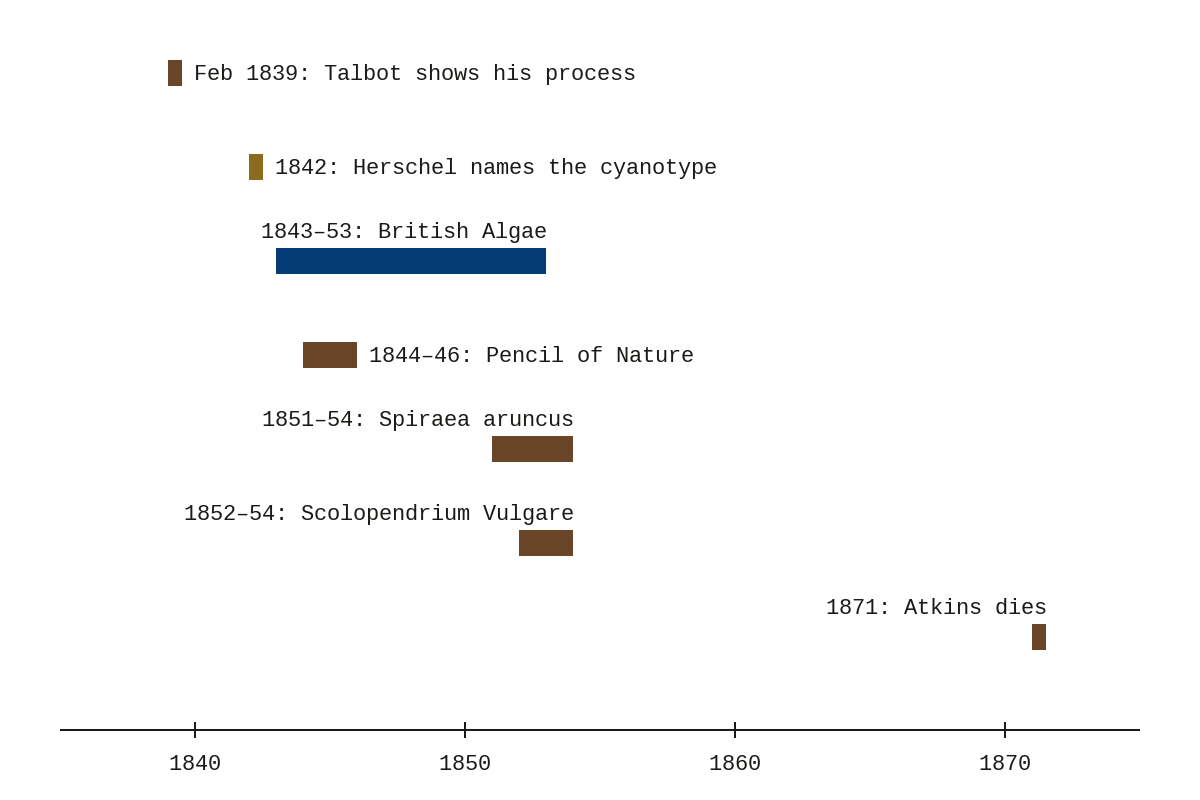
"From Herschel's Paper to Atkins's Book" by Spine & Watermark, https://spineandwatermark.com/photographs/cyanotype/, licensed under CC BY 4.0 (https://creativecommons.org/licenses/by/4.0/).| Date | Event | Per |
|---|---|---|
| February 1839 | William Henry Fox Talbot discloses the details of his process to a Royal Society committee | Cleveland biography |
| June 16, 1842 | Herschel's paper is read; Article 219 names the cyanotype | Herschel 1842 |
| 1842 | Herschel sends John George Children a copy of the paper | Cleveland biography |
| 1843–53 | Atkins produces the serial volumes of British Algae | Cleveland biography |
| 1844–46 | Talbot's Pencil of Nature appears in fascicles | Cleveland biography |
| 1851–54 | Spiraea aruncus (Tyrol) | Metropolitan Museum record, as given on Commons |
| 1852–54 | Scolopendrium Vulgare | Cleveland record |
| 1871 | Atkins dies | Cleveland biography |
The method Herschel singled out was not the easy one
Article 219 goes on to describe a different route from the four steps above: a second wash develops a faint picture already in the paper. Herschel praises its beauty while it develops, and then lists how it fails: throwing the sheet into water costs much of its sharpness, and a wet brush can leave the effect of a coarse, badly printed woodcut. In the next article he gives his verdict on the handling, calling complete success “comparatively rare” (p. 211).
What the paper hands Atkins is a family of related chemical routes rather than one fixed method with a single name. The records read for this page do not say which one she followed on any given day.
How did Anna Atkins turn a process into a book?
Anna Atkins (1799–1871) had a scientist for a father, John George Children, tied to the British Museum and the Royal Society, and Cleveland says his position let her hear early about Daguerre's and Talbot's announcements of photography. She already drew for science, having illustrated her father's translation of Lamarck's Genera of Shells. The same record names a practical problem with plants: accurate drawings were difficult to make. Laying the plant on the paper answered that problem, and Cleveland says the method recorded a plant's line, shape and texture.
Cleveland calls these sheets cameraless photographs, later called photograms.
The result carries the title British Algae: Cyanotype Impressions in Cleveland's record, dated 1843–53, ten years from first to last. The same record describes a brief text and almost 400 captioned plates, meant to accompany William Harvey's Manual of British Algae (1841). The Rijksmuseum's range for its leaves, about 1843 to about 1853, agrees with those end points.
Read 1843 as a starting date. Cleveland calls the work serial volumes, so it did not appear as one finished book in one year; 1843 marks the year Atkins began production.
Cleveland says the work is “generally credited as the first photographically illustrated book,” a year ahead of the first fascicles of Talbot's Pencil of Nature, and calls the book photography's earliest use in a scientific publication. Those are one museum's summaries, and no second source read for this page tests them, so they stand here as that museum's words.
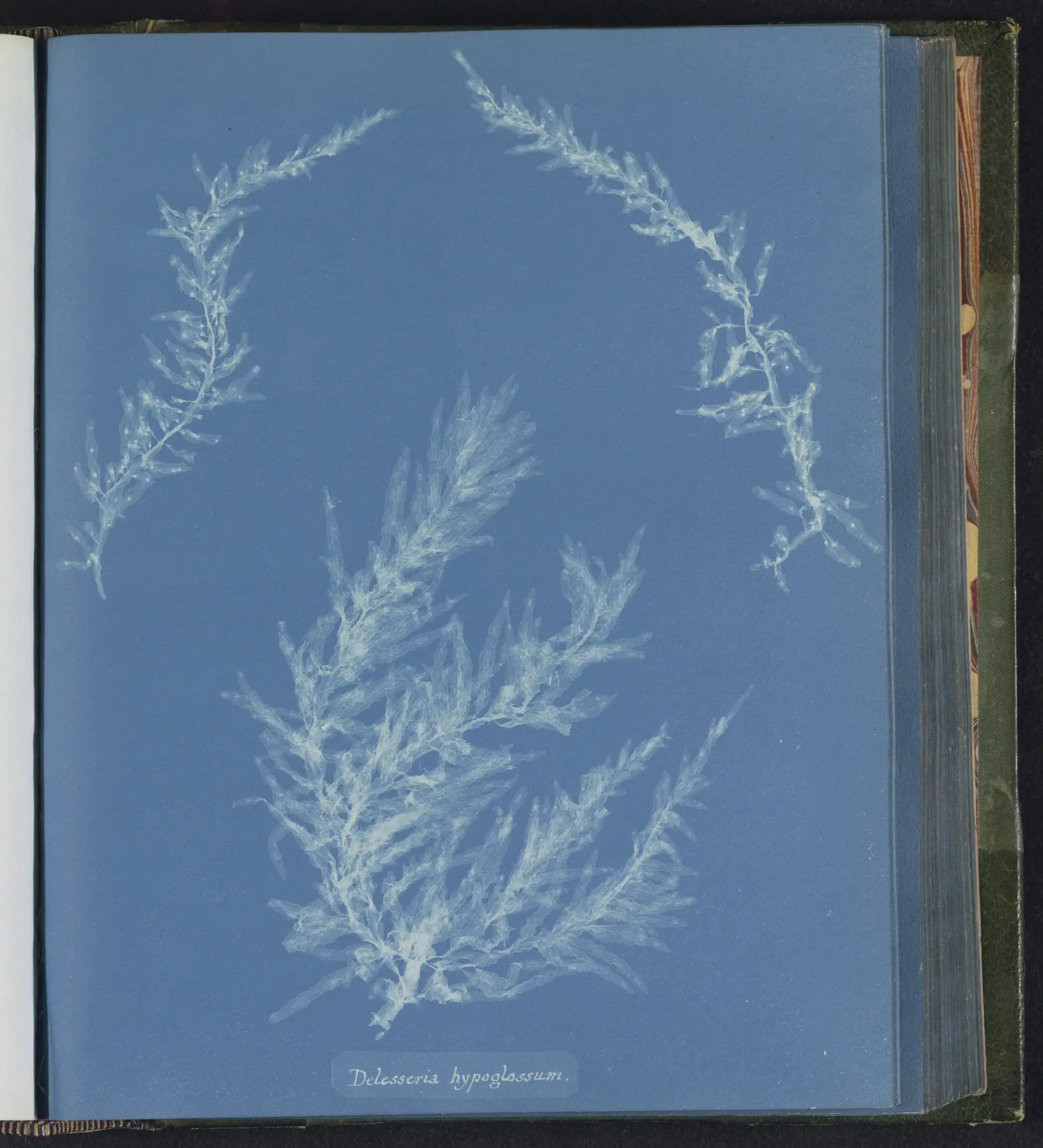
The Rijksmuseum's image of Delesseria hypoglossum takes in more than the plant: its frame shows the stack of pages and the green cover of a bound volume, with the name on a pale label at the foot of the leaf.

The next leaf's title shows the book doing a botanist's work: the Rijksmuseum records it as Dictyota dichotoma, “in the young state” and “in fruit.” Small sprigs sit above one large forked plant in the image, which suggests the page sets two stages side by side.
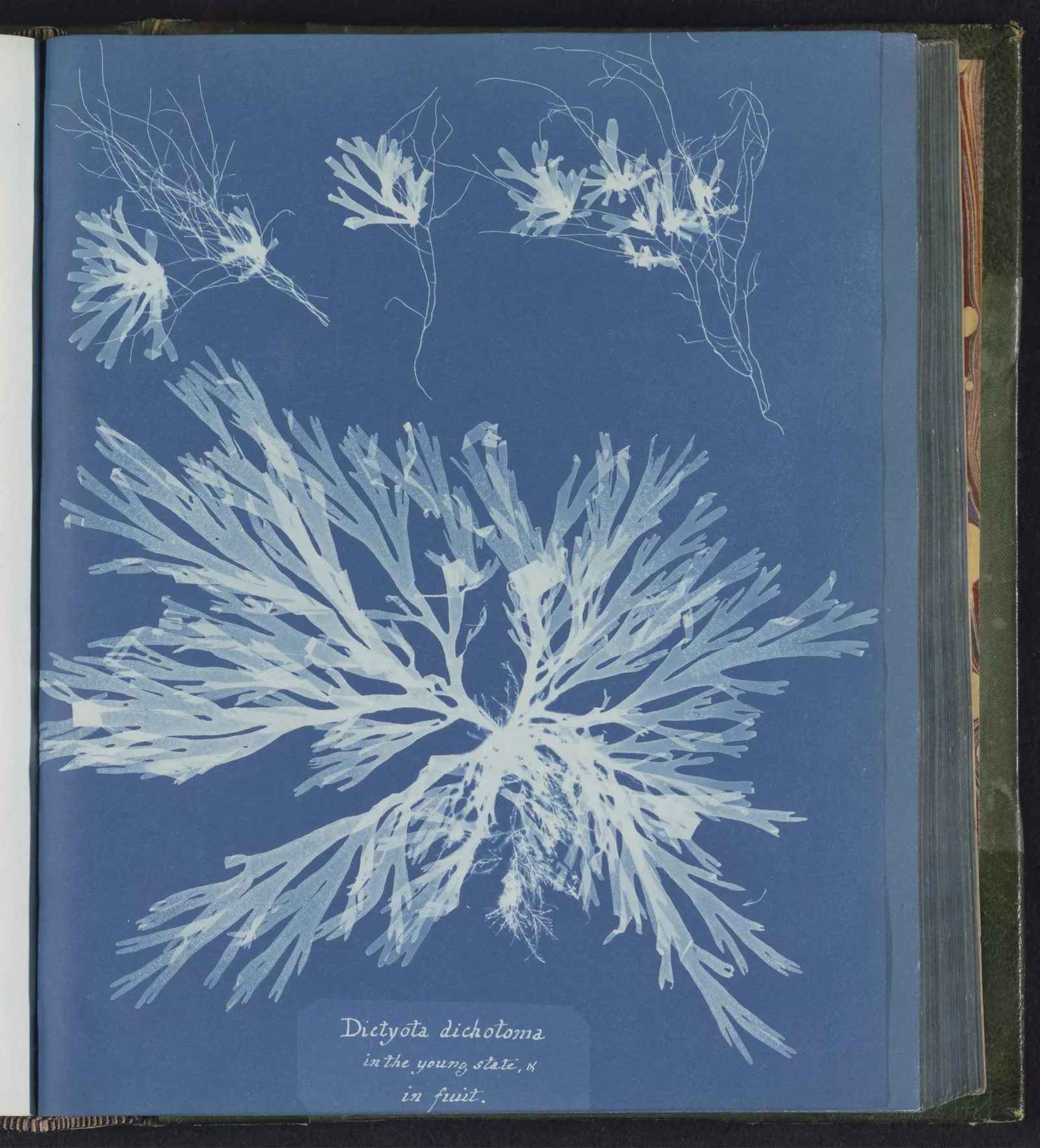

The Rijksmuseum's data tie all three of its leaves on this page to one book record, RP-F-2016-133, titled Photographs of British Algae. Cyanotype Impressions and dated 1843 to 1853. That record counts 307 cyanotype plates and gives the volume as 260 by 225 by 60 millimeters, a little larger than its 250 by 200 millimeter pages. Cleveland's figure of almost 400 plates describes the finished work, and neither record explains the difference.
Did Atkins print only algae?
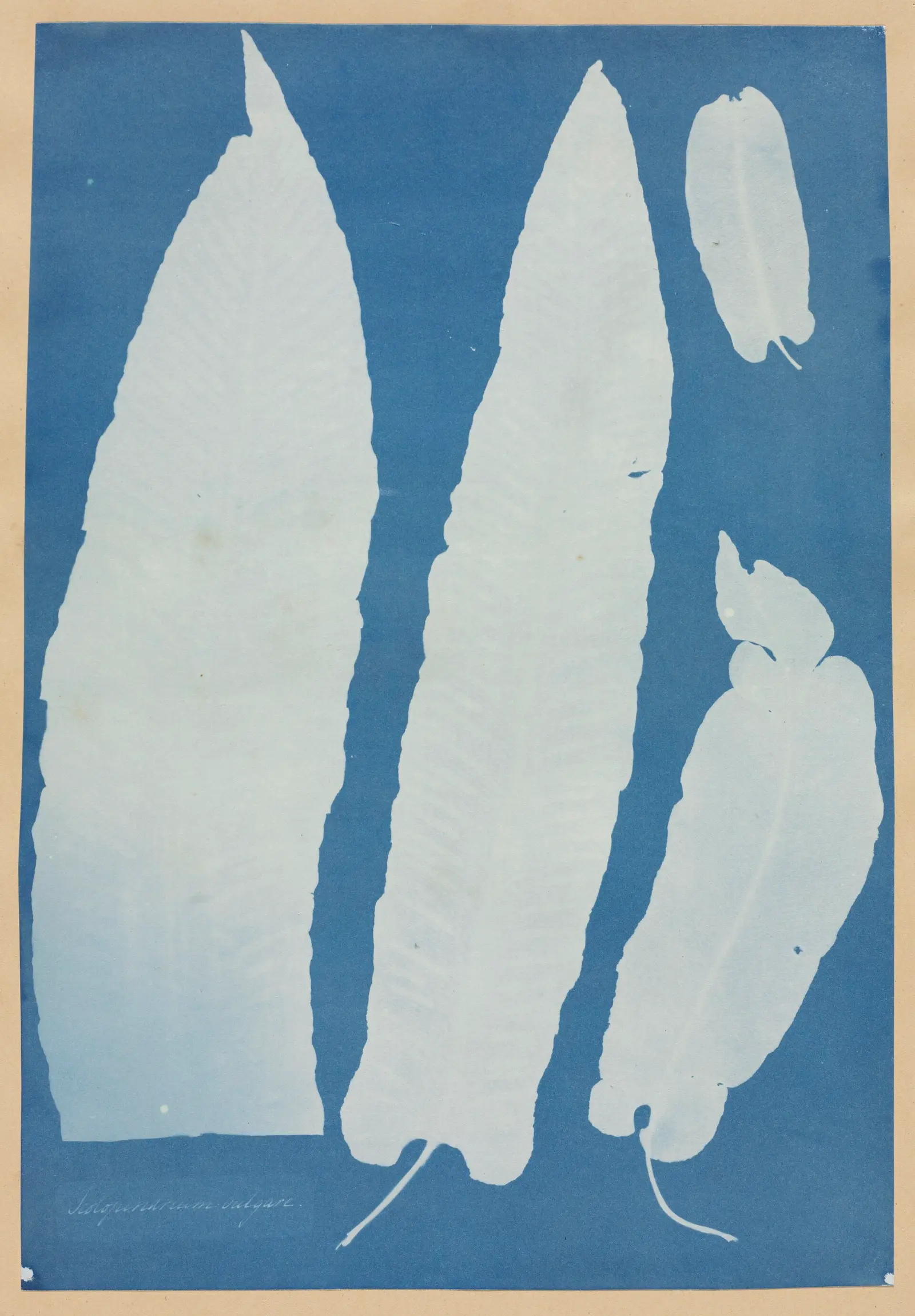
No. Cleveland says Atkins, possibly working with her friend Anne Dixon, made several more albums, with plants, ferns, feathers and lace among the subjects. Its own sheet is a Hart's-tongue fern, labeled Scolopendrium Vulgare and dated 1852–54. That record gives the paper as 48.3 by 37.5 centimeters (19 by 14 3/4 inches), nearly twice the height of the Rijksmuseum's algae page.
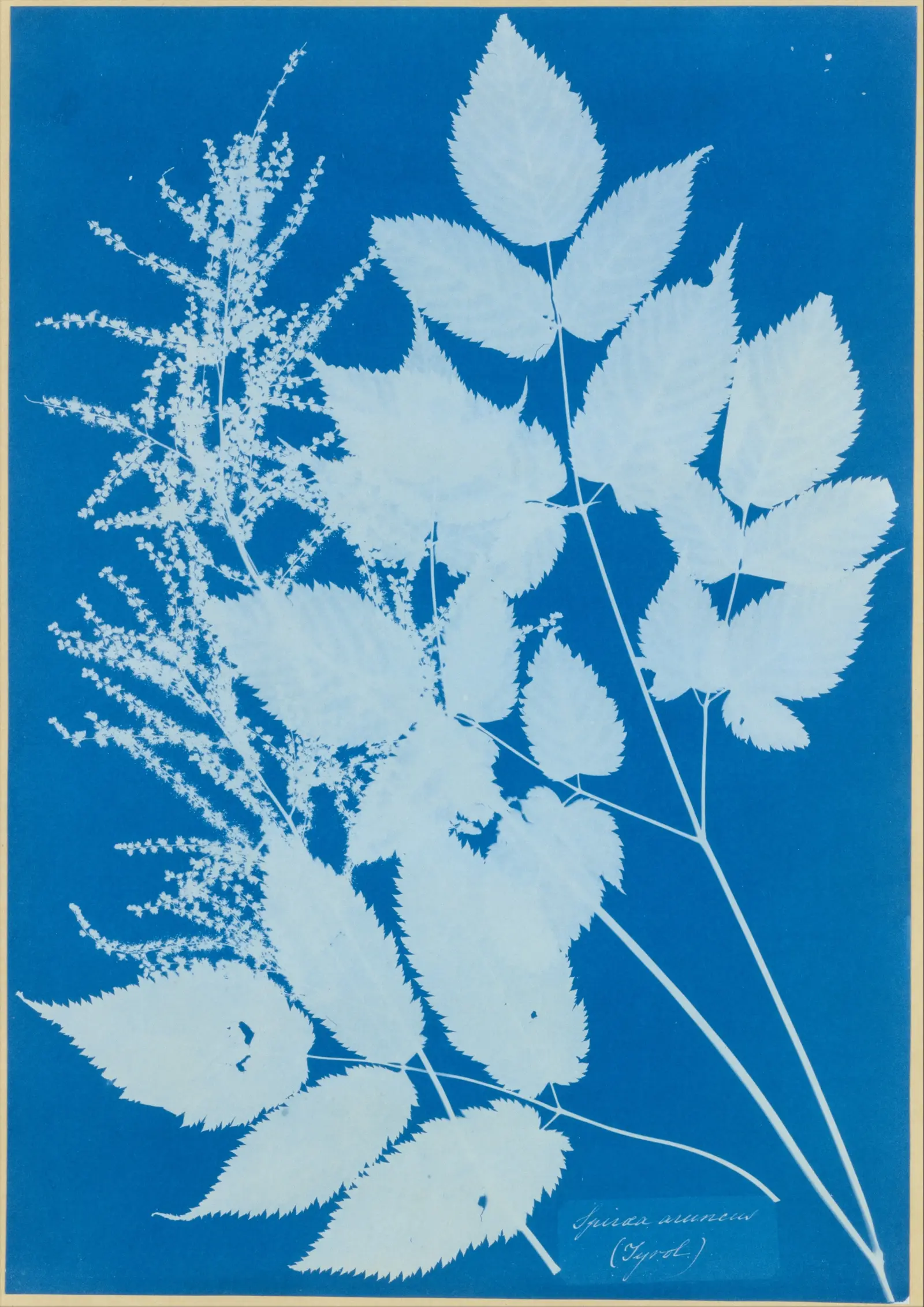
The Metropolitan Museum of Art holds a sheet from about the same years, recorded as Spiraea aruncus (Tyrol), 1851–54, with toothed leaves beside a fine feathery spray. The title carries a place name, Tyrol, which sets this sheet apart from a book announced as British algae.

The table lists the five leaves used on this page, each with its record's own date and size. These are open records rather than a count of what survives, and no number of surviving copies appears here. Each row in the download also carries its rights label and a note on how the record was read, so a row can stand alone if you copy it elsewhere.
| Leaf, per record | Date, per record | Held at | Size, per record |
|---|---|---|---|
| Alaria esculenta | ca. 1843 – ca. 1853 | Rijksmuseum, RP-F-2016-133-2 | page 250 × 200 mm |
| Delesseria hypoglossum | ca. 1843 – ca. 1853 | Rijksmuseum, RP-F-2016-133-139 | page 250 × 200 mm |
| Dictyota dichotoma / in the young state, & / in fruit | ca. 1843 – ca. 1853 | Rijksmuseum, RP-F-2016-133-144 | page 250 × 200 mm |
| Scolopendrium Vulgare | 1852–54 | Cleveland Museum of Art, 1995.26 | image 333 × 229 mm |
| Spiraea aruncus (Tyrol) | 1851–54 | Metropolitan Museum of Art, 2004.172 | image 351 × 246 mm |
Download the data (atkins-leaves-open-records.csv) · source and license notes
What do these records leave open?
The sizes in that table don't measure the same thing. The Rijksmuseum gives the whole page, while Cleveland and the Met give the image area. Even so, the Met's image is 1.4 times the height of the Rijksmuseum's whole page, so these two plant sheets ran larger than the three algae leaves listed here.
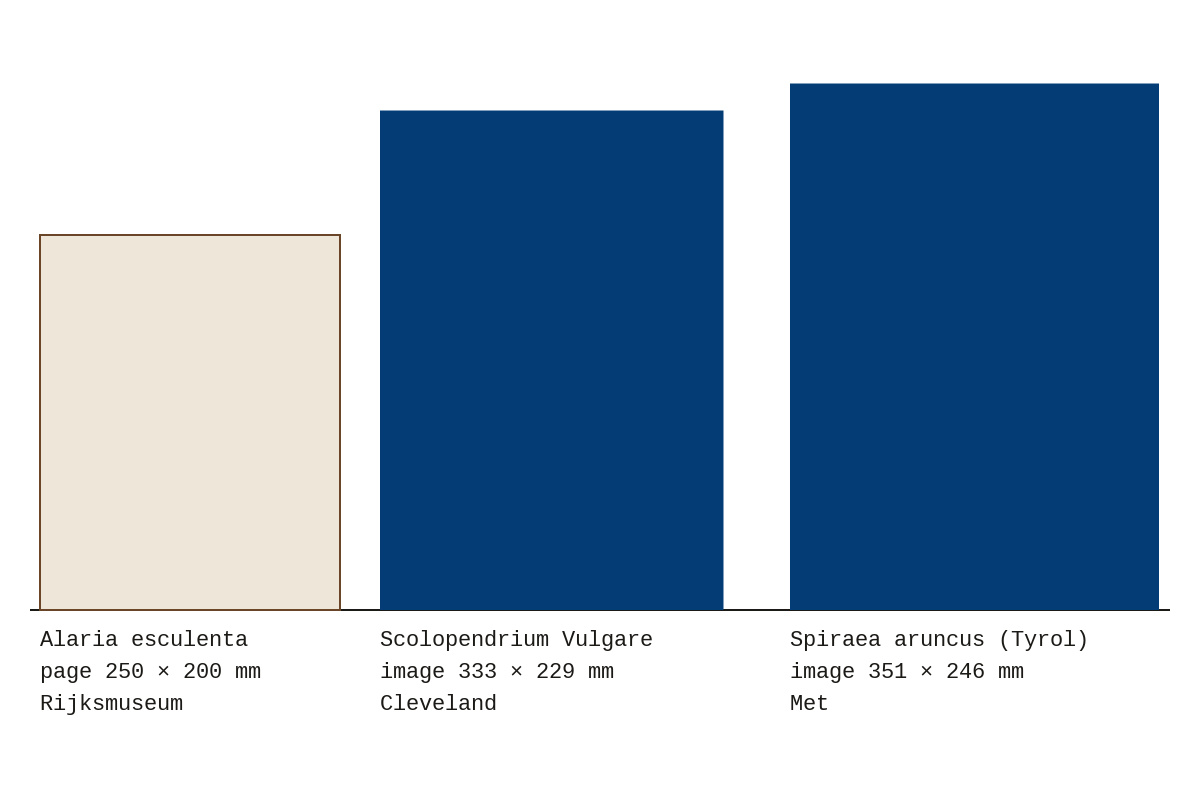
Credit line to copy
"Three Atkins Records Drawn to One Scale" by Spine & Watermark, https://spineandwatermark.com/photographs/cyanotype/, licensed under CC BY 4.0 (https://creativecommons.org/licenses/by/4.0/).Other gaps are larger. No record read for this page says which year any one algae leaf was made, and none spells out Atkins's working routine, so the steps above rest on Herschel's chemistry and Cleveland's short description.
Herschel's trials ran in sunshine, while Cleveland's account of Atkins says only light, so the sun on her sheets is this page's reading of the two together. Cleveland's “possibly” around Anne Dixon also stays open: its fern sheet lists her in its provenance, and that entry gives no date or detail. Who did what at the bench, sheet by sheet, the records here don't say.
Turn it over:
The record shows no reverse. The Rijksmuseum data describe one leaf and a page size, and the image shows only a strip of the facing page, so what the back of the Alaria esculenta leaf carries is the missing piece.
- Carte de Visite: paper photographs with a mount to date: Here the card around a later paper picture can help narrow its date to a range.
- View From the Window at Le Gras: an earlier image, made on metal: Years before Atkins's sheets, another picture was held on a plate.
Sources
- J. F. W. Herschel, "On the Action of the Rays of the Solar Spectrum on Vegetable Colours, and on Some New Photographic Processes," Philosophical Transactions of the Royal Society of London 132 (1842), beginning p. 181. Read June 16, 1842. doi.orgRead: full text of the 1842 paper in the Internet Archive scan; Arts. 210, 219 and 223 used; quoted with page numbers
- Cleveland Museum of Art, Anna Atkins, Scolopendrium Vulgare, 1852–54, accession 1995.26, open-access record with artist biography. clevelandart.orgRead: full open-access record, including description and biography, 2026-11-07Text license: CC0
- Rijksmuseum, Anna Atkins, Alaria esculenta, ca. 1843 – ca. 1853, RP-F-2016-133-2, object record. hdl.handle.netRead: catalogue record in the museum's open data, 2026-11-07; Dutch record text as copied on the Commons file page
- Rijksmuseum, Anna Atkins, Delesseria hypoglossum, ca. 1843 – ca. 1853, RP-F-2016-133-139, object record. hdl.handle.netRead: catalogue record in the museum's open data, 2026-11-07; Dutch record text as copied on the Commons file page
- Rijksmuseum, Anna Atkins, Dictyota dichotoma / in the young state, & / in fruit, ca. 1843 – ca. 1853, RP-F-2016-133-144, object record. hdl.handle.netRead: catalogue record in the museum's open data, 2026-11-07; Dutch record text as copied on the Commons file page
- Rijksmuseum, Anna Atkins, Photographs of British Algae. Cyanotype Impressions, 1843 – 1853, RP-F-2016-133, object record. hdl.handle.netRead: catalogue record in the museum's open data, 2026-11-07
- Metropolitan Museum of Art, Anna Atkins, Spiraea aruncus (Tyrol), 1851–54, accession 2004.172, as given on the Commons file page. commons.wikimedia.orgRead: catalogue record, data as copied on the Commons file page, 2026-11-06; museum website not read
- Khachatur Manukyan and colleagues, “Multiscale analysis of Benjamin Franklin’s innovations in American paper money,” PNAS 120, no. 30 (2023): e2301856120. https://doi.org/10.1073/pnas.2301856120 doi.orgRead: full article, public-access copy
Image credits
- "Alaria esculenta" by Anna Atkins — https://commons.wikimedia.org/wiki/File:Alaria_esculenta,_RP-F-2016-133-2.jpg — Public domain (Anna Atkins died in 1871; made c. 1843–1853. United States: published before 1931. European Union: author dead more than 70 years.); Rijksmuseum, RP-F-2016-133-2
- "Four Steps of a Cyanotype on the Sheet" by Spine & Watermark, https://spineandwatermark.com/photographs/cyanotype/, licensed under CC BY 4.0 (https://creativecommons.org/licenses/by/4.0/).
- "From Herschel's Paper to Atkins's Book" by Spine & Watermark, https://spineandwatermark.com/photographs/cyanotype/, licensed under CC BY 4.0 (https://creativecommons.org/licenses/by/4.0/).
- "Delesseria hypoglossum" by Anna Atkins — https://commons.wikimedia.org/wiki/File:Delesseria_hypoglossum,_RP-F-2016-133-139.jpg — Public domain (Anna Atkins died in 1871; made c. 1843–1853. United States: published before 1931. European Union: author dead more than 70 years.); Rijksmuseum, RP-F-2016-133-139
- "Dictyota dichotoma / in the young state, & / in fruit" by Anna Atkins — https://commons.wikimedia.org/wiki/File:Dictyota_dichotoma_in_the_young_state,_%26_in_fruit,_RP-F-2016-133-144.jpg — Public domain (Anna Atkins died in 1871; made c. 1843–1853. United States: published before 1931. European Union: author dead more than 70 years.); Rijksmuseum, RP-F-2016-133-144
- "Scolopendrium Vulgare" by Anna Atkins — https://commons.wikimedia.org/wiki/File:Anna_Atkins_-_Scolopendrium_Vulgare_-_1995.26_-_Cleveland_Museum_of_Art.tif — CC0 1.0 (https://creativecommons.org/publicdomain/zero/1.0/); Cleveland Museum of Art, 1995.26; modified: JPEG rendering of the TIF at 1920 px wide, from the Commons upload host; not cropped
- "Spiraea aruncus (Tyrol)" by Anna Atkins — https://commons.wikimedia.org/wiki/File:Spiraea_aruncus_(Tyrol)_MET_DT5664.jpg — CC0 1.0 (https://creativecommons.org/publicdomain/zero/1.0/); Metropolitan Museum of Art, 2004.172
- "Three Atkins Records Drawn to One Scale" by Spine & Watermark, https://spineandwatermark.com/photographs/cyanotype/, licensed under CC BY 4.0 (https://creativecommons.org/licenses/by/4.0/).
Cite this page
Spine & Watermark. “Cyanotype: How Could Seaweed Make a Picture With No Camera?.” Spine & Watermark, published November 7, 2026. https://spineandwatermark.com/photographs/cyanotype/. Accessed [date].
How sources are ranked · All corrections · Contact · Report an error (contact@spineandwatermark.com)