View From the Window at Le Gras: Why Is It So Hard to See?
Published · Revised
TL;DR: View from the Window at Le Gras is Nicéphore Niépce's heliograph, which Getty dates to 1826 and calls the first permanent image from a plate exposed in a camera-like device. The plate is pewter and its image is bitumen microdots. A Harry Ransom Center text says it shows only under controlled light.
Collation: heliograph: bitumen on pewter, exposed in a camera obscura · plate 16.7 × 20.3 cm per the Commons file page (6.6 × 8.0 in. when converted); museum measurement not read · image/text 1826 per Getty; c. 1826 per the Ransom Center text; 1827 on the Commons file page / object same · Harry Ransom Center, University of Texas at Austin; 964:0000:0001 per the Commons file page; holding record not readable
Full credit
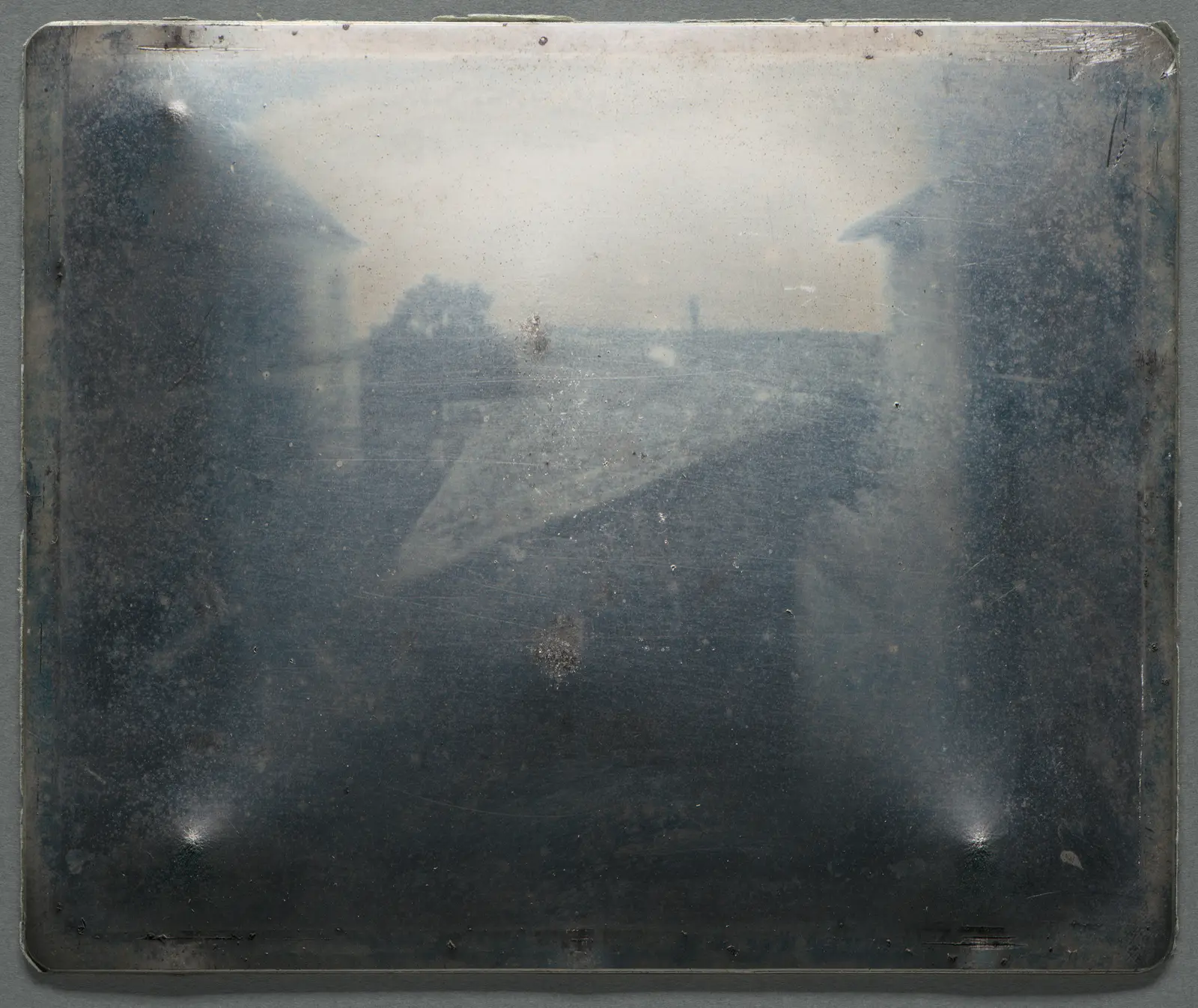
"View from the Window at Le Gras, 2020 photograph, cropped" by Nicéphore Niépce — https://commons.wikimedia.org/wiki/File:Untitled_(point_de_vue),_Ni%C3%A9pce_1827_%E2%80%94_HRC_2020_(cropped).jpg — Public domain (US: Nicéphore Niépce died in 1833; the plate dates from 1826 or 1827 and the Commons tag records publication before January 1, 1931; a faithful photograph of a flat public-domain work adds no new right (Bridgeman). EU: the author died more than 70 years ago; faithful reproductions of public-domain visual art carry no new right (Directive 2019/790, Article 14).); Harry Ransom Center, University of Texas at Austin, 964:0000:0001
Collation card, all fields
- Object
- View from the Window at Le Gras cool.culturalheritage.org
- Type
- photograph commons.wikimedia.org
- Process
- heliograph: bitumen on pewter, exposed in a camera obscura cool.culturalheritage.org getty.edu
- Format & size
- plate 16.7 × 20.3 cm per the Commons file page (6.6 × 8.0 in. when converted); museum measurement not read commons.wikimedia.org
- Material
- pewter plate; bitumen image layer in microdots getty.edu
- Made
- image/text 1826 per Getty; c. 1826 per the Ransom Center text; 1827 on the Commons file page / object same getty.edu cool.culturalheritage.org commons.wikimedia.org
- Held at
- Harry Ransom Center, University of Texas at Austin; 964:0000:0001 per the Commons file page; holding record not readable; hrc.utexas.edu getty.edu commons.wikimedia.org
- Date basis
- Literature: Getty Conservation Institute project page; Ransom Center text reprinted in the WAAC Newsletter, 2002; 1827 only from the user-maintained Commons file page; holding record not read getty.edu cool.culturalheritage.org commons.wikimedia.org
Set a museum photograph of the plate beside its best-known reproduction, a 1952 copy touched up with watercolor. In the photograph above, two dim buildings and a patch of pale sky float on dark gray metal, and bright marks sit near three corners. The retouched copy isn't shown here, because Gernsheim's own hand is part of it, so start from the Harry Ransom Center's page for the plate, which could not be read for this entry. Why is the plate so hard to read, and what is its image made of?
What does "first photo ever taken" mean here?
The label needs limits. The Getty Conservation Institute ranks it first among permanent images made by exposing a light-sensitive plate in a camera-like device. A Harry Ransom Center text, reprinted in the WAAC Newsletter in 2002, calls it the oldest permanent photograph from nature still in existence.
Both limits matter, because that same text has Niépce copying engravings with some success in 1824, work that copied prints, while this plate recorded a view through a window.
Nicéphore Niépce made it at Le Gras, his country house near Chalon-sur-Saône in France, and the plate is held at the Harry Ransom Center, University of Texas at Austin. Getty's date of 1826 makes it 200 years old in 2026. The Commons file page for the museum's photograph gives 1827, and another file title says 1826 or 1827, so this entry lists the dates without choosing.
Full credit
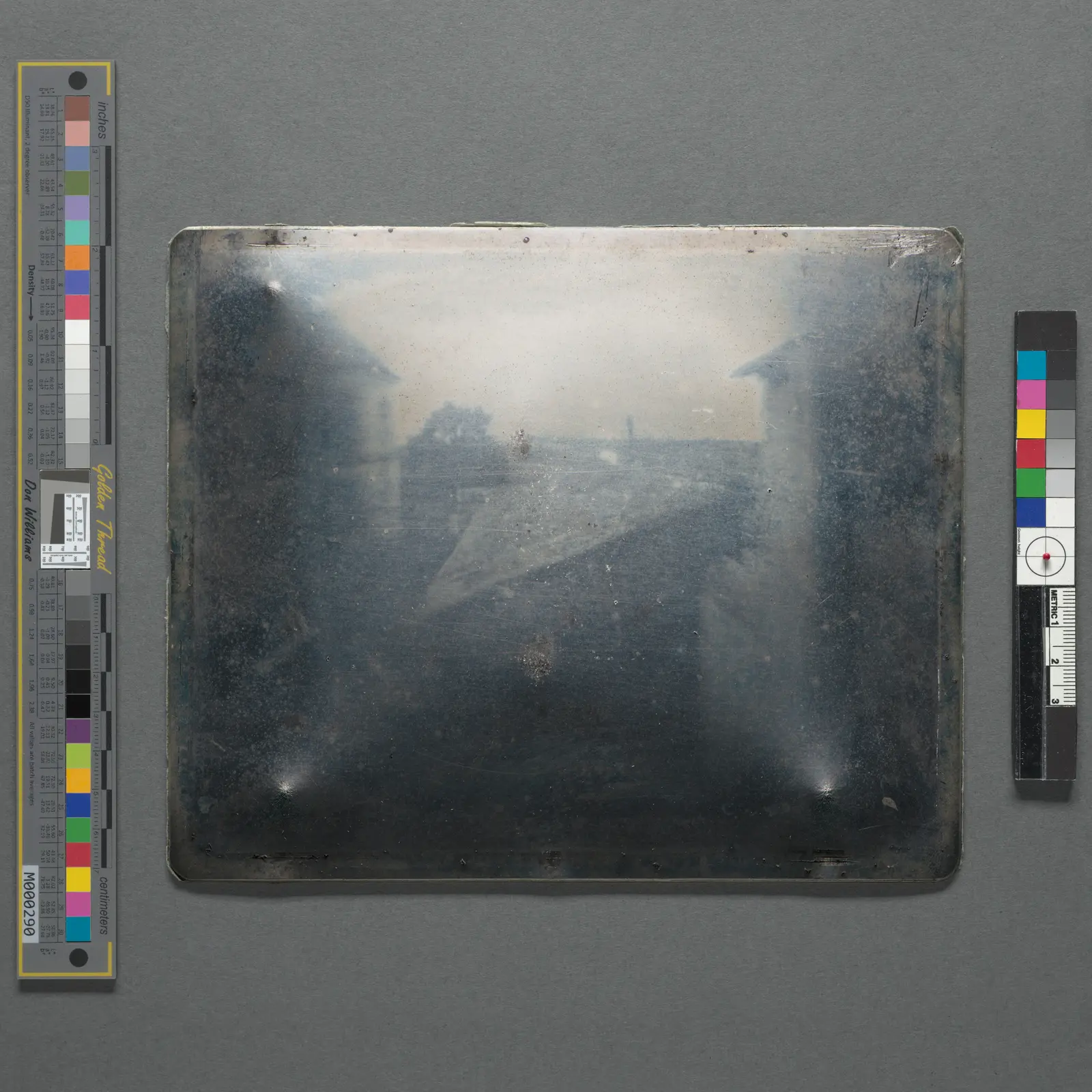
"View from the Window at Le Gras, 2020 photograph with targets" by Nicéphore Niépce — https://commons.wikimedia.org/wiki/File:Untitled_(point_de_vue),_Ni%C3%A9pce_1827_%E2%80%94_HRC_2020.jpg — Public domain (US: Nicéphore Niépce died in 1833; the plate dates from 1826 or 1827 and the Commons tag records publication before January 1, 1931; a faithful photograph of a flat public-domain work adds no new right (Bridgeman). EU: the author died more than 70 years ago; faithful reproductions of public-domain visual art carry no new right (Directive 2019/790, Article 14).); Harry Ransom Center, University of Texas at Austin, 964:0000:0001
The double date is tidy for the plate itself: image and object came into being together, so the card says same. The famous picture adds a third date, 1952, which belongs to a copy. Hokusai's Great Wave sets the reverse puzzle, with many impressions and no single original. Here there is one plate, and the trouble is seeing it.
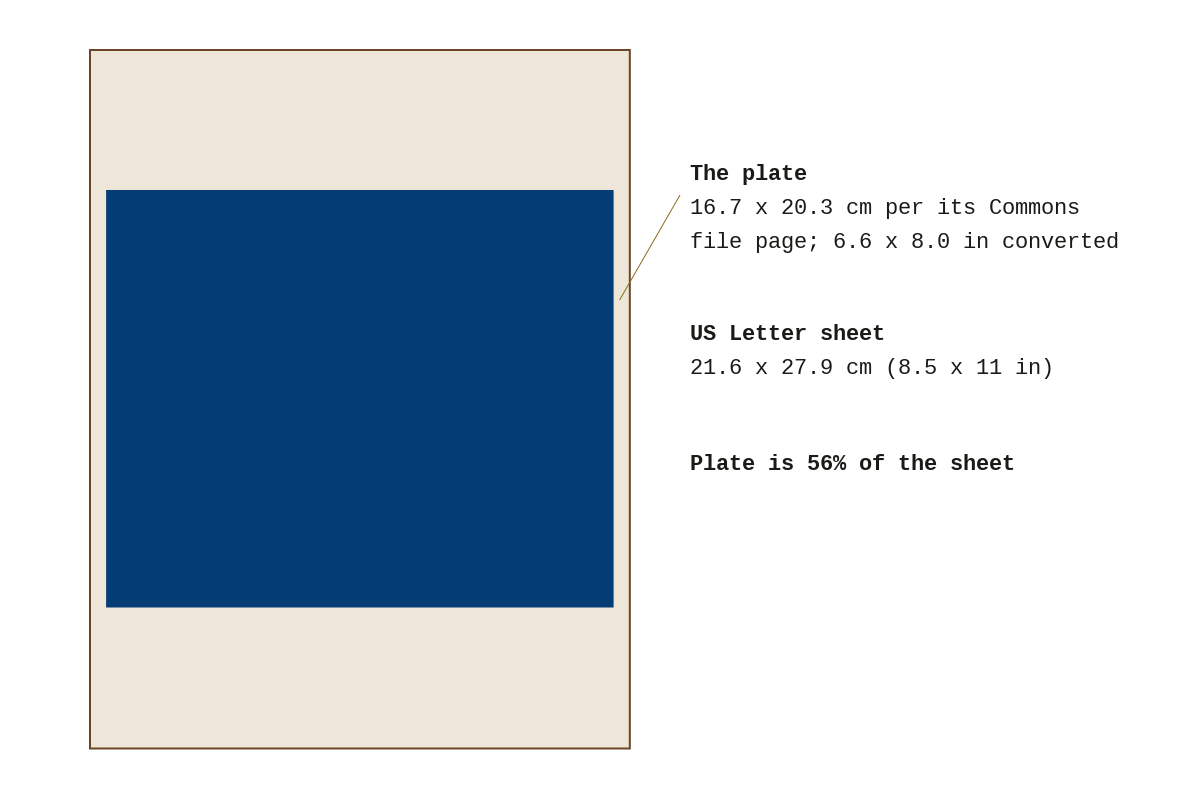
The Commons file page gives the plate as 16.7 by 20.3 centimeters (6.6 by 8.0 inches when converted), and the museum's own measurement could not be checked. At that size the plate would fit on a US Letter sheet with room to spare, covering about 56 percent of it.
Credit line to copy
"Plate size against a US Letter sheet" by Spine & Watermark, https://spineandwatermark.com/photographs/view-from-window-le-gras/, licensed under CC BY 4.0 (https://creativecommons.org/licenses/by/4.0/).Why is it so hard to see?
Two separate problems stack up, one in the viewing and one in the image. By the Ransom Center text, the image appears only when the light is controlled: as a rule, a viewer looks about 30 degrees off perpendicular, directly opposite a single point of light, ideally in a dark room with no other light.
Change those conditions and, by that account, the picture may not appear at all.
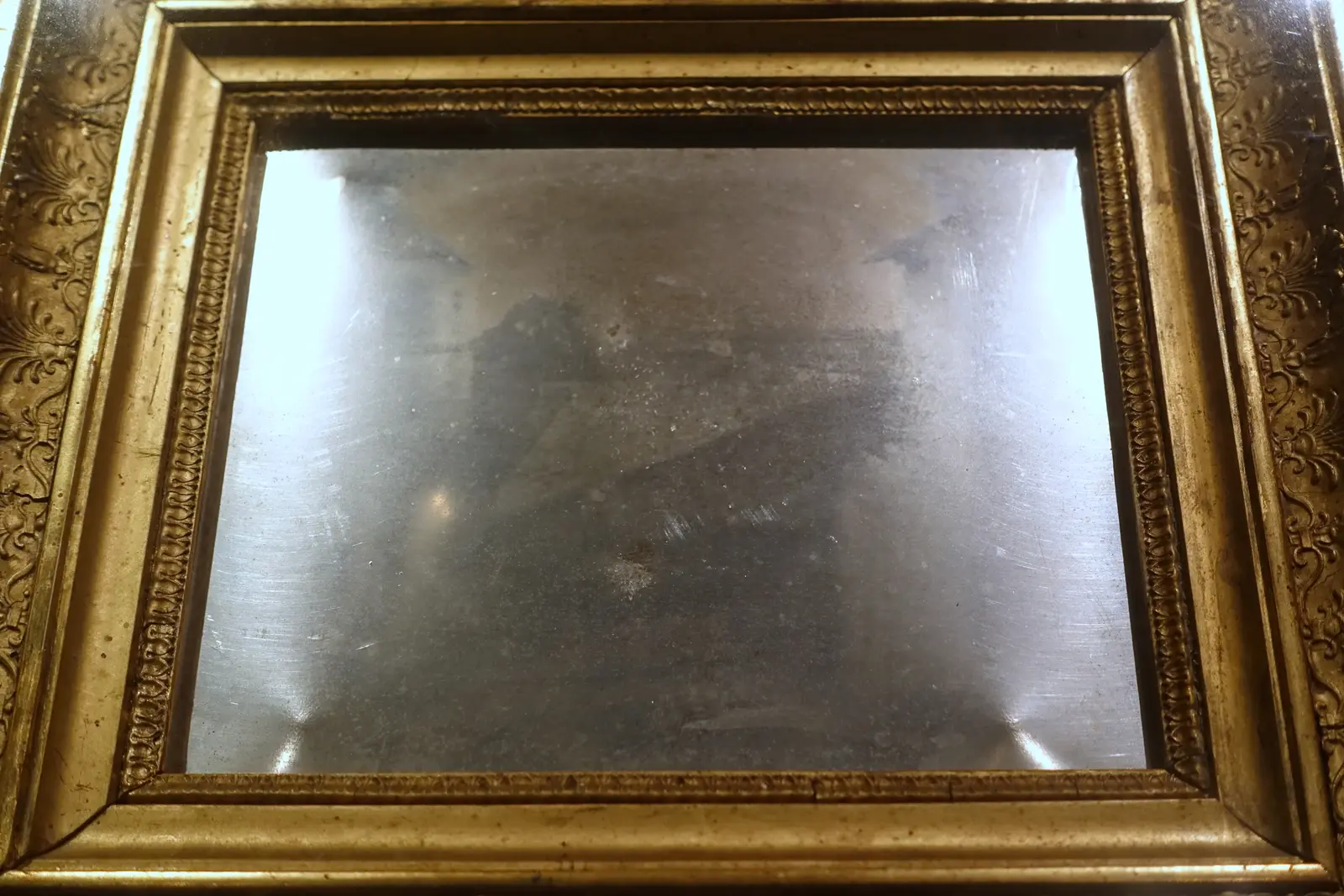

In that gallery photograph, glare whitens both sides of the metal and leaves a dark, blurred shape between them. The file page doesn't record the lighting, so the picture shows one moment and doesn't test the viewing rule.
The second problem sits in the image itself, since the same text calls the details very faint and blames Niépce's underexposure, not fading, and it describes the process as relatively permanent.
The Ransom Center text reads the view for you, from left to right:
- at far left, the top story of the family house, nicknamed the pigeon-house
- next, a pear tree, with sky showing in a gap among its branches
- then the barn's sloped roof, and behind it the bake house, long-roofed with a low chimney
- at far right, a second wing of the house
Those names come from that text, not from the picture.
The famous copy changes the picture. Helmut Gernsheim had Eastman Kodak's London research lab reproduce the plate in March 1952, then retouched the result in watercolor, aiming at his own idea of how the plate ought to look in reproduction, the text says. It adds that the dotted look comes from the copying and isn't on the plate.
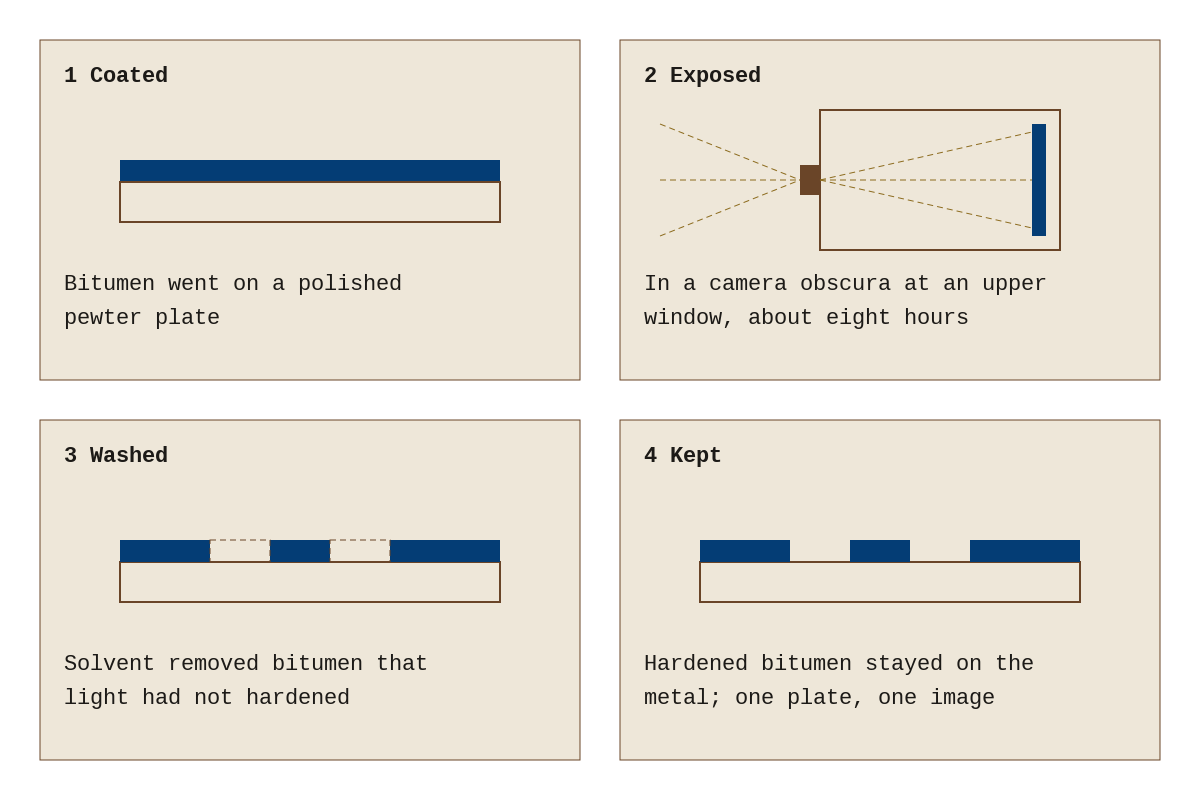
Made: bitumen, a long exposure and a wash
These steps follow the Ransom Center text, which says what happened on the plate; they give no amounts and make no claim about how the dots described in the next section formed.
- The coat. The polished pewter had a coat of bitumen of Judea, an asphalt.
- The exposure. The plate went into a camera obscura, a dark box with a lens, in an upstairs window.
- The wash. A solvent dissolved the bitumen that light had not hardened.
- The result. The hardened parts stayed on the metal, leaving one direct positive on pewter.
Credit line to copy
"Heliograph steps, no amounts or timings beyond the recorded exposure" by Spine & Watermark, https://spineandwatermark.com/photographs/view-from-window-le-gras/, licensed under CC BY 4.0 (https://creativecommons.org/licenses/by/4.0/).The Ransom Center text gives eight hours for the exposure, without showing how that figure was reached. Longer estimates turn up in accounts that could not be read for this entry, so no longer figure appears here.
For the wash, that text names oil of lavender with white petroleum. Niépce himself called the method heliography, according to the same text.
Printing was close to this work. Niépce began by copying engravings, and Getty reports that another of his plates, Le Cardinal d'Amboise, has a deep etch meant for ink printing, yet it never took ink or pulled a print. Plates made to print work by holding ink. The Ransom Center text treats the Le Gras plate as a one-of-a-kind picture on metal.
What did Getty find on the plate?
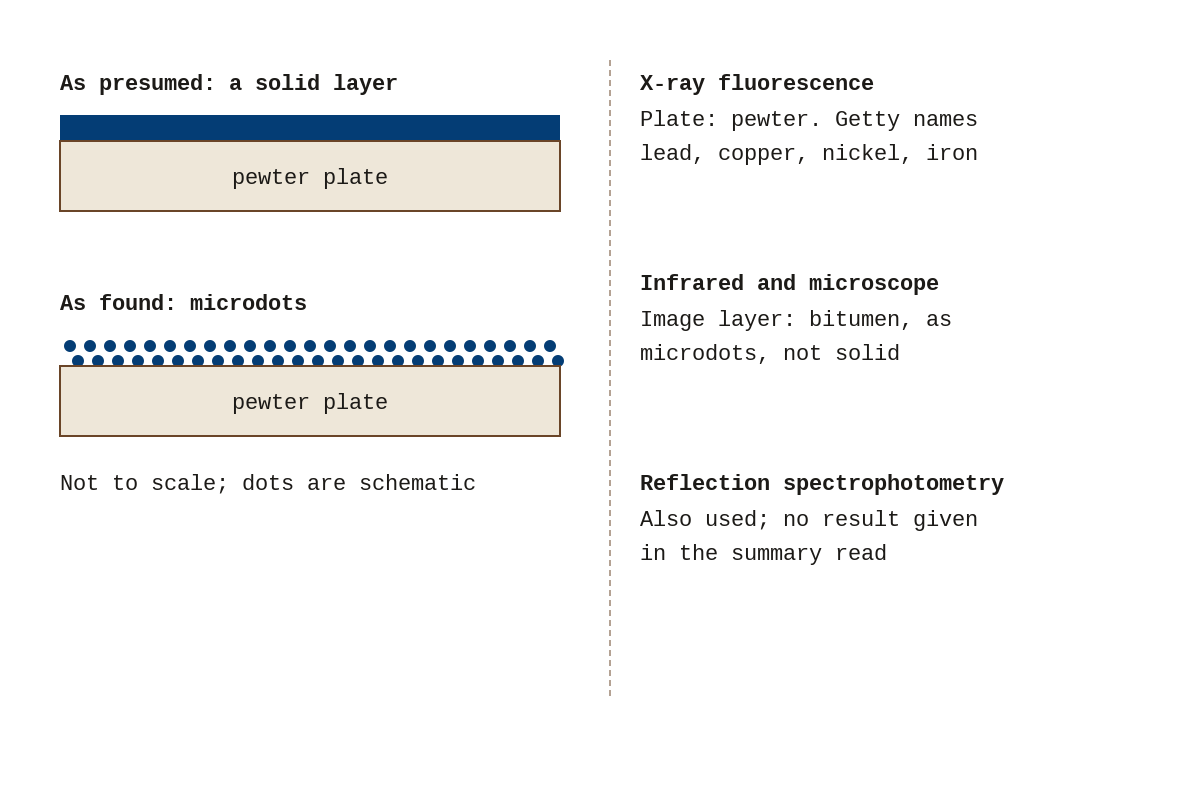
The plate reached the Getty Conservation Institute in June 2002, and by Getty's account the Ransom Center asked for the first scientific study of its materials and condition. The Institute's team used noninvasive tests. X-ray fluorescence, which reads the elements in a surface, confirmed pewter and named lead, copper, nickel and iron. Infrared spectrometry and microscopy confirmed that the image layer is bitumen.
That layer was not solid, as had been presumed; Getty describes it as microdots.
Credit line to copy
"What the tests found on the plate" by Spine & Watermark, https://spineandwatermark.com/photographs/view-from-window-le-gras/, licensed under CC BY 4.0 (https://creativecommons.org/licenses/by/4.0/).Don't merge these dots with the dotted look of the 1952 copy. Getty's belong to the image layer and came out of a lab study that included microscopy, while the others, per the Ransom Center text, come from the copying and aren't on the plate. That text ran in September 2002, three months after the plate reached Getty, and no source read here connects the two.
Lived: a lost plate, then a sealed case
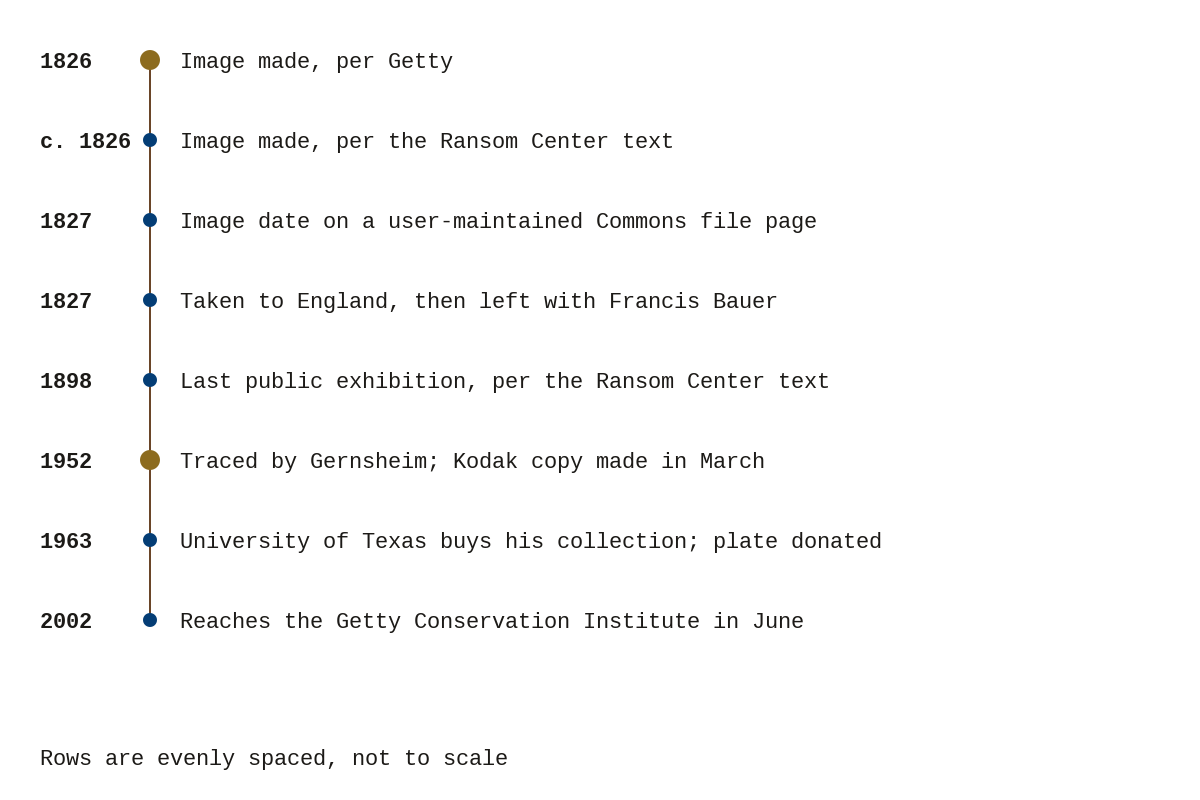
Niépce took the plate to England in 1827, hoping to interest the Royal Society, and he left it with his host, the botanist Francis Bauer, before his own death in 1833. In 1829 he had teamed up with the French artist Louis Daguerre, the Ransom Center text says, yet he made little more after that. The plate later left Bauer's estate and changed hands more than once, per the Ransom Center text, which gives 1898 as its last public exhibition.
Credit line to copy
"The plate, from Getty’s 1826 date to 2002" by Spine & Watermark, https://spineandwatermark.com/photographs/view-from-window-le-gras/, licensed under CC BY 4.0 (https://creativecommons.org/licenses/by/4.0/).| Year | What the source reports | Source |
|---|---|---|
| 1826 | Image made | Getty |
| c. 1826 | Image made | Ransom Center text |
| 1827 | Image date on a user-maintained file page | Commons file page |
| 1827 | Taken to England, then left with Francis Bauer | Ransom Center text |
| 1898 | Last public exhibition | Ransom Center text |
| 1952 | Traced by Gernsheim; Kodak copy made in March | Ransom Center text |
| 1963 | Texas buys his collection, and he then gives the plate | Ransom Center text |
| 2002 | Reaches the Getty Conservation Institute in June | Getty |
As for Gernsheim's find, the Ransom Center text has relatives of the last recorded owner forgetting that the plate was in storage.
Getty judged the overall condition good and reported corrosion only in small patches at the edges, and the 2020 photograph also shows those bright marks near three corners, plus scratches across the metal. The handling scar means a mark left by use rather than by making. No handling scar can be confirmed from the record. For the bright marks and the scratches: cause not established.
The Ransom Center text reprinted in 2002 has the plate in inert gas inside a steel and Plexiglas frame. Getty scientists built a new case that holds it in nitrogen without oxygen, with sensors to watch for changes in the air inside.
Getty says the microdots raise new questions about how the image was made and how to keep it, and the summary read here doesn't answer them. Gernsheim's 1977 article in History of Photography is listed below but could not be read. So how the dots formed, how long the exposure ran and where the plate spent its lost years all stay open on this page.
Turn it over:
The record read for this entry shows no view of the plate's own back. The frame is a different matter: Francis Bauer wrote Niépce's name and other details on its paper backing, per the Ransom Center text, and no transcription could be read.
- Carte de Visite: photographs that come with a card you can read: Later paper portraits add a mount and a back that can narrow a date.
- Cyanotype: a later photographic object that needed no camera: Sixteen years after Getty's date for this plate, John Herschel named a process that could work with no lens at all.
Sources
- Getty Conservation Institute, "Applied Research of Photographic Processes," The First Photograph Project and Niépce in England Conference sections. getty.eduRead: full project page
- "The World’s First Photograph," WAAC Newsletter, September 2002, text taken from the Harry Ransom Center website, hosted by Conservation OnLine. cool.culturalheritage.orgRead: full article
- Wikimedia Commons, file page for "Untitled (point de vue), Niépce 1827 — HRC 2020 (cropped)." commons.wikimedia.orgRead: full file page; a user-maintained record, not the museum’s
- Harry Ransom Center, University of Texas at Austin, page for the Niépce heliograph. hrc.utexas.eduRead: bibliography only: holding link, page not read
- Helmut Gernsheim, "The 150th Anniversary of Photography," History of Photography 1, no. 1 (1977): 3–8. DOI 10.1080/03087298.1977.10442876. doi.orgRead: bibliography only
Image credits
- "View from the Window at Le Gras, 2020 photograph, cropped" by Nicéphore Niépce — https://commons.wikimedia.org/wiki/File:Untitled_(point_de_vue),_Ni%C3%A9pce_1827_%E2%80%94_HRC_2020_(cropped).jpg — Public domain (US: Nicéphore Niépce died in 1833; the plate dates from 1826 or 1827 and the Commons tag records publication before January 1, 1931; a faithful photograph of a flat public-domain work adds no new right (Bridgeman). EU: the author died more than 70 years ago; faithful reproductions of public-domain visual art carry no new right (Directive 2019/790, Article 14).); Harry Ransom Center, University of Texas at Austin, 964:0000:0001
- "View from the Window at Le Gras, 2020 photograph with targets" by Nicéphore Niépce — https://commons.wikimedia.org/wiki/File:Untitled_(point_de_vue),_Ni%C3%A9pce_1827_%E2%80%94_HRC_2020.jpg — Public domain (US: Nicéphore Niépce died in 1833; the plate dates from 1826 or 1827 and the Commons tag records publication before January 1, 1931; a faithful photograph of a flat public-domain work adds no new right (Bridgeman). EU: the author died more than 70 years ago; faithful reproductions of public-domain visual art carry no new right (Directive 2019/790, Article 14).); Harry Ransom Center, University of Texas at Austin, 964:0000:0001
- "Plate size against a US Letter sheet" by Spine & Watermark, https://spineandwatermark.com/photographs/view-from-window-le-gras/, licensed under CC BY 4.0 (https://creativecommons.org/licenses/by/4.0/).
- "View from the Window at Le Gras on display at the Harry Ransom Center" by Daderot — https://commons.wikimedia.org/wiki/File:View_from_the_Window_at_Le_Gras,_by_Joseph_Nicephore_Niepce,_1826_or_1827,_France_-_Harry_Ransom_Center_-_University_of_Texas_at_Austin_-_DSC08424.jpg — CC0 1.0 (https://creativecommons.org/publicdomain/zero/1.0/); Harry Ransom Center, University of Texas at Austin, 964:0000:0001 per the sibling Commons file page
- "Heliograph steps, no amounts or timings beyond the recorded exposure" by Spine & Watermark, https://spineandwatermark.com/photographs/view-from-window-le-gras/, licensed under CC BY 4.0 (https://creativecommons.org/licenses/by/4.0/).
- "What the tests found on the plate" by Spine & Watermark, https://spineandwatermark.com/photographs/view-from-window-le-gras/, licensed under CC BY 4.0 (https://creativecommons.org/licenses/by/4.0/).
- "The plate, from Getty’s 1826 date to 2002" by Spine & Watermark, https://spineandwatermark.com/photographs/view-from-window-le-gras/, licensed under CC BY 4.0 (https://creativecommons.org/licenses/by/4.0/).
Cite this page
Spine & Watermark. “View From the Window at Le Gras: Why Is It So Hard to See?.” Spine & Watermark, published November 7, 2026. https://spineandwatermark.com/photographs/view-from-window-le-gras/. Accessed [date].
How sources are ranked · All corrections · Contact · Report an error (contact@spineandwatermark.com)