Great Wave off Kanagawa: Is There One Original Print?
Published · Revised
TL;DR: Hokusai's Great Wave off Kanagawa is a color woodblock print, so museums hold separate impressions, not one original. The Art Institute of Chicago catalogues three, dated 1830/33, and says all are later than the design's first state. No record read for this page gives the size of the print run.
Collation: color woodblock print; oban · 25.4 × 37.6 cm (10 × 14 13/16 in.) · image 1830/33 / object 1830/33 (one date field in the record; it does not date the two separately) · Art Institute of Chicago, 1952.343
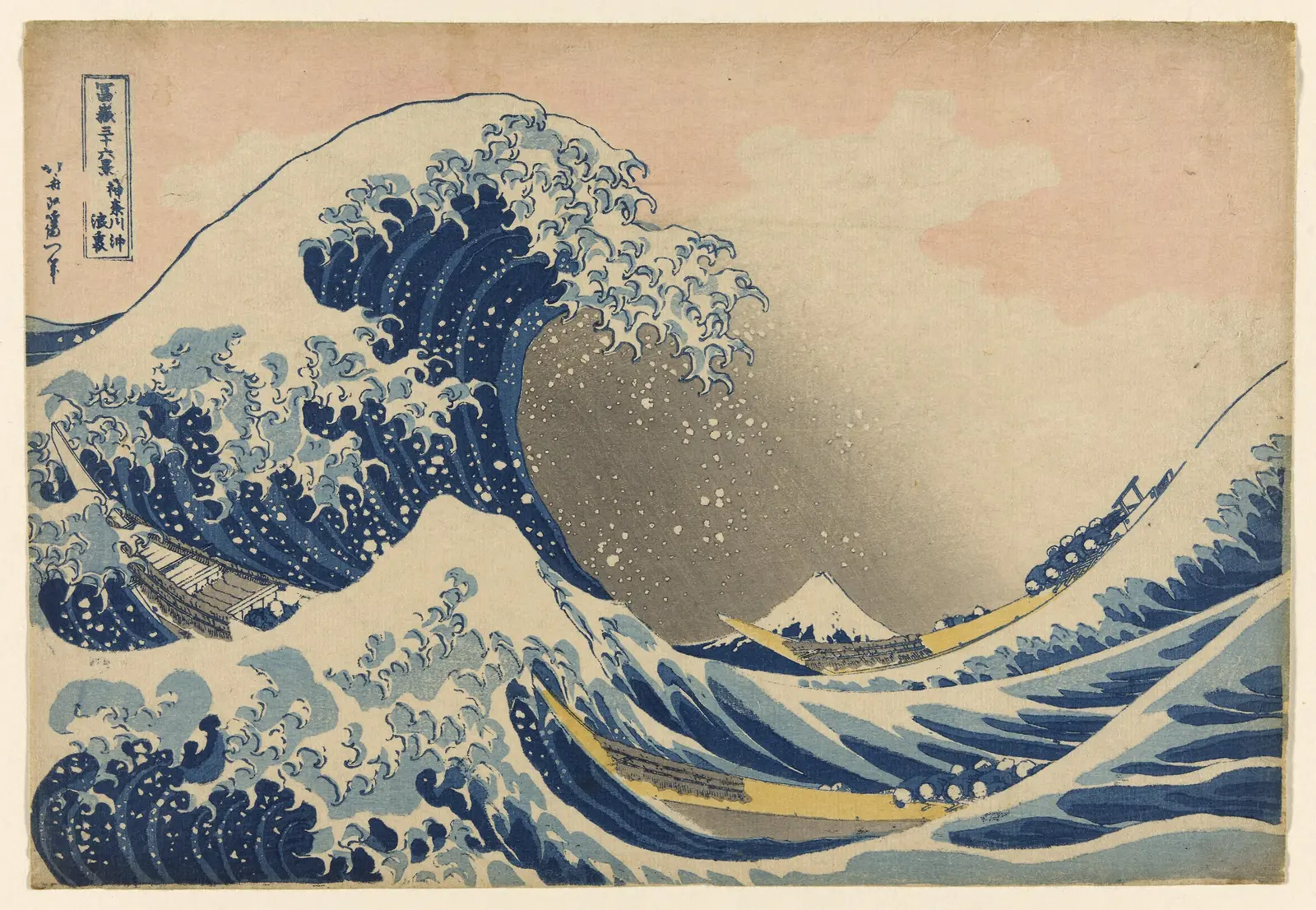

Collation card, all fields
- Object
- Under the Wave off Kanagawa (Kanagawa oki nami ura), also known as The Great Wave api.artic.edu
- Type
- print api.artic.edu
- Process
- color woodblock print; oban api.artic.edu
- Format & size
- 25.4 × 37.6 cm (10 × 14 13/16 in.) api.artic.edu
- Material
- paper, per the Rijksmuseum record of its impression; the AIC record does not name it data.rijksmuseum.nl
- Made
- image 1830/33 / object 1830/33 (one date field in the record; it does not date the two separately) api.artic.edu
- Held at
- Art Institute of Chicago, 1952.343, artic.edu api.artic.edu
- Date basis
- Holding record: AIC date field, 1830/33 api.artic.edu
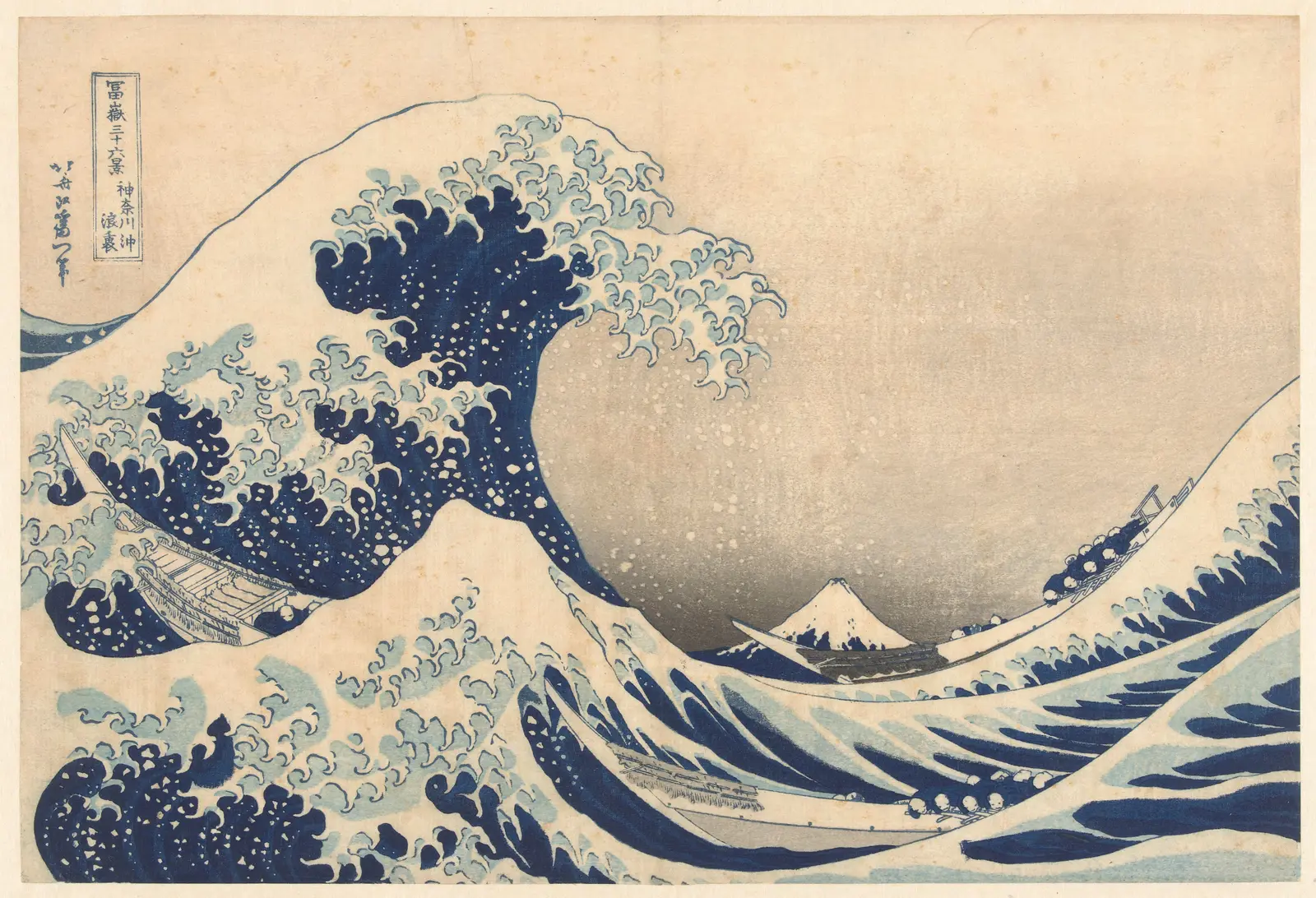
Set two museum impressions of this print side by side and compare the skies. In the Art Institute of Chicago's photograph of 1952.343, a cloud sits against a pink upper sky, while in the Metropolitan Museum of Art's photograph of JP10 the same area is a nearly even tan. The question is which one is the Great Wave off Kanagawa, and whether either counts as the original.
Is there one original Great Wave?
The print's catalogue title is Under the Wave off Kanagawa, from the series Thirty-Six Views of Mount Fuji. The Rijksmuseum's description records a high wave about to break over three rowing boats, with Mount Fuji in the background, and the Art Institute of Chicago (AIC) calls it the most famous image of the set.
Now count the records. AIC catalogues three impressions, numbered 1925.3245, 1928.1086 and 1952.343; the Met's open data file lists four under this title; and the Rijksmuseum in Amsterdam holds RP-P-1956-733. The total is eight sheets in three museums, a sample from the records read for this page and not a census of every surviving sheet.
An impression is one sheet printed from the blocks. Getty's Art & Architecture Thesaurus keeps that word for the individual printed image, and it advises against the phrase “original prints” except when discussing the phrase itself. So the useful question is how each surviving sheet relates to the others, not which sheet is the original.
How many were printed? The Library of Congress says woodblock printing produced ukiyo-e, the popular Edo-period prints and books, in quantity and at relatively low cost, but no record read for this page gives a print run for this design, so this page gives no figure. A 1914 magazine poster of Kitchener raises the same question, and the record read for it gives no print run either.
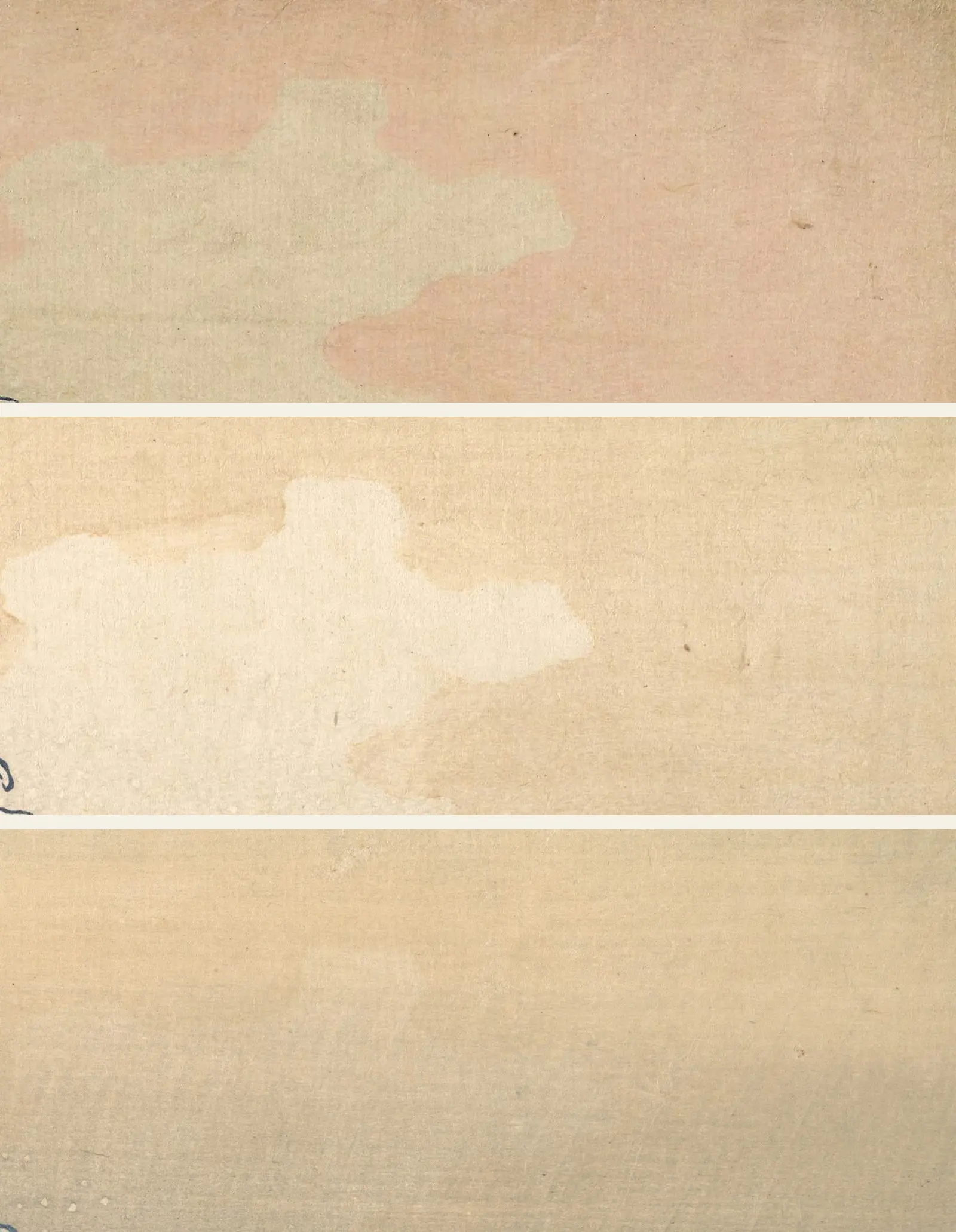
Look at the cloud in each strip. On 1952.343 it reads gray-green against pink, on JP2569 it is a pale shape against tan, and on JP10 it is barely there. Printing, age and the photograph itself could each play a part, and none of the records read here says which.
Made: carved blocks, then one sheet at a time
The Library of Congress describes Edo-period ukiyo-e as the work of four people: a publisher, an artist who drew the design, a carver and a printer. The AIC records name two of them for this print, the designer Katsushika Hokusai (1760–1849) and the publisher Nishimura-ya Yohachi. They name no carver or printer. Think of the blocks as dies in metal, and of each sheet as one strike.
The Library's conservators describe the general sequence in traditional Japanese printmaking:
- The black lines, which often include the seals of publisher and censor, are cut and printed as a keyblock print.
- Color areas are marked on that print, which then guides the cutting of a separate block for each color.
- Guide marks cut into each block keep the colors in register, or aligned.
- A dampened sheet goes on the inked block, is rubbed with a baren, a round pad covered in bamboo fiber, and is peeled off to dry.
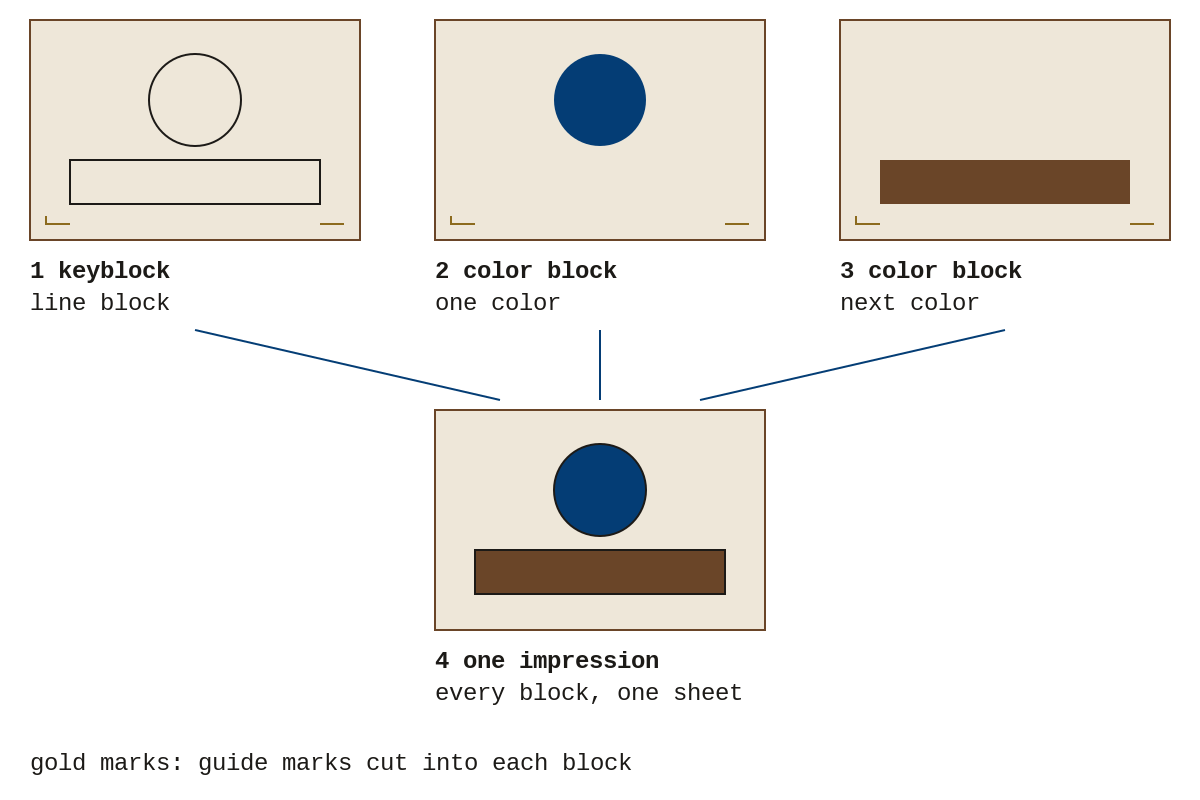
Credit line to copy
"One Keyblock, a Block for Each Color" by Spine & Watermark, https://spineandwatermark.com/print/great-wave-off-kanagawa/, licensed under CC BY 4.0 (https://creativecommons.org/licenses/by/4.0/).The Library's exhibition places multicolor printing from around the mid-18th century and says Edo-period block counts averaged ten to sixteen, while its conservators suggest as many as seven for one print they treated. No record read here gives the number for the Great Wave. The Rijksmuseum's technique note does add one detail for its own sheet, a line block in blue with color blocks, so the general account of black lines doesn't describe every impression.
The AIC medium line ends with oban, a format label, and the Library's exhibition lists most of its ôban prints at 15 by 10 inches beside narrower hosoban at 13 by 5 5/8 inches. Folio, quarto and octavo are format names of another kind. They count the folds in a printed sheet.
Why do later impressions carry the same date?
All three AIC records display 1830/33. Yet the description attached to all three says they are “later impressions than the first state” of the design. Getty's cataloguing guide calls a state any stage of a printing matrix at which impressions are taken, with a new state beginning when the matrix is altered.
That is the double date at work: every document object has the date of its content and the date the physical thing was made. The AIC date field holds one value, so the Collation card writes 1830/33 for both image and object, which repeats the record and doesn't mean each sheet was dated from its own physical evidence.
The museums' ranges differ too. AIC displays 1830/33, with start and end years of 1825–1838 on two records and 1826–1836 on the third; the Met gives ca. 1830–32, with begin and end years of 1820 and 1842; the Rijksmuseum gives 1829–1833. AIC's description also says the series was begun in 1830, when Hokusai was 70; this page doesn't choose among those ranges.
Later does not mean lesser here: a later impression is still evidence of how these blocks were used.
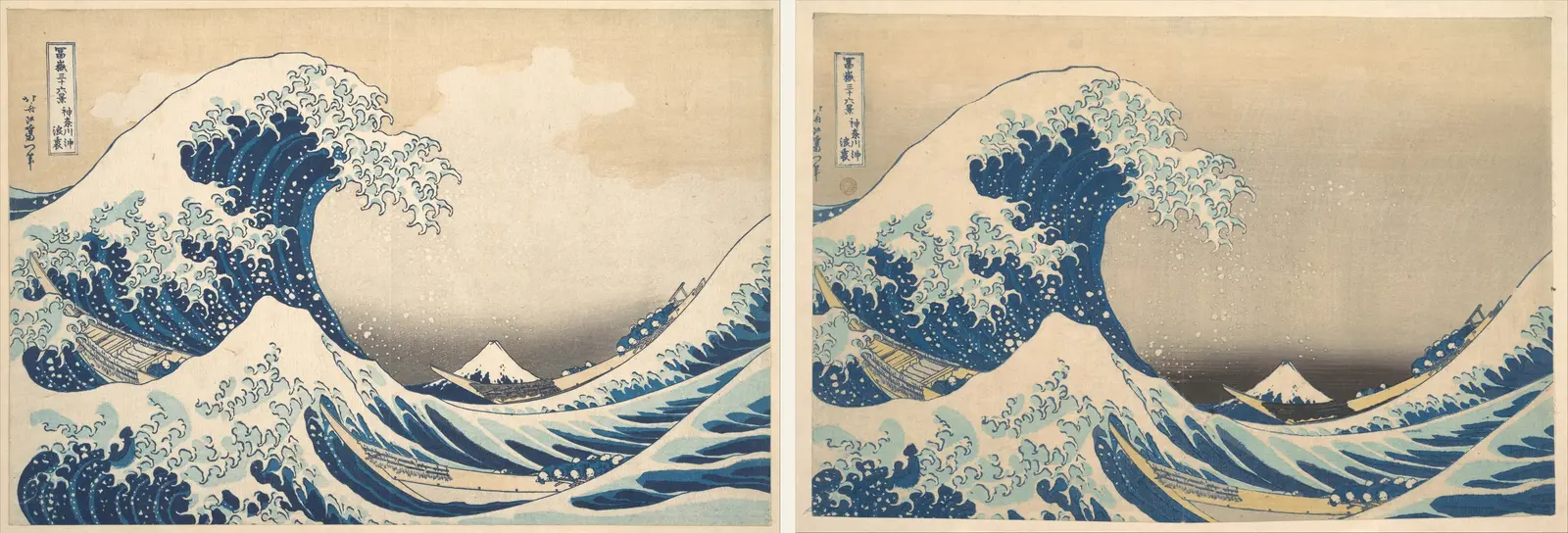

The Met gives these two sheets one date and no state, so its rows can't tell you which came first. AIC's record for 1925.3245 lists Matthi Forrer's Hokusai (1988) and Richard Lane's Hokusai: Life and Work (1989), and Christine Guth wrote on these waves in The Art Bulletin in 2011. None of the three could be read for this page, so they are listed and not used.
The View from the Window at Le Gras raises a related question, whether you are looking at the object or at something printed from it.
Where can you see it, and how big is it?
These are the eight records read for this page, with each museum's own date and size; a record shows that a museum holds the sheet, not that it is on display, so check with the museum before you travel.
| Holding | Accession no. | Date per record | Height × width (cm) | In inches (computed) |
|---|---|---|---|---|
| Art Institute of Chicago | 1925.3245 | 1830/33 | 25.4 × 37.6 | 10.0 × 14.8 |
| Art Institute of Chicago | 1928.1086 | 1830/33 | 25.4 × 37.6 | 10.0 × 14.8 |
| Art Institute of Chicago | 1952.343 | 1830/33 | 25.4 × 37.6 | 10.0 × 14.8 |
| Metropolitan Museum of Art | JP10 | ca. 1830–32 | 24.4 × 35.7 | 9.6 × 14.1 |
| Metropolitan Museum of Art | JP1847 | ca. 1830–32 | 25.7 × 37.9 | 10.1 × 14.9 |
| Metropolitan Museum of Art | JP2569 | ca. 1830–32 | 25.4 × 38.1 | 10.0 × 15.0 |
| Metropolitan Museum of Art | JP2972 | ca. 1830–32 | 25.1 × 37.8 | 9.9 × 14.9 |
| Rijksmuseum | RP-P-1956-733 | 1829–1833 | 25.4 × 37.5 | 10.0 × 14.8 |
Download the data (great-wave-impressions.csv) · source and license notes Data: Art Institute of Chicago, description text of artworks 24645, 77333 and 89503, CC BY 4.0, https://creativecommons.org/licenses/by/4.0/, https://api.artic.edu/api/v1/artworks/77333, retrieved 2026-11-07
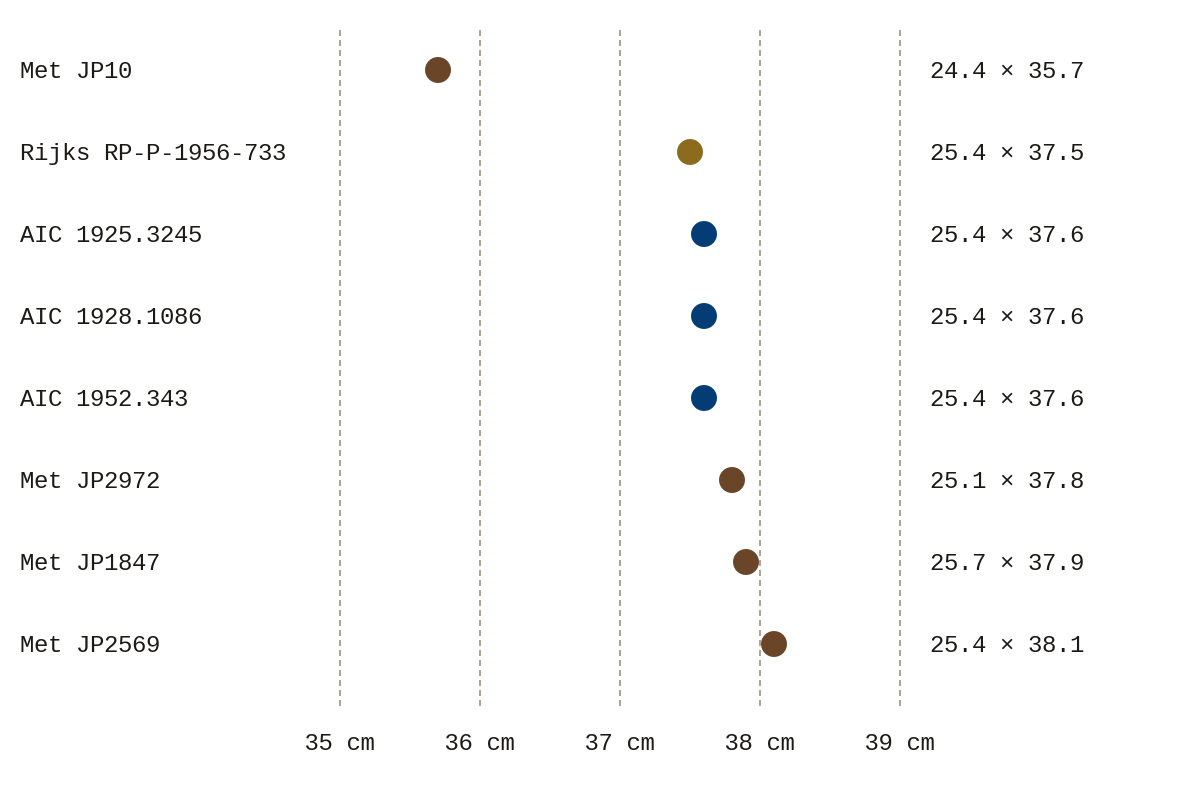
Recorded widths run from 35.7 to 38.1 cm, and that 2.4 cm gap is about 6 percent of the widest sheet, while heights run from 24.4 to 25.7 cm, a gap of 1.3 cm. The records read don't say why the sheets differ, whether through trimming, measuring practice or something else.
Credit line to copy
"Recorded Widths of Eight Impressions" by Spine & Watermark, https://spineandwatermark.com/print/great-wave-off-kanagawa/, licensed under CC BY 4.0 (https://creativecommons.org/licenses/by/4.0/).Even the arithmetic varies. All three AIC records give 25.4 × 37.6 cm, but 1952.343 converts the width to 14 13/16 inches while the other two say 14 3/4. By calculation, 37.6 cm is 14.8 inches.
Lived: who held these sheets
This site calls a mark left by use rather than by making the handling scar. No handling scar can be confirmed from the record for 1952.343, so ownership is the easier story to follow. Clarence Buckingham of Chicago bought 1925.3245 from Yamanaka & Company in December 1905, and it reached AIC as a gift in 1925. Kate Sturges Buckingham bought 1928.1086 from Alexander G. Mosle in May 1928 and gave it to AIC that year, and AIC bought 1952.343 from Frederick Standish Colburn in 1952.
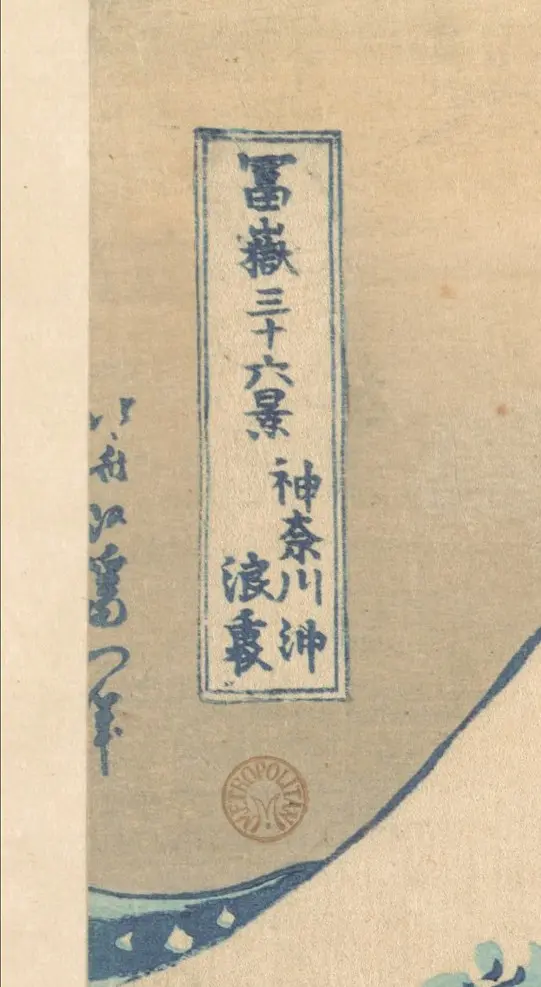
The Met's credit lines carry a year for each sheet there: JP10 in 1914, JP1847 in 1929, JP2569 in 1936 and JP2972 in 1939. The Met's photograph of JP10 also shows a small round brown stamp near the signature. The CSV row doesn't mention the stamp, so its origin here is cause not established.

What is still unread in these skies?

Go back to the three strips. AIC places its sheets after a first state, but its records don't say what changed at that step or how the three rank among themselves. The Met and Rijksmuseum records read here give no state at all. Until a record or study that can be read puts these eight in order, the pink sky on 1952.343 stays an observation and not a date.
Turn it over:
The records read give inscriptions but describe no back. AIC reads the signature as Hokusai aratame Iitsu fude and names the publisher as Nishimura-ya Yohachi. The record shows no reverse.
- Intaglio vs Relief Printing: why a woodblock counts as relief: The process terms these records use, and where they stop.
- Letterpress: relief printing with metal type in Europe: The same raised-surface idea, cast in metal.
Sources
- Art Institute of Chicago, Katsushika Hokusai, "Under the Wave off Kanagawa (Kanagawa oki nami ura), also known as The Great Wave," 1952.343, collection data. The description text is licensed CC BY 4.0; all other fields CC0. api.artic.eduRead: full data recordText license: CC-BY-4.0 (description field); CC0 (other fields)
- Art Institute of Chicago, Katsushika Hokusai, "Under the Wave off Kanagawa (Kanagawa oki nami ura), also known as The Great Wave," 1925.3245, collection data. The description text is licensed CC BY 4.0; all other fields CC0. api.artic.eduRead: full data recordText license: CC-BY-4.0 (description field); CC0 (other fields)
- Art Institute of Chicago, Katsushika Hokusai, "Under the Wave off Kanagawa (Kanagawa oki nami ura), also known as The Great Wave," 1928.1086, collection data. The description text is licensed CC BY 4.0; all other fields CC0. api.artic.eduRead: full data recordText license: CC-BY-4.0 (description field); CC0 (other fields)
- The Metropolitan Museum of Art, Open Access CSV (MetObjects.csv), rows for JP10, JP1847, JP2569 and JP2972. CC0. github.comRead: full file searched; four rows usedText license: CC0
- Rijksmuseum, Katsushika Hokusai, "Under the Wave off Kanagawa," RP-P-1956-733, collection data. data.rijksmuseum.nlRead: full data record
- Getty Research Institute, Art & Architecture Thesaurus, "prints (visual works)," ID 300041273, scope note. getty.eduRead: full record
- Getty, Categories for the Description of Works of Art, section 9, "State." getty.eduRead: full section
- Library of Congress, Preservation Directorate, "Conservation Treatment of a Japanese Pillar Print." loc.govRead: full page
- Library of Congress, The Floating World of Ukiyo-e, "Overview." loc.govRead: full page
- Library of Congress, The Floating World of Ukiyo-e, "Exhibition Items." loc.govRead: full page, for the format labels in the item list
- Library of Congress, The Floating World of Ukiyo-e, "Early Masters." loc.govRead: full page
- Matthi Forrer, Hokusai (Royal Academy of Arts, London, 1988), p. 264. api.artic.eduRead: bibliography only, as listed in the AIC record for 1925.3245
- Richard Lane, Hokusai: Life and Work (London, 1989), pp. 189, 192. api.artic.eduRead: bibliography only, as listed in the AIC record for 1925.3245
- Christine M. E. Guth, "Hokusai's Great Waves in Nineteenth-Century Japanese Visual Culture," The Art Bulletin 93(4), 2011, 468–485. doi.orgRead: bibliography only, from Crossref
Image credits
- "Under the Wave off Kanagawa, also known as The Great Wave" by Katsushika Hokusai — https://commons.wikimedia.org/wiki/File:1952.343_-_Under_the_Wave_off_Kanagawa_(Kanagawa_oki_nami.jpg — CC0 1.0 (https://creativecommons.org/publicdomain/zero/1.0/); Art Institute of Chicago, 1952.343
- "Upper-right sky of three impressions" by Katsushika Hokusai — https://commons.wikimedia.org/wiki/File:1952.343_-_Under_the_Wave_off_Kanagawa_(Kanagawa_oki_nami.jpg — CC0 1.0 (https://creativecommons.org/publicdomain/zero/1.0/); Art Institute of Chicago, 1952.343; Metropolitan Museum of Art, JP2569 and JP10; modified: cropped to the same relative box from three files, stacked in one image with paper-colored gaps
- "One Keyblock, a Block for Each Color" by Spine & Watermark, https://spineandwatermark.com/print/great-wave-off-kanagawa/, licensed under CC BY 4.0 (https://creativecommons.org/licenses/by/4.0/).
- "Two Met impressions side by side" by Katsushika Hokusai — https://commons.wikimedia.org/wiki/File:%E3%80%8C%E5%AF%8C%E5%B6%BD%E4%B8%89%E5%8D%81%E5%85%AD%E6%99%AF_%E7%A5%9E%E5%A5%88%E5%B7%9D%E6%B2%96%E6%B5%AA%E8%A3%8F%E3%80%8D-Under_the_Wave_off_Kanagawa_(Kanagawa_oki_nami_ura),_or_The_Great_Wave,_from_the_series_Thirty-six_Views_of_Mount_Fuji_(Fugaku_sanj%C5%ABrokkei)_MET_DP141042.jpg — CC0 1.0 (https://creativecommons.org/publicdomain/zero/1.0/); Metropolitan Museum of Art, JP2569 and JP10; modified: two files placed side by side at equal height, JP2569 left, scaled down
- "Recorded Widths of Eight Impressions" by Spine & Watermark, https://spineandwatermark.com/print/great-wave-off-kanagawa/, licensed under CC BY 4.0 (https://creativecommons.org/licenses/by/4.0/).
- "Detail of JP10: cartouche, signature and stamp" by Katsushika Hokusai — https://commons.wikimedia.org/wiki/File:%E5%86%A8%E5%B6%BD%E4%B8%89%E5%8D%81%E5%85%AD%E6%99%AF_%E7%A5%9E%E5%A5%88%E5%B7%9D%E6%B2%96%E6%B5%AA%E8%A3%8F-Under_the_Wave_off_Kanagawa_(Kanagawa_oki_nami_ura),_also_known_as_The_Great_Wave,_from_the_series_Thirty-six_Views_of_Mount_Fuji_(Fugaku_sanj%C5%ABrokkei)_MET_DP141063.jpg — CC0 1.0 (https://creativecommons.org/publicdomain/zero/1.0/); Metropolitan Museum of Art, JP10; modified: cropped to the left side of the sheet
- "Under the Wave off Kanagawa" by Katsushika Hokusai — https://commons.wikimedia.org/wiki/File:Hokusai,_The_Underwave_off_Kanagawa.jpg — Public domain (Katsushika Hokusai died in 1849; design published 1830/33. United States: published before 1931. European Union: author dead more than 70 years.); Rijksmuseum, RP-P-1956-733
Cite this page
Spine & Watermark. “Great Wave off Kanagawa: Is There One Original Print?.” Spine & Watermark, published November 7, 2026. https://spineandwatermark.com/print/great-wave-off-kanagawa/. Accessed [date].
How sources are ranked · All corrections · Contact · Report an error (contact@spineandwatermark.com)