Folio, Quarto, Octavo: To Bibliographers, They Count Folds
Published · Revised
TL;DR: Folio, quarto and octavo name how many times a printed sheet was folded: once, twice or three times, in the ideal model bibliographers use. A quarto therefore gives four leaves and eight pages per sheet. The names describe structure, not exact size, so a folio from a small sheet can be shorter than a quarto from a large one.
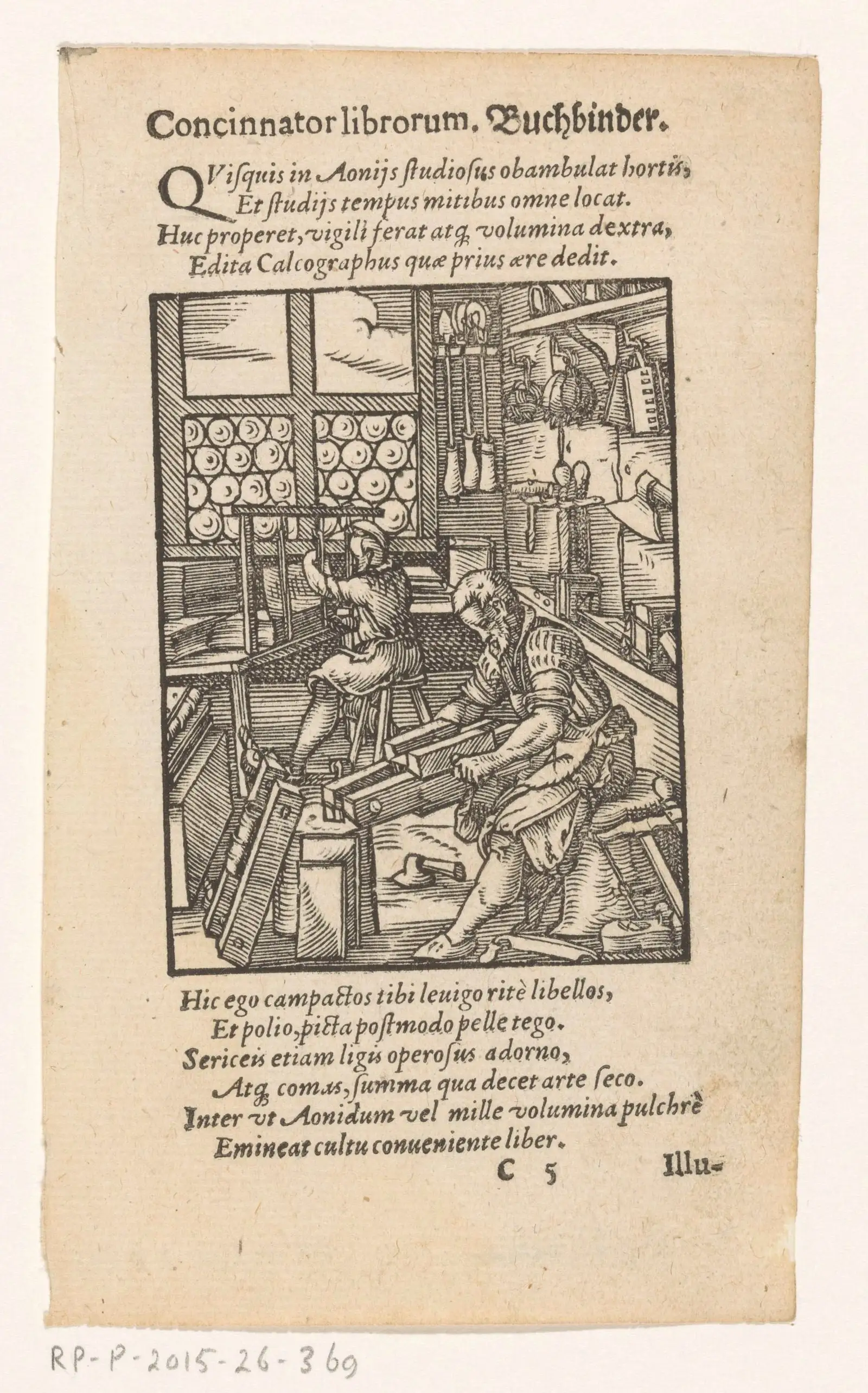
Collation: woodcut, with letterpress text · leaf 148 × 88 mm (5.8 × 3.5 in); image 79 × 61 mm (3.1 × 2.4 in); the record gives no format for the book · image 1568 / object 1568, Frankfurt, published by Sigmund Feyerabend · Rijksmuseum, Amsterdam, RP-P-2015-26-369

Collation card, all fields
- Object
- Jost Amman, Buchbinder (Bookbinder), leaf from Hartmann Schopper’s Panoplia data.rijksmuseum.nl
- Type
- book illustration, single leaf data.rijksmuseum.nl
- Process
- woodcut, with letterpress text data.rijksmuseum.nl
- Format & size
- leaf 148 × 88 mm (5.8 × 3.5 in); image 79 × 61 mm (3.1 × 2.4 in); the record gives no format for the book data.rijksmuseum.nl
- Material
- paper data.rijksmuseum.nl
- Made
- image 1568 / object 1568, Frankfurt, published by Sigmund Feyerabend data.rijksmuseum.nl
- Held at
- Rijksmuseum, Amsterdam, RP-P-2015-26-369, id.rijksmuseum.nl data.rijksmuseum.nl
- Date basis
- Holding record: Rijksmuseum open data record, 1568; the museum’s web page not read data.rijksmuseum.nl
Hold a page from an old book up to the light and find the chain lines. In handmade laid paper they show as pale stripes set far apart, crossed by finer lines packed close together. Which way those stripes run is the first clue to something the cover can't tell you: how many times this sheet was folded.
Folio, quarto and octavo are the first three answers: one, two and three folds. This page gives the fold counts, a table to check them against, and the steps for reading them from the paper itself. It doesn't value or authenticate a book.
One fold: what is a folio?
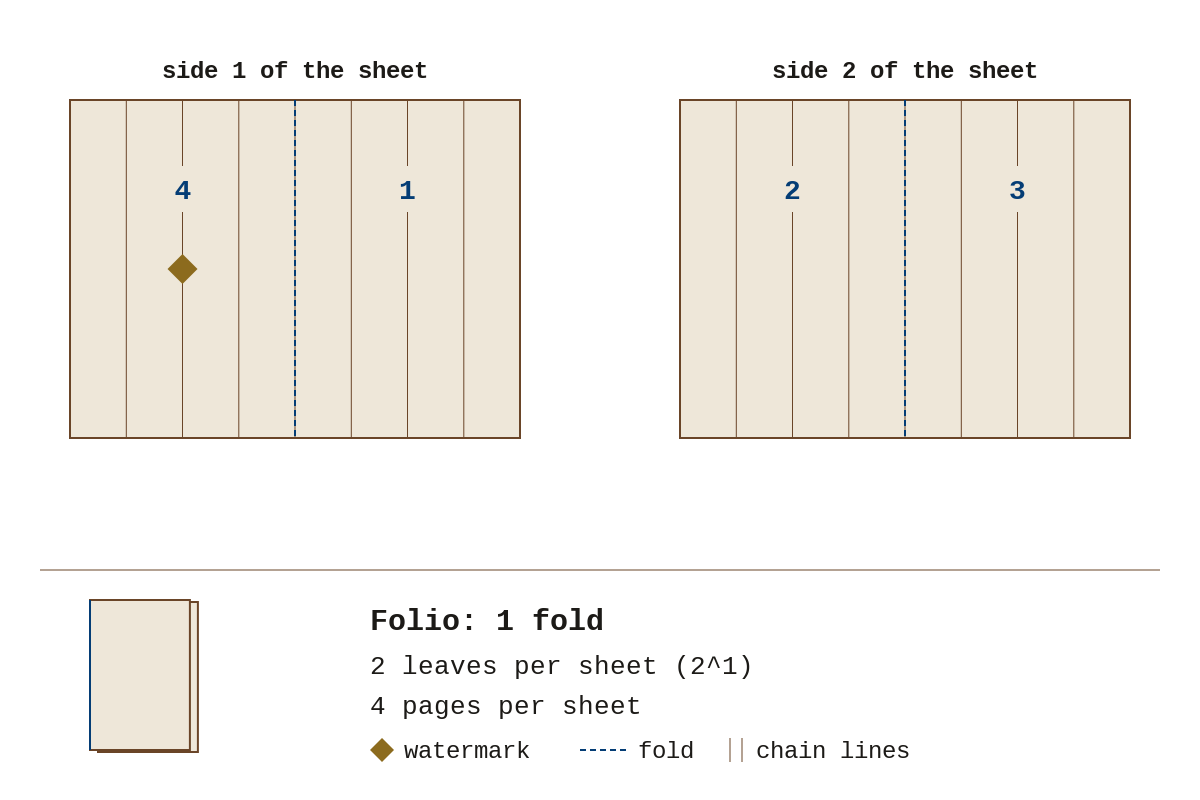
Start with one printed sheet of paper. R. B. McKerrow's An Introduction to Bibliography (1927) says the format terms are “used solely with reference to the number of times the original sheet has been folded” (p. 165). Fold the sheet once across its long side and each half becomes a leaf, so one sheet gives two leaves and four pages. Keep the Folger Shakespeare Library's distinction in mind throughout: a leaf is the piece of paper you turn, and a page is one side of it.
Credit line to copy
"One Fold: Folio" by Spine & Watermark, https://spineandwatermark.com/books/folio-quarto-octavo/, licensed under CC BY 4.0 (https://creativecommons.org/licenses/by/4.0/).The sheet was printed before it was folded, so page 4 sits beside page 1 on the flat paper. Douglas Cockerell's 1901 handbook says a folio's sheets were usually nested, two or more inside each other, to make a section (p. 36). So a folio gathering can hold more than two leaves without becoming a different format.
A folio also has an edge you can test. The Folger's Erin Blake points out that its only fold sits in the gutter, so a folio never has an unopened fold at the top or side, and a rough deckle edge, the feathered rim of handmade paper, can turn up on any of its three outer sides.
This page uses format as McKerrow does, and gathering for a group of leaves that goes to make up a book, with quire as its other name, following the Ligatus Language of Bindings.
One example in English has the word in its name. The Folger says Heminge and Condell collected almost all of Shakespeare's plays in a folio edition of 1623, now called the First Folio. The Gutenberg Bible, catalogued as a folio, is another: one paper leaf at the Art Institute of Chicago measures 39.2 × 28.5 cm (15 7/16 × 11 1/4 in).
What is a quarto? Two folds, four leaves, eight pages
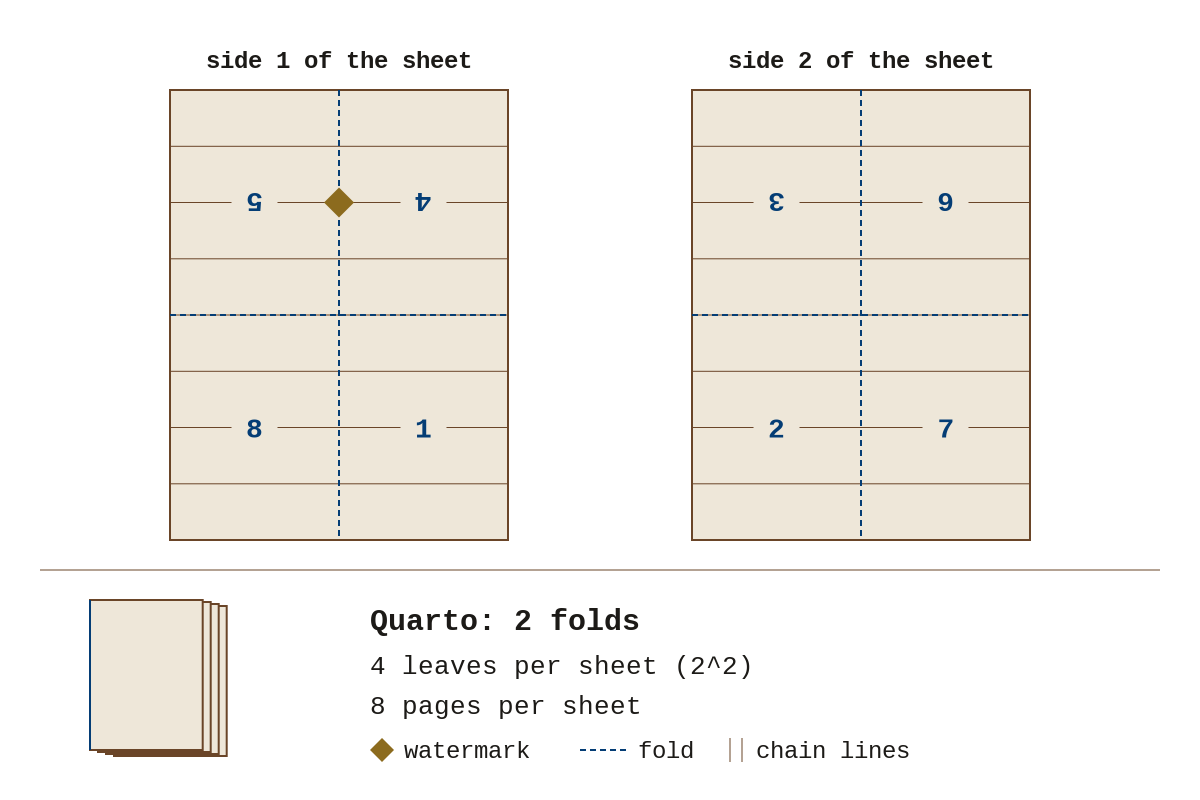
A quarto is a sheet folded twice. The Folger's DIY Quarto guide describes four pages printed on each side of the sheet, then two folds, each against the long side, for eight pages in all. The Getty Art & Architecture Thesaurus gives the same count: two folds, four leaves, eight pages.
Credit line to copy
"Two Folds: Quarto" by Spine & Watermark, https://spineandwatermark.com/books/folio-quarto-octavo/, licensed under CC BY 4.0 (https://creativecommons.org/licenses/by/4.0/).The page numbers on that sheet look scrambled until you fold it. Per the Folger, pages 1 and 8 sat side by side, head-to-head with 4 and 5, while 2, 3, 6 and 7 went on the reverse. Printers set them this way so the pages would fall into reading order after folding. Letterpress, the process that printed these sheets, explains what the type did to the paper.
The edges differ from a folio's too. Because the sheet is folded in half and then in half again, the Folger says a quarto never has a deckle edge at the top: that edge is either a fold or a cut where a fold used to be.
The sheet was also the unit people counted. The Folger notes that an author might speak of having written one sheet on a subject, that a printer might cost a job by sheets of paper, and that a quarto playbook could need a dozen or more of them.
Twelve quarto sheets, each folded on its own, would give 48 leaves and 96 pages. The Getty thesaurus records the quarto as the format considered most elegant in early 18th-century English publishing. The Folger says Shakespeare's sonnets first appeared together in 1609 as a quarto, and it points to its copy of the second quarto of Hamlet for readers who want to try the folding themselves.
What is an octavo? Three folds, eight leaves, sixteen pages
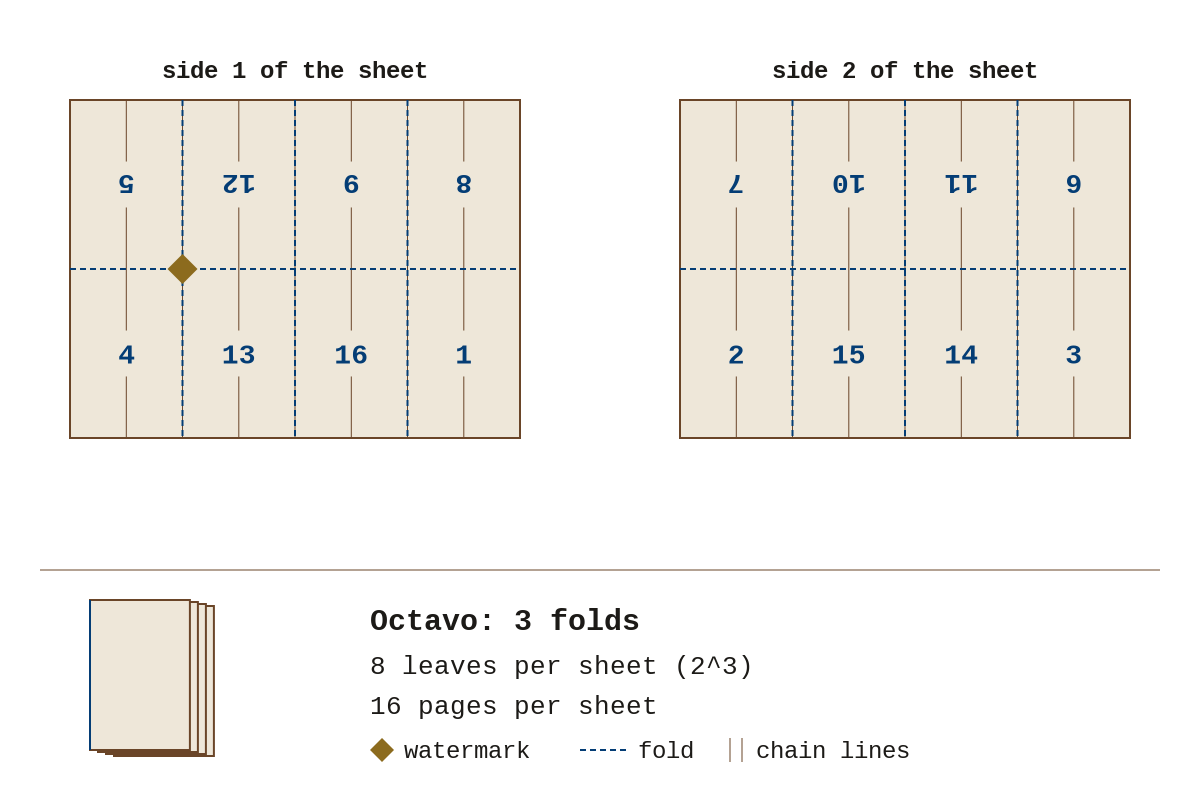
Fold the quarto once more and you have an octavo: eight leaves and sixteen pages from one sheet. McKerrow and Cockerell both count it this way, and McKerrow gives the leaf as one-eighth of the sheet.
Credit line to copy
"Three Folds: Octavo" by Spine & Watermark, https://spineandwatermark.com/books/folio-quarto-octavo/, licensed under CC BY 4.0 (https://creativecommons.org/licenses/by/4.0/).The eight pages on each side of the sheet are 1, 4, 5, 8, 9, 12, 13 and 16, and then 2, 3, 6, 7, 10, 11, 14 and 15. A book of ten octavo sheets, folded singly, would have 80 leaves and 160 pages.
One old handbook counts differently: Joseph Zaehnsdorf's The Art of Bookbinding (1890) says an octavo sheet is generally folded “into 4 folds” and still arrives at eight leaves or sixteen pages (pp. 4–5). His leaf and page counts match the table below, while his fold count doesn't, and this page follows McKerrow and Cockerell, who give three.
The folding table: leaves and pages from any sheet
Everything above reduces to one rule, and only under the ideal model: fold a sheet n times in succession and it gives 2^n leaves. Each leaf has two pages. For a whole book in that model, leaves = sheets × 2^n, and pages = leaves × 2.
| Format | Folds (n) | Leaves per sheet (2^n) | Pages per sheet | Pages on side 1 of the sheet |
|---|---|---|---|---|
| Folio | 1 | 2 | 4 | 1, 4 |
| Quarto | 2 | 4 | 8 | 1, 4, 5, 8 |
| Octavo | 3 | 8 | 16 | 1, 4, 5, 8, 9, 12, 13, 16 |
| Sixteenmo | 4 | 16 | 32 | in the download |
| Thirty-twomo | 5 | 32 | 64 | in the download |
| Twelvemo | not a run of folds | 12 | 24 | depends on the method |
Download the data (folding-calculator.csv) · source and license notes
The first five rows are arithmetic, checked here by a folding model, and the side 1 pages in the quarto row match the Folger's account. The last row is the warning: 12 isn't a power of 2, so a twelvemo can't come from halving alone, as the exceptions below show.
Gatherings can hide all of this. McKerrow says a folio might have from 2 to 12 leaves or more in a gathering, a quarto 4 or 8, and an octavo 4, 8 or 16 (p. 165). So a count of leaves alone doesn't give you the format. You need the paper.
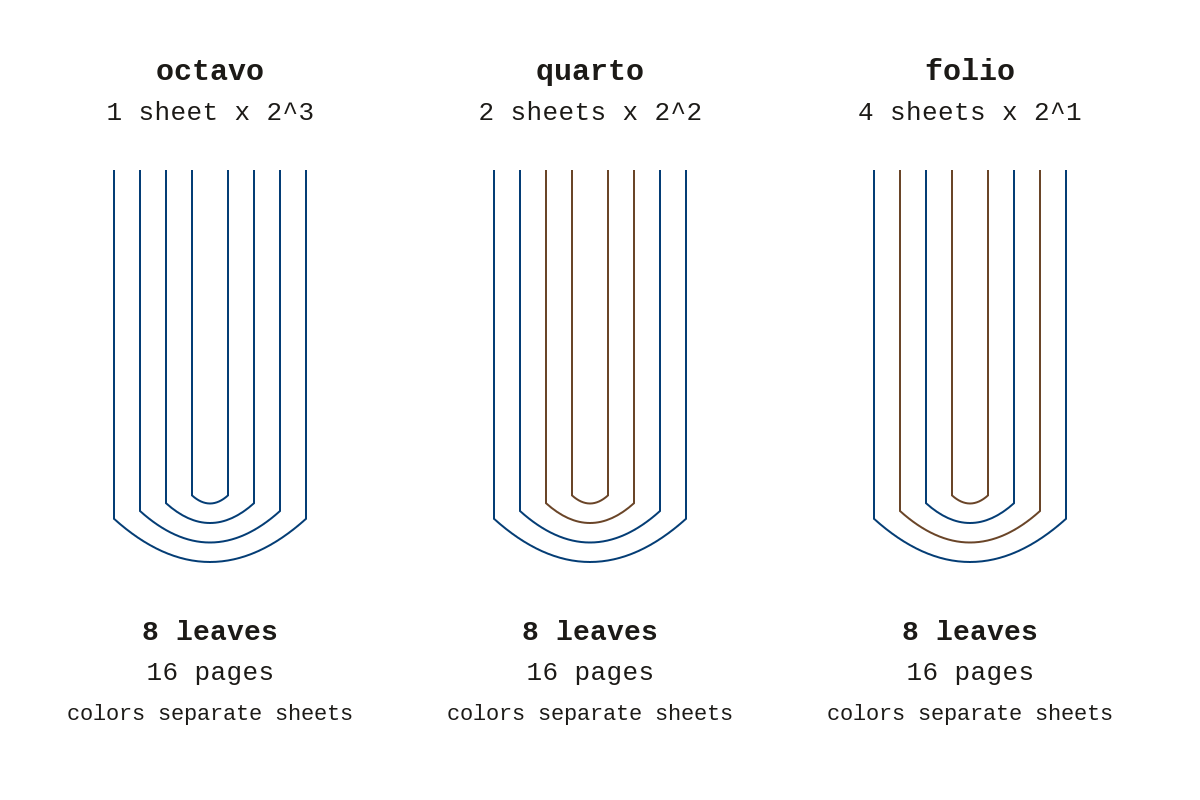
Credit line to copy
"Three Ways to Reach Eight Leaves" by Spine & Watermark, https://spineandwatermark.com/books/folio-quarto-octavo/, licensed under CC BY 4.0 (https://creativecommons.org/licenses/by/4.0/).Bibliographers keep the two ideas apart by naming both: McKerrow's example is a book whose gatherings have four leaves, which is said to be “in fours”, while a quarto with two sheets sewn together in each gathering is a quarto in eights (pp. 27–28). The format comes first and the gathering size second, and they can vary independently within the limits above.
Signature marks follow the same logic. The Folger describes them as the letters, numbers and sometimes symbols at the foot of the first part of a gathering, there to help a binder put the sheets in order. The marks generally stop about halfway through, because the remaining leaves are attached to the signed ones and need no label. They also let you cite a place in a book: the Folger's example, A3v, means the back of the third leaf in gathering A, whatever page number it may carry.
Chain lines turn with each fold
The stripes come from the tool that made the sheet. Per the Folger, a European paper mold was a wooden frame with widely spaced ribs, a chain wire on top of each rib, and closely spaced laid wires tied across them. Where the pulp touched the wires the paper came out thinner, so a lattice shows when the sheet is held to a light. McKerrow says almost all paper shows these lines until towards the end of the 18th century, in some makes much less distinctly than in others (p. 27).
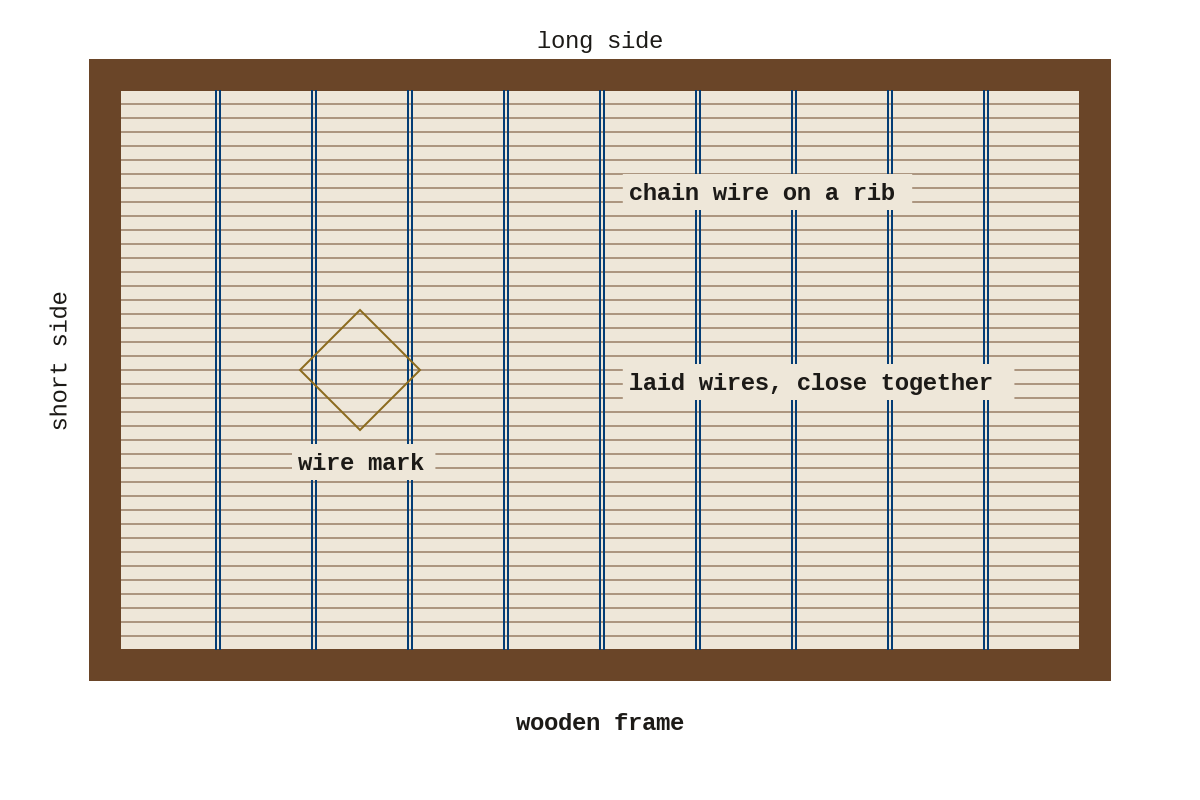
Credit line to copy
"A Laid Paper Mold in Plan" by Spine & Watermark, https://spineandwatermark.com/books/folio-quarto-octavo/, licensed under CC BY 4.0 (https://creativecommons.org/licenses/by/4.0/).Chain lines normally run parallel to the short side of the sheet. Folding is what turns them. McKerrow says they run up and down the page in a folio, horizontally in a quarto and vertically again in an octavo (pp. 166–67), and the Getty thesaurus also gives horizontal for a laid-paper quarto. The Folger's notebook-paper test shows the same thing: fold a sheet of lined paper and watch the rules swap direction with each fold.
The reason is geometry rather than any rule of the trade. Each fold halves the long side, so the leaf keeps swapping between upright and sideways on the sheet, and the printer lays the type to suit, which means a reader always holds the page the same way while the stripes turn beneath the text.
So one look at a leaf splits the formats into two families.
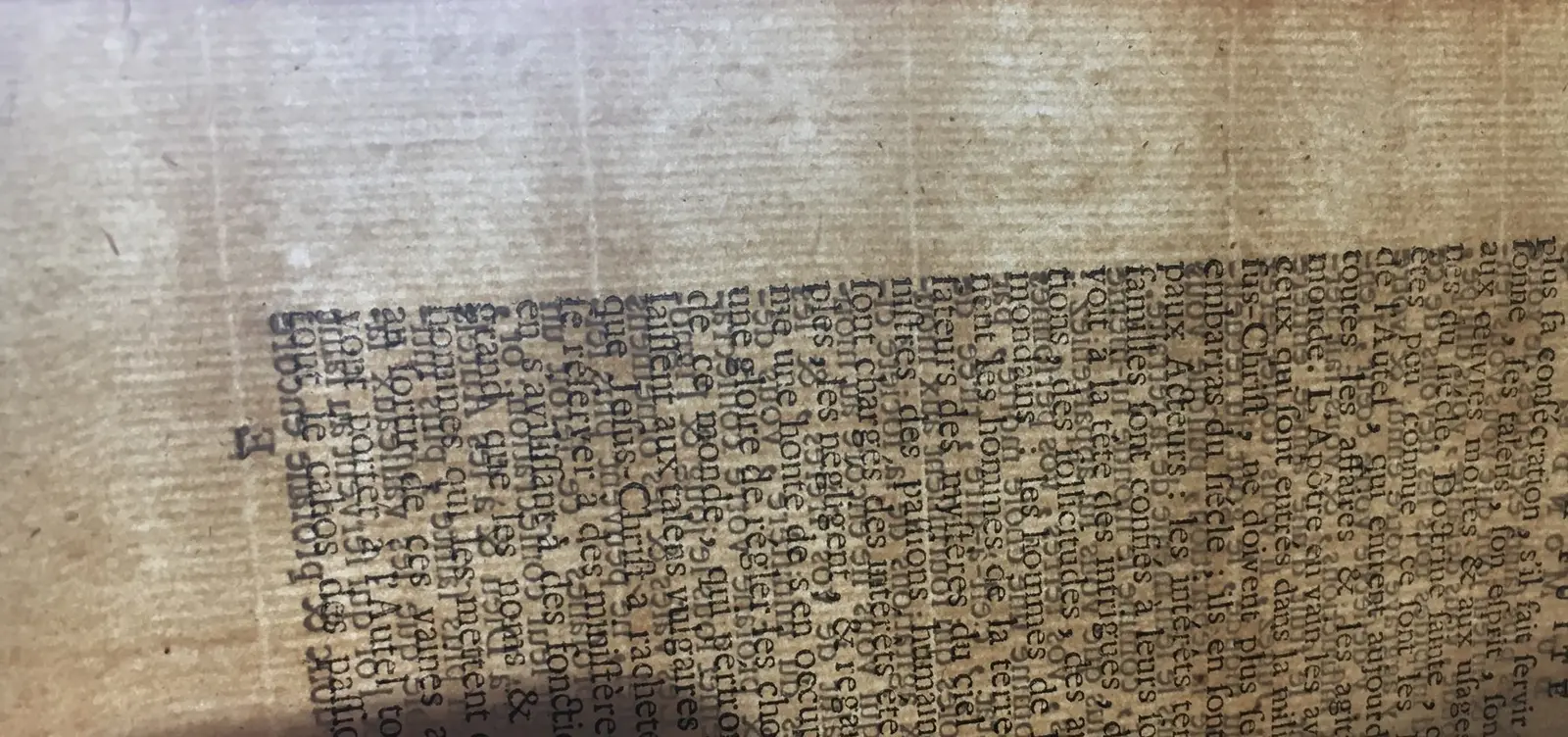

Those darker bands are a dating clue of their own. The Folger explains that shadows along the chain lines mark what is now called antique laid paper and that a mold redesign around 1800 removed them, then gives the limit: wove paper, from a finer woven screen, came into common use by the late 18th century and shows no lattice at all.
The watermark moves too
Chain lines can't separate a folio from an octavo, since both run upright. The watermark usually can. McKerrow's test starts with the mark at the centre of one half of the sheet, then follows it through each fold, and the mark lands in a different part of the leaf each time (pp. 166–67).
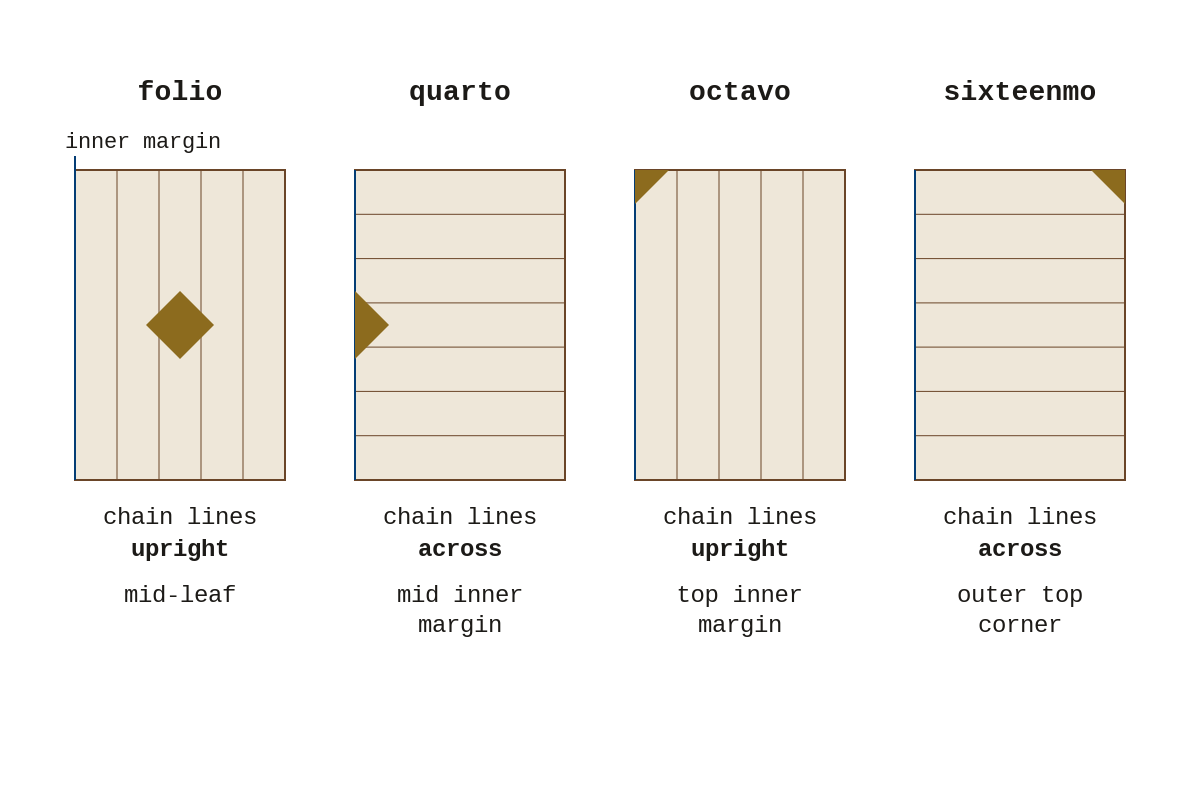
Credit line to copy
"Where the Watermark Falls in Four Formats" by Spine & Watermark, https://spineandwatermark.com/books/folio-quarto-octavo/, licensed under CC BY 4.0 (https://creativecommons.org/licenses/by/4.0/).| Format | Chain lines on the page | Where the watermark falls, per McKerrow | Leaves with the mark, folding model |
|---|---|---|---|
| Folio | usually up and down | usually middle of a leaf | model: leaf 1 or leaf 2 |
| Quarto | usually across | usually on its side, centre of the inner margins | model: leaves 1 and 4, or 2 and 3 |
| Octavo | usually up and down | usually upright, top of the inner margin | model: 1, 4, 5, 8, or 2, 3, 6, 7 |
| Sixteenmo | usually across | usually outer top corners | model: 9, 12, 13, 16, or 10, 11, 14, 15 |
The last column comes from the folding model made for this page, for one sheet folded alone. Its octavo and sixteenmo leaves agree with the ones McKerrow lists. In a quarto, the model splits the mark across the fold, so each of two leaves holds part of the design, and McKerrow says the same of a quarto in fours (p. 158).
McKerrow warns about second marks, a device in the normal place and a smaller mark elsewhere, generally the maker's initials. He says they were frequent in 18th-century paper and occasional earlier. He adds that the mark's place on the sheet wasn't fixed, especially in later times, and that in a sixteenmo or thirty-twomo it is often gone, cropped away in binding (pp. 165–67). When the watermark can't decide the question, he says, the format has to be called uncertain (p. 166).
Octavo size: how big is an octavo, and which format is largest?
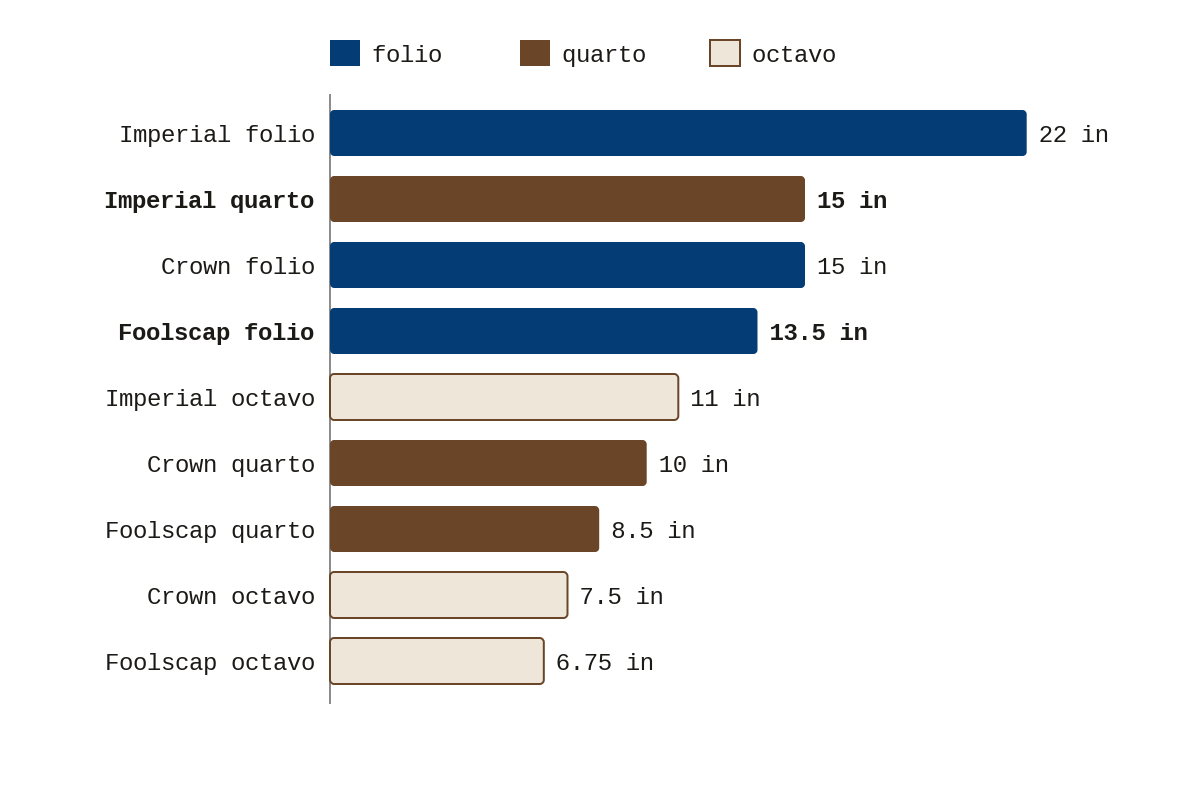
An octavo has no single size. Halve the printing-paper sheets in Cockerell's table (p. 283) and a foolscap octavo comes out at 6.75 × 4.25 in (171 × 108 mm), while an imperial octavo reaches 11 × 7.5 in (279 × 191 mm). The imperial leaf is 1.63 times as tall, under one format name.
Credit line to copy
"Leaf Heights From Three Sheet Sizes" by Spine & Watermark, https://spineandwatermark.com/books/folio-quarto-octavo/, licensed under CC BY 4.0 (https://creativecommons.org/licenses/by/4.0/).From the same sheet the folio is largest, then the quarto, then the octavo, because each fold halves the leaf. Across different sheets the order breaks: a foolscap folio at 13.5 in is shorter than an imperial quarto at 15 in, and an imperial octavo at 11 in is taller than a crown quarto at 10 in.
| Sheet (Cockerell, inches) | Folio, height × width | Quarto, height × width | Octavo, height × width |
|---|---|---|---|
| Foolscap, 17 × 13.5 | 13.5 × 8.5 | 8.5 × 6.75 | 6.75 × 4.25 |
| Crown, 20 × 15 | 15 × 10 | 10 × 7.5 | 7.5 × 5 |
| Demy, 22.5 × 17.5 | 17.5 × 11.25 | 11.25 × 8.75 | 8.75 × 5.625 |
| Royal, 25 × 20 | 20 × 12.5 | 12.5 × 10 | 10 × 6.25 |
| Imperial, 30 × 22 | 22 × 15 | 15 × 11 | 11 × 7.5 |
Download the data (format-size-examples.csv) · source and license notes
The size names in that table work like a second word beside the format. As Cockerell puts it, a term such as imperial folio or crown octavo means a sheet of a definite size folded a definite number of times (p. 36), and McKerrow works the same example: a crown 8vo is one-eighth of a crown sheet, 7.5 × 5 in before any edges are cut (p. 164). Handbooks often shorten the format to 4to, 8vo or 12mo.
Zaehnsdorf's 1890 list, a separate source, agrees on imperial quarto (15 × 11 in) and crown folio (15 × 10 in), and differs a little on others: he gives demy octavo as 9 × 5.5 in. All of this is English trade sizing from around 1900, and Cockerell notes that hand-made papers may differ slightly. For early books the Folger says sheet size varied, and McKerrow says one early octavo might measure nearly 50 per cent more than another in both height and width (p. 164).
Printers could also change the leaf without changing the format. The Folger's Caroline Duroselle-Melish shows Richard Tottell printing copies of Littleton's Tenures in octavo on large paper, to give students wider margins for their notes, so two copies of one edition need not match in size.
The Getty thesaurus gives about 11 × 13 in only as a common example of a quarto, and says the format varies, while the Folger's page on Shakespeare's printing calls a quarto a small book. The thesaurus records the shift: as printing mechanized in the 19th century, librarians began applying the term by size. Cockerell saw the same drift, writing that the names “are rather losing their true meaning” (p. 36). A modern catalogue's “quarto” may therefore mean a size, so check its conventions before reading a fold into it.
The Amman leaf at the top of this page shows the limit. Its record gives 148 × 88 mm (5.8 × 3.5 in), narrower and shorter than Cockerell's foolscap octavo, and names no format. The size alone can't supply one.
How to work out the format of a book in front of you
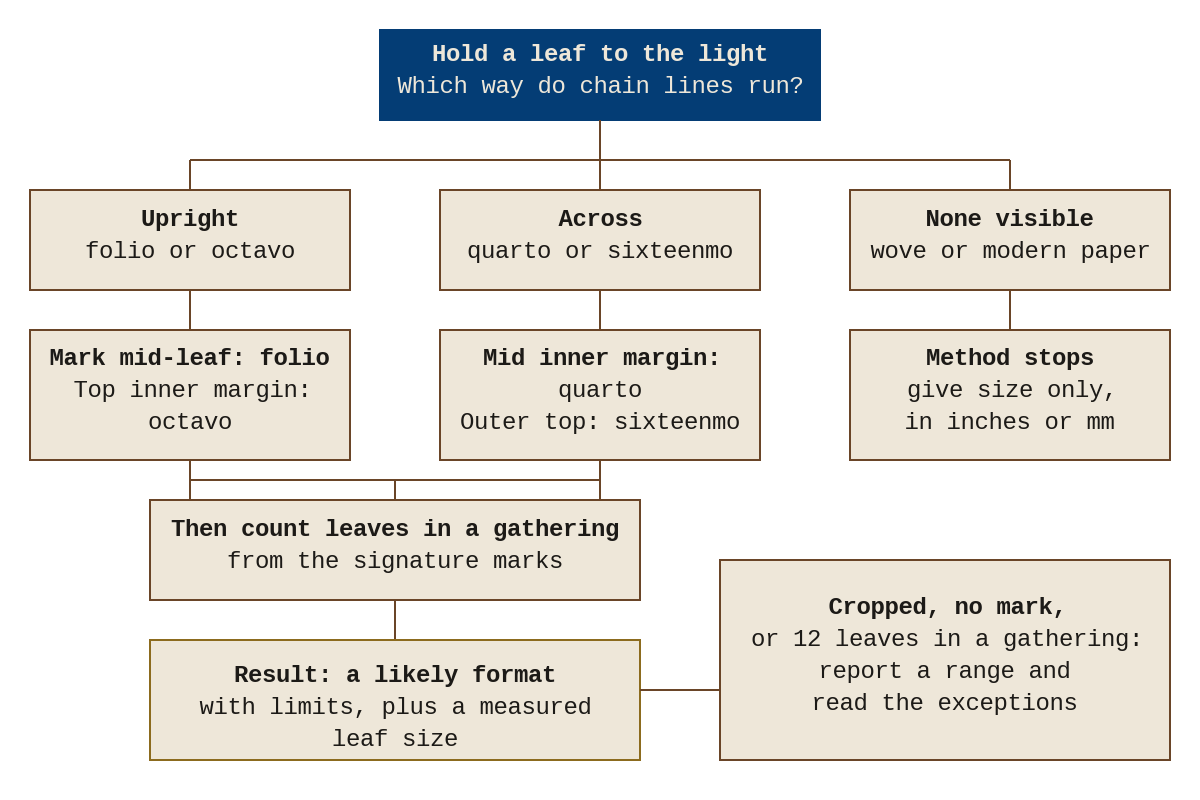
These steps read structure only, so they don't date an edition, set a value or test authenticity, and they ask for nothing more than good light and care with the binding.
- Check for a lattice. Hold an open leaf toward a light, without forcing the book flat. No lattice means the chain-line step can't help.
- Note the direction of the chain lines. Up the page points to folio or octavo. Across the page points to quarto or sixteenmo.
- Look for the watermark on several leaves. Use the table above: mid-leaf, inner margin, top of the inner margin, or an outer corner.
- Count leaves in a gathering. Signature marks, the letters and numbers the Folger describes at the foot of the first leaves in a gathering, show where each group starts.
- Measure a leaf. Give height and width, because the format name won't give them for you.
- Report a result with limits. For example: probably quarto, chain lines across, part of a mark in the inner margin, leaf 190 × 140 mm. If the clues disagree, say so.
Credit line to copy
"Reading a Book’s Format, Step by Step" by Spine & Watermark, https://spineandwatermark.com/books/folio-quarto-octavo/, licensed under CC BY 4.0 (https://creativecommons.org/licenses/by/4.0/).If a leaf is loose or the binding is failing, leave it as it is and ask a professional conservator, through a professional body such as the American Institute for Conservation.
When this method doesn't apply
The fold count is the rule for regular books, and the table below lists the cases where the clues stop agreeing with it.
| Case | What breaks | Source |
|---|---|---|
| Twelvemo | 12 leaves can't come from halving. The usual English method cut off a third of the sheet before folding, and another folded it without a cut; chain lines run across in both | McKerrow, pp. 169–71; Folger |
| Half-sheet | A central or missing mark, with chain lines the opposite way, can mean a half-sheet in folio | McKerrow, p. 166 |
| Wove or modern paper | No lattice, and sheets came in almost any size by Cockerell's day | Folger; Cockerell, p. 36 |
| Cancel | A replacement for what was first printed, perhaps most often a single inserted leaf, upsets a leaf count | McKerrow, p. 222 |
| Rotated sheet | Chain lines can read as quarto in a book that may be an octavo | Folger post and comment |
| Trimmed edges | Folds and rough edges are gone, so a small folio and a large octavo can look alike | Folger |
The rotated sheet has two readings on the same page. Duroselle-Melish describes Tottell's copies with the widest margins as printed in quarto format, going by horizontal chain lines, and using the type already standing for the octavo. In a comment, David Gants argues that copy STC 15748 is an octavo printed on a sheet turned ninety degrees, with horizontal chain lines and watermarks in the gutter. This page reports both and doesn't choose.
Trimming has misled a standard catalogue before. The Short-Title Catalogue listed XII Sibyllarum icones, engraved by Martin Droeshout, as an octavo in its earliest known edition, working from one cut-down title page.
Full credit
"Title page, William Shakespeare’s First Folio, 1623" by Martin Droeshout — https://commons.wikimedia.org/wiki/File:Title_page_William_Shakespeare%27s_First_Folio_1623.jpg — Public domain (Printed 1623; Droeshout died 1650 per the file page. United States: published before 1931. European Union: author dead more than 70 years; faithful reproduction of a two-dimensional work.); Elizabethan Club and Beinecke Library, Yale University, no accession number on the file page
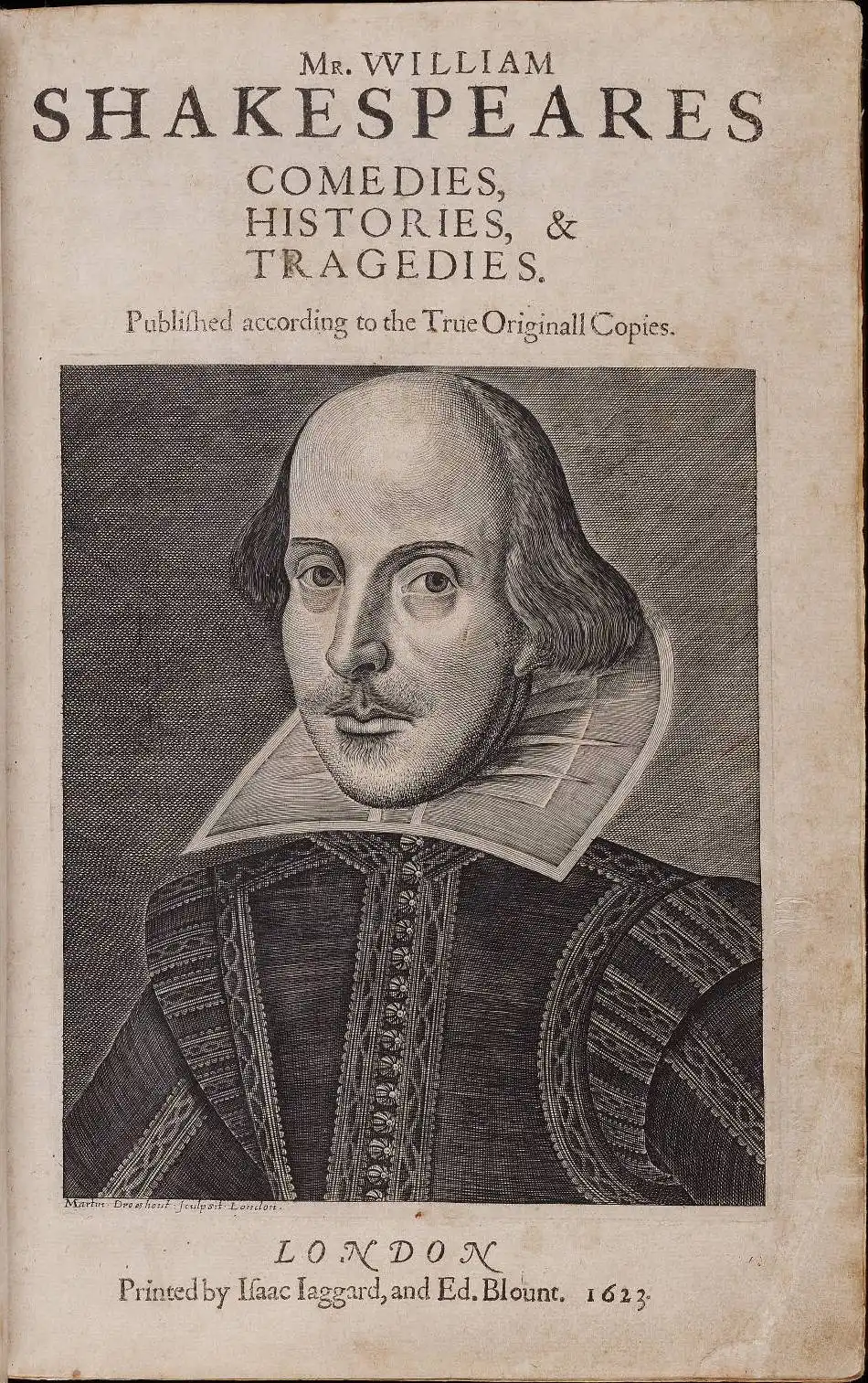
The Folger added a complete copy in 2007, now STC 22527a.5, with rough deckle edges on some leaves. Those edges and the position of the watermarks led to its re-identification as a folio. The same engraver made the Shakespeare portrait above, in the book the Folger calls a folio edition.
Philip Gaskell's A New Introduction to Bibliography is a later guide to these foldings; the Folger reproduces its twelvemo chart, and it is cited here without having been read. A manuscript such as the Book of Kells was written rather than printed from formes of type, so the folding table's page orders, worked out for printed sheets, say nothing about it. The woodblocks in books like Amman's are a separate matter too, covered in the entry on relief printing.
The Amman leaf is still the open case on this page. Its record gives a leaf size, a publisher and a date, but not which way its chain lines run or whether any part of a watermark survives, so the fold count of the book it came from stays unread here.
Turn it over:
The Rijksmuseum record lists two stamped collector's marks on the back of this leaf, Lugt 2228 and Lugt 4780, and says nothing of any text there. On the face, printed characters sit at the foot, where the Folger says signature marks go; the record doesn't name or read them.
- Medieval Manuscripts: the same quires, written by hand: Before any press, scribes were already counting leaves in folded sheets.
- Gutenberg Bible: a folio you can check against this table: One leaf at Chicago gives a real measurement to set beside these sizes.
Sources
- R. B. McKerrow, An Introduction to Bibliography for Literary Students (Oxford: Clarendon Press, 1927), pp. 27–28, 158, 164–71, 222. archive.orgRead: section only (pp. 27–28, 158, 164–71, 221–22), 2026-11-07
- Douglas Cockerell, Bookbinding, and the Care of Books (New York: D. Appleton, 1910; copyright 1901), pp. 36, 283. gutenberg.orgRead: section only (folding section and table of printing papers), 2026-11-07
- Joseph W. Zaehnsdorf, The Art of Bookbinding, 2nd ed. (London: George Bell, 1890), pp. 4–6. gutenberg.orgRead: section only (folding section and size list), 2026-11-07
- Folger Shakespeare Library, “DIY Quarto.” folger.eduRead: full page, 2026-11-07
- Folger Shakespeare Library, “Publishing Shakespeare.” folger.eduRead: full page, 2026-11-07
- Erin Blake, “Uncut, unopened, untrimmed, uh-oh,” The Collation, Folger Shakespeare Library. folger.eduRead: full post, 2026-11-07
- “Deciphering signature marks,” The Collation, Folger Shakespeare Library. folger.eduRead: full post, 2026-11-07
- Erin Blake, “Learning to ‘read’ old paper,” The Collation, Folger Shakespeare Library. folger.eduRead: full post, 2026-11-07
- “The mystery of gridded paper,” The Collation, Folger Shakespeare Library. folger.eduRead: full post, 2026-11-07
- Caroline Duroselle-Melish, “Extravagantly Large Paper,” The Collation, Folger Shakespeare Library, 17 November 2015, with comment by David Gants, 18 November 2015. folger.eduRead: full post and comments, 2026-11-07
- “Fun in cataloging, or, the mysterious 12mo,” The Collation, Folger Shakespeare Library. folger.eduRead: full post, 2026-11-07
- Getty Research Institute, Art & Architecture Thesaurus, “quarto (book format),” ID 300265439. vocab.getty.eduRead: full page, record display, 2026-11-07
- Ligatus, Language of Bindings Thesaurus, “gatherings,” concept 2286. lob.is.ed.ac.ukRead: full page, 2026-11-07
- Rijksmuseum, Jost Amman, Boekbinder. Buchbinder, RP-P-2015-26-369. id.rijksmuseum.nlRead: catalogue record through open data, 2026-11-07
- Art Institute of Chicago, "Gutenberg Bible Leaf," 1922.2210, open data record. api.artic.eduRead: catalogue record
- Philip Gaskell, A New Introduction to Bibliography (Oxford: Clarendon Press, 1972). openlibrary.orgRead: bibliography only, not read
Image credits
- "Boekbinder. Buchbinder" by Jost Amman — https://commons.wikimedia.org/wiki/File:Boekbinder_Buchbinder_(titel_op_object),_RP-P-2015-26-369.jpg — Public domain (Jost Amman, 1539–1591, published 1568. United States: published before 1931. European Union: author dead more than 70 years; the museum marks the object public domain.); Rijksmuseum, RP-P-2015-26-369
- "One Fold: Folio" by Spine & Watermark, https://spineandwatermark.com/books/folio-quarto-octavo/, licensed under CC BY 4.0 (https://creativecommons.org/licenses/by/4.0/).
- "Two Folds: Quarto" by Spine & Watermark, https://spineandwatermark.com/books/folio-quarto-octavo/, licensed under CC BY 4.0 (https://creativecommons.org/licenses/by/4.0/).
- "Three Folds: Octavo" by Spine & Watermark, https://spineandwatermark.com/books/folio-quarto-octavo/, licensed under CC BY 4.0 (https://creativecommons.org/licenses/by/4.0/).
- "Three Ways to Reach Eight Leaves" by Spine & Watermark, https://spineandwatermark.com/books/folio-quarto-octavo/, licensed under CC BY 4.0 (https://creativecommons.org/licenses/by/4.0/).
- "A Laid Paper Mold in Plan" by Spine & Watermark, https://spineandwatermark.com/books/folio-quarto-octavo/, licensed under CC BY 4.0 (https://creativecommons.org/licenses/by/4.0/).
- "Antique Laid Paper, Paris 1746" by MeeshKapiche — https://commons.wikimedia.org/wiki/File:Antique_Laid_Paper,_Paris_1746.jpg — CC BY-SA 4.0 (https://creativecommons.org/licenses/by-sa/4.0/); no institution recorded; modified: cropped to the upper part of the frame, removing a fingertip and the facing page; reduced to 1800 px wide; no other change
- "Where the Watermark Falls in Four Formats" by Spine & Watermark, https://spineandwatermark.com/books/folio-quarto-octavo/, licensed under CC BY 4.0 (https://creativecommons.org/licenses/by/4.0/).
- "Leaf Heights From Three Sheet Sizes" by Spine & Watermark, https://spineandwatermark.com/books/folio-quarto-octavo/, licensed under CC BY 4.0 (https://creativecommons.org/licenses/by/4.0/).
- "Reading a Book’s Format, Step by Step" by Spine & Watermark, https://spineandwatermark.com/books/folio-quarto-octavo/, licensed under CC BY 4.0 (https://creativecommons.org/licenses/by/4.0/).
- "Title page, William Shakespeare’s First Folio, 1623" by Martin Droeshout — https://commons.wikimedia.org/wiki/File:Title_page_William_Shakespeare%27s_First_Folio_1623.jpg — Public domain (Printed 1623; Droeshout died 1650 per the file page. United States: published before 1931. European Union: author dead more than 70 years; faithful reproduction of a two-dimensional work.); Elizabethan Club and Beinecke Library, Yale University, no accession number on the file page
Cite this page
Spine & Watermark. “Folio, Quarto, Octavo: To Bibliographers, They Count Folds.” Spine & Watermark, published November 7, 2026. https://spineandwatermark.com/books/folio-quarto-octavo/. Accessed [date].
How sources are ranked · All corrections · Contact · Report an error (contact@spineandwatermark.com)