Gutenberg Bible: Its Printer’s Name Comes From Other Records
Published · Revised
TL;DR: The Gutenberg Bible carries no title page or colophon, per Keio University Library, so catalogues put its printer in square brackets: Johann Gutenberg, Mainz, about 1454–55. The name comes from other records. About 48 or 49 copies survive, some incomplete; the Gesamtkatalog's 132 also counts fragments.
Collation: letterpress: movable metal type, with capitals and headings ornamented by hand · folio per GW; three volumes per the Library of Congress; this copy’s leaf size not in the text read. A paper leaf at Chicago: 39.2 × 28.5 cm (15 7/16 × 11 1/4 in.) · image/text Vulgate, 4th c. / object probably completed late 1455 per the Library of Congress; GW gives about 1454/55, not after August 1456 · Library of Congress, Rare Book and Special Collections Division, Otto Vollbehr Collection; accession number not in the text read; catalogue entry GW 04201

Collation card, all fields
- Object
- Gutenberg Bible, Library of Congress copy loc.gov
- Type
- book loc.gov
- Process
- letterpress: movable metal type, with capitals and headings ornamented by hand loc.gov api.artic.edu
- Format & size
- folio per GW; three volumes per the Library of Congress; this copy’s leaf size not in the text read. A paper leaf at Chicago: 39.2 × 28.5 cm (15 7/16 × 11 1/4 in.) gesamtkatalogderwiegendrucke.de loc.gov api.artic.edu
- Material
- vellum loc.gov
- Made
- image/text Vulgate, 4th c. / object probably completed late 1455 per the Library of Congress; GW gives about 1454/55, not after August 1456 loc.gov gesamtkatalogderwiegendrucke.de
- Held at
- Library of Congress, Rare Book and Special Collections Division, Otto Vollbehr Collection; accession number not in the text read; catalogue entry GW 04201; loc.gov loc.gov
- Date basis
- Catalogue: GW 04201, date in square brackets; Literature: Library of Congress exhibition text, holding record not read loc.gov gesamtkatalogderwiegendrucke.de
Find the square brackets around the printer’s name in a catalogue entry for this Bible. The Gesamtkatalog der Wiegendrucke, or GW, a union catalogue of 15th-century printing, gives it two parts of 324 and 319 leaves, 643 in all, and records the last two leaves as blank. The question is where a catalogue got a maker and a year that the pages do not print.
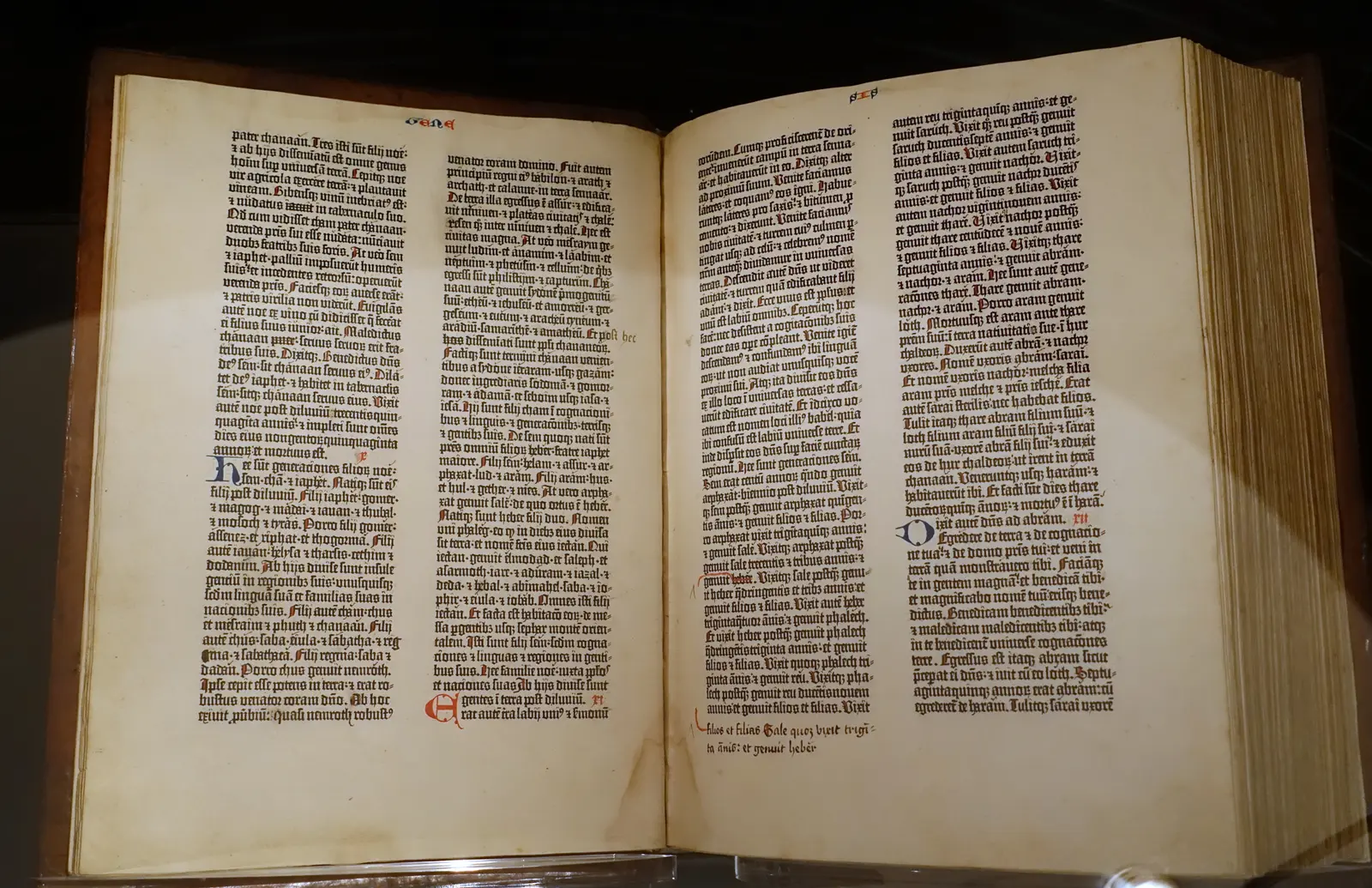
The book itself is a Latin Bible, printed on paper and on vellum, and Keio University Library's record gives its other names as the 42-line Bible and the Mazarin Bible. Two facts people repeat about it, who made it and when, come from outside its pages.
Why is Gutenberg's name not in the Gutenberg Bible?
Start with the catalogue's own rule. GW's guide says place and printer go in square brackets when the book contains no reference to them, and a date known only within limits is bracketed too. Its entry for this Bible brackets all three.
Keio University Library, which holds one volume, makes a similar point in plainer words: its record says the book lacks both a title page and a colophon, the closing note where a printer could say who made a book, where and when.
So the name's absence rests on the word of those two catalogues; no line-by-line search was made for this page, and no source read here reports one. The Library of Congress still calls the book the first great one printed in Western Europe from movable metal type, and its label drops the brackets altogether.
| Record | Imprint (summarized; the Library of Congress label as written) | What is bracketed |
|---|---|---|
| GW 04201 (lists ISTC ib00526000) | Mainz; the printer of the 42-line Bible, given as Johann Gutenberg; about 1454/55, not after August 1456 | place, printer and date |
| Keio University Library, Incunabula 036 | Mainz; the 42-line Bible's printer, given as Johann Gutenberg; about 1454–55 | place, printer and date, one by one |
| Princeton University Library, 2019 exhibition | Mainz; Johann Gutenberg and Johann Fust; about 1455 | all of it, with Fust added |
| Library of Congress, exhibition label | Mainz: Johann Gutenberg, 1455 | nothing |
What records connect Gutenberg to this Bible?
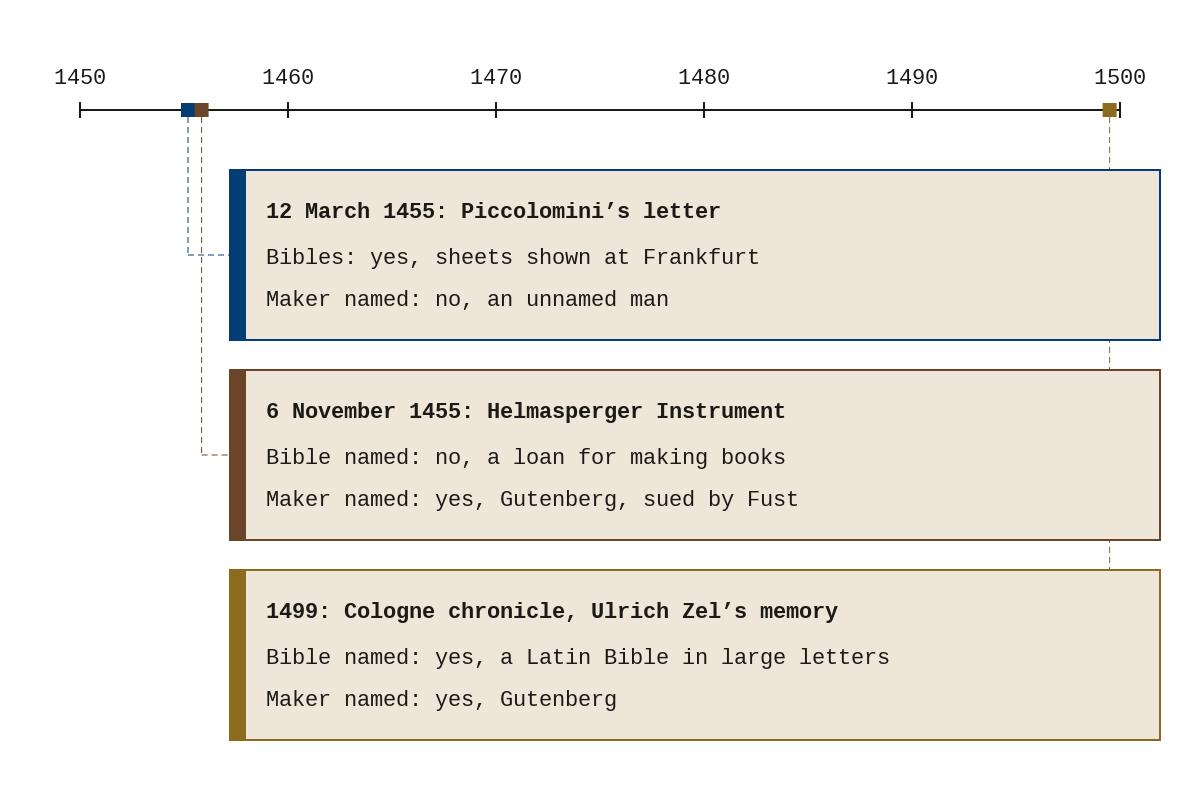
Follow the paper trail outside the book. Princeton's 2019 exhibition lists three 15th-century sources that appear to mention this printing project, and each one supplies only part of the story.
Credit line to copy
"Three 15th-Century Records: Bible, Name, Date" by Spine & Watermark, https://spineandwatermark.com/books/gutenberg-bible/, licensed under CC BY 4.0 (https://creativecommons.org/licenses/by/4.0/).| Date | Record | Is a Bible named? | Is Gutenberg named? |
|---|---|---|---|
| 12 March 1455 | Letter from Aeneas Silvius Piccolomini to Cardinal Juan de Carvajal | yes, sheets from several Bibles shown at Frankfurt | no, in Princeton's summary the man is unnamed |
| 6 November 1455 | Helmasperger Instrument, a notarized record of Johann Fust's lawsuit | no, in Princeton's summary the money went to making books | yes |
| 1499 | Cologne chronicle, recording the memory of the printer Ulrich Zel | yes, in Princeton's summary a Latin Bible in large letters | yes |
The letter has Bibles and no name; the lawsuit has a name and no Bible.
The gap between the letter and the chronicle is 44 years, and Princeton calls the chronicle the only 15th-century account that links Gutenberg's name to a printed Bible. That is thin direct support, though no source read here doubts the attribution. Keio treats it as the accepted view today.
Made: 42 lines, but not from the first page
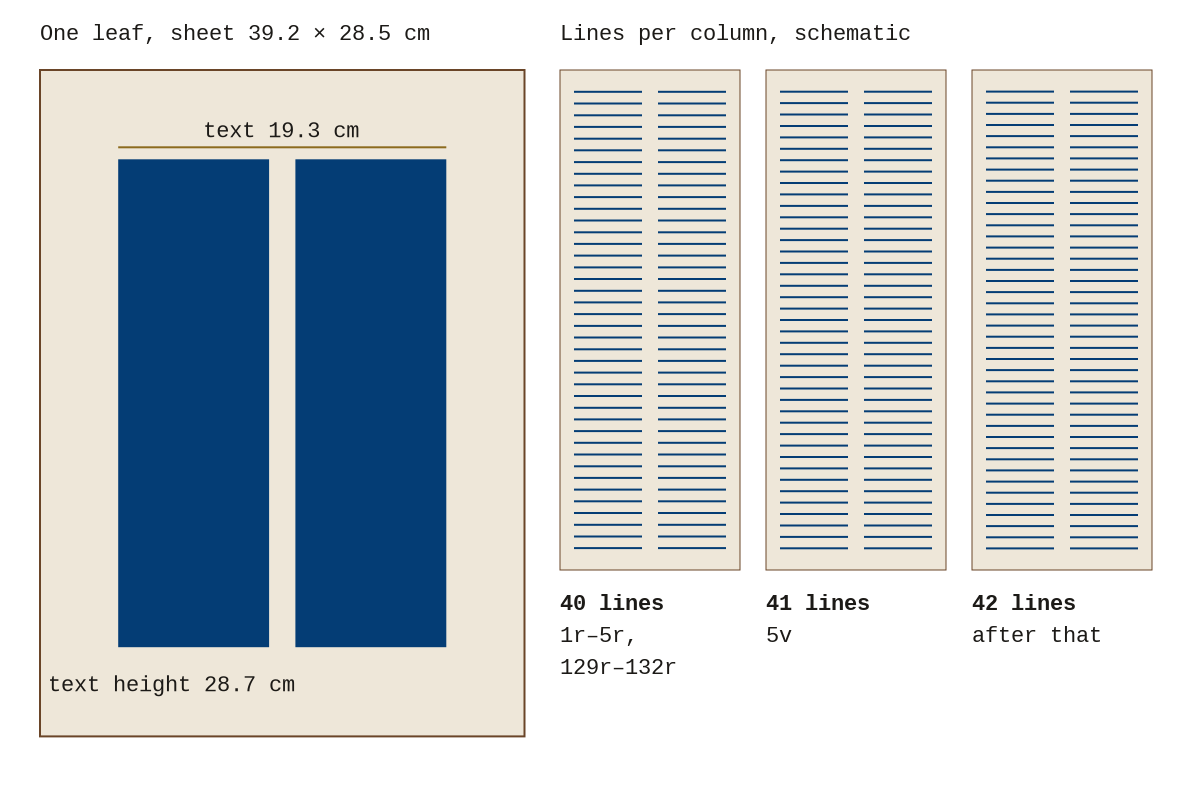
Count the lines before trusting the book's other name. The Library of Congress says the text runs in double columns, mostly with 42 lines to a page. Princeton and Keio count those lines per column, and GW records 40 to 42. Keio's record shows the steps: the opening setting runs 40 lines on folios 1r to 5r and again on 129r to 132r, with 41 on folio 5v.
Credit line to copy
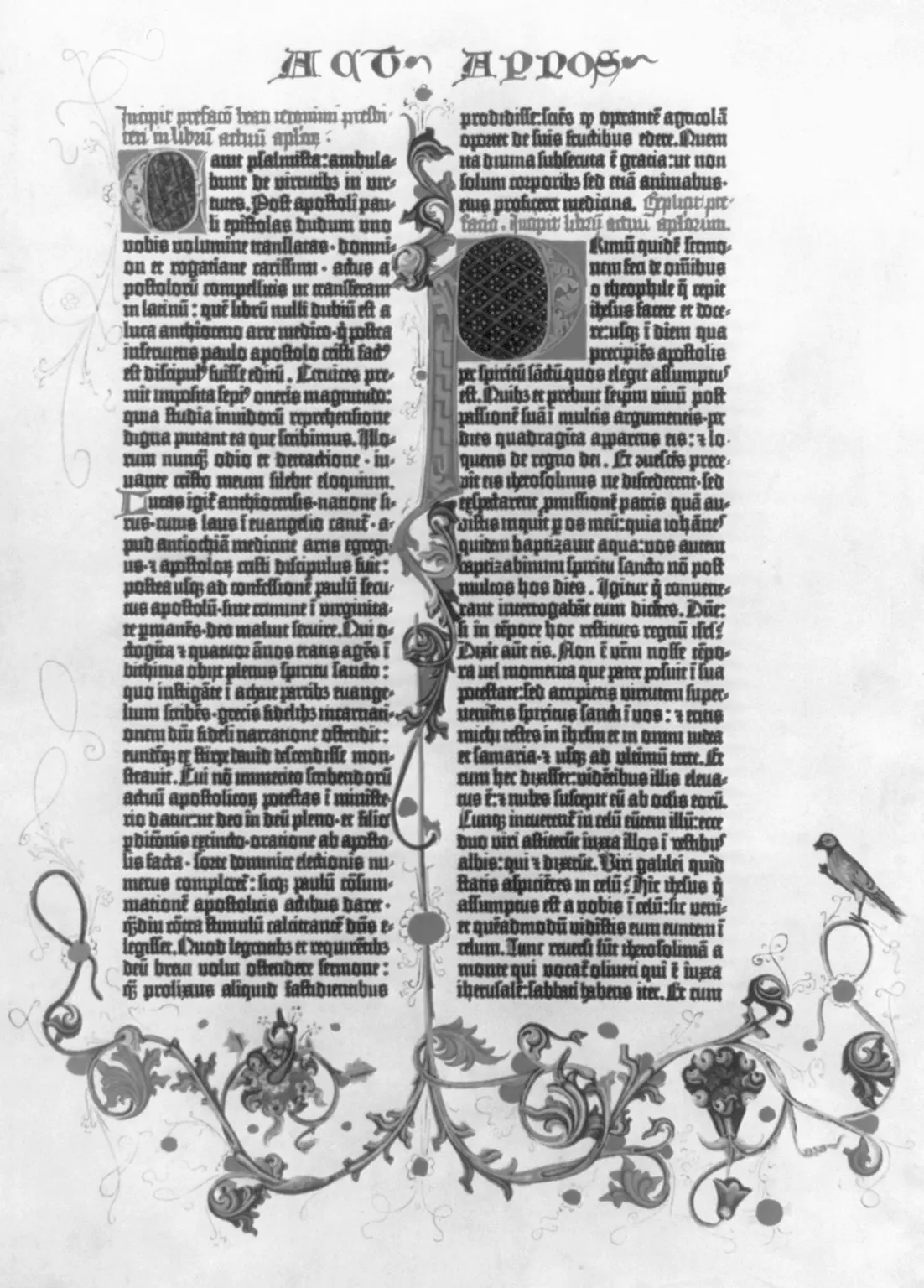
"A Gutenberg Bible Leaf and Its First Line Counts" by Spine & Watermark, https://spineandwatermark.com/books/gutenberg-bible/, licensed under CC BY 4.0 (https://creativecommons.org/licenses/by/4.0/).Princeton ties the change to a smaller type height. Keio adds that headings printed in red were dropped at the same stage, so those spaces were left for a hand to fill. That hand work differed by copy: Keio's record tentatively places its copy's illumination in Mainz, and Princeton says its Scheide copy was illuminated in Erfurt. A book where the hand did all of the work, such as the Book of Kells, makes a useful contrast.
The leaf itself is large. Chicago's measures 39.2 by 28.5 centimeters (15 7/16 by 11 1/4 inches), more than 4 inches taller than a sheet of US letter paper, and its text block fills about half of the leaf. Cleveland's page, 1968.261, measures 38.8 by 28.5 centimeters.
The run also grew during printing. Princeton says the printers raised the edition size eleven quires in and reprinted those quires, and GW lists leaves set a second and sometimes a third time. So two copies can differ in type setting on the same leaf.
Think of each line as a die in metal: the page keeps the impression of the tool. GW notes that the Pelplin seminary copy shows, on leaf 46a, the mark of a type that fell out of the page. The Library of Congress says Gutenberg is generally credited with working out how to make uniform, interchangeable metal types, and the letterpress entry follows that casting step. For how raised type differs from an engraved plate, see relief and intaglio printing compared.
The double date splits cleanly here. The image/text date is the Vulgate, the Latin translation the Library of Congress attributes to St Jerome in the fourth century. The object date has three wordings: probably completed late in 1455 (Library of Congress), about 1454/55 and not after August 1456 (GW), and a completion date resting solely on a 1455 note on the binding of the Paris paper copy (Bavarian State Library). This page does not choose among these wordings.
Lived: one edition, many separate lives
Compare the bindings next. Princeton says the edition was meant to be bound in two volumes, but the Library of Congress copy has three, in white pigskin from the 16th century. Keio's single volume, re-backed at some point, still has its 15th-century calf over wood, and Princeton's Scheide copy has stamped calfskin from Johann Fogel's workshop in Erfurt.
Full credit
"An illuminated page of the Gutenberg Bible" by unknown maker — https://commons.wikimedia.org/wiki/File:An_illuminated_page_of_the...Gutenberg_Bible..._LCCN2006680004.jpg — Public domain (US: the page was printed c. 1455 and its makers died more than 500 years ago; published before 1931 per the Commons tag; a faithful reproduction of a flat public-domain work adds no new right (Bridgeman). EU: author died more than 70 years ago; faithful reproductions of public-domain visual art carry no new right (Directive 2019/790, Article 14). Date of the reproduction not recorded. The Library of Congress rights note is not used as the basis.); Library of Congress, LCCN 2006680004
No handling scar can be confirmed from the record for the Library of Congress copy; its exhibition text describes binding and ownership, not wear. Other copies ended up in far worse shape. GW points to a census of vellum fragments that survive as binder's waste, and to a Princeton fragment preserved as a book cover. The records read here do not explain why any one leaf ended up that way: cause not established.
How many Gutenberg Bibles still exist?
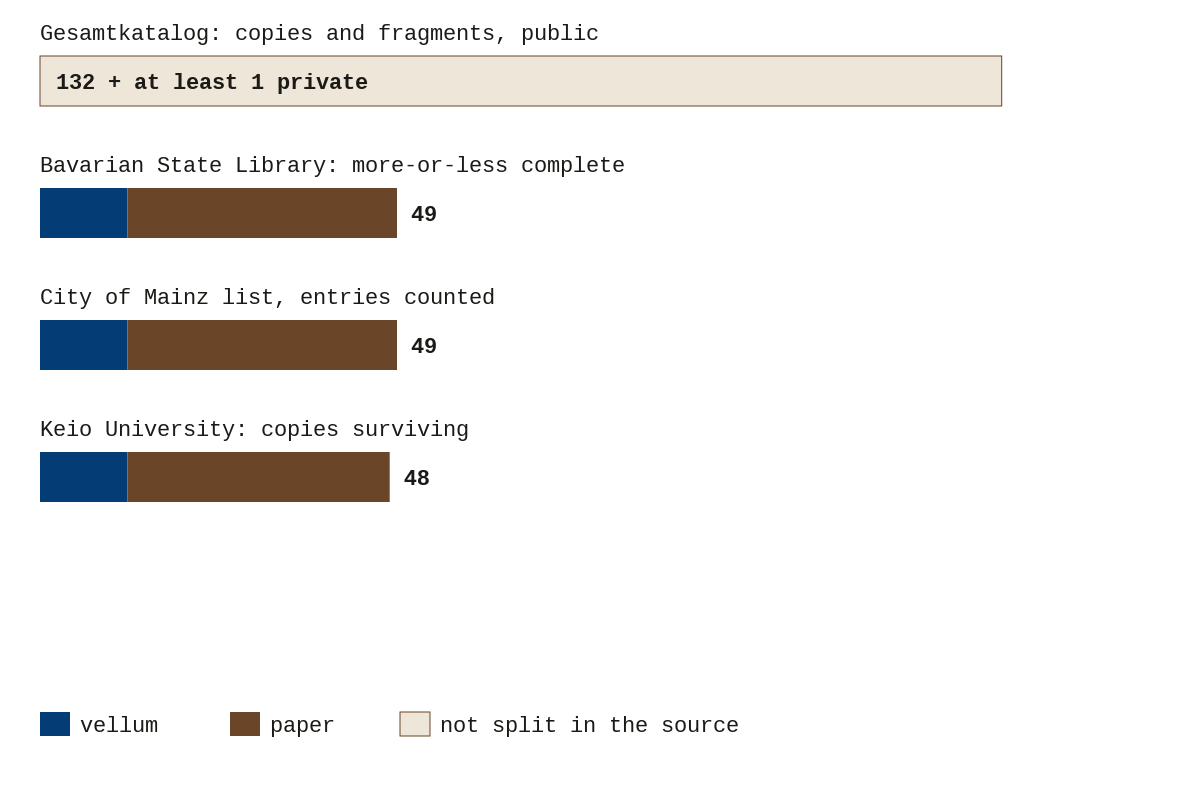
These figures measure different things, so ask what each number counts. GW's 132 covers copies and fragments in public institutions, with at least 1 more copy in private hands. Many of those are small: its list includes one leaf at Boston Public Library and one vellum leaf at Trinity College Dublin.
Credit line to copy
"What Four Counts of Surviving Gutenberg Bibles Include" by Spine & Watermark, https://spineandwatermark.com/books/gutenberg-bible/, licensed under CC BY 4.0 (https://creativecommons.org/licenses/by/4.0/).| Source | Count | What it counts |
|---|---|---|
| GW 04201 | 132, plus at least 1 | copies and fragments in public institutions, plus a private copy |
| Bavarian State Library | 49 | extant, more-or-less complete copies: 12 on vellum, 37 on paper |
| City of Mainz list | 49 | entries counted for this page: 12 parchment, 37 paper, one marked as a fragment |
| Keio University Library | 48 | surviving copies, 12 on vellum |
GW's guide warns against assuming a copy is complete when its location entry gives no details. Its page footer shows a last change in 2012, yet its notes cite a 2021 publication, so the page does not say when the 132 was last revised.
How many were printed is a separate and softer question. Princeton reports eyewitnesses in the 1455 letter claiming 158 copies, and others 180, and the Bavarian State Library notes that the 180 rests on that single letter. Modern estimates read here run from about 160 (Princeton, 120 or more on paper and perhaps 40 on vellum) to about 180 to 200 (Keio).
So the shorter counts give 48 or 49 surviving copies of about 160 to 200 printed. Fourteen of the 49 Mainz entries list one volume. Dividing GW's 132 by any of those would mix fragments with whole books, so this page gives no survival rate. It also leaves out sale prices.
Where can you see a Gutenberg Bible?
The City of Mainz list places 13 of its 49 entries in Germany and 10 in the United States, with others from Lisbon to Tokyo. Washington has the Library of Congress copy, which the library calls one of only three perfect vellum copies known, alongside those at the Bibliothèque Nationale and the British Library. Per the Library of Congress, the copy spent nearly five centuries with the Benedictine Order, at St. Blasius and St. Paul in Austria, and was bought from Otto Vollbehr by an act of Congress in 1930.
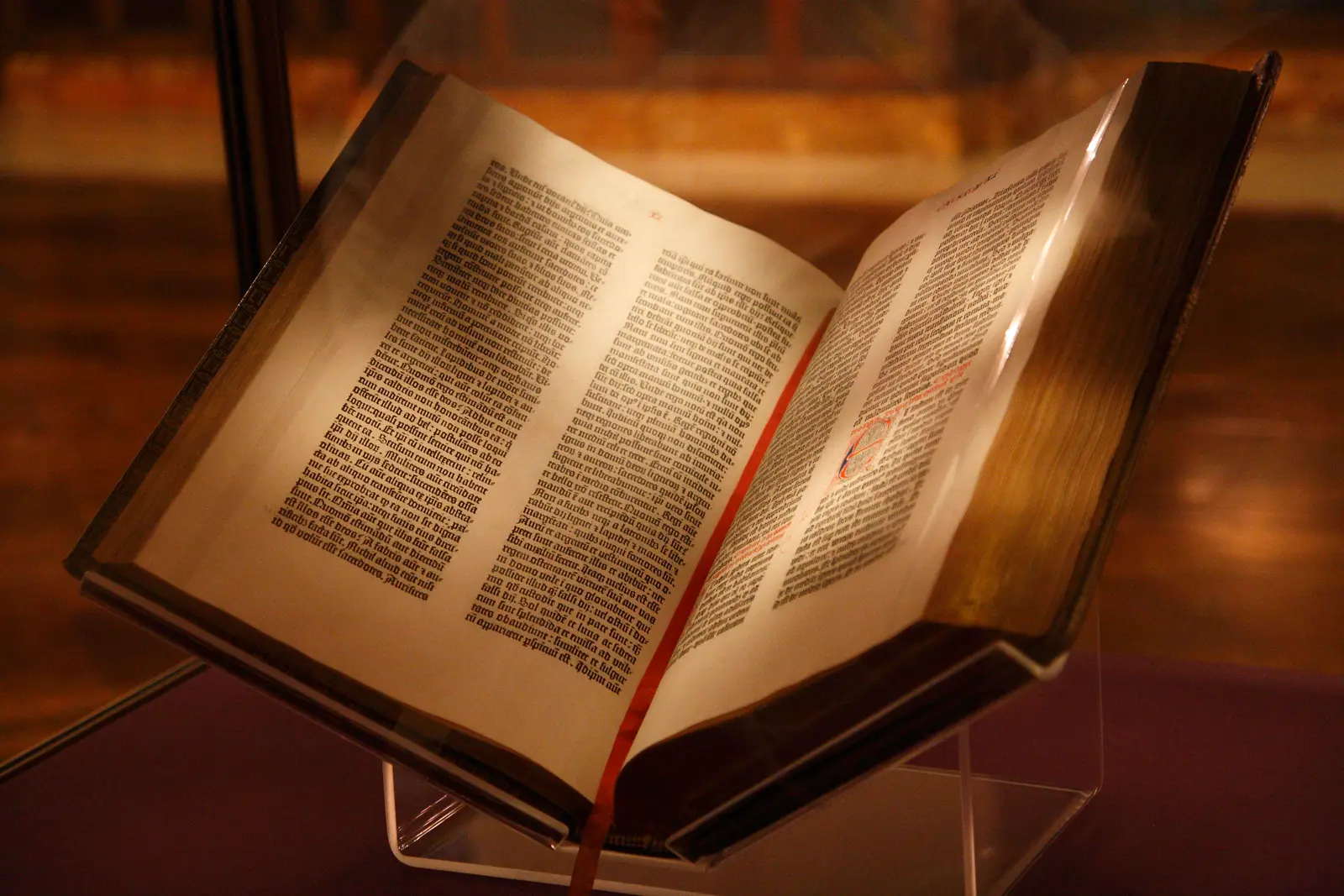

New York Public Library's is a two-volume paper copy, per the Mainz list. Single leaves sit in many more places, and two museums publish open records for theirs.
| Institution | What it holds, in its own record | Material | Size (cm) |
|---|---|---|---|
| Library of Congress | three volumes in 16th-century white pigskin | vellum | not given |
| Art Institute of Chicago, 1922.2210 | single leaf, dated 1454/55 | ivory laid paper | sheet 39.2 × 28.5 |
| Cleveland Museum of Art, 1968.261 | single page, dated c. 1450–1455 | laid paper | 38.8 × 28.5 |
Download the data (gutenberg-bible-copies.csv) · source and license notes
What the records leave unread is the reason for the silence. Princeton's bracket adds Fust, and Keio places his lawsuit late in the work, but nothing read here says why a book this large never named its maker. That question stays open, in a book whose second part stops on two blank leaves.
Turn it over:
The back of the book: GW has the text of the second part ending on leaf 317 verso, then leaves 318 and 319 blank, and Keio's record reports no colophon.
- Medieval Manuscripts: how books were put together before this one: Per Keio, the printer took the Bible's general page layout from manuscripts of the day.
- Folio, Quarto, Octavo: what “folio” means for this Bible's sheets: GW's 2° means one fold, which gives two leaves and four pages from each sheet before any trimming.
Sources
- Library of Congress, "The Gutenberg Bible," Library of Congress Bible Collection exhibition (2008–2017). loc.govRead: full exhibition page; catalogue record not read
- Gesamtkatalog der Wiegendrucke, GW 04201, Biblia. gesamtkatalogderwiegendrucke.deRead: full catalogue entry
- Gesamtkatalog der Wiegendrucke, "Introduction to the detailed description of incunabula." gesamtkatalogderwiegendrucke.deRead: full page
- Keio University Libraries, Digital Collections, Incunabula 036, "The 42-line Bible." dcollections.lib.keio.ac.jpRead: full catalogue entry
- Princeton University Library, "The Gutenberg Bible," Gutenberg & After: Europe’s First Printers, 1450–1470 (exhibition, 2019). dpul.princeton.eduRead: full exhibition page; the three 15th-century documents read only as summarized there
- Bavarian State Library, Munich Digitization Center, "Gutenberg Bible" collection page. digitale-sammlungen.deRead: full collection text
- City of Mainz, "The copies of the 42-line Bible today," Johannes Gutenberg information pages. gutenberg.deRead: full list
- Art Institute of Chicago, "Gutenberg Bible Leaf," 1922.2210, open data record. api.artic.eduRead: catalogue record
- Cleveland Museum of Art, "Page from a Gutenberg Bible," 1968.261, open data record. openaccess-api.clevelandart.orgRead: catalogue record
- Eric Marshall White, "The Gutenberg Bibles that Survive as Binder’s Waste," in Early Printed Books as Material Objects, ed. Bettina Wagner and Marcia Reed (Berlin/New York, 2010), 21–35, as cited by GW. gesamtkatalogderwiegendrucke.deRead: bibliography only, as reported by GW
Image credits
- "Gutenberg Bible, Genesis, Chapter XI, Volume I, leaf 9 recto" by Daderot — https://commons.wikimedia.org/wiki/File:Gutenberg_bible,_Genesis,_Chapter_XI,_Volume_I-9r_-_Harry_Ransom_Center_-_University_of_Texas_at_Austin_-_DSC08418.jpg — CC0 1.0 (https://creativecommons.org/publicdomain/zero/1.0/); Harry Ransom Center, University of Texas at Austin, accession no. not in the record read
- "Three 15th-Century Records: Bible, Name, Date" by Spine & Watermark, https://spineandwatermark.com/books/gutenberg-bible/, licensed under CC BY 4.0 (https://creativecommons.org/licenses/by/4.0/).
- "A Gutenberg Bible Leaf and Its First Line Counts" by Spine & Watermark, https://spineandwatermark.com/books/gutenberg-bible/, licensed under CC BY 4.0 (https://creativecommons.org/licenses/by/4.0/).
- "An illuminated page of the Gutenberg Bible" by unknown maker — https://commons.wikimedia.org/wiki/File:An_illuminated_page_of_the...Gutenberg_Bible..._LCCN2006680004.jpg — Public domain (US: the page was printed c. 1455 and its makers died more than 500 years ago; published before 1931 per the Commons tag; a faithful reproduction of a flat public-domain work adds no new right (Bridgeman). EU: author died more than 70 years ago; faithful reproductions of public-domain visual art carry no new right (Directive 2019/790, Article 14). Date of the reproduction not recorded. The Library of Congress rights note is not used as the basis.); Library of Congress, LCCN 2006680004
- "What Four Counts of Surviving Gutenberg Bibles Include" by Spine & Watermark, https://spineandwatermark.com/books/gutenberg-bible/, licensed under CC BY 4.0 (https://creativecommons.org/licenses/by/4.0/).
- "Gutenberg Bible on display at the New York Public Library" by Joshua Keller — https://commons.wikimedia.org/wiki/File:Gutenberg_Bible,_New_York_Public_Library,_USA._Pic_01.jpg — CC BY 2.0 (https://creativecommons.org/licenses/by/2.0/); New York Public Library, accession no. not in the record read
Cite this page
Spine & Watermark. “Gutenberg Bible: Its Printer’s Name Comes From Other Records.” Spine & Watermark, published November 7, 2026. https://spineandwatermark.com/books/gutenberg-bible/. Accessed [date].
How sources are ranked · All corrections · Contact · Report an error (contact@spineandwatermark.com)