Book of Kells: Trimmed Edges, a Lost Cover, Missing Leaves
Published · Revised
TL;DR: The Book of Kells, Trinity College Dublin MS 58, is a Gospel book written close to the year 800, per Trinity, and bound in four volumes since 1953. An earlier rebinding severely trimmed its leaves, and a 1914 study says the cuts damaged some painted designs.
Collation: handwritten and painted: insular majuscule script with painted decoration · 340 folios, now about 330 × 255 mm (13 × 10 in) after trimming; four volumes since 1953 · image/text four Gospels in Latin, based on the Vulgate text completed 384 per Trinity, mixed with Old Latin / object close to 800, disputed; trimmed and gilded 19th c.; rebound 1953 · Trinity College Dublin, MS 58
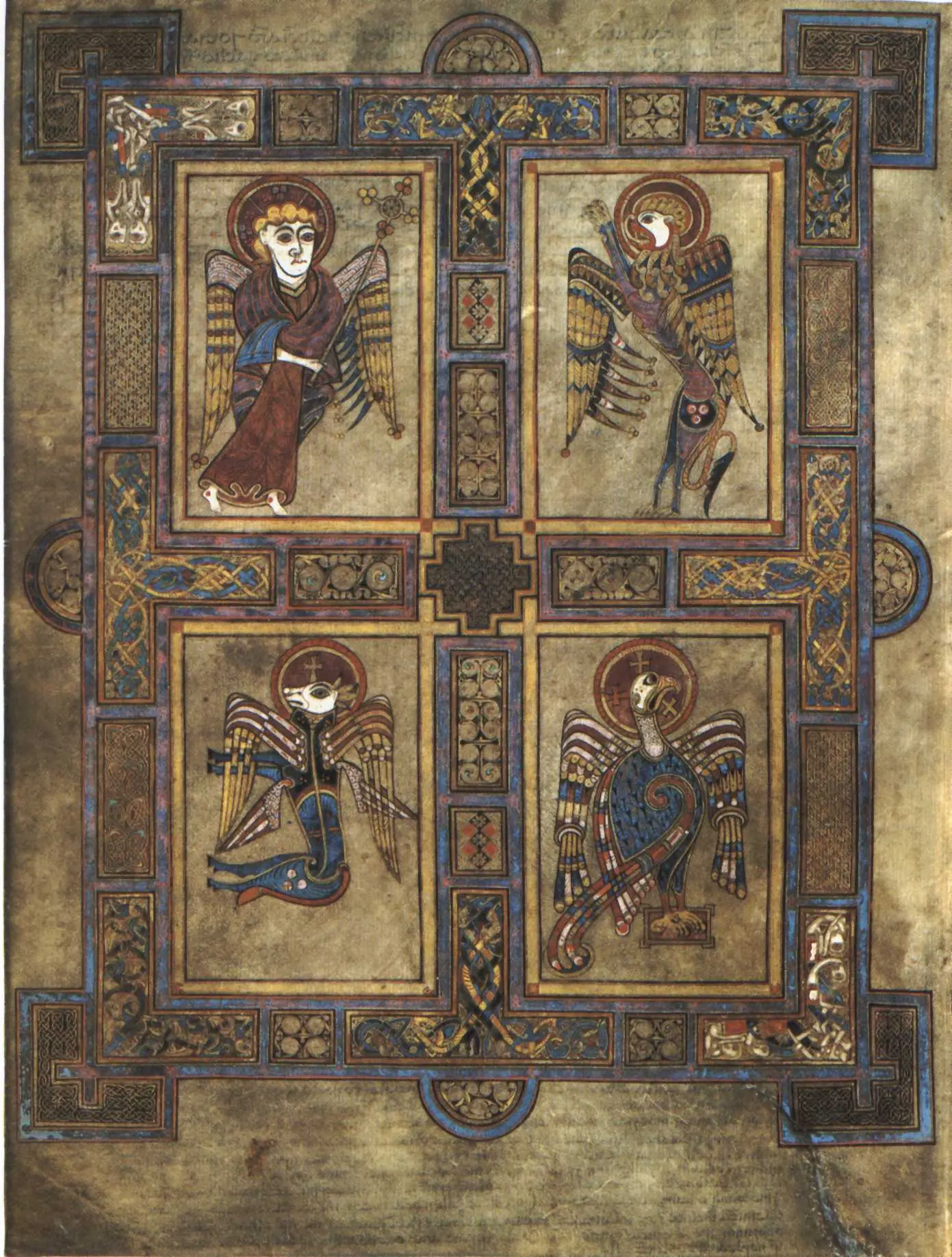
Full credit
"The four evangelist symbols, Book of Kells, fol. 27v" by unknown maker — https://commons.wikimedia.org/wiki/File:KellsFol027v4Evang.jpg — Public domain (US: the manuscript was written close to the year 800 per Trinity College Library and published long before 1931, so no copyright can remain; a faithful reproduction of a flat public-domain work adds no new right (Bridgeman). EU: its makers died more than 70 years ago; faithful reproductions of public-domain visual art carry no new right (Directive 2019/790, Article 14). Scanned from Meehan, The Book of Kells (1994), p. 8, per the file page.); Trinity College Dublin, MS 58
Collation card, all fields
- Object
- Book of Kells tcd.ie
- Type
- manuscript tcd.ie
- Process
- handwritten and painted: insular majuscule script with painted decoration tcd.ie
- Format & size
- 340 folios, now about 330 × 255 mm (13 × 10 in) after trimming; four volumes since 1953 tcd.ie tcd.ie
- Material
- vellum (prepared calfskin) tcd.ie
- Made
- image/text four Gospels in Latin, based on the Vulgate text completed 384 per Trinity, mixed with Old Latin / object close to 800, disputed; trimmed and gilded 19th c.; rebound 1953 tcd.ie tcd.ie
- Date basis
- Holding record: close to the year 800, per Trinity College Library, which says date and place are disputed tcd.ie
Follow the painted border out to the edge of the leaf and see where it stops. On folio 27 verso, the page above (a folio is one numbered leaf, with r and v for front and back), it stops at bare vellum, a thin strip at the top and sides, wider at the foot. Trinity College Library says the 340 leaves were severely trimmed and their edges gilded during a 19th-century rebinding. The question is what later binders did to this finished book, and what the record can still show.
Where did the binder's cut reach the paint?
Start with a warning printed in 1914. The editor's note to Sir Edward Sullivan's book told readers of its color plates to expect “the cut margins, which in some cases have damaged the designs” (p. iii). It blamed an unnamed binder of “about one hundred years ago,” which points to the early 1800s (p. iii), and Sullivan said outer margins had been “trimmed” out of existence (p. 5).
Trinity's page agrees on the trimming and the century, but it names no binder and says nothing about paint, so the damage claim is the 1914 book's and this page keeps it there.
Sullivan's sharpest example is folio 188 recto, the opening of Luke's Gospel, where one word, Quoniam, fills the page. He calls it “badly mutilated by the former binder both at top and left-hand side” (p. 15).
The page appears in the next section. Check its top and left against his words, but treat the picture as a guide, because the scan comes from a 1977 catalogue whose crop may not match the leaf. Trinity's digital collection holds the institution's own images, though that site could not be read for this page.
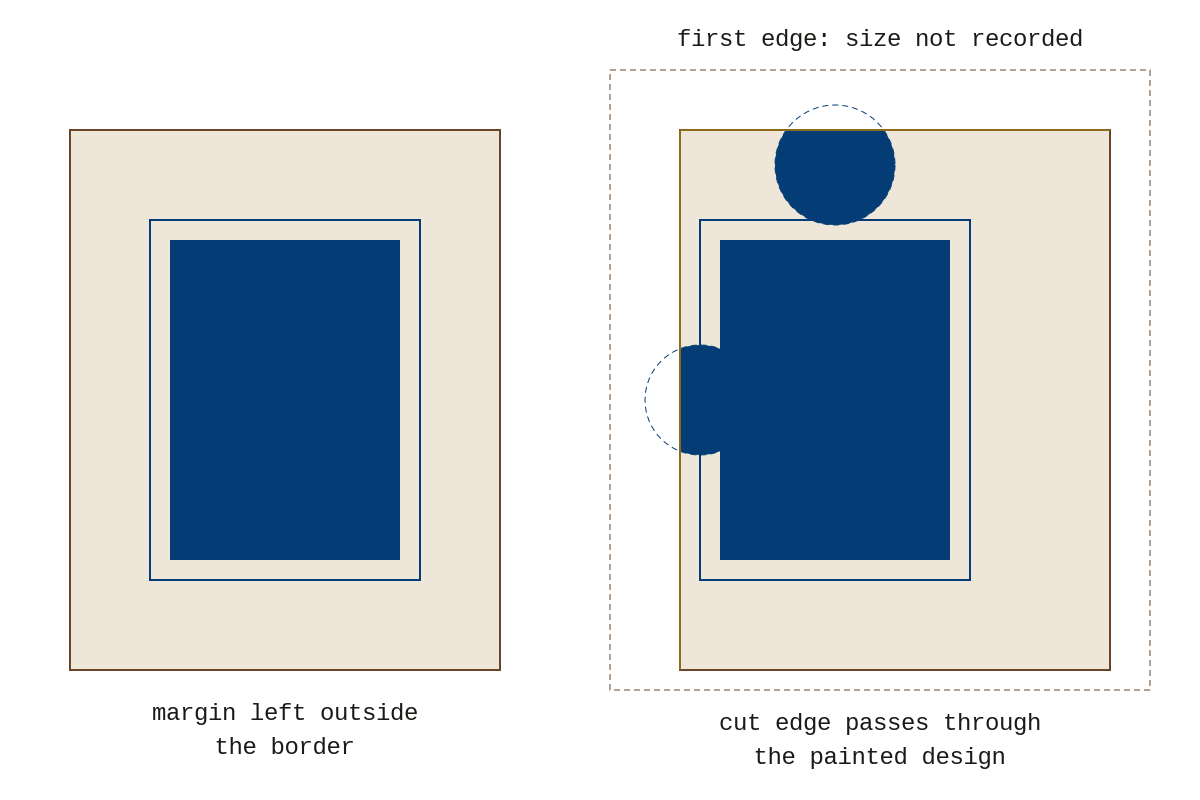
Credit line to copy
"How a Cut Can Fall on a Painted Leaf" by Spine & Watermark, https://spineandwatermark.com/books/book-of-kells/, licensed under CC BY 4.0 (https://creativecommons.org/licenses/by/4.0/).In words, the drawing shows two leaves. On the left, the cut edge leaves a margin outside the border. On the right, a dashed line marks the leaf's first edge and the cut runs inside it, through the painted shapes that once stood out from the frame.
How much came off isn't known from anything read here, because no source read gives the leaf's first size. Trinity gives today's leaf as about 330 by 255 mm (13 by 10 in), which is taller and wider than a sheet of US letter paper. Sullivan's height matches: 13 inches, “in their now cropped condition” (p. 5). Edge terms here follow the Ligatus Language of Bindings: cut edges, on the bookblock, the stack of leaves.
Made: who wrote the Book of Kells, and when?
Nobody can give you a name. Trinity says three artists seem to have made the major decorated pages and four main scribes copied the text, and it leaves open how far scribes and artists were the same people. Sullivan thought the lost closing note, the colophon, would probably have dated the work and might have named its artist (p. 17).
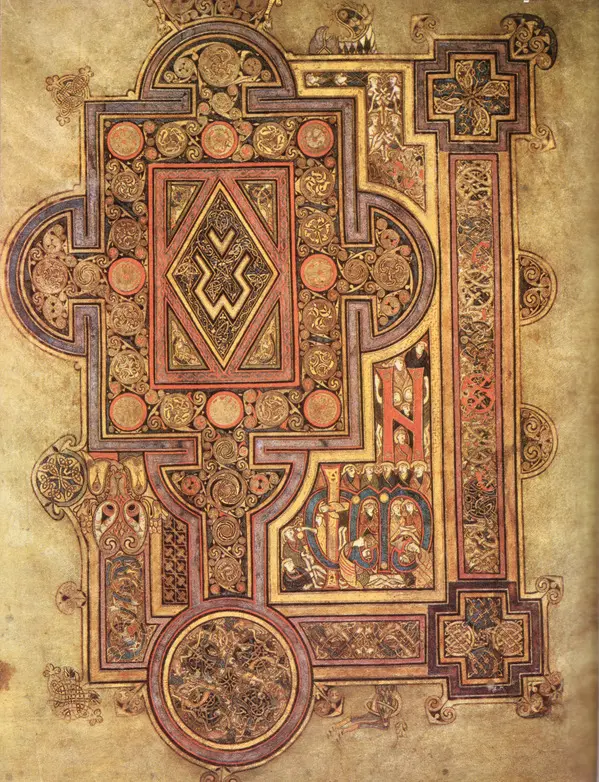
Full credit
"Opening of St Luke’s Gospel, Book of Kells, fol. 188r" by unknown maker — https://commons.wikimedia.org/wiki/File:KellsFol188rQuoniam.jpg — Public domain (US: the manuscript was written close to the year 800 per Trinity College Library and published long before 1931, so no copyright can remain; a faithful reproduction of a flat public-domain work adds no new right (Bridgeman). EU: its makers died more than 70 years ago; faithful reproductions of public-domain visual art carry no new right (Directive 2019/790, Article 14). Scanned from Treasures of Irish Art, 1500 B.C. to 1500 A.D. (1977).); Trinity College Dublin, MS 58
The double date splits in stages here. The text date is old: the four Gospels in Latin, drawn from the Vulgate that St Jerome completed in 384, per Trinity, mixed with earlier Old Latin readings. The object date comes about 416 years later. Trinity says the book must have been written close to the year 800, while another Trinity page calls it a ninth-century manuscript.
That date has moved. In 1914 Sullivan wrote that no one could say with certainty “whether it belongs to the sixth or the ninth century,” and the writers he lists run from those who chose the sixth century to Macalister, whose reasoning pointed to the middle of the ninth (p. 20). Trinity still calls both date and place a matter of scholarly controversy, so its date near 800 is not a settled year.
The place stays open too. Trinity reports that majority academic opinion now leans toward the scriptorium, or writing room, on Iona, while others argue for Northumbria or Pictland. After a Viking raid on Iona in 806, monks took refuge at Kells, and Trinity says there is no way of knowing whether the book was made at Iona, at Kells, or partly at each. This page doesn't choose.
Its fame rests on the painting, per Trinity. The Chi Rho page, folio 34 recto, introduces Matthew's account of the nativity, and Trinity ranks it as the most famous single page in medieval art, by an artist whose fine work has been compared to a goldsmith's. Sullivan calls it the Monogram page, built around XPI, a shortened form of Christi in Matthew 1:18 (p. 11). You can look for it in the digital collection linked above.
The copying is another matter: Trinity calls it careless, with words dropped and a passage on folio 218 verso repeated on the next page, then struck out with red crosses. That carelessness, set against the splendor, has led, Trinity says, to the conclusion that the book was meant for ceremony on special occasions, not daily services.
Lived: what use left on these leaves
Read the blank spaces next. In the late 11th and 12th centuries, per Trinity, empty parts of folios 5v–7v and 27r took records of property deals for the monastery at Kells, and a poem was added to folio 289v in the 15th century. Marks like these fit the handling scar, a mark left by use and not by making, because the sources tie them to later owners writing in the book.
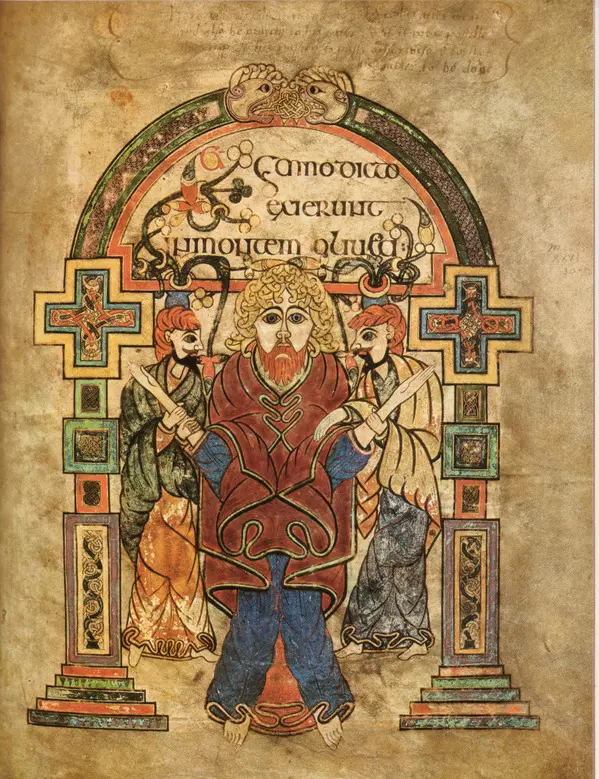
Full credit
"The Arrest of Christ, Book of Kells, fol. 114r" by unknown maker — https://commons.wikimedia.org/wiki/File:KellsFol114rArrestOfChrist.jpg — Public domain (US: the manuscript was written close to the year 800 per Trinity College Library and published long before 1931, so no copyright can remain; a faithful reproduction of a flat public-domain work adds no new right (Bridgeman). EU: its makers died more than 70 years ago; faithful reproductions of public-domain visual art carry no new right (Directive 2019/790, Article 14). Scanned from Treasures of Irish Art, 1500 B.C. to 1500 A.D. (1977).); Trinity College Dublin, MS 58
Other owners wrote in it too. A Gerald Plunket added notes in the 16th century, Bishop James Ussher wrote in his leaf count in 1621, and Queen Victoria and Prince Albert signed a blank leaf in 1849 (Sullivan, pp. 4, 17). The picture above shows small writing over the arch and a short note at the right margin, and nothing read here identifies those lines, so they are described and not assigned.
Sullivan says the first leaf is too rubbed to reproduce well (p. 5), but he gives no reason for the wear, so its cause is not established. The book's editor adds that darkened backgrounds probably came from age and burial in soil (p. iii). That burial followed a theft in 1006, when, per the Annals of Ulster as Trinity reports them, the book was stolen for its ornamental shrine. Sullivan adds that it turned up months later under sods, without its gold cover (p. 3).
The trimming doesn't belong in this group. A binder's cut was part of a rebinding, not wear from use, so this page counts it as a later treatment and not as a handling scar. A similar line runs through the Beowulf manuscript, where fire and handling have to be told apart.
What did each rebinding change?
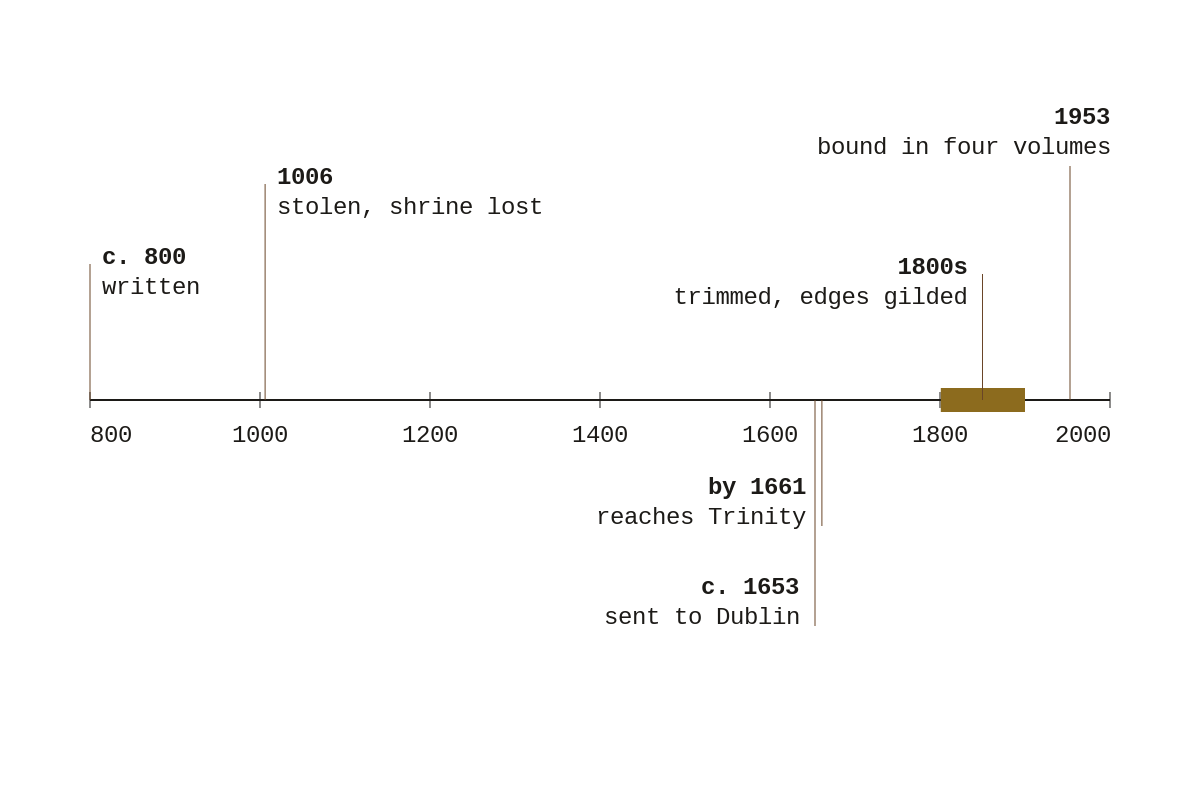
Lay the dated events in order, then look at what is missing between them.
Credit line to copy
"Dated Events in the Life of the Book of Kells" by Spine & Watermark, https://spineandwatermark.com/books/book-of-kells/, licensed under CC BY 4.0 (https://creativecommons.org/licenses/by/4.0/).| When | What happened | Who says so |
|---|---|---|
| close to 800 | Book written; date disputed | Trinity |
| 1006 | Stolen for its shrine; cover lost | Trinity, Sullivan |
| about 1653 | Sent to Dublin for safety by the governor of Kells | Trinity |
| by 1661 | Reaches Trinity College | Trinity, Sullivan (accounts differ) |
| 19th century | Leaves trimmed, edges gilded, during a rebinding | Trinity; “about one hundred years ago” in the 1914 book |
| 1953 | Rebound in four volumes for conservation | Trinity |
The two accounts part ways on how it reached the college. Trinity credits Henry Jones, who became Bishop of Meath in 1661, while Sullivan has it arrive with Ussher's collection in that year (p. 5). Both are given here, and neither is chosen.
Four volumes is the newest change. Trinity's about page says the book began as a single volume and was rebound in four in 1953 for conservation. So the same book was cut in one rebinding and divided in another, a later history that sits on top of how a book like this was first put together.
Treat this list as incomplete. What was read doesn't record every binding between 1661 and 1953, and the 19th-century binder has no name here. Harsher things have happened to parchment, as the Archimedes Palimpsest's leaves, cut apart and rewritten show. A printed book makes the opposite case: the Gutenberg Bible left much less of the page to a painter's hand.
None of this is a method to try on an old book: trimming and rebinding belong with a conservator, and the American Institute for Conservation is a place to start.
Where can you see the Book of Kells?
It is held at Trinity College Dublin, in the Old Library. Trinity's library page says two volumes can normally be seen, one open at a major decorated page and one at two pages of script.
How many leaves are missing from the Book of Kells?
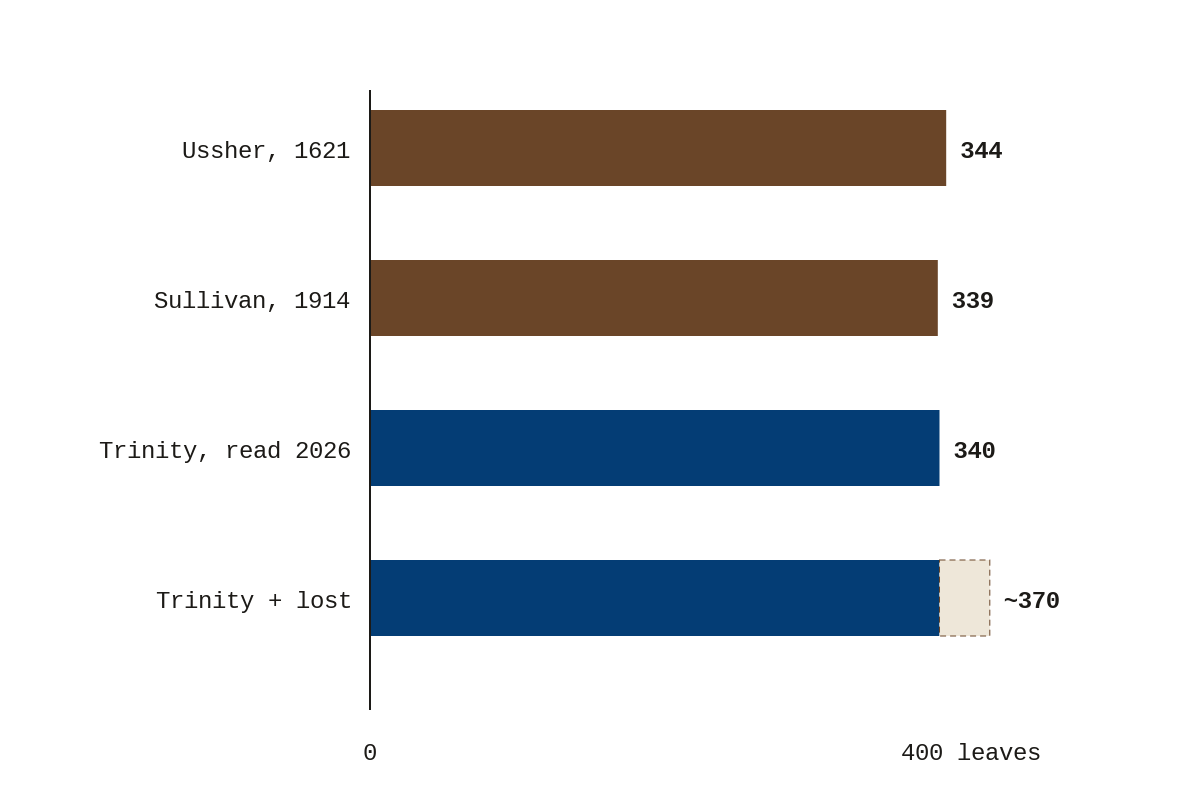
Compare three counts: 1621, 1914 and the figure on Trinity's page today.
Credit line to copy
"Three Leaf Counts of the Book of Kells" by Spine & Watermark, https://spineandwatermark.com/books/book-of-kells/, licensed under CC BY 4.0 (https://creativecommons.org/licenses/by/4.0/).| Who counted | When | Leaves | Note |
|---|---|---|---|
| James Ussher | 1621 | 344 | His note, quoted by Sullivan (p. 4) |
| Edward Sullivan | 1914 | 339 | Sullivan (p. 5) |
| Trinity College Library | read 2026 | 340 | Library page; its date of counting isn't given |
Ussher's figure is 5 higher than Sullivan's, and Sullivan's own reckoning fits that: all but five of the lost leaves, he says, were gone before Ussher (p. 17). Trinity's 340 is one above Sullivan's 339. Neither source explains the difference, so its cause is not established.
The larger loss came earlier. Trinity says around 30 folios were lost during the Middle Ages and the early modern period, including probable portraits of Mark and Luke on single leaves.
Sullivan reached about 29 folios, or 58 pages, by counting missing verses, with about 152 gone from the end of John alone (p. 17). He thought most of the loss might date from the 1006 theft (p. 3), while Trinity gives the wider range and names no single event.
Add Trinity's two figures and the book once ran to about 370 leaves, an estimate and not a count.
The leaves still hold back the plainest facts. The closing note Sullivan assumed is missing, the 19th-century binder is unnamed, and no source read here measures how much margin went. No leaf-by-leaf survey of the cut edges turned up in those sources.
Turn it over:
The other side of the evangelist page, folio 27 recto, is one of the spots where, per Trinity, property records were added in the late 11th and 12th centuries.
- Medieval Manuscripts: how a book like this was first put together: The quires and sewing came first; the cuts and new volumes here came centuries later.
- Folio, Quarto, Octavo: what trimmed edges hide in a printed book: Trimming removes the folds and rough edges a reader uses to work out a printed book's format.
Sources
- The Library of Trinity College Dublin, "The Book of Kells," Research Collections. tcd.ieRead: full page, 2026-11-07
- Trinity College Dublin, "About the Book of Kells." tcd.ieRead: full page, 2026-11-07
- Edward Sullivan, The Book of Kells (London: The Studio, 1914). archive.orgRead: section: introduction and notes, 2026-11-07; plates not used
- The Library of Trinity College Dublin, "Beyond the Book of Kells." tcd.ieRead: full page, 2026-11-07
- Trinity College Dublin, Digital Collections, Book of Kells. digitalcollections.tcd.ieRead: bibliography only: link to the collection, site not read
- Ligatus, Language of Bindings Thesaurus, "cut edges," concept 1273. lob.is.ed.ac.ukRead: full page (one concept entry), 2026-11-07
- Bernard Meehan, The Book of Kells: An Illustrated Introduction to the Manuscript in Trinity College Dublin (London: Thames and Hudson, 1994), as listed by Trinity. tcd.ieRead: bibliography only, as listed by Trinity
Image credits
- "The four evangelist symbols, Book of Kells, fol. 27v" by unknown maker — https://commons.wikimedia.org/wiki/File:KellsFol027v4Evang.jpg — Public domain (US: the manuscript was written close to the year 800 per Trinity College Library and published long before 1931, so no copyright can remain; a faithful reproduction of a flat public-domain work adds no new right (Bridgeman). EU: its makers died more than 70 years ago; faithful reproductions of public-domain visual art carry no new right (Directive 2019/790, Article 14). Scanned from Meehan, The Book of Kells (1994), p. 8, per the file page.); Trinity College Dublin, MS 58
- "How a Cut Can Fall on a Painted Leaf" by Spine & Watermark, https://spineandwatermark.com/books/book-of-kells/, licensed under CC BY 4.0 (https://creativecommons.org/licenses/by/4.0/).
- "Opening of St Luke’s Gospel, Book of Kells, fol. 188r" by unknown maker — https://commons.wikimedia.org/wiki/File:KellsFol188rQuoniam.jpg — Public domain (US: the manuscript was written close to the year 800 per Trinity College Library and published long before 1931, so no copyright can remain; a faithful reproduction of a flat public-domain work adds no new right (Bridgeman). EU: its makers died more than 70 years ago; faithful reproductions of public-domain visual art carry no new right (Directive 2019/790, Article 14). Scanned from Treasures of Irish Art, 1500 B.C. to 1500 A.D. (1977).); Trinity College Dublin, MS 58
- "The Arrest of Christ, Book of Kells, fol. 114r" by unknown maker — https://commons.wikimedia.org/wiki/File:KellsFol114rArrestOfChrist.jpg — Public domain (US: the manuscript was written close to the year 800 per Trinity College Library and published long before 1931, so no copyright can remain; a faithful reproduction of a flat public-domain work adds no new right (Bridgeman). EU: its makers died more than 70 years ago; faithful reproductions of public-domain visual art carry no new right (Directive 2019/790, Article 14). Scanned from Treasures of Irish Art, 1500 B.C. to 1500 A.D. (1977).); Trinity College Dublin, MS 58
- "Dated Events in the Life of the Book of Kells" by Spine & Watermark, https://spineandwatermark.com/books/book-of-kells/, licensed under CC BY 4.0 (https://creativecommons.org/licenses/by/4.0/).
- "Three Leaf Counts of the Book of Kells" by Spine & Watermark, https://spineandwatermark.com/books/book-of-kells/, licensed under CC BY 4.0 (https://creativecommons.org/licenses/by/4.0/).
Cite this page
Spine & Watermark. “Book of Kells: Trimmed Edges, a Lost Cover, Missing Leaves.” Spine & Watermark, published November 7, 2026. https://spineandwatermark.com/books/book-of-kells/. Accessed [date].
How sources are ranked · All corrections · Contact · Report an error (contact@spineandwatermark.com)