Beowulf Manuscript: Its Edges Kept Crumbling After the Fire
Published · Revised
TL;DR: The Beowulf manuscript, Cotton MS Vitellius A. xv, survived the 1731 Cotton Library fire with scorched, brittle edges. Transcripts made in 1787 hold over 1,900 letters that later disappeared as those edges crumbled, with handling a main cause, per Prescott. Paper frames stopped the loss in 1845, per Prescott.
Witness: British Library, Cotton MS Vitellius A. xv, called the unique manuscript of the poem · main sources: 1732 House of Commons report; Prescott, in Wright 1997: 391–454; Zupitza 1882; Chambers 1921; the 1787 Thorkelin transcripts as described there · gap: the letters lost since the 1780s are known from transcripts, not from the leaves
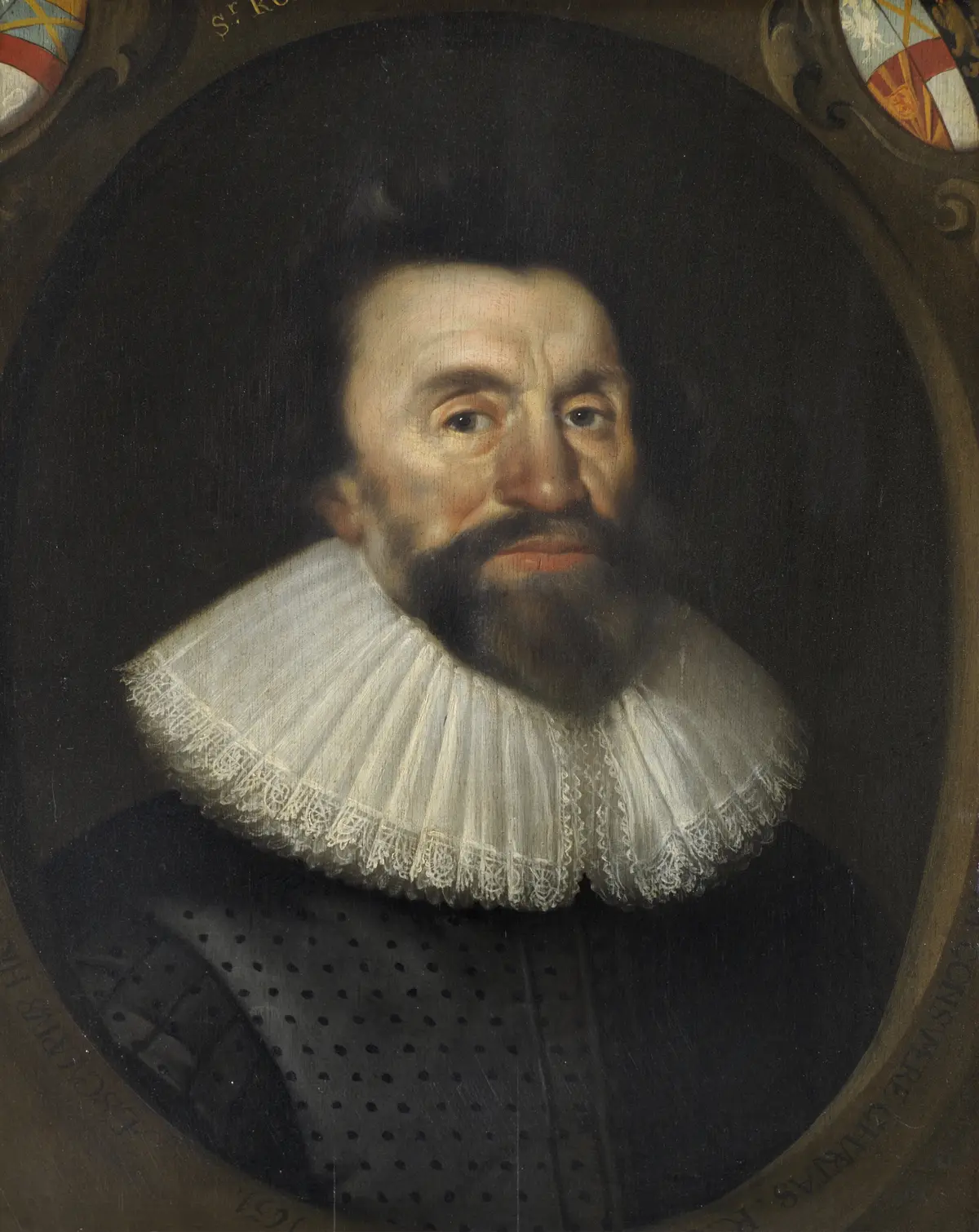
Full credit
"Sir Robert Bruce Cotton" by Cornelis Janssens van Ceulen — https://commons.wikimedia.org/wiki/File:Robert_Cotton.jpg — Public domain (Cornelis Janssens van Ceulen was buried in 1661; painted circa 1629. United States published before 1931 per the Commons record. European Union author dead more than 70 years. Flat reproduction of a two-dimensional painting (PD-Art).); Trinity College, Cambridge, TC Oils P 43
Witness card, all fields
- Witness
- British Library, Cotton MS Vitellius A. xv, called the unique manuscript of the poem ebeowulf.uky.edu archive.org
- Main sources
- 1732 House of Commons report; Prescott, in Wright 1997: 391–454; Zupitza 1882; Chambers 1921; the 1787 Thorkelin transcripts as described there archive.org ebeowulf.uky.edu archive.org archive.org
- Gap
- the letters lost since the 1780s are known from transcripts, not from the leaves archive.org archive.org
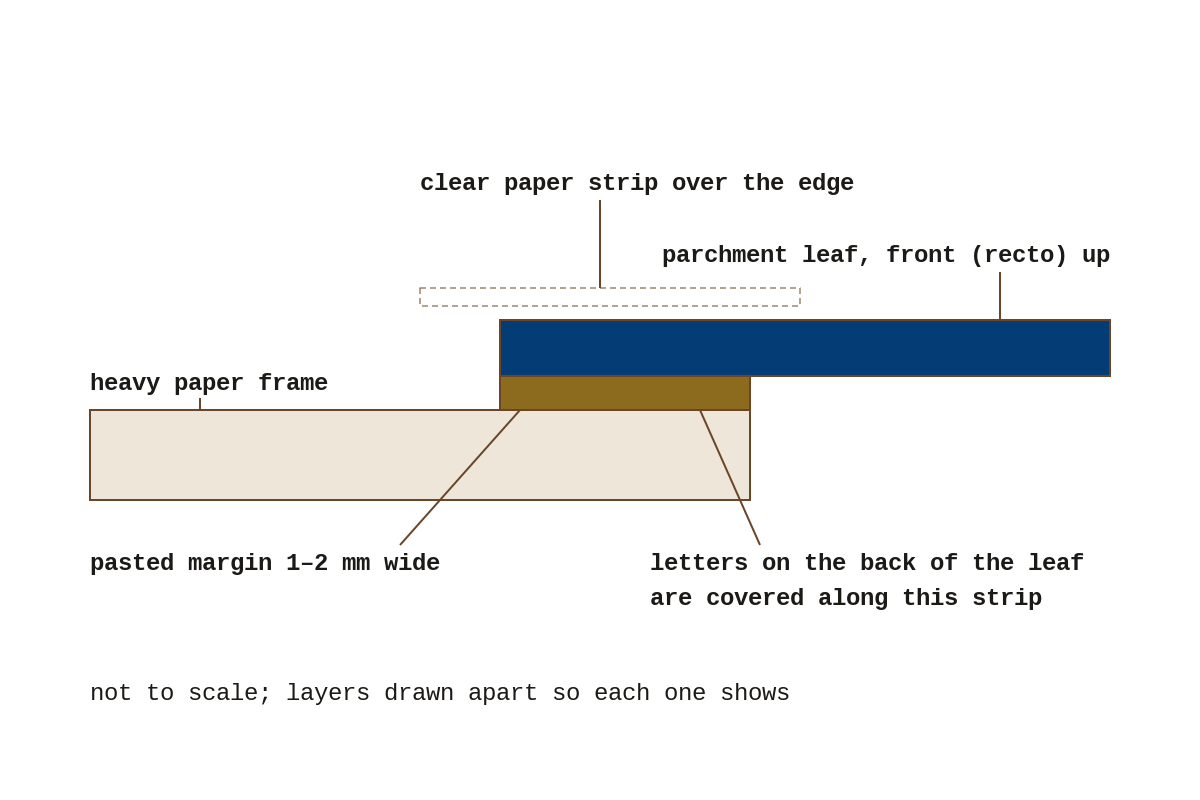
Find the paper frame around each leaf. In the Beowulf manuscript, every parchment leaf sits inside a sheet of heavy paper, held by a pasted margin only 1 to 2 mm wide, per Kevin Kiernan's account as Andrew Prescott reports it. Those frames went on in 1845, 114 years after the fire. Why did a book that came through the flames still need saving a century later?
Zupitza's 1882 edition and Electronic Beowulf both call this the unique manuscript of the Old English poem Beowulf, held at the British Library as Cotton MS Vitellius A. xv. The shelfmark goes back to the man in the portrait: Sir Robert Cotton's library used a pressmark system named for Roman emperors, per Prescott.
What did the 1731 Cotton Library fire do?
Start with the committee that went to look. Its report, printed by the House of Commons in 1732, puts the first smoke at about two o'clock on the morning of Saturday, October 23, 1731, at Ashburnham House in Westminster (p. 11). A wooden mantle-tree over a stove chimney had caught fire directly under the room that held the Royal and Cotton manuscripts.
The rescue did its own damage. David Casley, the deputy librarian, first carried out the Codex Alexandrinus and the books shelved under Augustus, which were considered the most valuable in the collection. Once the backs of the presses were burning, books were thrown out of the windows, and the report says many of the survivors had suffered from the engine water as well as the flames (pp. 11–12). Nothing in the report says when this volume came out of the room.
For this manuscript, the fire's mark was at the edges: Prescott, in his history of the library's restoration, describes heavy scorching along them and parchment that turned fragile. He also thinks the book was probably one of the 105 damaged bundles that Joseph Planta found stored in cases at the British Museum in the 1790s.
William Whiston, who wrote the report's narrative of the fire, admitted that nobody had yet found a way to stretch shrunken vellum back to its first size. He ended that passage with a hope about the shrivelled books: “it is hoped, that the Care, that has already been taken about them, will prevent their receiving farther Damage” (p. 14).
For this book, that hope failed.
Credit line to copy
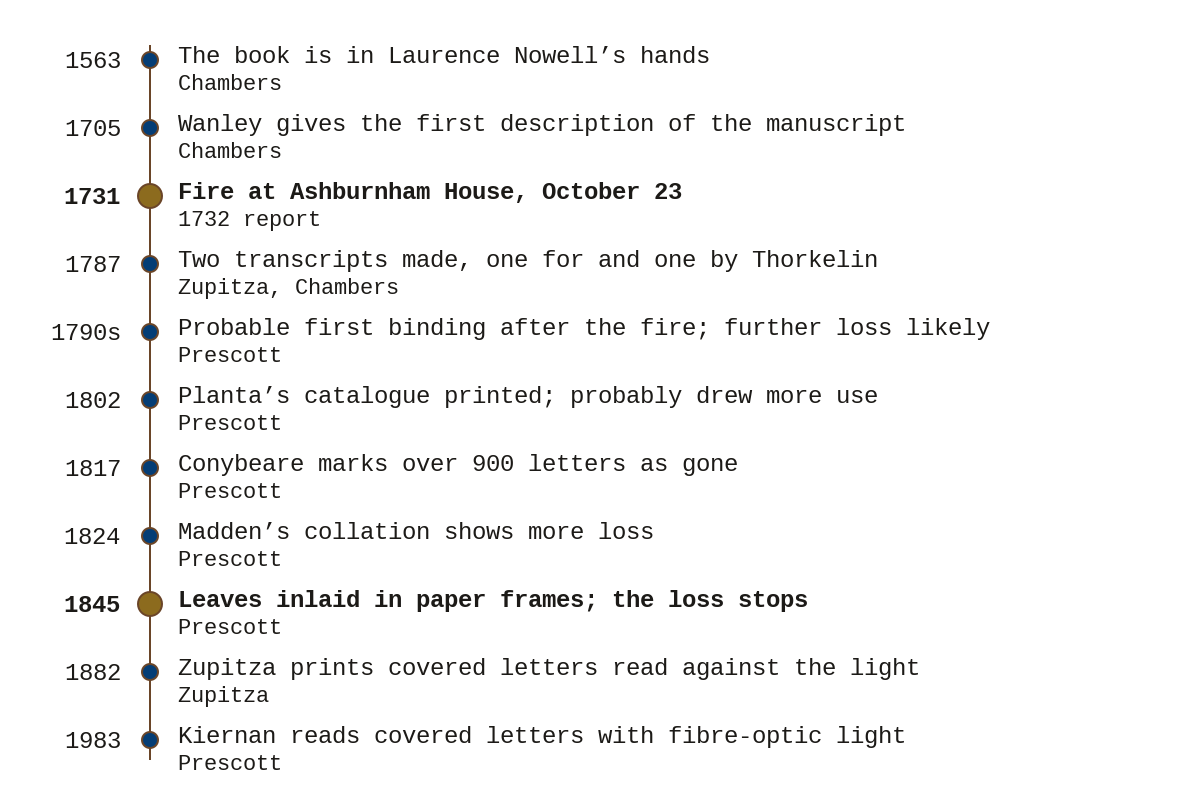
"What Happened to the Beowulf Manuscript, 1563 to 1983" by Spine & Watermark, https://spineandwatermark.com/lost/beowulf-manuscript/, licensed under CC BY 4.0 (https://creativecommons.org/licenses/by/4.0/).| Year | Event | Stated by |
|---|---|---|
| 1563 | The book is in Laurence Nowell's hands | Chambers |
| 1705 | Wanley gives the first description of the manuscript | Chambers |
| 1731 | Fire at Ashburnham House, October 23 | 1732 report |
| 1787 | Two transcripts made, one for and one by Thorkelin | Zupitza, Chambers |
| 1790s | Probable first binding after the fire; further loss likely | Prescott |
| 1802 | Planta's catalogue printed; probably drew more use | Prescott |
| 1817 | Conybeare marks over 900 letters as gone | Prescott |
| 1824 | Madden's collation shows more loss | Prescott |
| 1845 | Leaves inlaid in paper frames; the loss stops | Prescott |
| 1882 | Zupitza prints covered letters read against the light | Zupitza |
| 1983 | Kiernan reads covered letters with fibre-optic light | Prescott |
What did the 1732 report count?
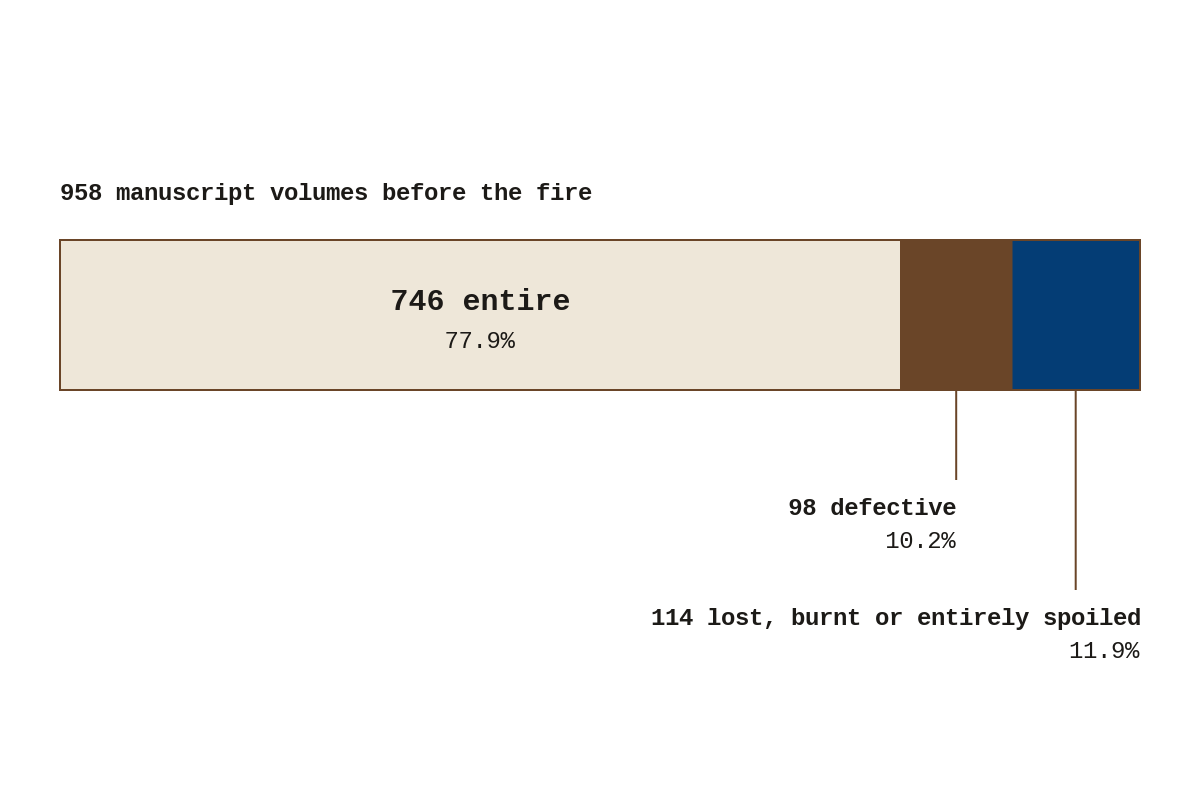
Read the tally next, on page 15, where the report gives 958 manuscript volumes before the fire. Of those, 114 were “lost, burnt, or intirely spoiled” and 98 “damaged, so as to be defective”, which leaves 746 entire. Against the whole library, that makes 11.9% lost and 10.2% defective, or 212 volumes of 958.
Credit line to copy
"The Cotton Library Damage Count in the 1732 Report" by Spine & Watermark, https://spineandwatermark.com/lost/beowulf-manuscript/, licensed under CC BY 4.0 (https://creativecommons.org/licenses/by/4.0/).| Report's category | Volumes | Stated in | Share, this page's arithmetic |
|---|---|---|---|
| Entire | 746 | 1732 report, p. 15 | 77.9% (746 ÷ 958) |
| Damaged, so as to be defective | 98 | 1732 report, p. 15 | 10.2% (98 ÷ 958) |
| Lost, burnt, or entirely spoiled | 114 | 1732 report, p. 15 | 11.9% (114 ÷ 958) |
Download the data (cotton-fire-damage-claims.csv) · source and license notes
Then look for the Beowulf manuscript in the list that follows. David Casley's list of damaged books runs through the Vitellius press on pages 93 to 95, and under Vitellius A it gives numbers II, III, V, VI, VII, VIII and IX. There is no XV. As far as the printed list goes, the book counts among the undamaged.
Prescott points out that omission, and he treats the famous totals as misleading in both directions: many volumes called lost survived as fragments that were restored in the 1800s, and he counts only thirteen as completely destroyed. Yet books listed as intact, this one among them, had been hurt. The report is the most detailed early witness to the fire, and it still left out the book this page is about.
What is in the volume, and who copied it?
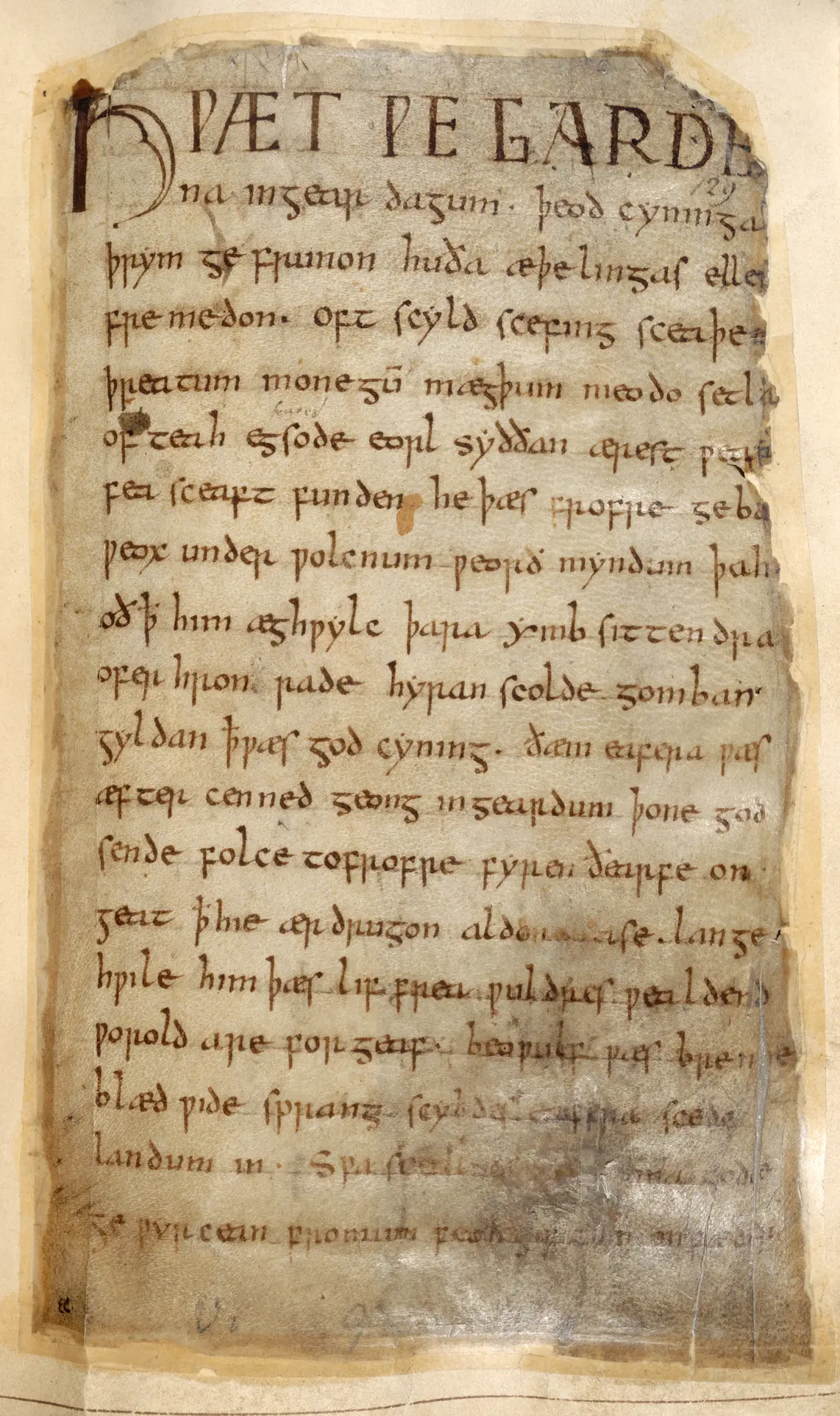
Look at the leaf below, the poem's first page, and notice that the paper frame now carries the weight of the page. The script runs close to a broken edge on the right. The record for this image calls it folio 132, while Chambers starts the poem at folio 129 (132) (p. 385). Electronic Beowulf lists more than one foliation for this codex, so check which numbering a citation uses.
Full credit
"The beginning of Beowulf, Cotton MS Vitellius A. XV, f. 132" by Unknown scribe — https://commons.wikimedia.org/wiki/File:The_beginning_of_Beowulf_-_Beowulf_(c.1000),_f.132_-_BL_Cotton_MS_Vitellius_A_XV.jpg — Public domain (Manuscript copied about 1000 per Chambers 1921, scribes unnamed. United States: made and first published long before 1931. European Union: anonymous work far past 70 years. The holding library marks this image file itself as public domain in its embedded metadata.); British Library, Cotton MS Vitellius A. XV, f. 132
Credit line to copy
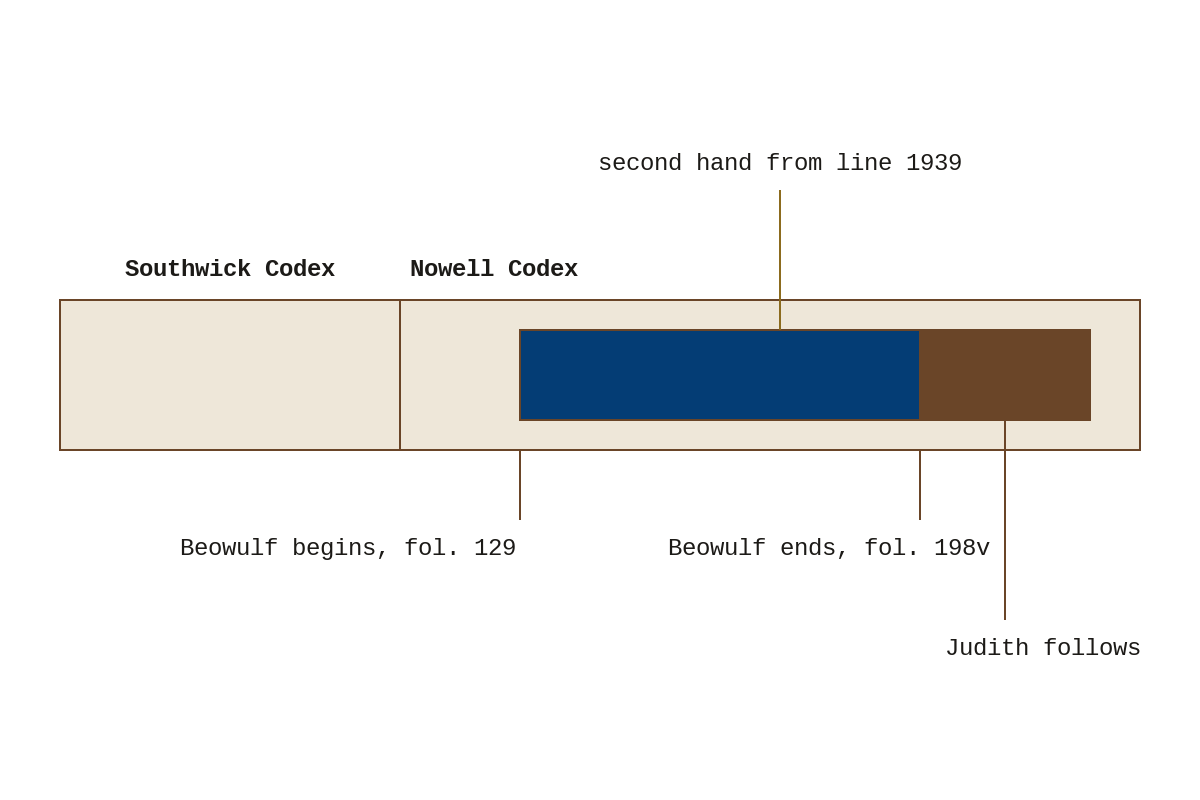
"The Two Codices in Cotton MS Vitellius A. xv" by Spine & Watermark, https://spineandwatermark.com/lost/beowulf-manuscript/, licensed under CC BY 4.0 (https://creativecommons.org/licenses/by/4.0/).The volume is two books bound together, according to Electronic Beowulf: the Southwick Codex, then the Nowell Codex, which holds Beowulf at fols. 129–198v and Judith straight after it. Chambers, following Kenneth Sisam, reports that the book was in the hands of Laurence Nowell in 1563, before it reached Cotton.
The leaf numbers came much later. Prescott says Planta faced loose, unnumbered sheets and quires that the fire and then readers had thrown out of order, so he had the Cotton volumes numbered in ink first. Folding sets the order of the leaves in a sheet, and a loose leaf has lost that guide. Damaged margins sometimes left the numberers nowhere sensible to write.
Two scribes copied the poem, and no source read here names either one. R. W. Chambers, writing in 1921, says the first hand runs to line 1939 and a second, thicker hand finishes the poem and goes on to Judith (p. 385).
For the copy's age, Chambers gives “about the year 1000” as the general view of his day, somewhat more likely before that date than after it (p. 386). Richard Clement, writing in 2010, lists a final copy made around 1000 among the things scholars long thought they knew, and he says the date the poem was composed is now less sure. Electronic Beowulf sends readers to Kiernan's 1981 book for the codex's history, but that book was not read here, so this page does not settle the copy's age.
The poem's date is a separate question from the copy's, and the story's date is a third: the title of Thorkelin's 1815 edition placed the deeds in the third and fourth centuries (Chambers's bibliography gives the title), which dates the events told, not the writing of the poem.
Why only one manuscript survives is a question no source read here answers. Other losses have other shapes, and for Sappho's books this site looks first at choices about copying, not at a fire.
The volume itself is held at the British Library, whose reading-room conditions were not checked for this page. Electronic Beowulf, the edition sponsored by the library and the University of Kentucky, presents the whole codex page by page.
Why did the edges keep crumbling after the fire?
Separate two things that are usually told as one. The fire scorched the edges, but it did not take the letters that the 1787 transcripts record, because those letters could still be read 56 years after the fire.
A fire is not use, so the scorching is not the handling scar on this page. The reading room is another matter.
In Prescott's account, the Cotton manuscripts reached the British Museum in 1757, and readers could call up brittle books whose edges had no protection. He thinks this volume was probably bound in the 1790s under Planta, and that the binding likely cost more text. Planta's printed catalogue of 1802, he argues, then drew readers to books too fragile for public use.
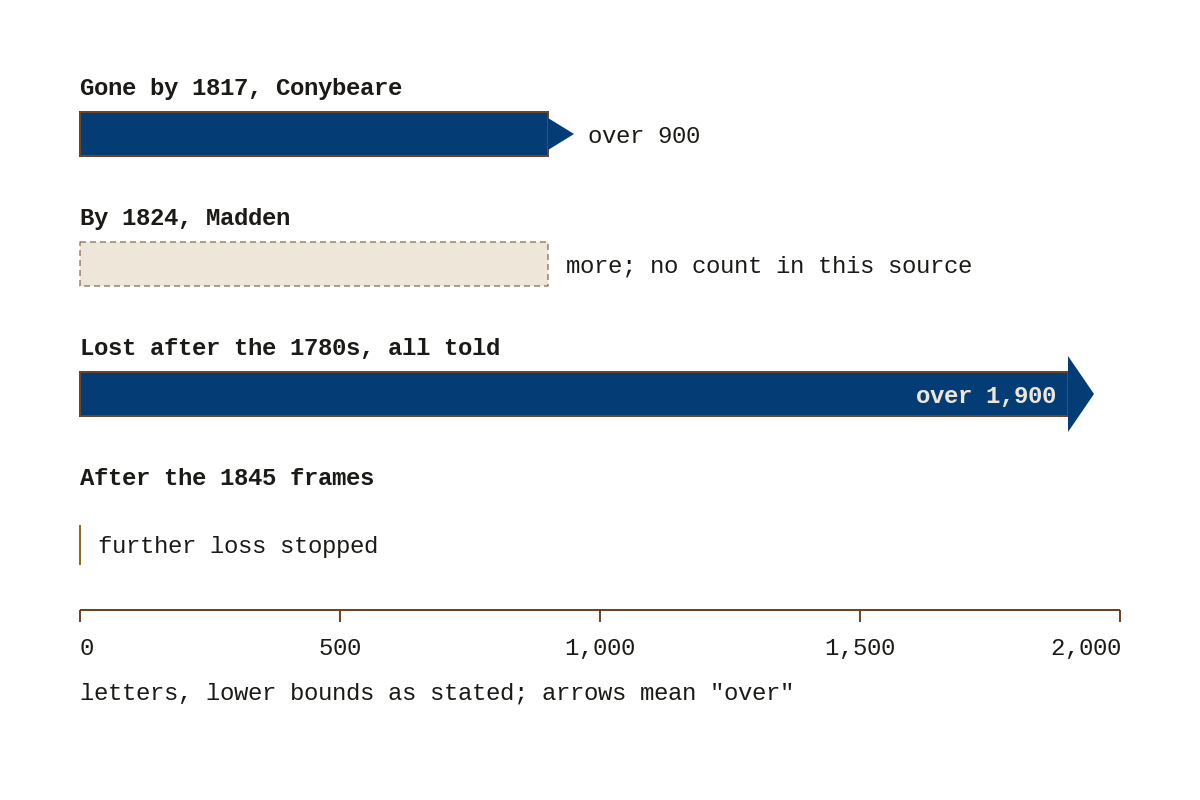
The people who measured the loss added to it. In 1817 John Conybeare compared Thorkelin's 1815 edition with the manuscript and marked over 900 letters as gone, and Sir Frederic Madden's collation of 1824 found more gone. Prescott says both men sped the decay by handling the leaves to make those counts, and he blames readers, free to handle the book, for much of the damage in the early 1800s.
Madden himself later described the problem to the Museum's Trustees. A Reading Room ticket, he complained, opened the whole collection to its holder, whatever state a manuscript was in, and he asked for limits on the damaged Cotton volumes until they were safe.
Credit line to copy
"Letters Lost From the Beowulf Manuscript, as Stated" by Spine & Watermark, https://spineandwatermark.com/lost/beowulf-manuscript/, licensed under CC BY 4.0 (https://creativecommons.org/licenses/by/4.0/).| Point | Letters | Measured against | Stated by |
|---|---|---|---|
| By 1817, Conybeare | over 900 | Thorkelin's 1815 edition | Conybeare, per Prescott |
| By 1824, Madden | more than Conybeare; no count in this source | not given in this source | Madden's collation, per Prescott |
| After the 1780s, all told | over 1,900 | the Thorkelin transcripts | Prescott |
| After 1845 | further loss stopped; no count in this source | not applicable | Prescott |
These figures don't divide cleanly. Both totals are stated as “over”, and they measure from different baselines, so this page gives no percentage.
Handling is not the only cause on record. Back in 1882, Julius Zupitza wrote that the manuscript “did not suffer so much from the fire of 1731 itself as from its consequences” (p. vi), and he blamed the lack of a careful early rebinding. Prescott also reports a 1750s complaint about damp and insects in the Vitellius press, though not about this volume by name.
The binding counts as treatment, not use. Letter by letter, no source read here can say which chip fell to which reader, so for any single missing letter the honest label is cause not established. The pattern is what Prescott documents: fire left the edges weak, and handling carried pieces of them away.
How did a paper frame stop the loss?
Look at the leaf edge. In Kiernan's description, which Prescott reports, each frame is a sheet of heavy paper with its center gone, slightly smaller than the leaf it holds. Paste on a margin of 1 to 2 mm holds the leaf, and clear paper strips secure its edge on the front. Prescott credits Madden with the method and says Henry Gough inlaid this volume in 1845, one of twelve he did that year.
It took Madden years to get there. He told the Trustees in 1842 that handling such books had meant further damage, while they worried about the cost and first allowed Gough only a few volumes. Only in March 1845 did they let the work go ahead across the burnt vellum manuscripts.
Credit line to copy
"How a Paper Frame Holds a Leaf" by Spine & Watermark, https://spineandwatermark.com/lost/beowulf-manuscript/, licensed under CC BY 4.0 (https://creativecommons.org/licenses/by/4.0/).The frames worked, and they had a price. Zupitza says “the binder could not help covering some letters or portions of letters in every back page” (p. vi), and for his 1882 edition he read many of them “by holding the leaf to the light” (p. vi).
A century later, in 1983, Kiernan showed that fibre-optic light from behind the leaf could bring out many of the covered letters, per Prescott. The framed edge is therefore a place where text was hidden and kept at the same time.
Rebinding changed other parchment books as well: the Book of Kells had its edges trimmed. None of this is a method to try at home, because the same handling is what cost this book its letters. Burnt or brittle leaves belong with a conservator; start with the American Institute for Conservation.
What do the 1787 transcripts still hold?
Follow the missing letters to Copenhagen. Zupitza says two transcripts were made nearly a century before his edition, one by and one for Grímur Jónsson Thorkelin, whom Prescott calls a Danish antiquary. Chambers dates both to 1787 and places them in the Royal Library at Copenhagen. Humfrey Wanley's catalogue of 1705 had already described the poem as the wars of a Danish hero, per Chambers.
 Illustration
Those two copies are why anyone can count the loss at all. Zupitza says that when Thorkelin used the book the edges of only a few pages had crumbled, while Prescott notes that small pieces were apparently falling as the copies were being made. Zupitza leaned on them: where Thorkelin's copies settle a reading, he usually cites no later authority (p. vi).
They are not flawless, and Zupitza corrected obvious faults in both of them (p. vii). This site still treats them as evidence, not as second-best, the same line it takes with the copies made from the Archimedes books. For these letters a copy made roughly eight centuries after the manuscript is close to the only witness left, because the parchment that held them no longer exists.
What the leaves still hide is smaller and more exact. The sources read here give totals, not a leaf-by-leaf list of which letters survive only in Copenhagen and which sit under a frame. Nobody quoted here counts how many fell to readers and how many to binders or damp, and setting the leaves against the transcripts line by line could show which letters went, though not what took them.
Turn it over:
The evidence still lacks a count by cause. No source read here separates the letters lost to readers from those lost to binding or damp, or lists, leaf by leaf, which letters survive only in the transcripts and which remain under the frames.
- Archimedes Palimpsest: a book where copies and photographs now hold what the leaves lost: Its erased copy outlasted two others kept in use.
- Voynich Manuscript: another manuscript whose dates need separating: Its parchment has a tested date; its ink and text do not.
Sources
- House of Commons, A Report from the Committee Appointed to View the Cottonian Library (1732), Appendix A, pp. 11–15, and Appendix B, pp. 93–95. archive.orgRead: sections only (narrative of the fire, the count on p. 15, and the Vitellius A list, pp. 93–95), 2026-11-07
- Andrew Prescott, “‘Their Present Miserable State of Cremation’: The Restoration of the Cotton Library,” in Sir Robert Cotton as Collector: Essays on an Early Stuart Courtier and His Legacy, ed. C. J. Wright (British Library, 1997), pp. 391–454. ebeowulf.uky.eduRead: full text of an online copy of the chapter, read 2026-11-06; cited here in print, paraphrased only; print page numbers not available for single claims
- Julius Zupitza, ed., Beowulf: Autotypes of the Unique Cotton MS. Vitellius A. XV in the British Museum, Early English Text Society 77 (Trübner, 1882), Preliminary Notice, pp. v–vii. archive.orgRead: section only (Preliminary Notice, pp. v–viii), 2026-11-07
- R. W. Chambers, Beowulf: An Introduction to the Study of the Poem (Cambridge University Press, 1921), pp. 385–387. archive.orgRead: section only (Bibliography §§ 3–4, The MS and its transcripts, and the start of Editions, pp. 385–387), 2026-11-07
- Richard Clement, “Scribal Practice in the Beowulf Manuscript” (published online, 2010), introduction as excerpted on Medievalists.net. medievalists.netRead: section only (the introduction excerpted on this page), 2026-11-07
- Electronic Beowulf, 5th edition, “Cotton Vitellius A. xv” (2026). ebeowulf.uky.eduRead: full page (index page of the edition) and the About page, 2026-11-06
- Kevin S. Kiernan, Beowulf and the Beowulf Manuscript (New Brunswick, 1981). ebeowulf.uky.eduRead: bibliography only
- Wikimedia Commons file page, Robert Cotton.jpg, recording Trinity College, Cambridge, TC Oils P 43. commons.wikimedia.orgRead: file page only; the holding record could not be read
- Wikimedia Commons file page, The beginning of Beowulf - Beowulf (c.1000), f.132 - BL Cotton MS Vitellius A XV.jpg, from the British Library. commons.wikimedia.orgRead: file page only; the British Library record could not be read
Image credits
- "Sir Robert Bruce Cotton" by Cornelis Janssens van Ceulen — https://commons.wikimedia.org/wiki/File:Robert_Cotton.jpg — Public domain (Cornelis Janssens van Ceulen was buried in 1661; painted circa 1629. United States published before 1931 per the Commons record. European Union author dead more than 70 years. Flat reproduction of a two-dimensional painting (PD-Art).); Trinity College, Cambridge, TC Oils P 43
- "What Happened to the Beowulf Manuscript, 1563 to 1983" by Spine & Watermark, https://spineandwatermark.com/lost/beowulf-manuscript/, licensed under CC BY 4.0 (https://creativecommons.org/licenses/by/4.0/).
- "The Cotton Library Damage Count in the 1732 Report" by Spine & Watermark, https://spineandwatermark.com/lost/beowulf-manuscript/, licensed under CC BY 4.0 (https://creativecommons.org/licenses/by/4.0/).
- "The beginning of Beowulf, Cotton MS Vitellius A. XV, f. 132" by Unknown scribe — https://commons.wikimedia.org/wiki/File:The_beginning_of_Beowulf_-_Beowulf_(c.1000),_f.132_-_BL_Cotton_MS_Vitellius_A_XV.jpg — Public domain (Manuscript copied about 1000 per Chambers 1921, scribes unnamed. United States: made and first published long before 1931. European Union: anonymous work far past 70 years. The holding library marks this image file itself as public domain in its embedded metadata.); British Library, Cotton MS Vitellius A. XV, f. 132
- "The Two Codices in Cotton MS Vitellius A. xv" by Spine & Watermark, https://spineandwatermark.com/lost/beowulf-manuscript/, licensed under CC BY 4.0 (https://creativecommons.org/licenses/by/4.0/).
- "Letters Lost From the Beowulf Manuscript, as Stated" by Spine & Watermark, https://spineandwatermark.com/lost/beowulf-manuscript/, licensed under CC BY 4.0 (https://creativecommons.org/licenses/by/4.0/).
- "How a Paper Frame Holds a Leaf" by Spine & Watermark, https://spineandwatermark.com/lost/beowulf-manuscript/, licensed under CC BY 4.0 (https://creativecommons.org/licenses/by/4.0/).
- Illustration: Spine & Watermark. Generated schematic illustration — not a photograph or historical record. © Spine & Watermark, all rights reserved; not licensed for reuse (see /image-use/).
Cite this page
Spine & Watermark. “Beowulf Manuscript: Its Edges Kept Crumbling After the Fire.” Spine & Watermark, published November 7, 2026. https://spineandwatermark.com/lost/beowulf-manuscript/. Accessed [date].
How sources are ranked · All corrections · Contact · Report an error (contact@spineandwatermark.com)