Sappho: Most of What Survives Is Quotation or Torn Papyrus
Published · Revised
TL;DR: Sappho was a Greek lyric poet from Lesbos, active around 610 BC by Wharton's date. None of her nine ancient books survives complete in the sources read here, so most of what survives is quotation or torn copy. Her fullest poem in Wharton's edition is whole because a critic quoted it.
Witness: one poem whole in a quotation, per Wharton 1895; the rest in quotations, reports and torn copies · main sources: Dionysius of Halicarnassus, Longinus and Hephaestion, per Wharton; Oxyrhynchus papyri, per Grenfell and Hunt · gap: none of the nine ancient books survives complete in the sources read
Full credit
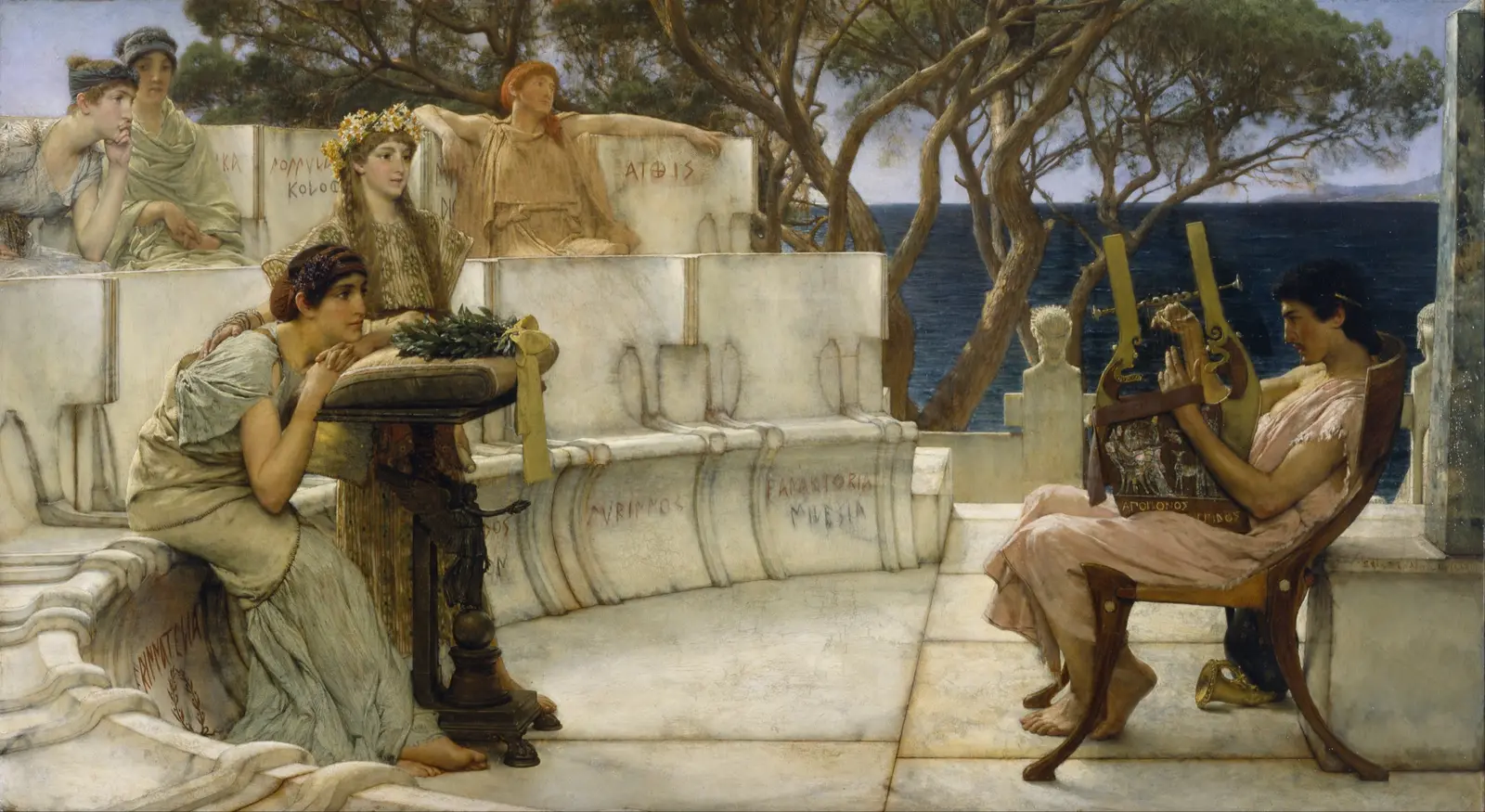
"Sappho and Alcaeus" by Lawrence Alma-Tadema — https://commons.wikimedia.org/wiki/File:Sir_Lawrence_Alma-Tadema,_R.A.,_O.M._-_Sappho_and_Alcaeus_-_Google_Art_Project.jpg — Public domain (Lawrence Alma-Tadema died in 1912; painted and exhibited in 1881. United States published or exhibited before 1931. European Union author dead more than 70 years. Flat reproduction of a two-dimensional painting (PD-Art).); Walters Art Museum, 37.159; modified: scaled from 7,628 px to 2,400 px wide and saved as JPEG; not cropped
Witness card, all fields
- Witness
- one poem whole in a quotation, per Wharton 1895; the rest in quotations, reports and torn copies gutenberg.org
- Main sources
- Dionysius of Halicarnassus, Longinus and Hephaestion, per Wharton; Oxyrhynchus papyri, per Grenfell and Hunt gutenberg.org archive.org
- Gap
- none of the nine ancient books survives complete in the sources read archive.org archive.org
Read the small note under Sappho’s first poem. In H. T. Wharton's 1895 edition the Greek runs to 28 lines, and the note says that Dionysius of Halicarnassus quoted the poem at Rome about 25 BC, while other authors keep certain lines, “though nowhere else the whole.” What needs explaining is why one critic's example holds the fullest poem in that edition, and what kind of copy everything else is.
Who was Sappho, and how much did she write?
Sappho was a lyric poet of the Greek island of Lesbos. An ancient biography recovered at Oxyrhynchus, in Egypt, calls her a Lesbian by birth, from the city of Mitylene (P.Oxy. 1800), and Wharton reports that she is said to have been at the height of her fame about 610 BC. She wrote in the Aeolic dialect, the Greek of her island, and called herself Psappha in it.
Little else about her life is firm. The painting above shows what a Victorian artist imagined, and Wharton, who used its head of Sappho for his frontispiece, offered it only as perhaps the best picture of what she and her surroundings might have been. He doubted the busts of her too: none, he says, seem genuine.
Full credit
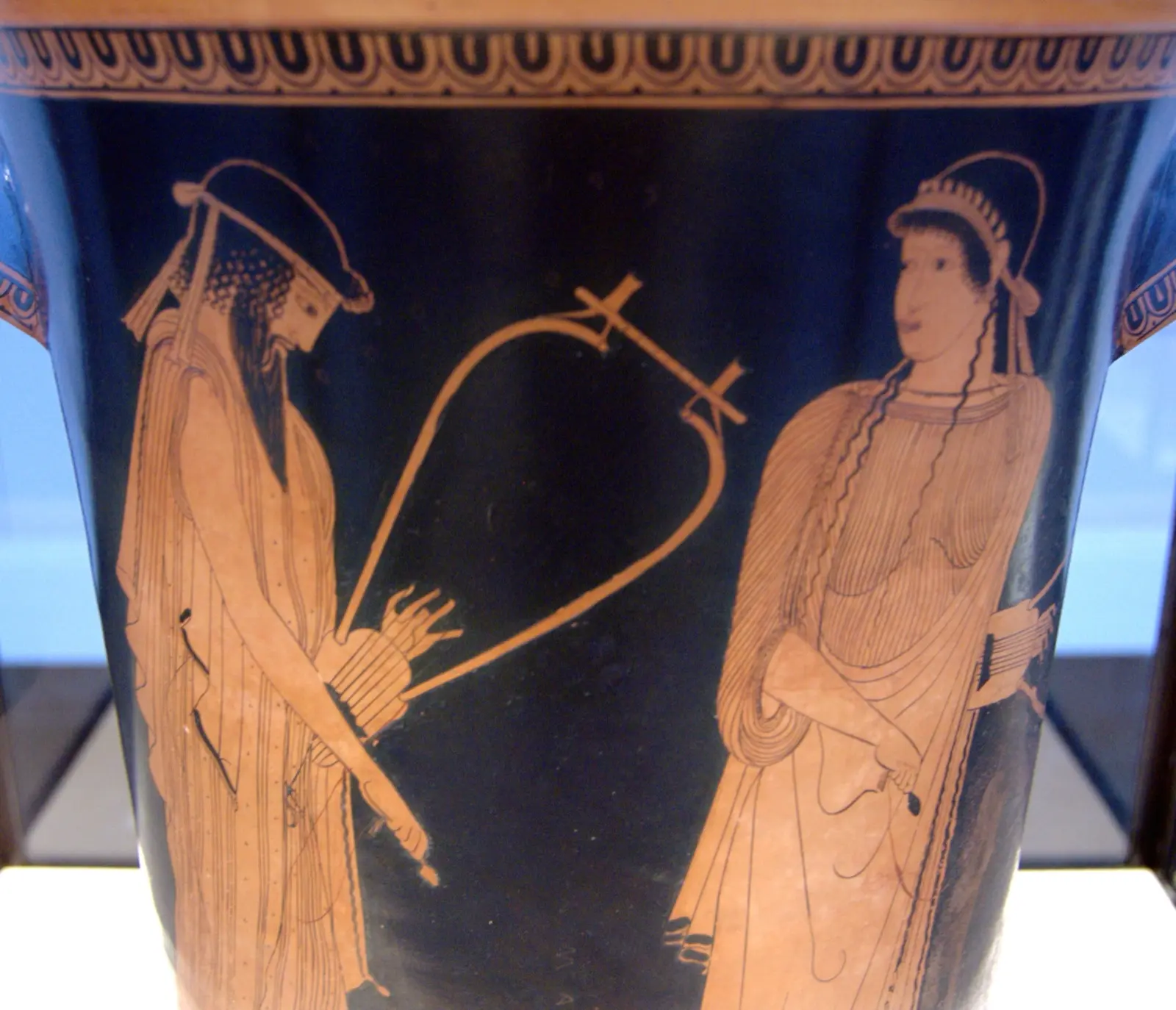
"Alcaeus and Sappho, Attic red-figure kalathos, side A" by Bibi Saint-Pol — https://commons.wikimedia.org/wiki/File:Alkaios_Sappho_Staatliche_Antikensammlungen_2416_n1.jpg — Public domain (The vase dates to c. 470 BC. The photographer released the 2007 photograph into the public domain worldwide on the file page, so United States and European Union use rest on that release.); Staatliche Antikensammlungen, Munich, Inv. 2416; modified: scaled from 2,212 px to 1,600 px wide and saved as JPEG; not cropped
This vase, given to the Brygos Painter in its Commons record, comes closer in time, although its date still falls about 140 years after Wharton's date for her, so it cannot be a likeness from life.
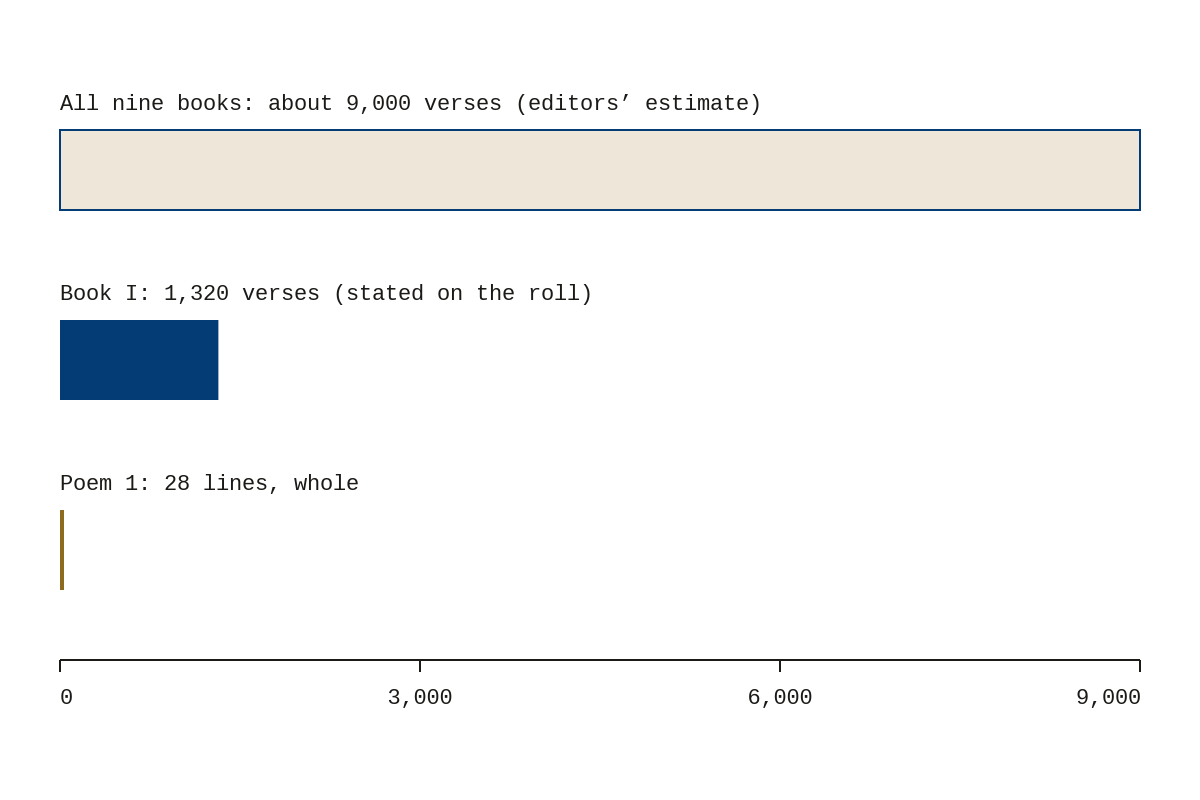
She wrote far more than survives. Her lyrics are reported to have filled nine books, per Wharton and the Oxyrhynchus editors. A papyrus roll of Book I carries its own count, 1,320 verses, and Bernard Grenfell and Arthur Hunt suggested in 1914 that her whole output “may well have extended to something like 9,000 verses” (Oxyrhynchus Papyri X, p. 20).
That figure is a hedged estimate, not a count. Against it, the first poem's 28 lines come to about 0.3%, and the recorded length of Book I alone to about 15%.
Credit line to copy
"Poem 1 Against the Recorded and Estimated Verse Counts" by Spine & Watermark, https://spineandwatermark.com/lost/sappho-fragments/, licensed under CC BY 4.0 (https://creativecommons.org/licenses/by/4.0/).How did her fullest poem survive?
Dionysius was writing about word order, not trying to save a poem. In chapter 23 of On Literary Composition he describes the smooth style of writing and names the authors who best represent it, and then, in W. Rhys Roberts's 1910 translation, he promises examples, “selecting among poets Sappho” (p. 237), and copies out the whole text.
It opens this way in Wharton's prose: “Immortal Aphrodite of the broidered throne, daughter of Zeus, weaver of wiles, I pray thee break not my spirit with anguish and distress, O Queen.”
Follow the route from there. Wharton's date for Sappho and his date for Dionysius sit about 585 years apart, and the sources read here report no surviving copy of the poem from that gap.
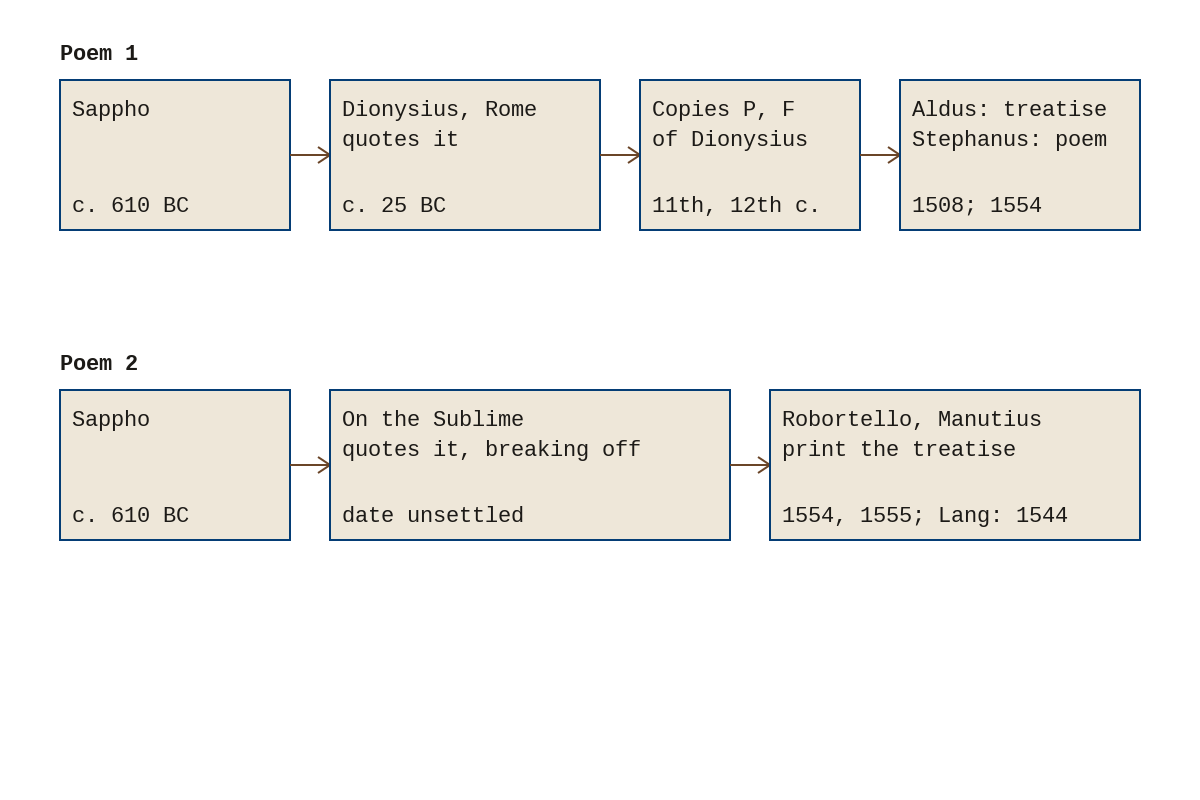
The next witnesses are copies of Dionysius himself. Roberts lists a manuscript in Paris (Parisinus 1741), dated to the 11th century or possibly the 10th, and one in Florence (Laurentianus LIX 15), dated to the 12th. His notes on page 238 show the two disagreeing inside the poem, and one word in line 20 comes from a later editor who took it from a medieval dictionary.
A shorter version of the treatise could have broken the chain. It did not. Roberts notes a Greek epitome about one-third the length of the original, and he remarks that ancient epitomes often seem to have replaced the full works they cut down (p. 10). This one kept the Sappho, so the poem had a second way through; another quotation in the treatise would have been lost had the epitome alone come down.
Print came last. The sources read count it differently. Wharton says the first edition of any part of Sappho was this poem, printed by H. Stephanus in 1554, about 1,578 years after Dionysius. Roberts lists earlier printed editions of the treatise itself, by Aldus Manutius in 1508 and Robert Stephanus in 1547, so the poem may have reached type inside another writer's book about style before any edition of Sappho.
Credit line to copy
"Two Routes to Print" by Spine & Watermark, https://spineandwatermark.com/lost/sappho-fragments/, licensed under CC BY 4.0 (https://creativecommons.org/licenses/by/4.0/).Poem 2, the one modern work calls fragment 31
The next-longest entry in Wharton has the same kind of history. His fragment 2 survives because the treatise On the Sublime, usually credited to a writer called Longinus, quotes it to show how an author selects and combines the signs of passion. Its first words in Wharton read: “That man seems to me peer of gods, who sits in thy presence.”
Roberts's note pairs the two: he credits Dionysius and On the Sublime with “the preservation of the two most considerable extant fragments” of her poetry (p. 238). The second is not whole. The Greek stops in a damaged line, which Wharton fills out in brackets.
Modern work calls this poem fragment 31, as in the title of Armand D'Angour's 2013 chapter. Wharton prints Catullus's poem 51, an imitation, beside his fragment 2, and Dolores O'Higgins's chapter “Sappho’s Splintered Tongue: Silence in Sappho 31 and Catullus 51” points to the same pairing. This page read only those two titles, not a modern edition's numbering, so treat the match as a cross-check.
The treatise's date is less settled than Dionysius's. Wharton puts it about AD 250, while Andrew Lang's introduction to H. L. Havell's translation says that opinion wavers between the age of Augustus and the age of Aurelian, and that no extant classical writer cites it. The sources differ on its first printing too: Lang gives 1544 for the editions of Robertelli and Manutius, while Roberts's 1907 edition of the treatise gives 1554 for Robortello and 1555 for Manutius.
What is the echo copy?
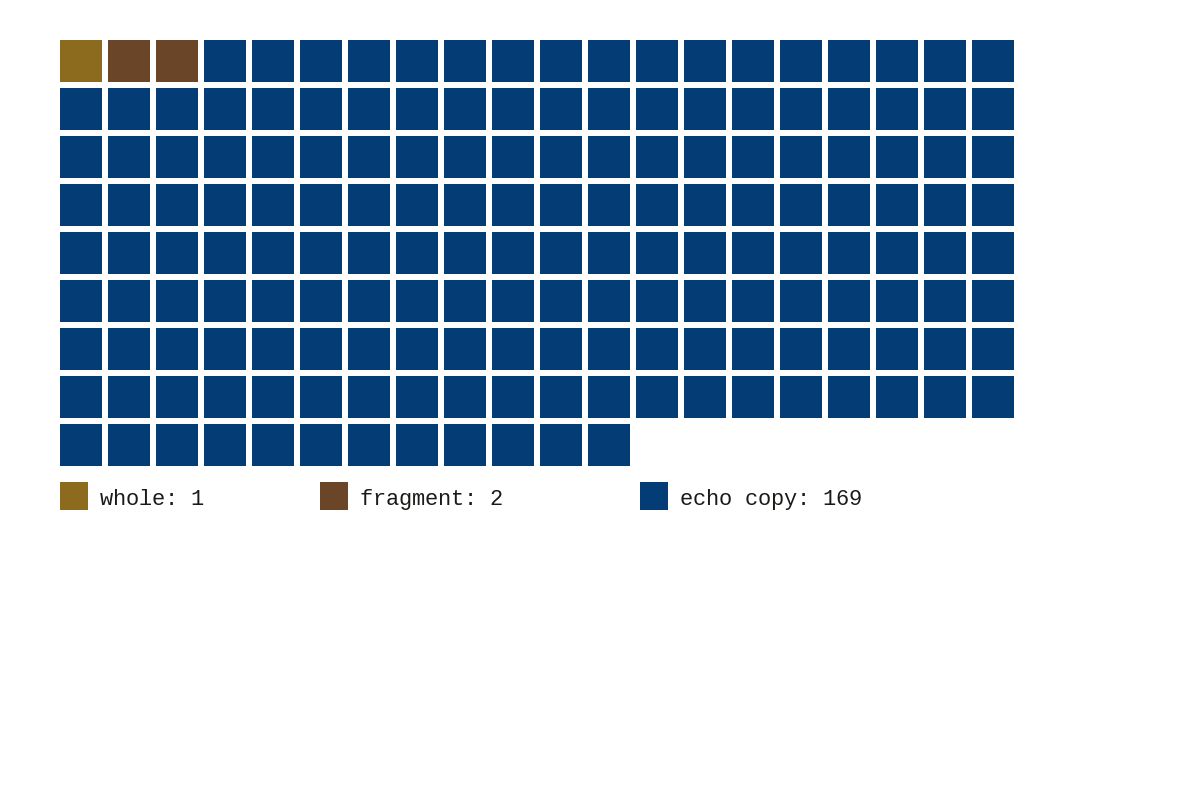
Poem 2 survives in a form that this site has a particular word for. The echo copy is this site’s term for the only surviving form of a lost work: the fragments quoted, summarized or paraphrased in other surviving works. No manuscript of the work itself survives. What you can read is whatever another author chose to pass along.
Every fate on this site gets one of three labels, and the Sappho register applies them entry by entry:
- Whole: the text of the poem runs start to finish in the source read.
- Fragment: a torn piece of a copy of her own text.
- Echo copy: another writer's quotation, summary or paraphrase is all that carries it.
Wharton makes a useful base because his edition is readable and in the public domain, and because he follows the numbering of the German scholar Bergk, 1 to 170, printing “every word” Bergk considered hers, per his note after entry 170. Number 141 was moved to 57A, and two scraps from the Fayum region of Egypt follow at the end, which makes 172 entries.
| Form | Entries in this register | Share of 172 |
|---|---|---|
| Whole | 1 | 0.6% |
| Fragment | 2 | 1.2% |
| Echo copy | 169 | 98.3% |
Credit line to copy
"Forms in the Sappho Register" by Spine & Watermark, https://spineandwatermark.com/lost/sappho-fragments/, licensed under CC BY 4.0 (https://creativecommons.org/licenses/by/4.0/).Those shares describe this register, not all of Sappho, and they stop at 1895. Poem 1 also strains the labels, since its text is whole although its only full route is a quotation, so the witness column of the download records that route beside the label.
| Wharton no. | Form | Witness | Author and passage |
|---|---|---|---|
| 1 | whole | quotation, to show style or rhetoric | Dionysius of Halicarnassus, On Literary Composition 23 |
| 2 | echo copy | quotation, to show style or rhetoric | Longinus, On the Sublime 10 |
| 14 | echo copy | quotation, to show dialect or grammar | Apollonius of Alexandria |
| 33 | echo copy | quotation, to show metre | Hephaestion |
| 144 | echo copy | report or paraphrase, no full verse | Servius, on Aeneid 6.21 |
| Fayum A | fragment | torn parchment scrap | Berlin Egyptian Museum parchment, front; attribution disputed, per Wharton |
Download the data (sappho-survival-register.csv) · source and license notes
The file also marks the doubts Wharton reports: he thinks entry 26 is probably spurious, and he calls the authenticity of entry 120 doubtful. Compare the Voynich Manuscript, a surviving book whose text has no accepted reading: Sappho is the reverse case, an author whose words can be read but whose books are gone.
Why were these lines kept?
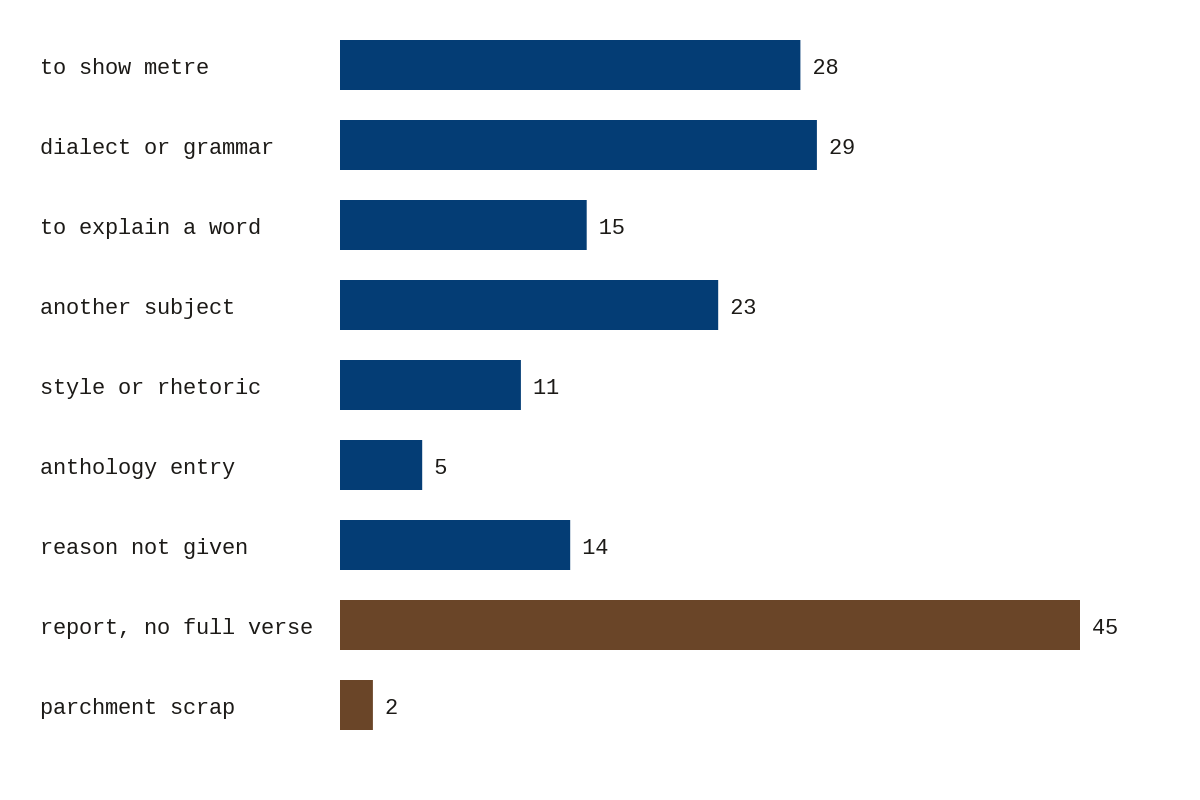
Open the file and sort by witness. Of the 120 entries that quote her lines in passing, 72 are there for a technical reason: 28 for metre, 29 for dialect or grammar, and 15 to explain a word. That is 60% of the group. Only 11, about 9%, are quoted as examples of style, the reason poem 1 survives.
Wharton saw the same pattern and said it flatly in his Life of Sappho: “Save for the quotations of grammarians and lexicographers, no word of hers would have survived.” Papyrus finds have since overtaken that sentence, although the pattern it describes still holds for the entries he printed.
Credit line to copy
"Why the Register Entries Were Kept" by Spine & Watermark, https://spineandwatermark.com/lost/sappho-fragments/, licensed under CC BY 4.0 (https://creativecommons.org/licenses/by/4.0/).Think of each quotation as an impression pulled to test one part of a die. The metre writer Hephaestion, the source named in 24 entries, wanted the rhythm, so “I loved thee once, Atthis, long ago” (entry 33) reached Wharton because it opened a book in a metre Hephaestion was describing. The grammarian Apollonius, named in 17 entries, wanted the form of a word, and “To you, fair maids, my mind changes not” (entry 14) illustrates an Aeolic spelling of “to you.”
The result is a strange anthology. Going by the reasons given, few of these lines were chosen as her best work, and many of them stop after a single line. Other quotations come very late: the image of the stars hiding their faces around the full moon (entry 3) is credited to Eustathius of Thessalonica, late in the 12th century, and Wharton does not say where Eustathius found it.
A further 45 entries hold no full verse at all, only a report of a word she used or a claim she made. Servius says she told the story of Theseus and the seven boys and seven maidens, for instance, and Wharton adds that no such passage is preserved.
The reason classes are this site's sorting, so check them against the qualifier column. Wharton states the reason in 87 of the 120 quoting rows, the class follows the quoter's field in 19, and no reason is given in 14.
What did the papyri add?
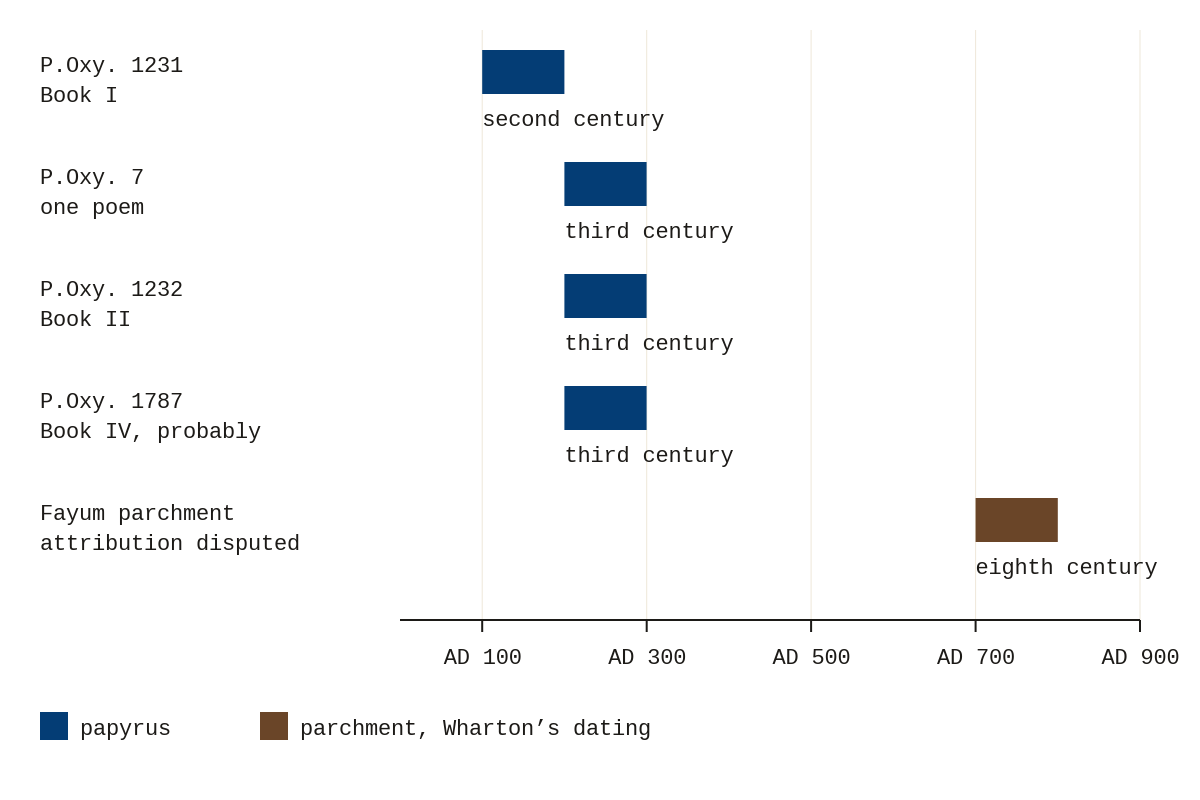
Now look for her own text instead of someone else's. Wharton's two Fayum scraps are the only such entries he could print, and they are one piece of parchment, bought for Berlin in 1879 and written on both sides. He dated the writing to about the eighth century and reported a live dispute over it: F. Blass assigned the verses to Sappho while Bergk printed them as uncertain and thought they might be by Alcaeus.
Then finds at Oxyrhynchus changed the count. In the preface to their 1898 volume, Grenfell and Hunt thought it “not very likely that we shall find another poem of Sappho.” The same volume printed one, in portions of 20 lines on a piece 19.7 by 9.6 cm (7.8 by 3.8 in). They assigned it “with tolerable certainty” (no. 7, p. 10) from its subject, dialect and metre.
By 1922 they could call a roll of hers “the sixth distinct papyrus” of Sappho from the site (no. 1787, p. 26), counting one published elsewhere. These pieces are fragments in this site's sense, not echo copies, since each one comes from a copy of her own work:
- P.Oxy. 1231, second century: Book I, with its verse count. One fragment, rebuilt from some twenty small pieces, holds remains of four poems, including most of one about an apparently absent friend, Anactoria.
- P.Oxy. 7, third century: a poem the editors read as addressed to her brother.
- P.Oxy. 1232, third century: the end of a roll, named as hers in its closing title and assigned by the editors to Book II.
- P.Oxy. 1787, third century: probably Book IV, torn into small pieces.
Credit line to copy
"Dated Copies Assigned to Sappho" by Spine & Watermark, https://spineandwatermark.com/lost/sappho-fragments/, licensed under CC BY 4.0 (https://creativecommons.org/licenses/by/4.0/).Plates are in the scanned volumes: 1898 for P.Oxy. 7, 1914 for 1231 and 1232, and 1922 for 1787. None of these rows enters the register, because the numbering behind it closed in 1895.
Newer finds exist, with a caution. Papyri published in 2014 preserve two previously unknown poems, known as the Brothers Poem and the Kypris Poem, per Giulia Donelli's 2021 paper.
Where those papyri came from is disputed. Crossref now labels a 2016 chapter on their provenance [Retracted], and Brent Nongbri has raised questions about where the pieces were kept, so this page draws no conclusion from them.
Why did the complete books stop being copied?
Start with who chose to copy, not with a fire. That is an editorial position, and you can disagree with it: when a classical text goes missing, this site asks first who decided to copy it or not, and when the format changed, and only then turns to single disasters.
Wharton collects the disaster stories. Scaliger said her works were burned at Constantinople and Rome in 1073, though Wharton notes no supporting evidence, Cardan placed the burning about 380, and Petrus Alcyonius repeated what he had heard as a boy. Wharton himself leans toward religious hostility as the cause, but this page does not follow him there, since the sources read here cannot check any of the three reports.
The format change can be checked. Frederic Kenyon wrote in 1899 that the codex, the modern book form, rose beside the roll late in the papyrus period and that vellum rose with it (pp. 24–25). His examples of Greek papyrus codices run from about the third century to the seventh, and, following E. Thompson, he gives capacity as the codex's advantage, since it could hold far more than a roll.
 Illustration
The Oxyrhynchus editors describe three of the four Sappho papyri above as rolls. Sewn books are built differently, as the page on quires shows, and folding a sheet sets the order of the leaves. A lyric collection on rolls had to be recopied by hand to live on in that shape.
Somebody had to decide that, again and again. The epitome of Dionysius shows how much rode on such choices. Bishop Blomfield, as Wharton reports, argued that her books must have gone early, because no later grammarian commented on her. The parchment scrap, if it is hers and if Wharton's date holds, points the other way for at least part of her text.
How much weight each cause carries cannot be measured from these sources, which neither count losses by cause nor say when the last complete Book I was lost. Disasters do happen, as the Beowulf manuscript, which went through a real fire, shows. For Sappho, the sources read tie no reported fire to a surviving piece of evidence.
The papyri may still hold more. Grenfell and Hunt found the remains of P.Oxy. 1787 mixed with other lyric fragments in an identical hand, and they printed only the pieces that dialect or some other sign tied to Sappho (p. 27), so the small pieces they could not assign may or may not be hers.
Turn it over:
The evidence still lacks an ancient edition in one piece. No source read gives the contents of any of the nine books in order, or the date copying stopped, and Book I's verse count survives on a torn roll without most of the 1,320 verses it counts.
- Archimedes Palimpsest: a text that survived under another text: The erased copy outlasted two others kept in use.
- Dead Sea Scrolls: another body of text known mostly from fragments: Those pieces carry marks from the people who first sorted them.
Sources
- Henry Thornton Wharton, Sappho: Memoir, Text, Selected Renderings, and a Literal Translation, 3rd ed. (John Lane, 1895), Project Gutenberg eBook 57390. gutenberg.orgRead: full text of the memoir, every numbered entry and note, and the Fayum section, 2026-11-07
- W. Rhys Roberts, ed. and trans., Dionysius of Halicarnassus: On Literary Composition (Macmillan, 1910), pp. 10, 237–238, chapter 23 and list of manuscripts. archive.orgRead: sections only (chapter 23 with notes, list of manuscripts and editions, introduction pp. 10, 49), 2026-11-07
- W. Rhys Roberts, ed. and trans., Longinus on the Sublime: The Greek Text (Cambridge University Press, 1907), Introduction, opening section. archive.orgRead: section only (opening of the Introduction), 2026-11-07
- Longinus, On the Sublime, chapter 10, translated by H. L. Havell, with an introduction by Andrew Lang (1890), Project Gutenberg eBook 17957. gutenberg.orgRead: sections only (chapter 10 and Lang's introduction), 2026-11-07
- Bernard P. Grenfell and Arthur S. Hunt, The Oxyrhynchus Papyri, Part I (Egypt Exploration Fund, 1898), preface and no. 7, pp. 10–13. archive.orgRead: sections only (preface and the entry for no. 7), 2026-11-07
- Bernard P. Grenfell and Arthur S. Hunt, The Oxyrhynchus Papyri, Part X (Egypt Exploration Fund, 1914), nos. 1231–1232, pp. 20–21, 44–45. archive.orgRead: sections only (introductions to nos. 1231 and 1232), 2026-11-07
- Bernard P. Grenfell and Arthur S. Hunt, The Oxyrhynchus Papyri, Part XV (Egypt Exploration Society, 1922), nos. 1787 and 1800, pp. 26–27, 145–146. archive.orgRead: sections only (introduction to no. 1787 and the biography of Sappho in no. 1800), 2026-11-07
- Frederic G. Kenyon, The Palaeography of Greek Papyri (Clarendon Press, 1899), pp. 24–25. archive.orgRead: section only, pp. 24–25, 2026-11-07
- "Giulia Donelli, \"Herodotus, the Old Sappho and the Newest Sappho,\" Lexis 39 (n.s.), no. 1 (2021): 13–34, DOI 10.30687/lexis/2724-1564/2021/01/001." doi.orgRead: section only (introduction and notes), 2026-11-07Text license: CC BY 4.0
- Crossref record for DOI 10.1163/9789004314832_004, a chapter in The Newest Sappho (Brill, 2016), title marked [Retracted]. doi.orgRead: bibliography only, from the Crossref record
- "Brent Nongbri, \"Dirk Obbink and the Hobby Lobby Sappho Fragments,\" Variant Readings (blog), 21 February 2020." brentnongbri.comRead: full page, paraphrased, 2026-11-06
- "Armand D'Angour, \"Love's Battlefield: Rethinking Sappho Fragment 31,\" in Erôs in Ancient Greece (Oxford University Press, 2013), DOI 10.1093/acprof:oso/9780199605507.003.0005." doi.orgRead: bibliography only, from the Crossref record
- Dolores O'Higgins, "Sappho's Splintered Tongue: Silence in Sappho 31 and Catullus 51," in Re-Reading Sappho (University of California Press; dated 1998 in the Crossref record), DOI 10.1525/9780520918078-006. doi.orgRead: bibliography only, from the Crossref record
- "Wikimedia Commons file record, \"Alcaeus and Sappho. Side A of an Attic red-figure kalathos,\" Staatliche Antikensammlungen, Munich, Inv. 2416." commons.wikimedia.orgRead: catalogue record on the Commons file page; museum record not readable
- "Wikimedia Commons file record, Sir Lawrence Alma-Tadema, \"Sappho and Alcaeus,\" 1881, Walters Art Museum 37.159." commons.wikimedia.orgRead: catalogue record on the Commons file page; museum record not readable
Image credits
- "Sappho and Alcaeus" by Lawrence Alma-Tadema — https://commons.wikimedia.org/wiki/File:Sir_Lawrence_Alma-Tadema,_R.A.,_O.M._-_Sappho_and_Alcaeus_-_Google_Art_Project.jpg — Public domain (Lawrence Alma-Tadema died in 1912; painted and exhibited in 1881. United States published or exhibited before 1931. European Union author dead more than 70 years. Flat reproduction of a two-dimensional painting (PD-Art).); Walters Art Museum, 37.159; modified: scaled from 7,628 px to 2,400 px wide and saved as JPEG; not cropped
- "Alcaeus and Sappho, Attic red-figure kalathos, side A" by Bibi Saint-Pol — https://commons.wikimedia.org/wiki/File:Alkaios_Sappho_Staatliche_Antikensammlungen_2416_n1.jpg — Public domain (The vase dates to c. 470 BC. The photographer released the 2007 photograph into the public domain worldwide on the file page, so United States and European Union use rest on that release.); Staatliche Antikensammlungen, Munich, Inv. 2416; modified: scaled from 2,212 px to 1,600 px wide and saved as JPEG; not cropped
- "Poem 1 Against the Recorded and Estimated Verse Counts" by Spine & Watermark, https://spineandwatermark.com/lost/sappho-fragments/, licensed under CC BY 4.0 (https://creativecommons.org/licenses/by/4.0/).
- "Two Routes to Print" by Spine & Watermark, https://spineandwatermark.com/lost/sappho-fragments/, licensed under CC BY 4.0 (https://creativecommons.org/licenses/by/4.0/).
- "Forms in the Sappho Register" by Spine & Watermark, https://spineandwatermark.com/lost/sappho-fragments/, licensed under CC BY 4.0 (https://creativecommons.org/licenses/by/4.0/).
- "Why the Register Entries Were Kept" by Spine & Watermark, https://spineandwatermark.com/lost/sappho-fragments/, licensed under CC BY 4.0 (https://creativecommons.org/licenses/by/4.0/).
- "Dated Copies Assigned to Sappho" by Spine & Watermark, https://spineandwatermark.com/lost/sappho-fragments/, licensed under CC BY 4.0 (https://creativecommons.org/licenses/by/4.0/).
- Illustration: Spine & Watermark. Generated schematic illustration — not a photograph or historical record. © Spine & Watermark, all rights reserved; not licensed for reuse (see /image-use/).
Cite this page
Spine & Watermark. “Sappho: Most of What Survives Is Quotation or Torn Papyrus.” Spine & Watermark, published November 7, 2026. https://spineandwatermark.com/lost/sappho-fragments/. Accessed [date].
How sources are ranked · All corrections · Contact · Report an error (contact@spineandwatermark.com)