Dead Sea Scrolls: What Did Early Sticky Tape Do to Them?
Published · Revised
TL;DR: The best-known Dead Sea Scrolls are ancient Jewish manuscripts from 11 caves near Qumran, and most of what survives is fragments. The Israel Antiquities Authority says the first scholars joined pieces with adhesive tape and stored them between window glass. It says aging adhesive and glass pressure then darkened the skins.
Witness: scroll fragments in the tens of thousands; four of the first scrolls housed at the Shrine of the Book, Jerusalem, per the Library of Congress · main sources: Library of Congress exhibition Scrolls from the Dead Sea (1993); Israel Antiquities Authority conservation account; Discoveries in the Judaean Desert series (listed, not read) · gap: the sources read give no treatment record for any single fragment and no count of pieces that cannot be joined

Witness card, all fields
- Witness
- scroll fragments in the tens of thousands; four of the first scrolls housed at the Shrine of the Book, Jerusalem, per the Library of Congress loc.gov loc.gov
- Main sources
- Library of Congress exhibition Scrolls from the Dead Sea (1993); Israel Antiquities Authority conservation account; Discoveries in the Judaean Desert series (listed, not read) loc.gov loc.gov deadseascrolls.org.il
- Gap
- the sources read give no treatment record for any single fragment and no count of pieces that cannot be joined loc.gov
Look for what’s stuck to the fragments, not what’s written on them. The Israel Antiquities Authority’s conservation page carries a photograph captioned as the removal of adhesive tape with tweezers, and it describes taking off earlier adhesives as a long job that is still under way. No ancient scribe put that tape there. The question here is what a repair meant to hold these pieces together did to them.
The plainer questions come first: what the scrolls are, what they hold, who wrote them and how old they are. Then the tape.
What are the Dead Sea Scrolls?
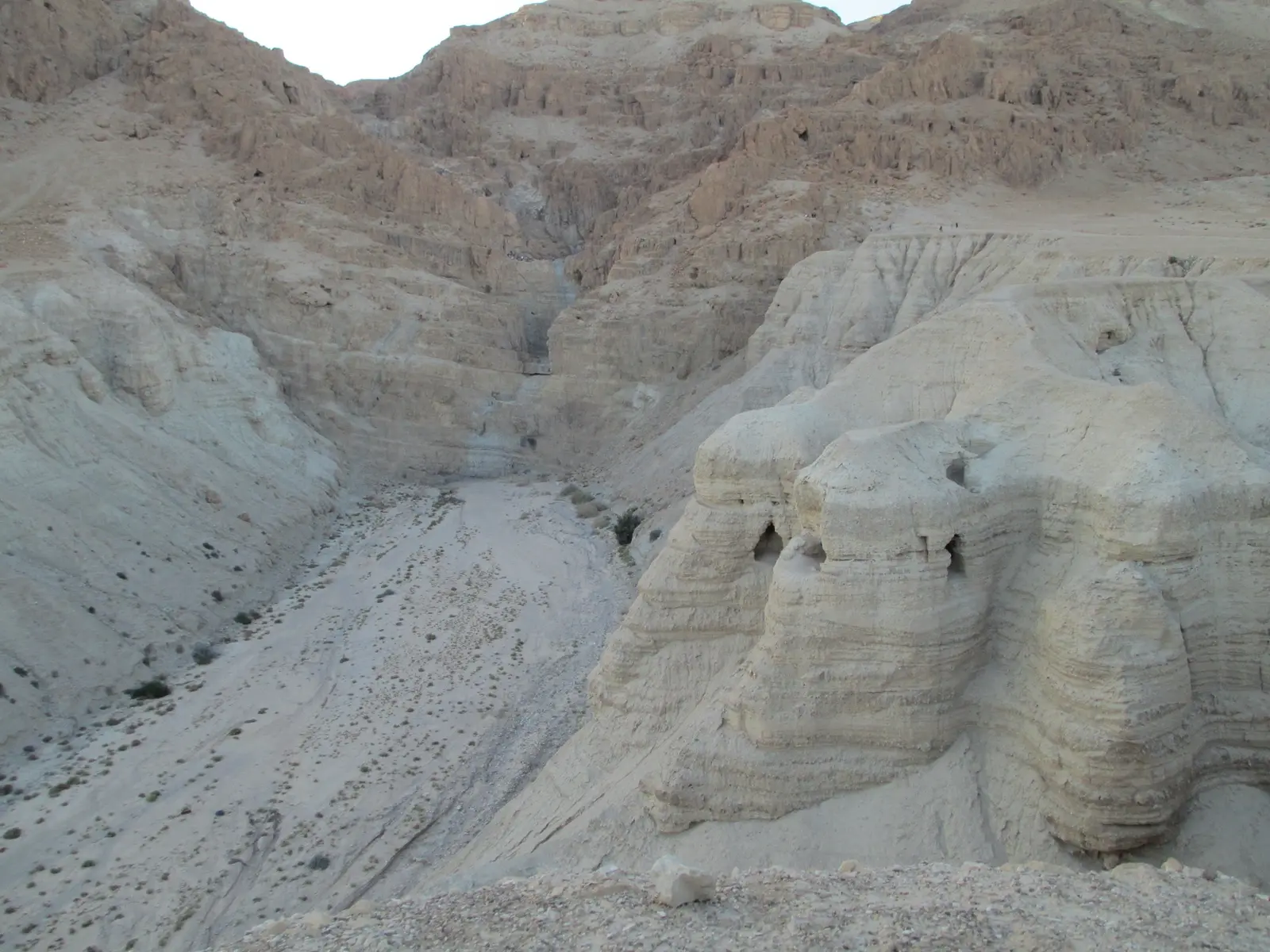
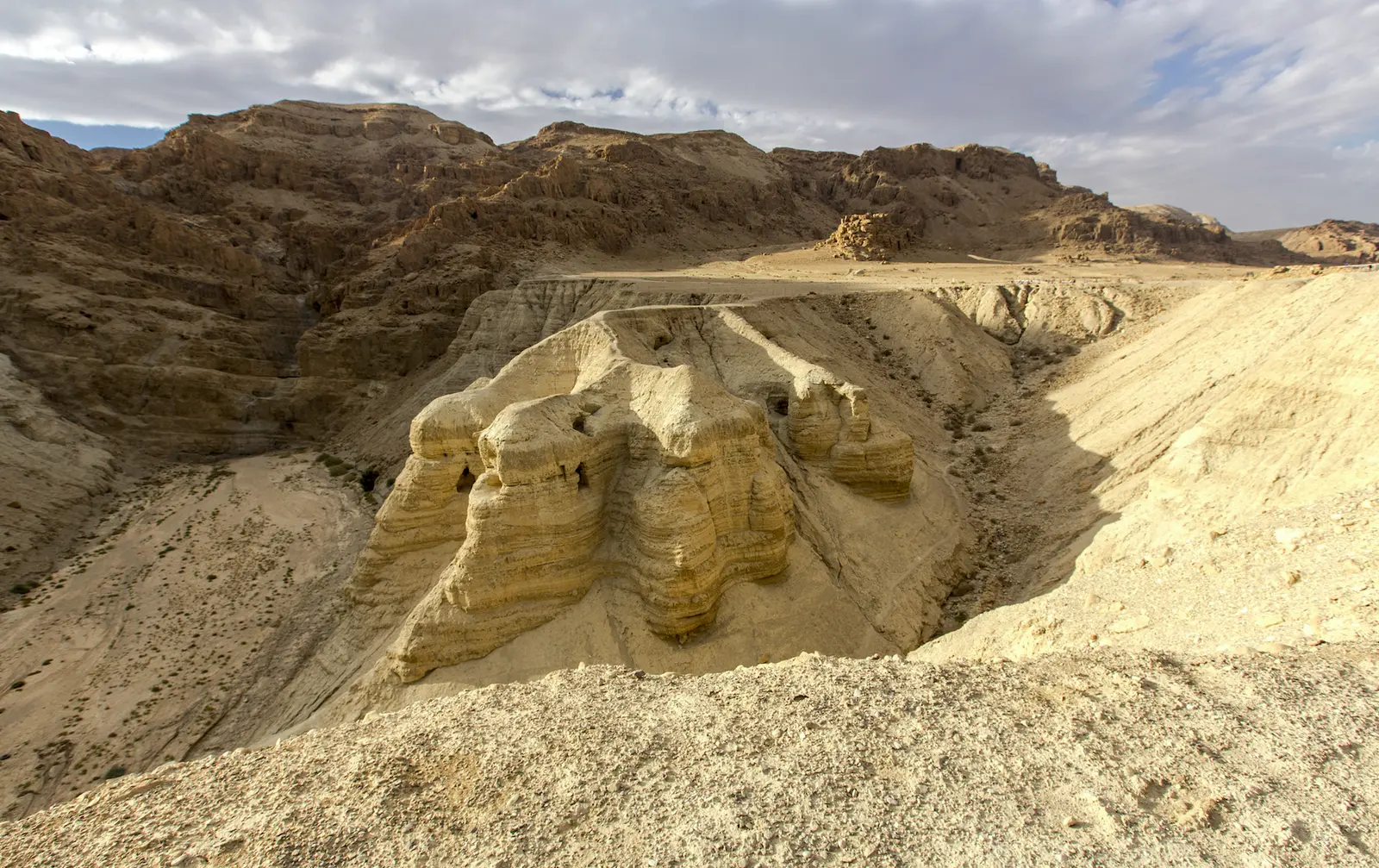
In 1947, the Library of Congress says in its exhibition text, young Bedouin shepherds looking for a stray goat walked into a cave in the Judean Desert and found jars of ancient scrolls. Seven scrolls came from that find. It also set off a search of nearly a decade, and the search produced thousands of fragments from eleven caves.
The name now covers more than those caves. The Israel Antiquities Authority, the body the library calls the administration for scroll research, uses it for all the manuscripts from the Judean Desert, including finds from Wadi Murabba’at, Nahal Hever and Masada. Most of this page concerns the Qumran caves.
How much survives depends on what gets counted, since the authority describes only a handful of nearly whole scrolls beside tens of thousands of fragments, which together stand for over 900 different texts. The library’s 1993 exhibition text says almost one thousand different compositions. Each source counts in its own terms, so this page gives both.
Age is one clear reason they matter. The library says any other surviving manuscript of the Hebrew Scriptures is younger than they are by almost one thousand years. The authority says over a thousand years older than the biblical manuscripts known before them. The wordings differ at the edge, and neither gives an exact gap.
What do the scrolls contain?
According to many scholars, the library says, the main groups are biblical works, apocryphal or pseudepigraphical works (books that some Bible canons include and others leave out), and sectarian writings tied to one devout commune. Some scholars add a fourth group of general Jewish writing from the period. The library and the authority both say every book of the Hebrew Bible is represented except Esther.
The authority counts about 230 biblical manuscripts and labels a quarter of the non-biblical ones sectarian. Hebrew is the most common language, with about 15 percent in Aramaic and several in Greek, per the same account.
A few long pieces break the pattern of fragments. The authority lists a complete manuscript of Isaiah among the first scrolls photographed in 1948, and a second copy among the three Eliezer Sukenik acquired. A library reading list names a 1972 photographic edition, Scrolls from Qumran Cave I: The Great Isaiah Scroll, the Order of the Community, the Pesher to Habakkuk. The library places four of the first scrolls at the Shrine of the Book in Jerusalem; the authority says the shrine was built in 1965 to house all seven.
Now look at what they are written on. The authority splits the scrolls into 80 percent leather and parchment and 20 percent papyrus, and elsewhere notes one text engraved on copper. Parchment, in the library’s glossary, is animal skin prepared for writing.
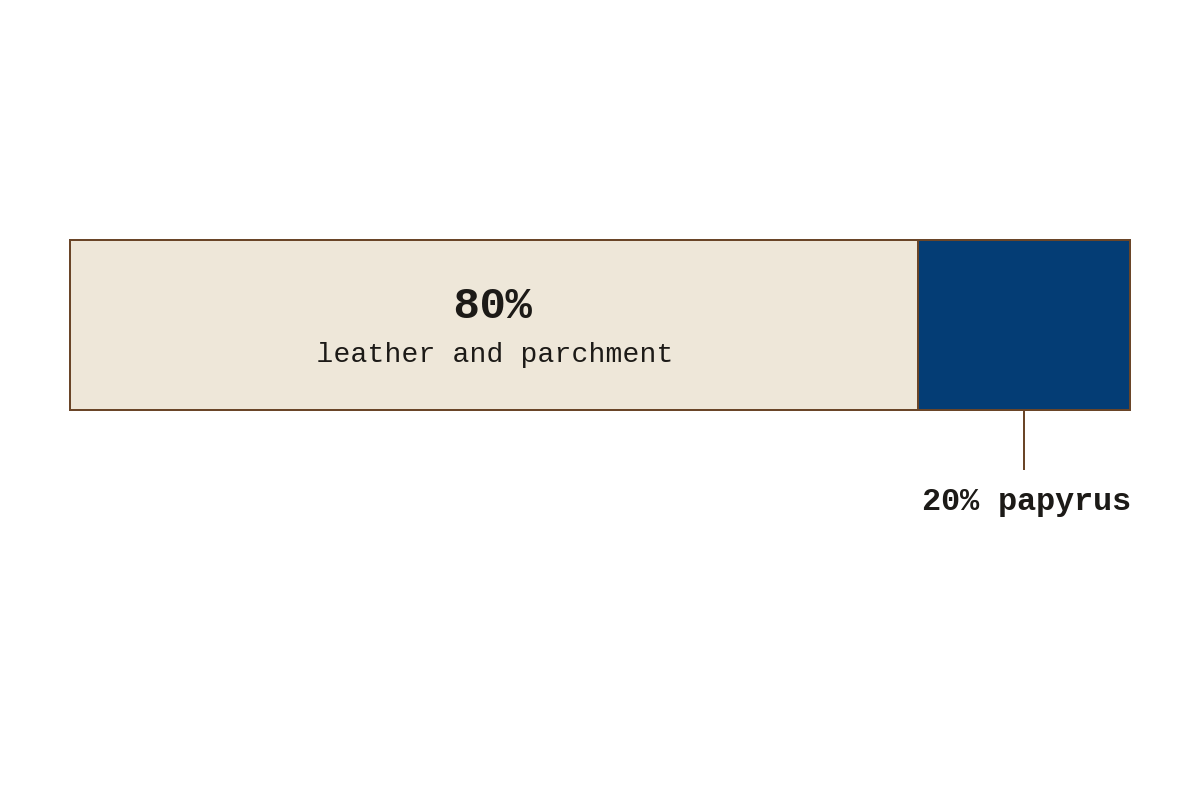
Credit line to copy
"Writing Materials of the Dead Sea Scrolls, as Stated" by Spine & Watermark, https://spineandwatermark.com/lost/dead-sea-scrolls/, licensed under CC BY 4.0 (https://creativecommons.org/licenses/by/4.0/).The caption for the Psalms Scroll calls sheepskin the more common skin at Qumran. European makers worked calf, sheep and goat skin into parchment many centuries later, as the page on how medieval manuscripts were made sets out. Skin matters to this story, because skin is what the tape went on.
Who wrote the Dead Sea Scrolls?
No source read here settles it. The library says Roland de Vaux, who excavated the Qumran site, read it as a desert retreat for the Essenes, a separatist Jewish sect, and that many scholars believe this community wrote, copied or collected the scrolls. Others argue for a Sadducean sect, for a Roman fortress or winter villa, for little link between the site and the scrolls, or for no single answer.
The authority’s account moves the same way. Early scholars credited all the Qumran scrolls to the Essenes, it says, and that consensus has since been challenged and changed, though a link to the Essenes still has its defenders.
The library adds that two inkwells turned up at the site near a large table, which suggests a room for copying, while some manuscripts may have been written elsewhere. Its closing section says scholars agree the scrolls matter and disagree on who produced them. This page leaves it there.
How old are the Dead Sea Scrolls?
The Library of Congress gives the third century BCE to 68 CE, resting on historical, paleographic (the study of ancient handwriting) and linguistic evidence plus carbon-14 dating. The authority dates the Qumran cave scrolls from the third century BCE to the first century CE, before 70 CE, and says manuscripts from other Judean Desert sites run from the eighth century BCE to the 11th century CE.
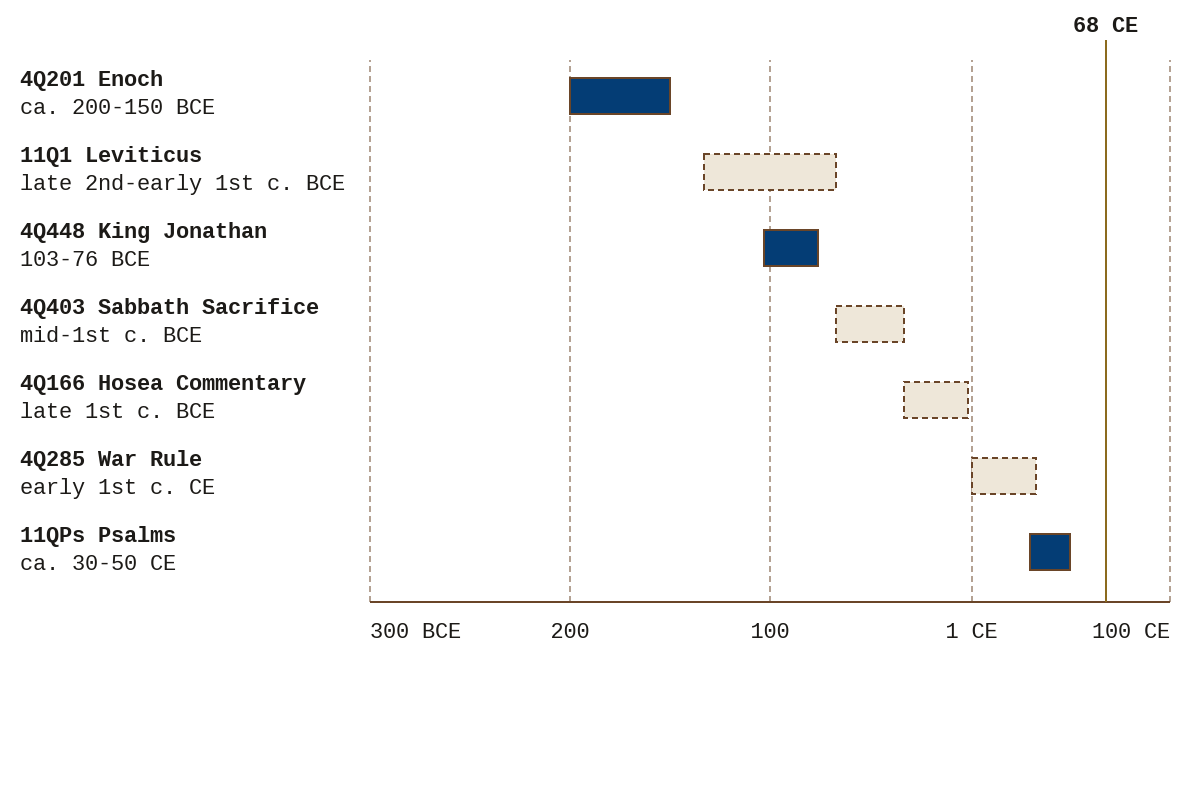
Credit line to copy
"Copying Dates in Library of Congress Captions" by Spine & Watermark, https://spineandwatermark.com/lost/dead-sea-scrolls/, licensed under CC BY 4.0 (https://creativecommons.org/licenses/by/4.0/).The exhibition captions give dates piece by piece, and the table takes seven of its twelve fragments. Lengths run from the War Rule fragment, 4 by 5 cm and smaller than a credit card, to the 100.2 cm Leviticus piece, about 20 times as long.
| Fragment | Copied, per the caption | Height × length, per the caption |
|---|---|---|
| 4Q201 Enoch (fragment A) | ca. 200–150 BCE | 17.5 × 17.5 cm |
| 11Q1 Leviticus | late 2nd to early 1st century BCE | 10.9 × 100.2 cm |
| 4Q448 Prayer for King Jonathan | between 103 and 76 BCE | 17.8 × 9.5 cm |
| 4Q403 Sabbath Sacrifice | mid-1st century BCE | 18 × 19 cm |
| 4Q166 Hosea Commentary | late 1st century BCE | 17.5 × 16.8 cm |
| 4Q285 War Rule | early 1st century CE | 4 × 5 cm |
| 11QPs Psalms | ca. 30–50 CE | 18.5 × 86 cm |
Those are copying dates, which is one half of the double date. A caption that says copied ca. 30–50 CE dates that copy and doesn’t say when the psalms inside were composed. Most captions in this table give no year for the text; the one for 4Q448 is the exception, since it ties that prayer to King Jonathan’s rule, 103 to 76 BCE. So the honest form for the others is text unknown on this page, object as the caption states.
Carbon-14 needs the same care about what was tested. The library’s reading list says tests on linen wrappers placed the finds in the late Second Temple period. The abstract of a 1995 study in Radiocarbon by Jull and colleagues reports samples from 18 texts and 2 linen fragments, with results that fit the age estimates from handwriting. A test speaks for its sample, as the Voynich page shows with its skin and its writing.
The full laboratory papers could not be read for this page, so it gives no lab figures and no single age for the whole collection. The range above is the library’s.
Why did leaving the caves put them at risk?
The authority places the caves about 400 meters below sea level, with a steady, dry climate that it calls the likely main reason the scrolls lasted two millennia. Taking them out from 1947 and on to Jerusalem, 800 meters above sea level, meant a rise of about 1,200 meters and a sharp change of climate.
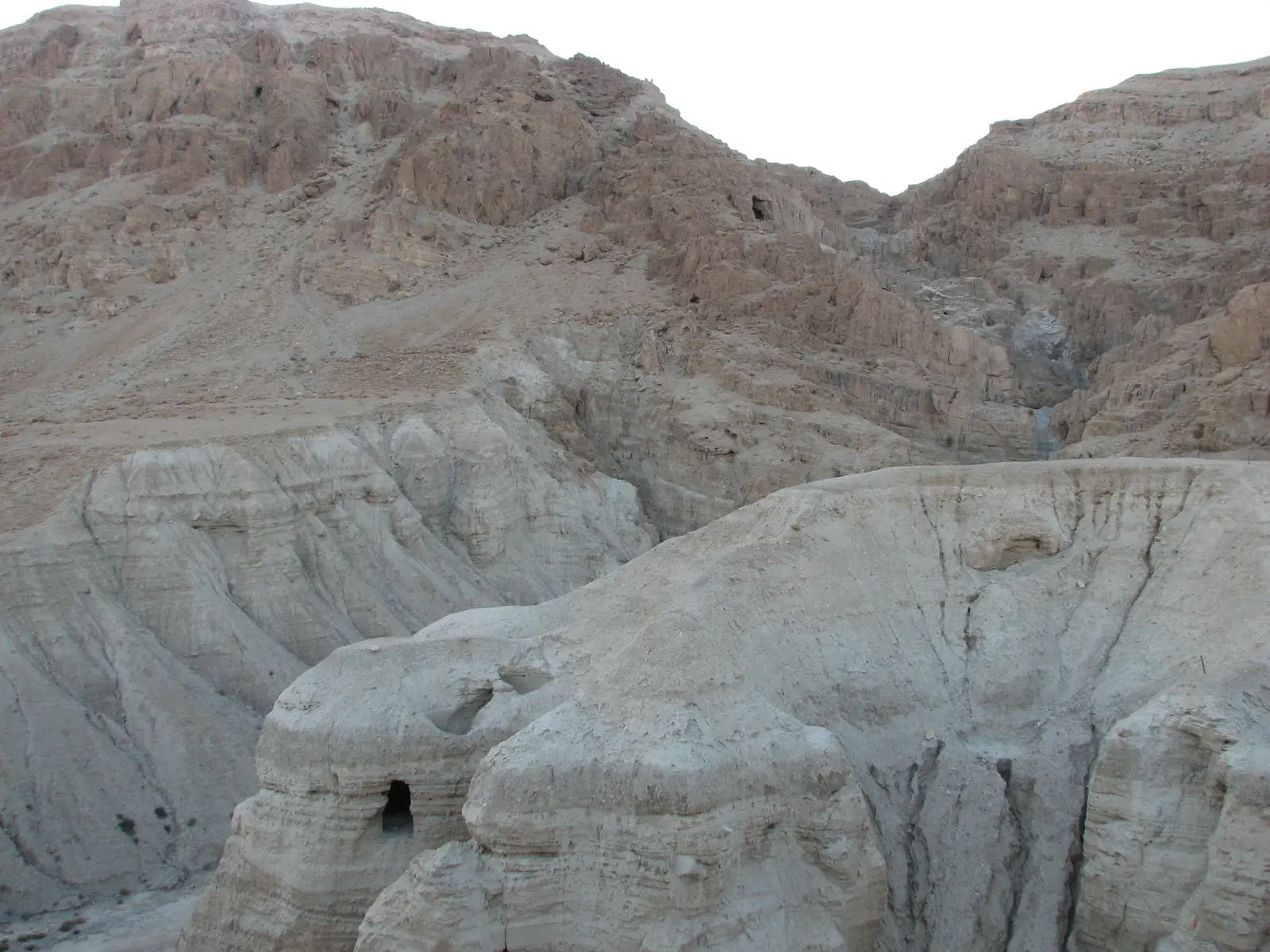

Then came the sorting. In Cave 4 alone, the authority says, thousands of fragments from about 500 scrolls turned up. In 1953 Gerald Lankester Harding and Roland de Vaux named an international team, who worked at the Rockefeller Museum to fit the pieces together. A caption on the authority’s site points to bright window sunlight and a lack of proper storage in that 1950s workspace.
What did the sticky tape do?
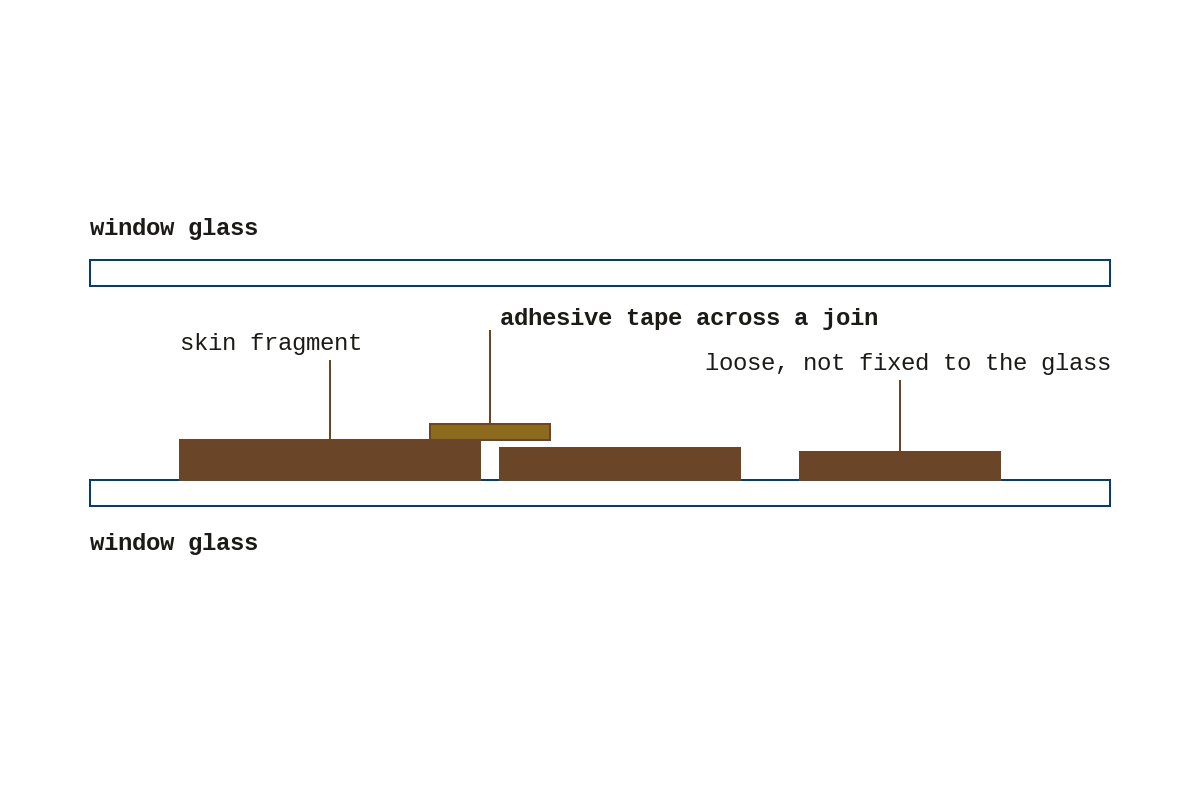
The first scholars who sorted these pieces left marks of their own on them. Sticky tape is this page’s plain word for what the authority calls adhesive tape; its account names no product and gives no year for the first use. By its account those scholars taped pieces together and taped over cracks, then stored them loose between sheets of window glass.
Credit line to copy
"Fragments Between Plates of Window Glass, Side View" by Spine & Watermark, https://spineandwatermark.com/lost/dead-sea-scrolls/, licensed under CC BY 4.0 (https://creativecommons.org/licenses/by/4.0/).Its dated list puts the sorting and the glass in the 1950s/1960s, in more than 1,200 plates, and a 1967 inventory numbered them 1 to 1261. Set that against tens of thousands of fragments. The account gives no count of pieces per plate, so this page does not divide one by the other.
Then the tape aged.
The authority puts the harm down to the adhesives as they aged and to pressure from the glass. Skins went dark, edges gelatinized, meaning they went soft and jelly-like, and some text can no longer be read. That account names two causes, so the tape doesn’t carry all the blame. It also doesn’t say which pieces darkened from which cause.
 Illustration
One record of the earlier state survives apart from the skins. Infrared negatives taken in the 1950s and 1960s show the fragments as they were found, per the authority, and the official publication rests on them. They sit in their own climate-controlled store.
When did the repairs happen?
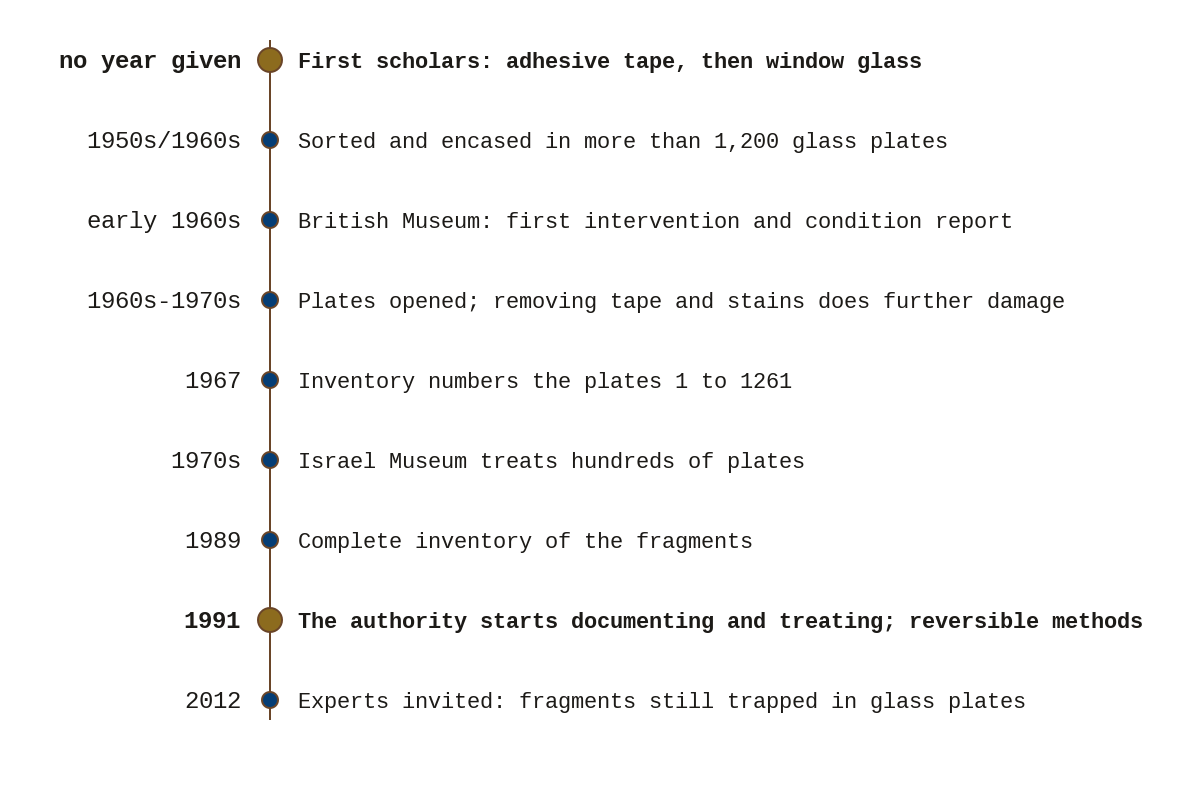
Read the dates only as closely as the source gives them. The authority’s account of the tape gives no year, only a later mention of adhesives from treatments in the 1950s to 1970s, so the tape sits first on this timeline with none. The glass gets the 1950s/1960s, and the attempts to undo the damage get the 1960s and 1970s.
Credit line to copy
"Repairs to the Dead Sea Scrolls, as Dated by the Israel Antiquities Authority" by Spine & Watermark, https://spineandwatermark.com/lost/dead-sea-scrolls/, licensed under CC BY 4.0 (https://creativecommons.org/licenses/by/4.0/).| When, per the authority | What happened |
|---|---|
| No year given | First scholars use adhesive tape, then window glass |
| 1950s/1960s | Fragments sorted and encased in more than 1,200 glass plates |
| Early 1960s | British Museum: first conservation intervention and condition report |
| 1960s and 1970s | Plates opened; attempts to remove tape and stains do further damage |
| 1967 | Inventory numbers the plates 1 to 1261 |
| 1970s | Israel Museum treats hundreds of plates |
| 1989 | Complete inventory of the fragments |
| 1991 | The authority begins documenting and treating the fragments, with a laboratory that aims for reversible methods |
| 2012 | Outside experts invited to review open problems, including fragments still trapped in glass plates |
Each fix left work for the next one. When the plates were opened, the authority says, the methods used to take off tape and stains caused more damage. Captions on the same page mention a British Museum leather dressing applied in the 1960s, and rice paper and perspex glue used for repairs in the 1970s. The British Museum’s report itself was not read for this page.
That history explains the rule the authority set for its laboratory from 1991: any new method should be reversible, so that it could be undone. None of this is a procedure to copy at home. Tape on an old document of your own is a job for a conservator; start with the American Institute for Conservation. Later hands changed other old books as well, as the Book of Kells page shows.
Why isn’t tape damage a handling scar?
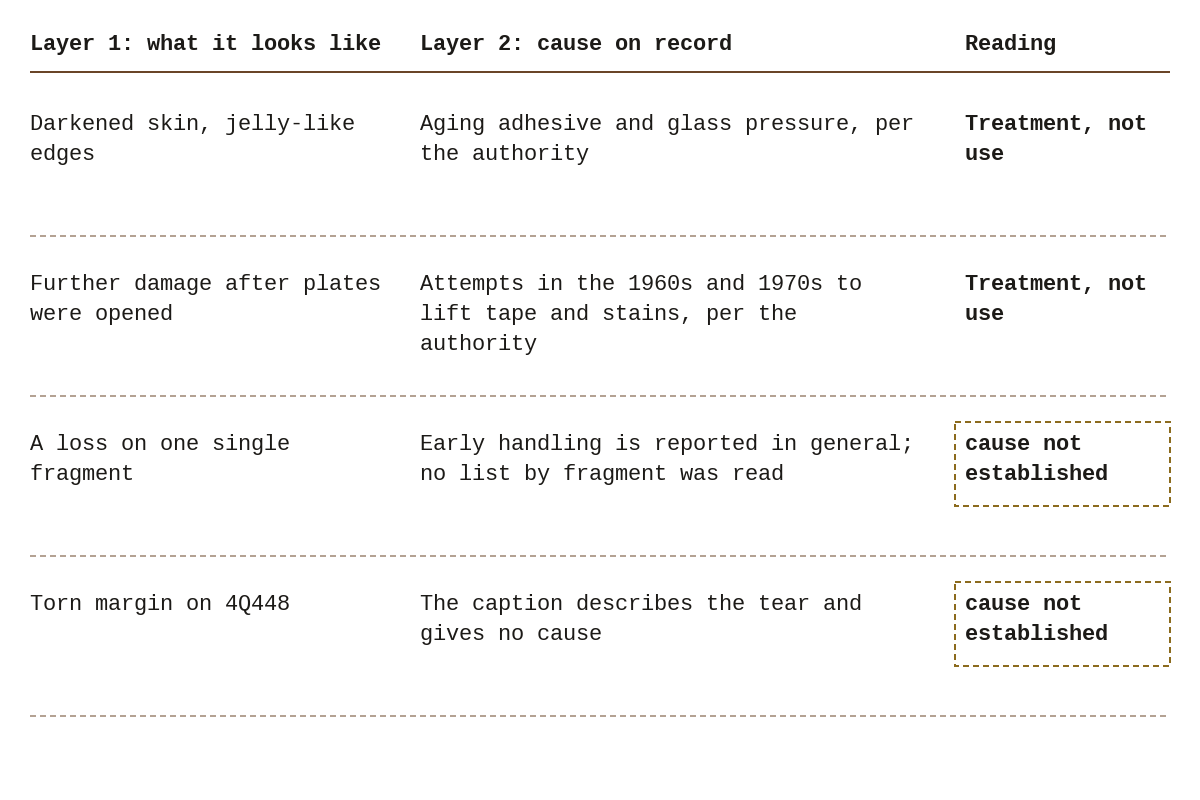
The handling scar is this site’s term for a mark an object gained through use, not from its making. It works in two layers. What a mark looks like can be described, while why it is there is a separate claim that needs a record behind it.
Adhesive tape is a repair treatment, so the damage it left does not count directly as the handling scar.
The same line runs through other pages here. The Beowulf manuscript has a binding that counts as treatment, not use. The Archimedes Palimpsest has candle wax that does count, because its project’s account ties the wax to centuries of use as a prayer book. The test is what the record says about the cause, not how bad the mark looks.
Credit line to copy
"Two Layers of a Mark: How It Looks and Why It Is There" by Spine & Watermark, https://spineandwatermark.com/lost/dead-sea-scrolls/, licensed under CC BY 4.0 (https://creativecommons.org/licenses/by/4.0/).| Layer 1: what it looks like | Layer 2: cause on record | Reading |
|---|---|---|
| Darkened skin, jelly-like edges | Aging adhesive and glass pressure, per the authority | Treatment, not use |
| Further damage after plates were opened | Attempts in the 1960s and 1970s to lift tape and stains, per the authority | Treatment, not use |
| A loss on one single fragment | Early handling is reported in general; no list by fragment was read | cause not established |
| Torn margin on 4Q448 | The caption describes the tear and gives no cause | cause not established |
Handling itself is the harder row. The authority says scholars in the early decades harmed the scrolls without knowing it as they tried to fit the pieces together. That comes closest to use on this page. But no source read here says which break came from which session, so for any one fragment the label is cause not established.
Use in antiquity is harder still. The library suggests that some linen served as packing for worn-out scrolls, and that scrolls may have been hidden in a time of panic or buried when they wore out; it says the cloth fits either. A worn edge from ancient reading would be a true handling scar, yet no source read here ties a named mark to that.
The caption for 4Q448 shows the limit. It records a tear in the leather on the right margin, along its lower third. It doesn’t say how. The form is on record and the cause is not, so this page marks it cause not established and moves on.
What has changed since then?
Look at the storage, not the skins. From 1991, the authority says, the Getty Conservation Institute sponsored specialists who advised on a laboratory and storage used only for the scrolls. Its climate system was built to keep the average humidity and temperature measured in the caves, so the store is meant to copy conditions in caves like those below.

Conservators record each fragment’s condition, however small, then photograph and map it, per the same account. Showing them has rules too. After three months on show, a scroll has to sit out a year or more before it can travel.
Imaging takes some of the pressure off, and it has a short record of its own: an expert committee formed in 2007, a studio and pilot followed by 2008, and the Leon Levy Dead Sea Scrolls Digital Library grew from that work. The authority says it lets scholars study fragments without touching them, and one caption credits imaging with bringing out letters that couldn’t be read on the Psalms Scroll. This page links to those images and doesn’t reproduce them, because the authority reserves the rights.
Part of the old problem is not over. In March 2012, the authority says, it asked outside experts about fragments still trapped in glass plates, corroding ink and parchment splitting into layers. Its page doesn’t say how many plates remain, or how many pieces still carry tape. Whatever the treatment files say about a single fragment, set beside its infrared negative, has not been read here.
Turn it over:
The evidence still lacks the working record. The sources read here give no treatment history from the 1950s to the 1970s for any named fragment, and no count of pieces that can’t be joined. The authority files some tiny pieces as unidentified because their poor condition keeps them from being categorized, and it gives no total on the pages read.
- Archimedes Palimpsest: another text read again by imaging: Imaging across twelve wavelengths helped bring back its erased text.
- Sappho: another body of text known mostly in pieces: In Wharton’s edition, her fullest poem is whole because a critic quoted it.
Sources
- Israel Antiquities Authority, “Conservation,” The Leon Levy Dead Sea Scrolls Digital Library. deadseascrolls.org.ilRead: full page text, stored in the rights check 2026-11-06, read 2026-11-07; photographs not viewed
- Library of Congress, “Introduction,” Scrolls from the Dead Sea (exhibition, 1993). loc.govRead: full section, 2026-11-07
- Library of Congress, “The Qumran Library,” Scrolls from the Dead Sea (exhibition, 1993). loc.govRead: full section, 2026-11-07
- Library of Congress, “The Qumran Community,” Scrolls from the Dead Sea (exhibition, 1993). loc.govRead: section only: the Qumran settlement debate, 2026-11-07
- Library of Congress, “Two Thousand Years Later,” Scrolls from the Dead Sea (exhibition, 1993). loc.govRead: full section, 2026-11-07
- Library of Congress, “Conclusion,” Scrolls from the Dead Sea (exhibition, 1993). loc.govRead: full section, 2026-11-07
- Library of Congress, “Learn More: Selected Readings,” Scrolls from the Dead Sea (exhibition, 1993). loc.govRead: section only: reading lists and the related items on this topic, 2026-11-07
- Library of Congress, “Glossary,” Scrolls from the Dead Sea (exhibition, 1993). loc.govRead: section only: entries for parchment and paleographic, 2026-11-07
- Israel Antiquities Authority, “Introduction,” The Leon Levy Dead Sea Scrolls Digital Library. deadseascrolls.org.ilRead: full page text, 2026-11-07
- Israel Antiquities Authority, “Discovery and Publication,” The Leon Levy Dead Sea Scrolls Digital Library. deadseascrolls.org.ilRead: full page text, 2026-11-07
- Israel Antiquities Authority, “Scrolls Content,” The Leon Levy Dead Sea Scrolls Digital Library. deadseascrolls.org.ilRead: full page text, 2026-11-07
- A. J. Timothy Jull, Douglas J. Donahue, Magen Broshi and Emanuel Tov, “Radiocarbon Dating of Scrolls and Linen Fragments from the Judean Desert,” Radiocarbon 37, no. 1 (1995): 11–19. doi.orgRead: abstract only (Crossref record)
- Georges Bonani, Susan Ivy, Willy Wölfli, Magen Broshi, Israel Carmi and John Strugnell, “Radiocarbon Dating of Fourteen Dead Sea Scrolls,” Radiocarbon 34, no. 3 (1992): 843–849. doi.orgRead: bibliography only
- Discoveries in the Judaean Desert (Oxford: Clarendon Press, 1955–). loc.govRead: bibliography only
- Dr. Avishai Teicher, Pikiwiki Israel, “Wadi Qumran and the Qumran caves,” 2012, Wikimedia Commons file record. commons.wikimedia.orgRead: file page
Image credits
- "Wadi Qumran and the Qumran caves" by Dr. Avishai Teicher, Pikiwiki Israel — https://commons.wikimedia.org/wiki/File:PikiWiki_Israel_28412_Vadi_Qumran_and_Qumran_caves.JPG — CC BY 2.5 (https://creativecommons.org/licenses/by/2.5/); no institution recorded; modified: reduced from 4608 px to 1800 px wide; no other change
- "Writing Materials of the Dead Sea Scrolls, as Stated" by Spine & Watermark, https://spineandwatermark.com/lost/dead-sea-scrolls/, licensed under CC BY 4.0 (https://creativecommons.org/licenses/by/4.0/).
- "Copying Dates in Library of Congress Captions" by Spine & Watermark, https://spineandwatermark.com/lost/dead-sea-scrolls/, licensed under CC BY 4.0 (https://creativecommons.org/licenses/by/4.0/).
- "Caves of Qumran" by Holyland2026 — https://commons.wikimedia.org/wiki/File:Caves_of_Qumran.jpg — CC BY-SA 4.0 (https://creativecommons.org/licenses/by-sa/4.0/); no institution recorded
- "Fragments Between Plates of Window Glass, Side View" by Spine & Watermark, https://spineandwatermark.com/lost/dead-sea-scrolls/, licensed under CC BY 4.0 (https://creativecommons.org/licenses/by/4.0/).
- Illustration: Spine & Watermark. Generated schematic illustration — not a photograph or historical record. © Spine & Watermark, all rights reserved; not licensed for reuse (see /image-use/).
- "Repairs to the Dead Sea Scrolls, as Dated by the Israel Antiquities Authority" by Spine & Watermark, https://spineandwatermark.com/lost/dead-sea-scrolls/, licensed under CC BY 4.0 (https://creativecommons.org/licenses/by/4.0/).
- "Two Layers of a Mark: How It Looks and Why It Is There" by Spine & Watermark, https://spineandwatermark.com/lost/dead-sea-scrolls/, licensed under CC BY 4.0 (https://creativecommons.org/licenses/by/4.0/).
- "Caves at Dead Sea Scrolls" by Lux Moundi — https://commons.wikimedia.org/wiki/File:Caves@Dead_Sea_Scrolls_(8246948498).jpg — CC BY 2.0 (https://creativecommons.org/licenses/by/2.0/); no institution recorded
Cite this page
Spine & Watermark. “Dead Sea Scrolls: What Did Early Sticky Tape Do to Them?.” Spine & Watermark, published November 7, 2026. https://spineandwatermark.com/lost/dead-sea-scrolls/. Accessed [date].
How sources are ranked · All corrections · Contact · Report an error (contact@spineandwatermark.com)