Medieval Manuscripts: Usually Written First, Bound Later
Published · Revised
TL;DR: Medieval manuscripts were usually copied on loose quires, small stacks of folded parchment or paper, and bound afterward, per Leiden University's Quill guide and a University of Toronto exhibit. The Getty's 2003 exhibition also binds last, but folds the sheets after writing. Not every set of quires was planned as one book.
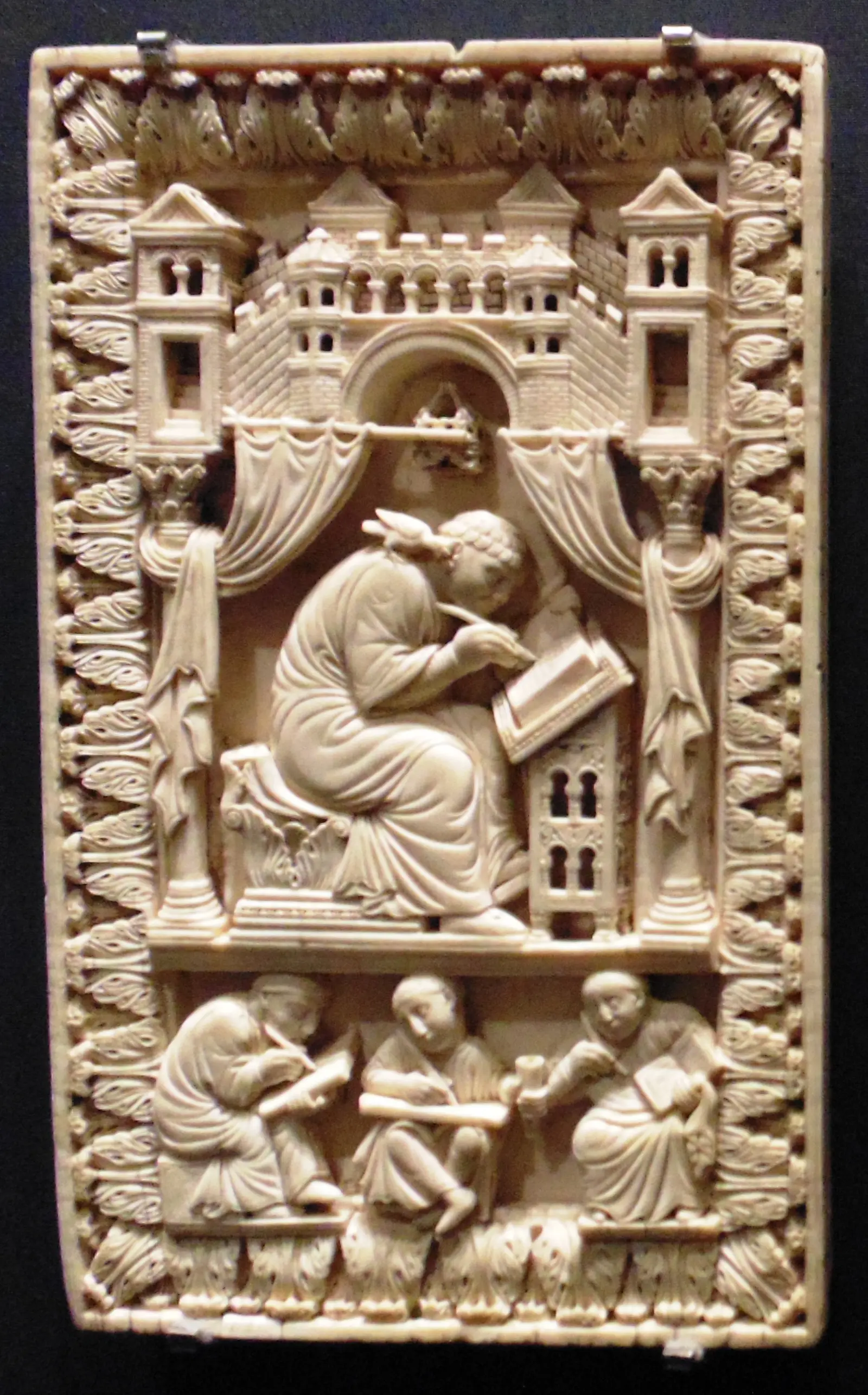

Look for the stray word at the foot of the last page in a quire. A quire is a small stack of folded leaves, and that word repeats the first word of the next stack. This page answers one question about medieval manuscripts, which is how they were made. Rather than surveying famous books, it follows a single process from animal skin to sewing, and it shows why the writing usually came before the binding.
The steps, in order
Leiden University's Quill guide, written by the former Leiden professor Erik Kwakkel, sets out the working order below, and the University of Toronto's exhibit on one small book describes the same outline more briefly. Practice differed by place and by book, and a later section shows where the sources part ways.
- Prepare the skin. Calf, sheep or goat skin was worked into thin sheets of parchment. In Europe, paper came into use for manuscripts later.
- Make the quires. Sheets were folded and stacked into small packages.
- Prick and rule. Small holes and guide lines set out the page.
- Copy the text. A scribe wrote on the ruled pages of the unbound quires.
- Correct it. The text was checked after copying, with more or less care.
- Decorate it. Penwork or painting went in, usually from a different artisan.
- Sew and bind. The finished quires went to a binder.
One named book shows these steps at work. The Late Medieval Miscellany, MSS 01020, was made in or around Florence between 1425 and 1450, per the Toronto exhibit by Maura Quinn. It measures about 110 × 180 millimeters (4.3 × 7.1 inches), small enough for one hand, the exhibit says. It contains 156 leaves.
Collation: parchment quires: written, then assembled · about 110 × 180 mm (4.3 × 7.1 in); per the exhibit, 156 leaves in 19 quires, most of 8 leaves; those figures do not fully reconcile · image/text several texts, no dates in the exhibit pages read / object between 1425 and 1450, in or around Florence · Thomas Fisher Rare Books Library, University of Toronto, MSS 01020
Collation card, all fields
- Object
- Late Medieval Miscellany, MSS 01020 spatial-humanities.library.utoronto.ca
- Type
- manuscript spatial-humanities.library.utoronto.ca
- Process
- parchment quires: written, then assembled spatial-humanities.library.utoronto.ca
- Format & size
- about 110 × 180 mm (4.3 × 7.1 in); per the exhibit, 156 leaves in 19 quires, most of 8 leaves; those figures do not fully reconcile spatial-humanities.library.utoronto.ca spatial-humanities.library.utoronto.ca
- Material
- parchment spatial-humanities.library.utoronto.ca
- Made
- image/text several texts, no dates in the exhibit pages read / object between 1425 and 1450, in or around Florence spatial-humanities.library.utoronto.ca spatial-humanities.library.utoronto.ca
- Held at
- Thomas Fisher Rare Books Library, University of Toronto, MSS 01020; fishercollections.library.utoronto.ca spatial-humanities.library.utoronto.ca
- Date basis
- Literature: Maura Quinn, University of Toronto exhibit, from a calendar for 1424–1444 on f. 6r; holding record not readable spatial-humanities.library.utoronto.ca spatial-humanities.library.utoronto.ca
The card uses the double date, which dates a text and its object apart. The exhibit dates the book as a whole, from a perpetual calendar for 1424 to 1444 on f. 6r, and the pages read here give no dates for its several texts, so the text side stays open. Toronto's catalogue record could not be read for this page, which means the date rests on the exhibit alone.
How was parchment made?
Parchment is animal skin scraped and stretched until it is thin and strong enough to write on, and Toronto notes that calf and sheep were common. The Getty's 2003 exhibition text describes pelts steeped in lime until the fur came loose, then scraped wet on a stretcher while the tension was adjusted, over several days. That account records an old craft; this page gives no working instructions.
Quality varied. Toronto calls the parchment in MSS 01020 fairly low in quality, with follicles and patches of uneven stretching still visible.
Credit line to copy
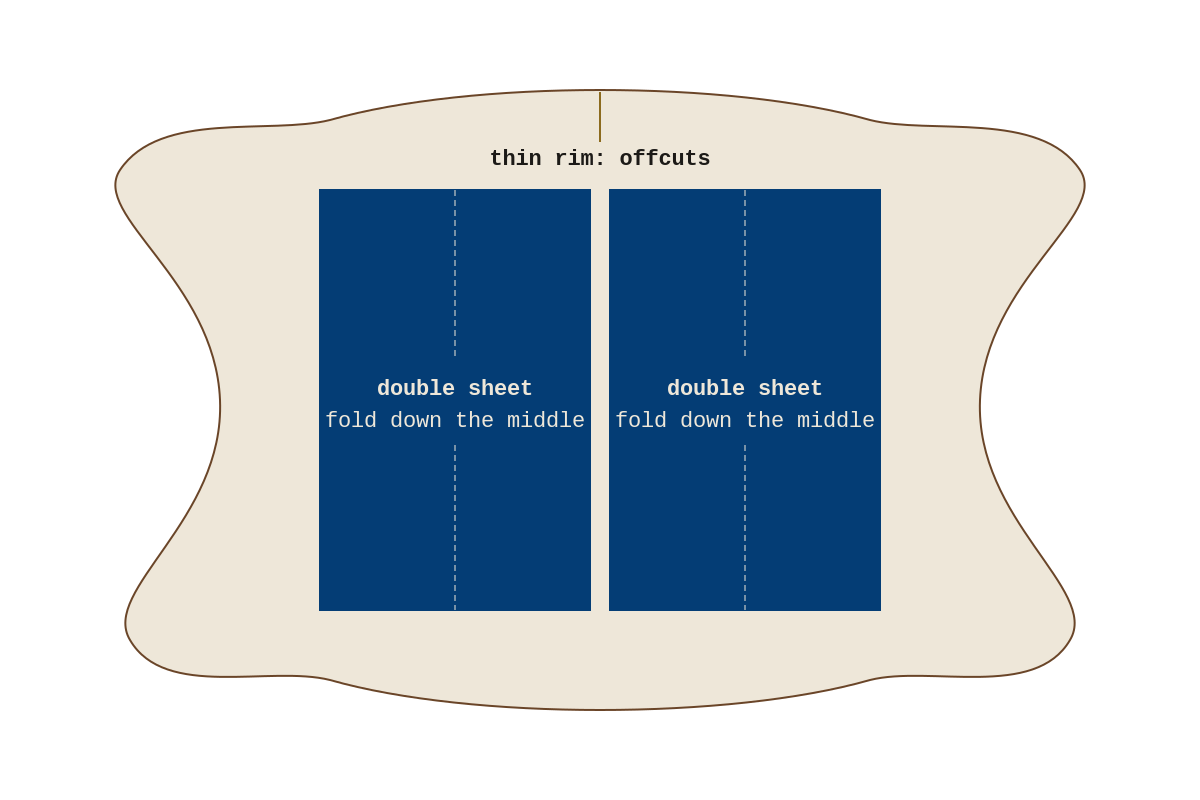
"What One Skin Supplied" by Spine & Watermark, https://spineandwatermark.com/books/medieval-manuscripts/, licensed under CC BY 4.0 (https://creativecommons.org/licenses/by/4.0/).Quill says scribes cut sheets from the best part of a skin and avoided the thin edge, and that the rim came away as offcuts; before about 1200, a single skin usually yielded one to three double sheets, by the same guide. Paper is the other material: Quill places its spread into European manuscripts in the fourteenth century, and the Getty dates its becoming common in Europe to around 1450. Those two statements measure different things, so both stand here.
How was a quire folded and stacked?
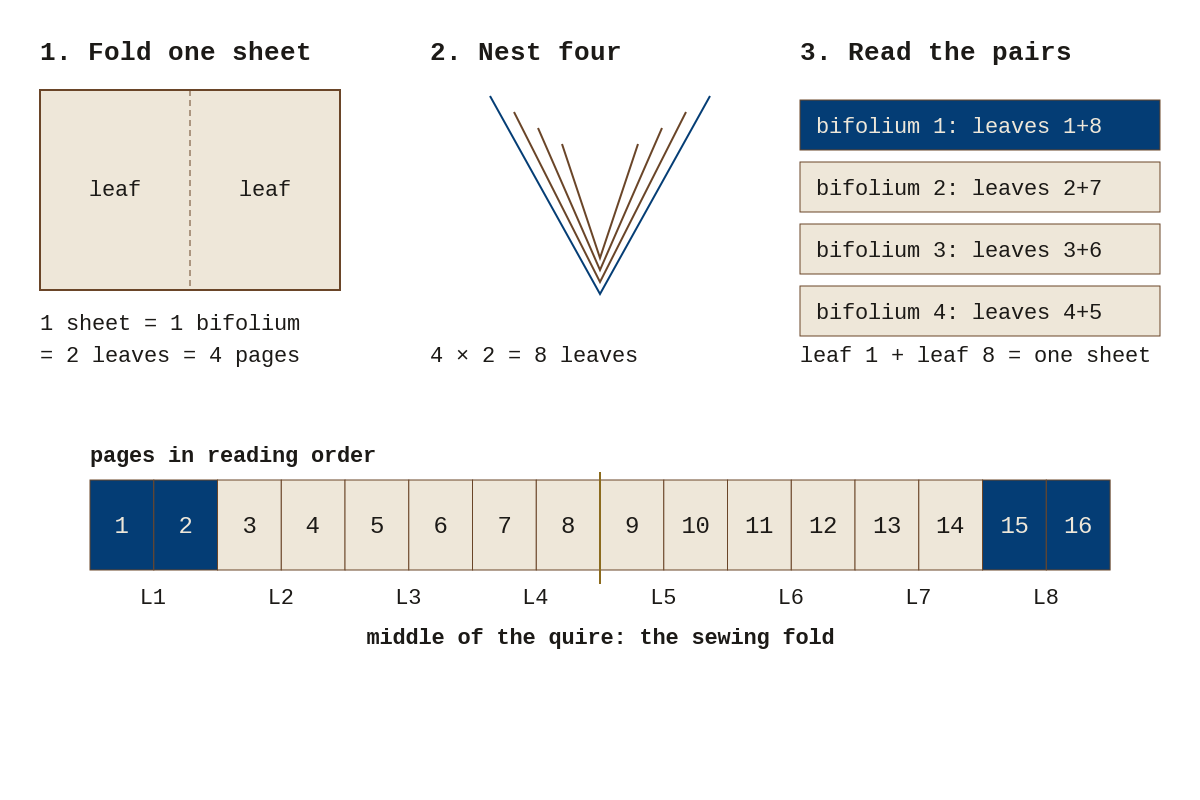
Fold one sheet in half and you have a bifolium, which gives two leaves and four pages, and nest four bifolia to get a quire of 8 leaves and 16 pages. The counts follow one rule, leaves = sheets × 2^n, where n is the number of folds, and pages are always leaves × 2.
Credit line to copy
"How a Quire Nests" by Spine & Watermark, https://spineandwatermark.com/books/medieval-manuscripts/, licensed under CC BY 4.0 (https://creativecommons.org/licenses/by/4.0/).The pairs matter because each leaf in a nested quire is half of a folded sheet. In this model, leaf 1 and leaf 8 began as a single piece of parchment, even though 12 pages now separate them.
| Bifolium | Leaves on the sheet | Pages on the sheet |
|---|---|---|
| 1 (outermost) | 1 and 8 | 1, 2, 15, 16 |
| 2 | 2 and 7 | 3, 4, 13, 14 |
| 3 | 3 and 6 | 5, 6, 11, 12 |
| 4 (innermost) | 4 and 5 | 7, 8, 9, 10 |
The same arithmetic covers other sizes, and each row below is calculated from the ideal model and is not a count of any surviving book.
| Format | Sheets | Folds | Leaves | Pages | Model |
|---|---|---|---|---|---|
| one bifolium | 1 | 1 | 2 | 4 | ideal; no leaf added or cut |
| quire of 4 bifolia | 4 | 1 | 8 | 16 | ideal; no leaf added or cut |
| quire of 5 bifolia | 5 | 1 | 10 | 20 | ideal; no leaf added or cut |
| quire of 6 bifolia | 6 | 1 | 12 | 24 | ideal; no leaf added or cut |
| one sheet, two folds | 1 | 2 | 4 | 8 | ideal; each fold halves the whole sheet |
| one sheet, three folds | 1 | 3 | 8 | 16 | ideal; each fold halves the whole sheet |
Download the data (quire-leaf-count.csv) · source and license notes
Real books bend the model. Quill reports that English copyists often chose six bifolia and Continental ones four, and that a single extra leaf could be added or a leaf cut out.
Most of the nineteen quires in MSS 01020 have eight leaves, Toronto says, with variation in the last five, and the exhibit names one quire of 16 leaves, one of 10 and two of 6. If the first fourteen and the unnamed fifth all had 8, the total would be 158, two more than the 156 leaves it reports, so its figures can't be fully rebuilt from that page. The exhibit's contents list runs on to f. 157.
A bifolium could also be undone later, as when the Archimedes Palimpsest's leaves were cut apart and turned to make a new prayer book. This page uses quire as a synonym for gathering, following the Ligatus Language of Bindings, and bifolium as Quill uses it.
How was the page ruled before writing?
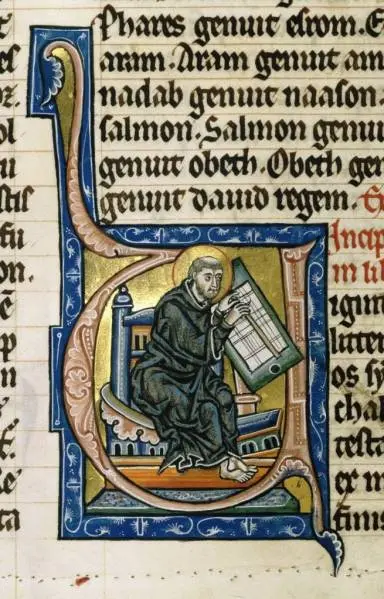
Before a word went down, the page was laid out, and Quill describes small holes pricked in the margins, then lines drawn between them to guide the writing and to box in the text.
Full credit
"Initial C with a monk ruling lines, Hamburg Bible" by Unknown author — https://commons.wikimedia.org/wiki/File:Hmburgbiblen_-_A4_GKS_4_fol_A1.jpg — Public domain (Anonymous, circa 1255 per the file page. United States: published before 1931. European Union: anonymous work more than 70 years old; faithful reproduction of a two-dimensional work.); Royal Danish Library, GKS 4 2°, f. A1
The tool changed over time. Until the early twelfth century, Quill says, ruling meant scoring the skin with a sharp point, and pencil or pen lines then took over.
Who copied the text?
Toronto says professional scribes generally did the writing, often in workshops, while the owners of some small practical books wrote their own. Quill also names monks among the scribes who kept to parchment after paper arrived, so the answer depends on the book, and a single volume can hold more than one hand.
MSS 01020 is that kind of book: the exhibit counts at least three different hands, which is why it thinks the owner was unlikely to have done the copying. Quill calls the work slow, saying the way a nib was cut let it travel only downward, so letters took several strokes, and it reports a year's work for a Bible. Its glossary ties lifting the pen between strokes to book script; in cursive, it says, the pen stayed on the page.
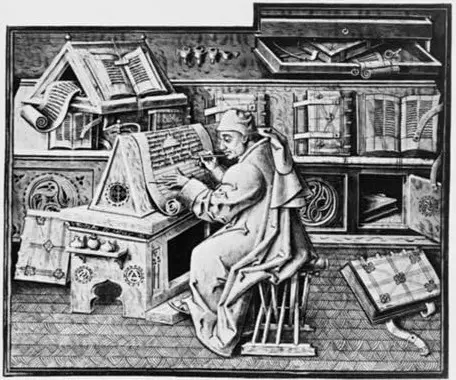
Full credit
"Medieval scribe Jean Miélot, sitting at a desk" by Unknown engraver — https://commons.wikimedia.org/wiki/File:Medieval_scribe_Jean_Mi%C3%A9lot,_sitting_at_a_desk,_making_a_copy_of_another_book_LCCN2006680149.jpg — Public domain (Print published in Westminster by Nichols and Sons in 1885 per the Library of Congress data on the file page; no engraver named. United States: published before 1931. European Union: anonymous work published more than 70 years ago. The Library of Congress rights statement is not relied on.); Library of Congress, LCCN 2006680149; modified: cropped to the printed picture, removing the blank page and the black surround; no other change
Checking followed the copying. Quill calls it an important stage, done quickly by some and against the original by others.
What is the stray word for?
The stray word is a catchword. Quill and Toronto both describe it: at the end of a quire, the scribe wrote the first word or words of the next quire, which Quill places at the foot of the last page. A binder could then match the two and put the quires in order.
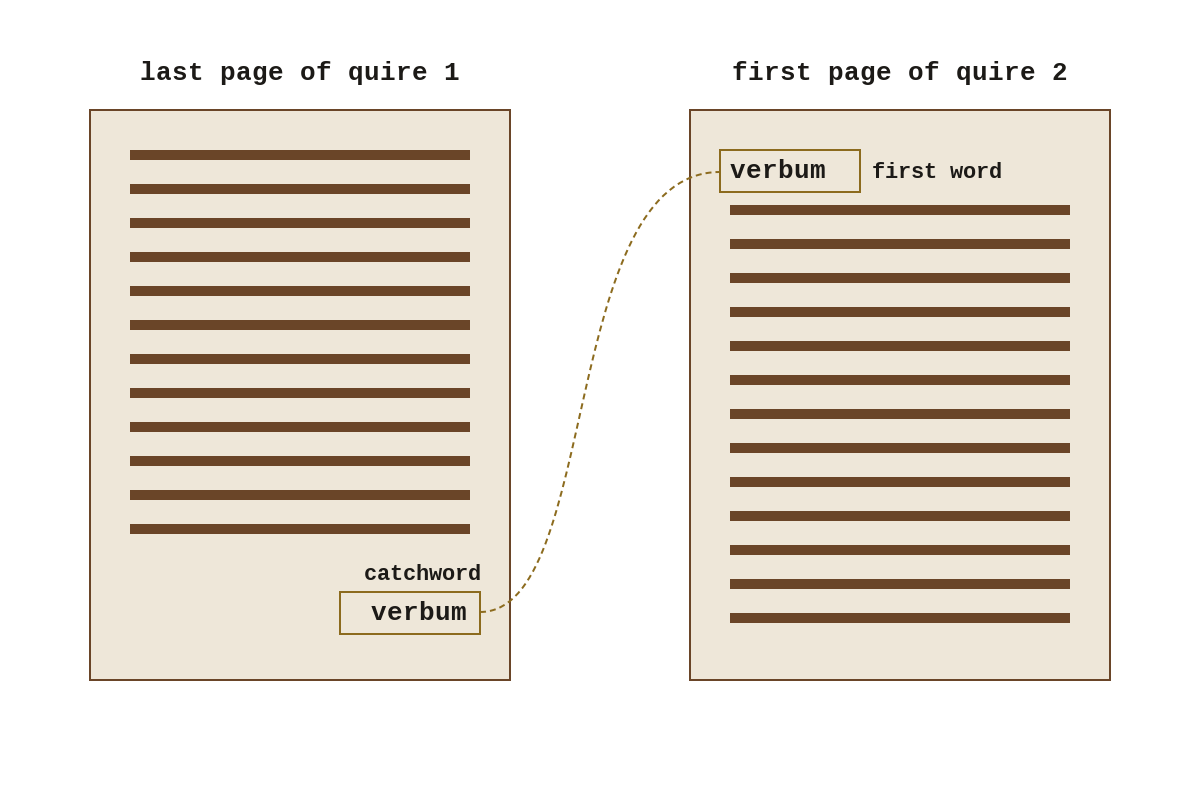
Credit line to copy
"How a Catchword Matches Two Quires" by Spine & Watermark, https://spineandwatermark.com/books/medieval-manuscripts/, licensed under CC BY 4.0 (https://creativecommons.org/licenses/by/4.0/).The stray word is a note about order, not part of the reading.
It also counts as evidence: MSS 01020 ends each quire with a catchword, and Toronto reads that as showing the book was meant as one volume from the start and is missing no pages, even though its contents don't line up with the quire breaks.
Catchwords were one system among several: Quill mentions numbered quires and numbered bifolia.
None of it was foolproof, since binders sometimes got the sequence wrong anyway, Quill says. Printers kept the unit, too, as the Gutenberg Bible's reprinted quires show.
Where does an illuminated manuscript fit?
An illuminated manuscript is one painted with color and often gold, and that painting usually followed the text, since Quill places decoration after copying and correcting. The guide sets penwork flourishes at the plain end of the scale and painted illumination at the costly end, and it says decorated books were not very common on the whole.
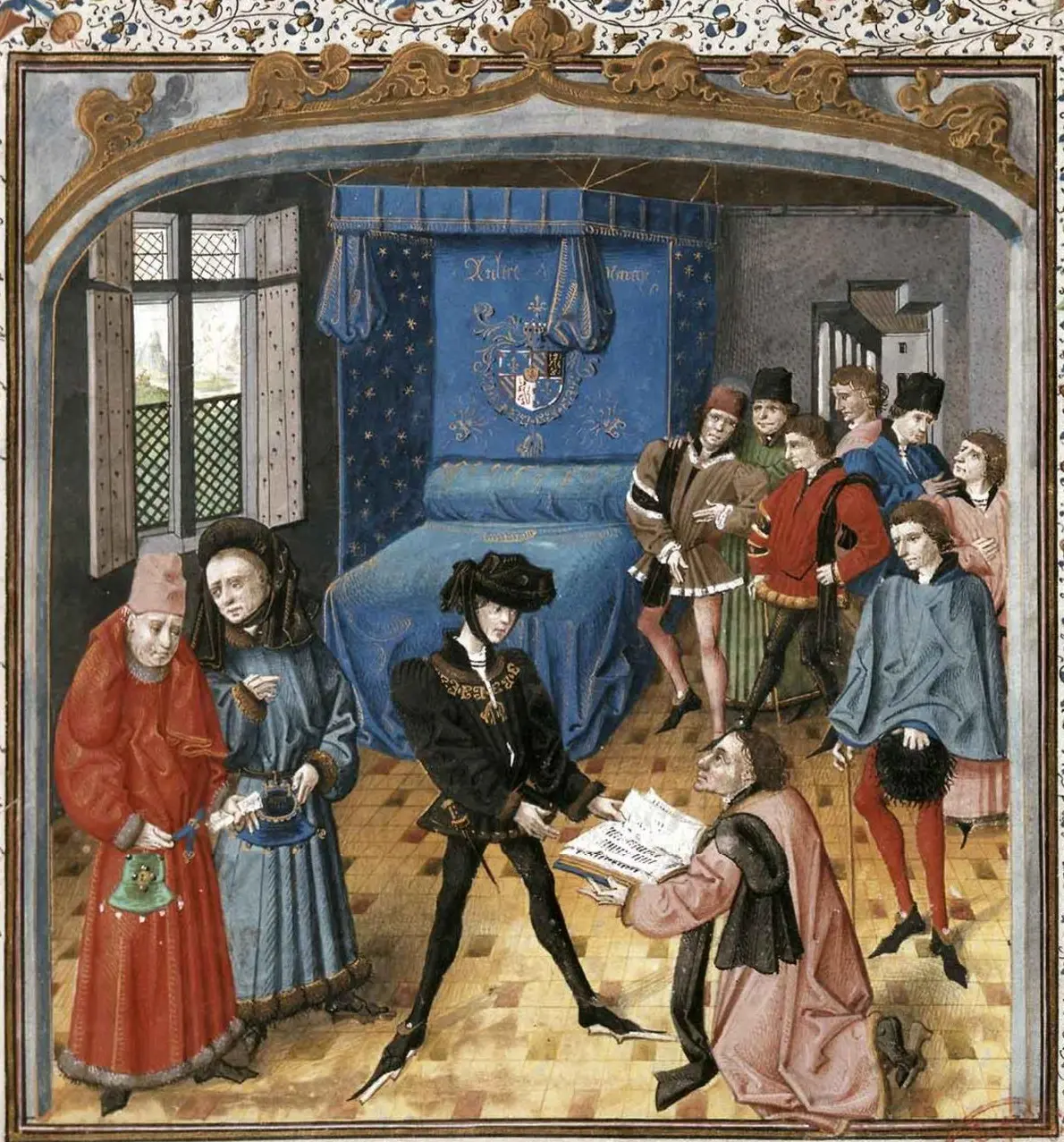
Full credit
"Presentation of Jean Miélot’s translation to Philip the Good" by Jean Le Tavernier — https://commons.wikimedia.org/wiki/File:Jean_Mi%C3%A9lot_Presentation.jpg — Public domain (Jean Le Tavernier died in 1462; circa 1454 per the file page. United States: published before 1931. European Union: author dead more than 70 years; faithful reproduction of a two-dimensional work.); Bibliothèque royale, Brussels, Ms. 9092, f. 1r; modified: cropped to the miniature and its frame, leaving out the page border, text and arms; no other change
Toronto calls the decoration in MSS 01020 minimal, with only some red slashes through capitals and some red flourishes. Set against Quill's scale, that would put the book near the plain end, though neither source ranks it; the placement is this page's own reading.
When was the manuscript bound?
Binding came last in the accounts that describe it. Quill says that once a book had been copied, corrected and decorated, the quires only had to be bound, and that a client buying commercially could bring the finished quires to a binder. Toronto says the same in shorter form, with copying done on loose quires that were sewn into the binding afterward.
The Getty's text gives the method: gatherings were put in order and sewn to cords or thongs, the loose ends then ran through channels in wooden boards, and leather or fabric usually covered the result. Terms here follow the Ligatus Language of Bindings: those cords are sewing supports, and the last move is board lacing.
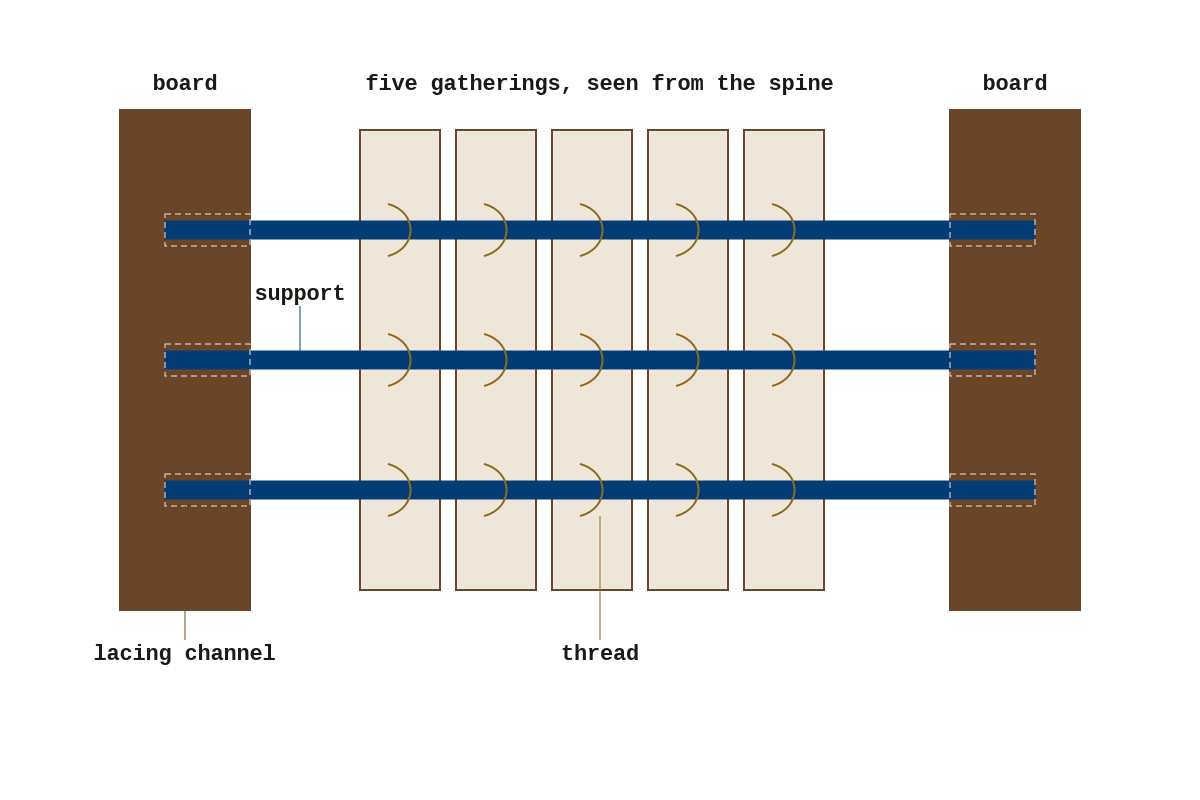
Credit line to copy
"Gatherings Sewn on Supports and Laced to Boards" by Spine & Watermark, https://spineandwatermark.com/books/medieval-manuscripts/, licensed under CC BY 4.0 (https://creativecommons.org/licenses/by/4.0/).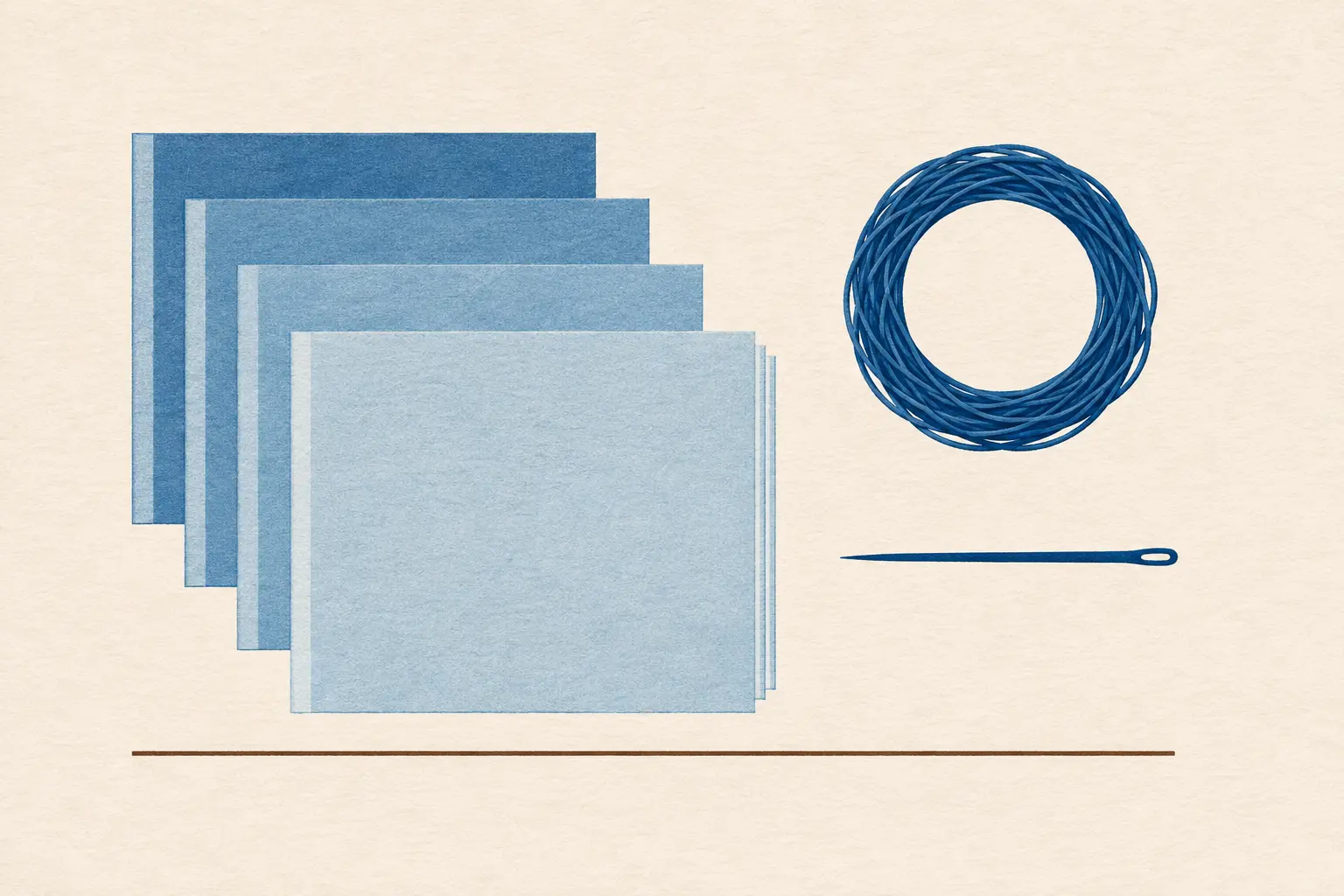 Illustration
Cheaper books could skip the boards. A limp binding has a full cover without boards; Quill describes a stiff parchment sheet stitched around the quires and says students favored it for its low cost. At the other extreme, Quill reports giant Bibles half a meter tall, weighing as much as 25 kilograms, much of that in the boards.
A first binding need not be the last. MSS 01020 is now in brown leather over pasteboard, and its first binding is gone; when it was rebound, Toronto says, the pages were trimmed even, sometimes slicing through words.
Where do the sources disagree?
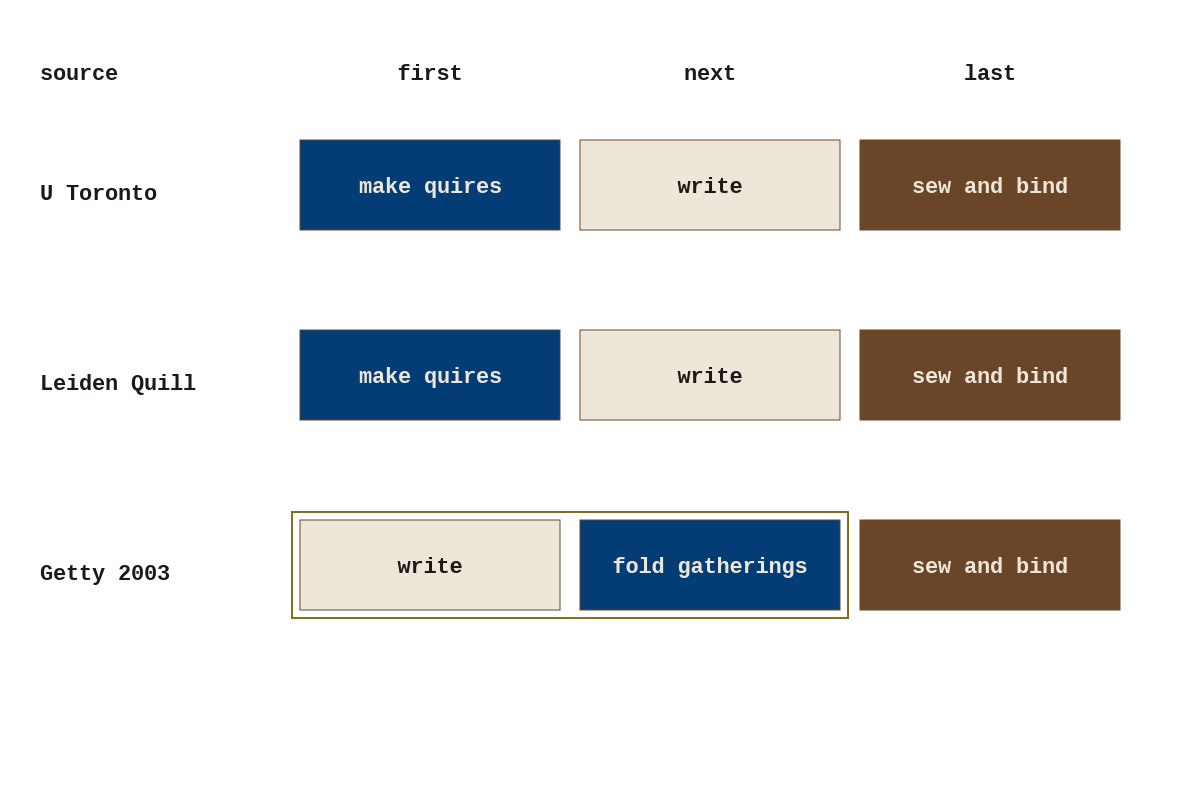
The sources read here agree that binding comes after writing, but they differ on when the folding happened.
Credit line to copy
"The Order Three Sources Give" by Spine & Watermark, https://spineandwatermark.com/books/medieval-manuscripts/, licensed under CC BY 4.0 (https://creativecommons.org/licenses/by/4.0/).| Source | First | Next | Last |
|---|---|---|---|
| University of Toronto exhibit | make quires, generally before writing | write on loose quires | sew into the binding |
| Leiden, Quill | make quires, then rule | copy, correct, decorate | bind |
| Getty, 2003 exhibition | rule, write, illuminate | fold sheets into gatherings | sew and bind |
This page doesn't choose between them; each row reports one source's account. Toronto also says that quires were sewn down the middle as booklets, a detail that Quill's account of bundled bifolia doesn't mention.
So usually carries real limits. Toronto says quires were sometimes made to fit one text, and that some miscellanies have no catchwords because their parts were not always meant to be bound together, while Quill reports prefabricated quires on occasion.
No source read here counts manuscripts, so usually reports how these guides describe normal practice, not a measured share of surviving books.
Turn it over:
A catchword shows only that someone planned an order for that book, and not every book has one. The missing piece for MSS 01020 is its first binding, since the sewing it first received can't be described from the pages read here.
- Folio, Quarto, Octavo: the same folded sheet, counted for printers: The fold counts on this page become format names once sheets go to press.
- Book of Kells: what a later binder did to a finished book: A manuscript could still be cut and rebound long after its scribes had finished.
Sources
- Erik Kwakkel, "Quill: Introduction," Digital Manuscripts in the Classroom, Leiden University Libraries (April 2021; previously published as Quill: Books before Print). digmanclass.universiteitleiden.nlRead: full page, 2026-11-07
- Erik Kwakkel, "Quill: Glossary," Digital Manuscripts in the Classroom, Leiden University Libraries. digmanclass.universiteitleiden.nlRead: section entries Bifolium, Quire, Catchwords and Signatures, Pricking and Ruling, Offcuts, Limp Binding, Boards, Cursive Script, 2026-11-07
- Maura Quinn, "Book Making," A Library in the Palm of Your Hand: Late Medieval Miscellany MSS 01020, Spatial Humanities, University of Toronto Libraries. spatial-humanities.library.utoronto.caRead: full page, 2026-11-07
- Maura Quinn, "Introduction to the Late Medieval Miscellany," A Library in the Palm of Your Hand, University of Toronto Libraries. spatial-humanities.library.utoronto.caRead: full page, 2026-11-07
- Maura Quinn, "The Book," A Library in the Palm of Your Hand, University of Toronto Libraries. spatial-humanities.library.utoronto.caRead: full page, 2026-11-07
- Maura Quinn, "Contents of the Late Medieval Miscellany," A Library in the Palm of Your Hand, University of Toronto Libraries. spatial-humanities.library.utoronto.caRead: full page, 2026-11-07
- Maura Quinn, "Damage and Repair," A Library in the Palm of Your Hand, University of Toronto Libraries. spatial-humanities.library.utoronto.caRead: full page, 2026-11-07
- J. Paul Getty Museum, "The Making of a Medieval Book," exhibition page, May 20–September 28, 2003. getty.eduRead: full page, 2026-11-07
- Ligatus, Language of Bindings Thesaurus, “gatherings,” concept 2286. lob.is.ed.ac.ukRead: full page, 2026-11-07
- Ligatus, Language of Bindings Thesaurus, "sewing supports," concept 1585. lob.is.ed.ac.ukRead: full page (one concept entry), 2026-11-07
- Ligatus, Language of Bindings Thesaurus, "board lacing," concept 3849. lob.is.ed.ac.ukRead: full page (one concept entry), 2026-11-07
- Ligatus, Language of Bindings Thesaurus, "limp bindings," concept 12132. lob.is.ed.ac.ukRead: full page (one concept entry), 2026-11-07
- Kunsthistorisches Museum Wien, "Hl. Gregor mit Schreibern," Kunstkammer 8399, object page. khm.atRead: full page (one object record), 2026-11-07
Image credits
- "Saint Gregory the Great with scribes" by O.Mustafin — https://commons.wikimedia.org/wiki/File:W00319.jpg — CC0 1.0 (https://creativecommons.org/publicdomain/zero/1.0/); Kunsthistorisches Museum, Vienna, Kunstkammer 8399
- "What One Skin Supplied" by Spine & Watermark, https://spineandwatermark.com/books/medieval-manuscripts/, licensed under CC BY 4.0 (https://creativecommons.org/licenses/by/4.0/).
- "How a Quire Nests" by Spine & Watermark, https://spineandwatermark.com/books/medieval-manuscripts/, licensed under CC BY 4.0 (https://creativecommons.org/licenses/by/4.0/).
- "Initial C with a monk ruling lines, Hamburg Bible" by Unknown author — https://commons.wikimedia.org/wiki/File:Hmburgbiblen_-_A4_GKS_4_fol_A1.jpg — Public domain (Anonymous, circa 1255 per the file page. United States: published before 1931. European Union: anonymous work more than 70 years old; faithful reproduction of a two-dimensional work.); Royal Danish Library, GKS 4 2°, f. A1
- "Medieval scribe Jean Miélot, sitting at a desk" by Unknown engraver — https://commons.wikimedia.org/wiki/File:Medieval_scribe_Jean_Mi%C3%A9lot,_sitting_at_a_desk,_making_a_copy_of_another_book_LCCN2006680149.jpg — Public domain (Print published in Westminster by Nichols and Sons in 1885 per the Library of Congress data on the file page; no engraver named. United States: published before 1931. European Union: anonymous work published more than 70 years ago. The Library of Congress rights statement is not relied on.); Library of Congress, LCCN 2006680149; modified: cropped to the printed picture, removing the blank page and the black surround; no other change
- "How a Catchword Matches Two Quires" by Spine & Watermark, https://spineandwatermark.com/books/medieval-manuscripts/, licensed under CC BY 4.0 (https://creativecommons.org/licenses/by/4.0/).
- "Presentation of Jean Miélot’s translation to Philip the Good" by Jean Le Tavernier — https://commons.wikimedia.org/wiki/File:Jean_Mi%C3%A9lot_Presentation.jpg — Public domain (Jean Le Tavernier died in 1462; circa 1454 per the file page. United States: published before 1931. European Union: author dead more than 70 years; faithful reproduction of a two-dimensional work.); Bibliothèque royale, Brussels, Ms. 9092, f. 1r; modified: cropped to the miniature and its frame, leaving out the page border, text and arms; no other change
- "Gatherings Sewn on Supports and Laced to Boards" by Spine & Watermark, https://spineandwatermark.com/books/medieval-manuscripts/, licensed under CC BY 4.0 (https://creativecommons.org/licenses/by/4.0/).
- Illustration: Spine & Watermark. Generated schematic illustration — not a photograph or historical record. © Spine & Watermark, all rights reserved; not licensed for reuse (see /image-use/).
- "The Order Three Sources Give" by Spine & Watermark, https://spineandwatermark.com/books/medieval-manuscripts/, licensed under CC BY 4.0 (https://creativecommons.org/licenses/by/4.0/).
Cite this page
Spine & Watermark. “Medieval Manuscripts: Usually Written First, Bound Later.” Spine & Watermark, published November 7, 2026. https://spineandwatermark.com/books/medieval-manuscripts/. Accessed [date].
How sources are ranked · All corrections · Contact · Report an error (contact@spineandwatermark.com)