Archimedes Palimpsest: The Erased Book Outlasted 2 Others
Published · Revised
TL;DR: The Archimedes Palimpsest is a 10th-century copy of Archimedes, scraped, cut, turned and rewritten as a prayer book completed in April 1229. It is the only known copy of The Method, per Reviel Netz. The two other known Byzantine Archimedes manuscripts, which scholars kept copying and translating, are lost.
Collation: palimpsest: earlier leaves scraped, cut, turned and rewritten · 174 parchment leaves in the main volume (numbered 1–177, less missing 104, 123 and 170) plus 8 later paper leaves; Cambridge leaf 192 × 147 mm (7.6 × 5.8 in) · image/text c. 287–212 BC / object copied middle or later 10th c.; overwritten, completed 13 or 14 April 1229 (sources differ) · privately owned; deposited at the Walters Art Museum in January 1999, housed there per CNRS, March 2026 (accession no.: n/a); Blois, Musée des Beaux-Arts, Inv. 73.7.52; Cambridge University Library, MS Add. 1879.23
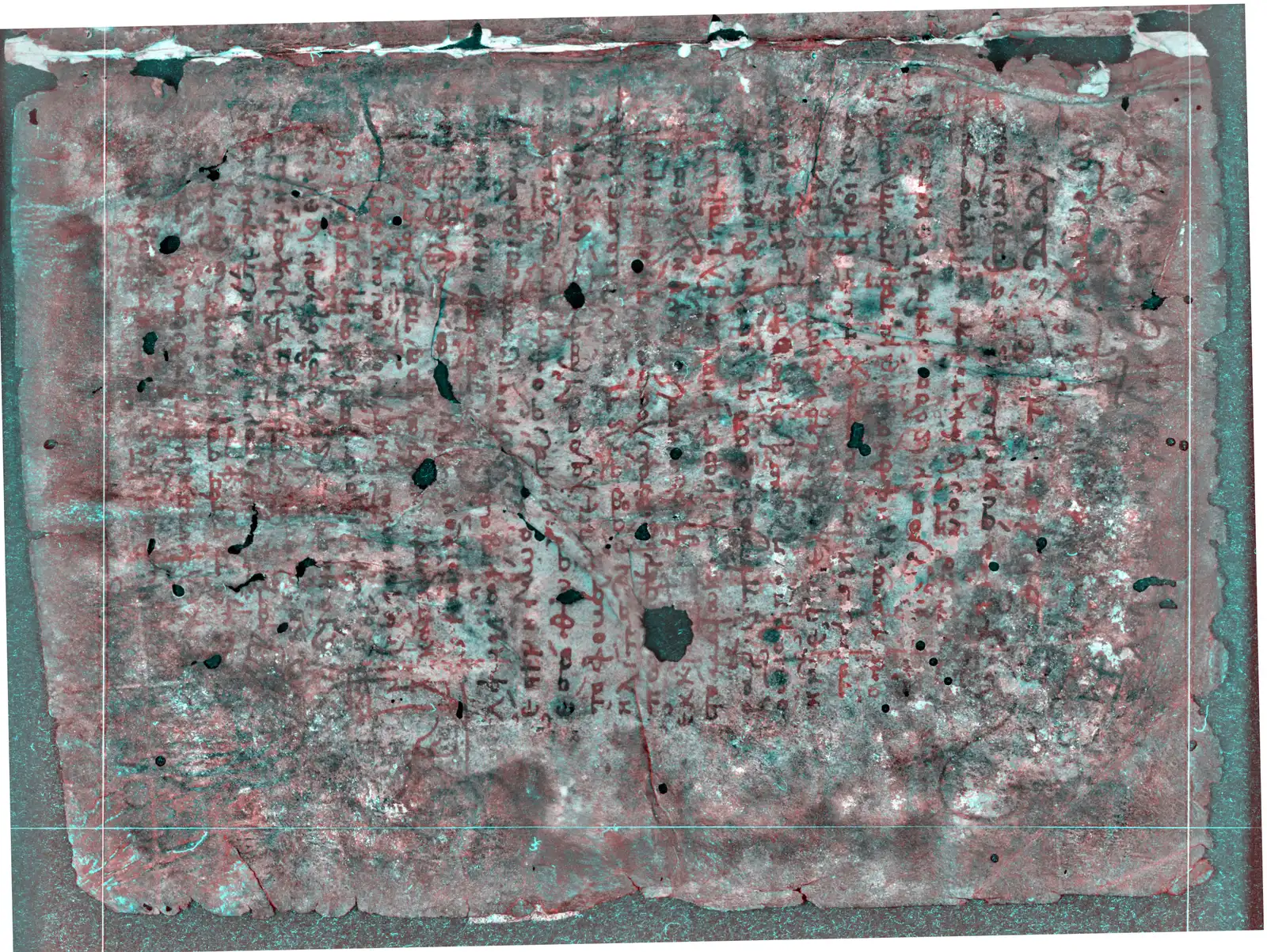

Collation card, all fields
- Object
- Archimedes Palimpsest archimedespalimpsest.org
- Type
- manuscript cudl.lib.cam.ac.uk
- Process
- palimpsest: earlier leaves scraped, cut, turned and rewritten cudl.lib.cam.ac.uk
- Format & size
- 174 parchment leaves in the main volume (numbered 1–177, less missing 104, 123 and 170) plus 8 later paper leaves; Cambridge leaf 192 × 147 mm (7.6 × 5.8 in) archimedespalimpsest.org cudl.lib.cam.ac.uk
- Material
- parchment cudl.lib.cam.ac.uk
- Made
- image/text c. 287–212 BC / object copied middle or later 10th c.; overwritten, completed 13 or 14 April 1229 (sources differ) archimedespalimpsest.org cudl.lib.cam.ac.uk
- Held at
- privately owned; deposited at the Walters Art Museum in January 1999, housed there per CNRS, March 2026 (accession no.: n/a); Blois, Musée des Beaux-Arts, Inv. 73.7.52; Cambridge University Library, MS Add. 1879.23, cudl.lib.cam.ac.uk archimedespalimpsest.org cnrs.fr
- Date basis
- Catalogue: script (10th c.); 14 April 1229 from a colophon read as a later hand's copy, per the Cambridge record; Literature: 13 April 1229, John Lowden's reading, per the project's history cudl.lib.cam.ac.uk archimedespalimpsest.org
Turn a leaf of this prayer book on its side and look for a second, fainter script. On the one leaf held in Cambridge, 192 by 147 millimeters (7.6 by 5.8 inches), two columns of brown writing run at right angles to the prayers. That underlayer is Archimedes, copied in the 10th century and written over in 1229. The question is why the erased book is the one still here.
Of the three known Byzantine manuscripts that carried Archimedes in Greek, the two that stayed in use as mathematics books disappeared. The one turned into a prayer book survives, minus three numbered leaves, plus 20th-century mold, glue and forged paintings.
What is the Archimedes Palimpsest, physically?
Read the record before the story. A palimpsest is a manuscript whose first text was erased so the parchment could be written on again. The main volume is privately owned and, as CNRS reported in March 2026, kept at Baltimore’s Walters Art Museum, so the most precise description comes from the one leaf in a public library, at Cambridge. The main volume has 174 parchment leaves, numbered 1 to 177, plus 8 later paper leaves; the sources read give no leaf size for it.
What texts lie under the prayers?
Count the layers before reading anything into them. Think of the book as an overstruck coin, a new design pressed over an old one. The project's own tally, from 2011, is eight manuscripts in one book: the prayer book and seven erased texts, of which Archimedes is the largest.
Full credit
"Archimedes" by Luca Giordano — https://commons.wikimedia.org/wiki/File:1652_Giordano_Archimedes_Gem%C3%A4ldegalerie_Kat.Nr._453_anagoria.jpg — Public domain (Luca Giordano died in 1705; painted 1650–53. United States published before 1931. European Union author dead more than 70 years. Photographic reproduction of a two-dimensional painting (PD-Art); the photographer is anagoria (own work on Commons).); Gemäldegalerie Berlin, 453; modified: scaled from 4,032 px to 1,600 px wide and saved as JPEG; not cropped
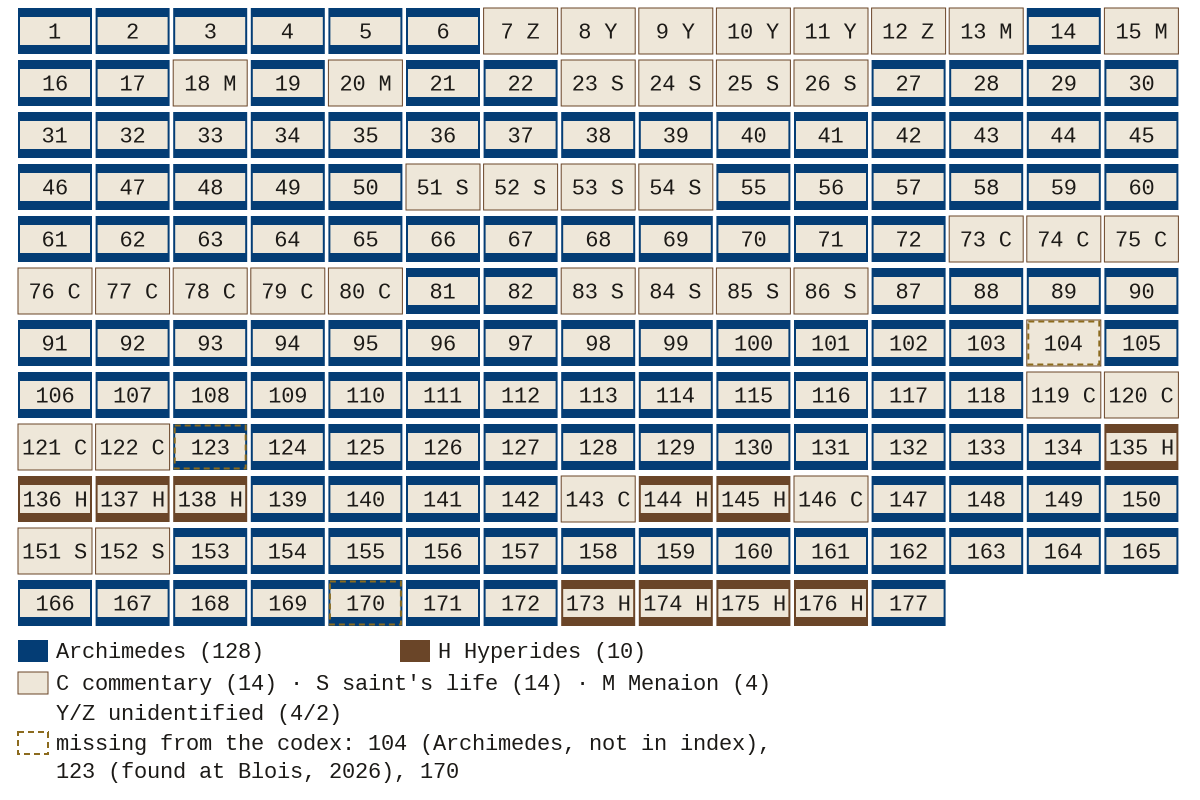
The project's Folio Index, its map of which old leaf lies under which prayer-book leaf, lets you count how much of each Archimedes treatise survives.
| Treatise | Old leaves in the index | Other witness (per the project unless noted) |
|---|---|---|
| Equilibrium of Planes | 3 | not stated in the sources read |
| On Floating Bodies | 13 | Latin translation by William of Moerbeke (1269); this is the only Greek text |
| The Method of Mechanical Theorems | 15 | none: “exist nowhere else” |
| Spiral Lines | 17 | Renaissance copies of the lost Codex A |
| Sphere and Cylinder | 22 | Renaissance copies of the lost Codex A |
| Measurement of the Circle | 2 | Renaissance copies of the lost Codex A |
| Stomachion (fragmentary) | 1 | a separate Arabic fragment, per Netz, Acerbi and Wilson (2004) |
Download the data (archimedes-palimpsest-treatises.csv) · source and license notes Data: "Archimedes Palimpsest Folio Index" by Will Noel and Doug Emery, Archimedes Palimpsest data set (OPenn), 31 October 2011, CC BY 3.0, https://creativecommons.org/licenses/by/3.0/, https://openn.library.upenn.edu/Data/0014/ArchimedesPalimpsest/Documents/Internal/FolioIndex.txt, retrieved 2026-10-07
Some leaves hold the end of one treatise and the start of the next, so the counts overlap. The index records 67 Archimedes leaves in all.
The other erased books are smaller. Natalie Tchernetska identified speeches by the Athenian orator Hyperides in 2002, and five bifolia (sheets folded into two leaves) of them are now known. A commentary on Aristotle's Categories was mostly recovered between 2005 and 2010; the project dates its text to the second or third century AD, and the sources read leave this copy undated. The rest are two Byzantine liturgical texts and two still unidentified in 2011.
Credit line to copy
"What Lies Under Each Leaf of the Prayer Book" by Spine & Watermark, https://spineandwatermark.com/lost/archimedes-palimpsest/, licensed under CC BY 4.0 (https://creativecommons.org/licenses/by/4.0/).Download the data (archimedes-palimpsest-folio-map.csv) · source and license notes Data: "Archimedes Palimpsest Folio Index" by Will Noel and Doug Emery, Archimedes Palimpsest data set (OPenn), 31 October 2011, CC BY 3.0, https://creativecommons.org/licenses/by/3.0/, https://openn.library.upenn.edu/Data/0014/ArchimedesPalimpsest/Documents/Internal/FolioIndex.txt, retrieved 2026-10-07
Of the 177 numbered prayer-book leaves, the index maps 128, about 72 percent, to the Archimedes book; the missing leaf 104 held Archimedes too. Hyperides lies under 10, the Categories commentary under 14, a saint's life under another 14, a Menaion under 4, and two unidentified texts under 4 and 2.
The Method is a letter from Archimedes to Eratosthenes, and it shows how he found results before he proved them. He weighed thin slices of one figure against another on an imagined balance. “Certain things first became clear to me by a mechanical method,” he writes in Thomas Heath's 1912 translation (p. 13), “although they had to be demonstrated by geometry afterwards.”
How was the Archimedes Palimpsest made?
Made: cut, turned and rewritten
The Archimedes book was copied in the middle or later 10th century, a date that rests on the style of its script. The project's history places the copying almost certainly in Constantinople. Archimedes could not have read it: Greek script changed so much around the 8th century AD, notes Reviel Netz of Stanford, one of its editors, that he “would be unable to read it.”
The second life began with a cut. Cambridge University Library's record describes the method: each original bifolio was cut in half, and the halves were rotated to form the bifolios of a smaller Euchologion. One old leaf, turned sideways and folded, became two new leaves. Medieval book-making built its gatherings from folded sheets too, and the page on folio, quarto and octavo counts what each fold does to a leaf.
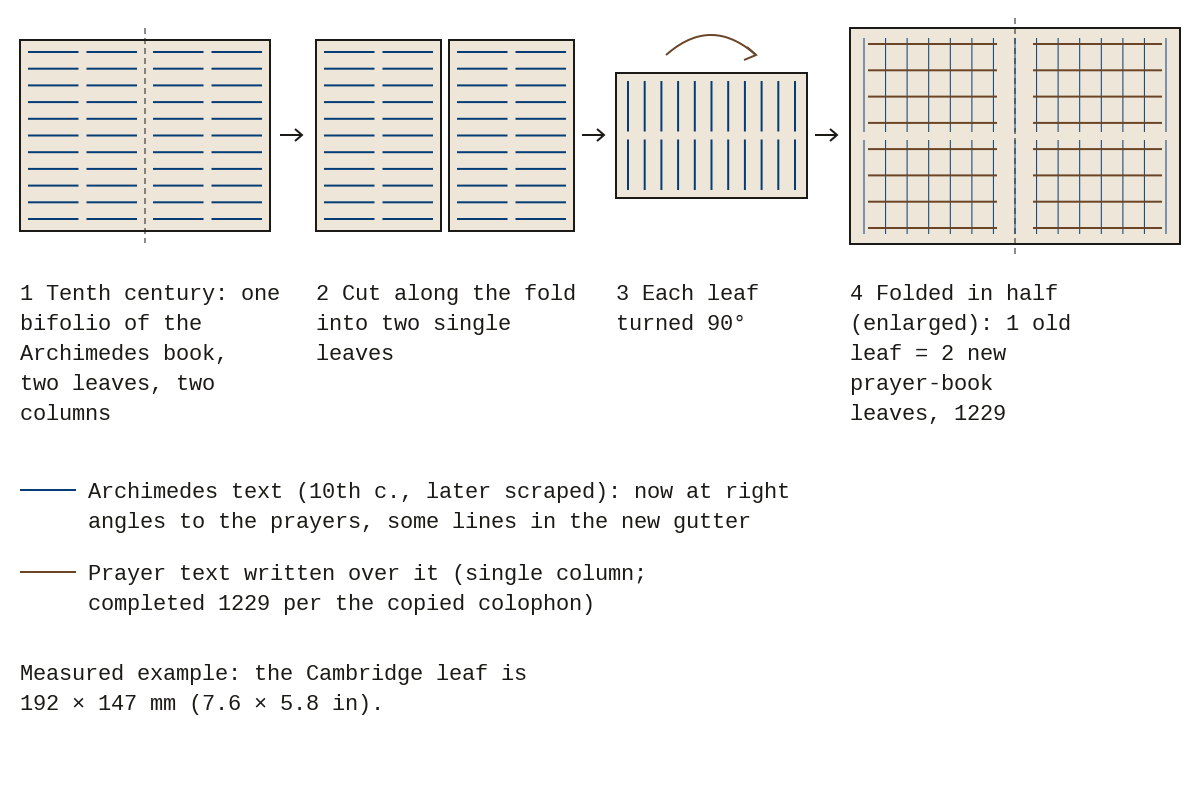
Credit line to copy
"How One Archimedes Leaf Became Two Prayer-Book Leaves" by Spine & Watermark, https://spineandwatermark.com/lost/archimedes-palimpsest/, licensed under CC BY 4.0 (https://creativecommons.org/licenses/by/4.0/).So the old text runs at right angles to the prayers, and some of it falls in the gutter, the inner margin at the spine. The Cambridge leaf puts numbers on both layers. The Archimedes text sits in two columns of at least 19 lines, and the Liturgy of St Basil over it in one column of 26 lines. A core sample taken for the project shows what scraping left behind: the Archimedes text is “nothing more than a stain” at the top of the parchment.
This is where the double date matters: every document object has the date of its content and the date the physical thing was made. Here the text belongs to Archimedes' lifetime, c. 287–212 BC by the project's dates; the object is a 10th-century copy remade in 1229. The Voynich Manuscript raises the same question about its skin and its writing.
Even 1229 comes in two versions. The project's history reports that John Lowden read a colophon, the scribe's closing note, on folio 1 verso in 2002, giving April 13, 1229. Cambridge's record gives 14 April 1229, names the scribe as probably Ioannes Myronas, and reads the colophon as a later hand's copy of an original now lost.
What happened to the palimpsest after 1229?
 Illustration
Lived: wax, mold, glue and paint
Some marks come from the book's new job. The project's conservators found large areas covered in candle wax, because the manuscript spent several hundred years in use as a prayer book by candlelight. That wax is a handling scar: a mark left by use rather than by making. The Cambridge leaf has its own; its record notes minor losses at the edges from wear and tear.
Other damage did not come from use. Mold attacked the book severely after Johan Ludvig Heiberg saw it, and in moldy patches the parchment's collagen is breaking down. In the second half of the 20th century, part of the spine was glued with an adhesive the project's conservation page likens to Elmer's Wood Glue, which proved tougher than the parchment and slowed the disbinding from 2000 to 2004. The Cambridge leaf also shows water staining, cause not established.
The strangest additions are four portraits of the Evangelists, painted over the prayers and the erased texts beneath them. The project dates them to after 1929, because John Lowden showed they were copied from a publication of that year.
Three leaves, 104, 123 and 170, were there when Heiberg studied the book, last in 1908, and are missing now. One has turned up. In March 2026, CNRS announced that leaf 123 had been identified in Blois, at the Musée des Beaux-Arts, inventory 73.7.52, with Sphere and Cylinder Book I, Propositions 39 to 41, on one side and a painting of Daniel surrounded by two lions on the other. CNRS says the painting was reportedly added around 1942.
How was the erased text read again?
Copies did the first rescue.
Heiberg, alerted by a few lines of undertext that Athanasios Papadopoulos-Kerameus transcribed in an 1899 catalogue, had the manuscript photographed in Constantinople in 1906, and he published its text in his edition of Archimedes between 1910 and 1915. His photographs, now in the Royal Danish Library as Ms. Phot. 38, include leaf 123 and one side of leaf 170, which are no longer in the book.
How the book then left the library in Constantinople is not known, according to the project's history; court records place it in a French private collection by the 1960s. After a 1998 sale it was deposited at the Walters Art Museum in January 1999, where conservator Abigail Quandt began taking it apart in 2000.
A final imaging session in August 2007 recorded each leaf in twelve wavelengths, from ultraviolet to infrared, at 800 dots per inch, and the whole manuscript took just under three weeks. The raw frames still did not give easily legible text. That came only from computer processing.
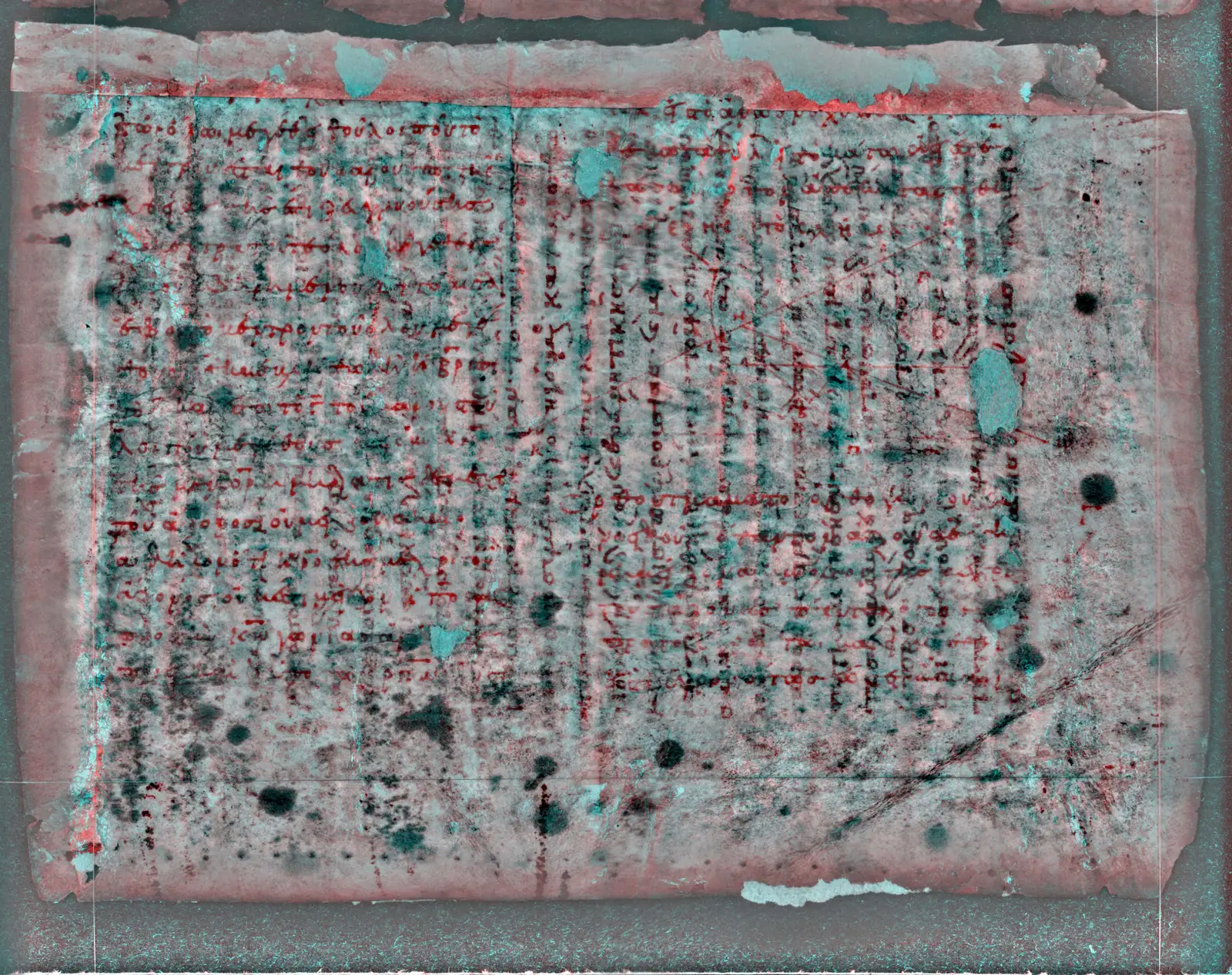

For the forged pages, the team turned to X-ray fluorescence, which maps chemical elements. The inks are rich in iron, so an iron map brings out the old letters even where the new ones cross them.
On one forged page, a small patch took ten hours on a laboratory instrument; at the Stanford Synchrotron Radiation Laboratory, a whole column took about 24 hours.
In October 2008 the images and transcriptions were released free, under a Creative Commons Attribution license.
Why is the erased copy the one that survived?
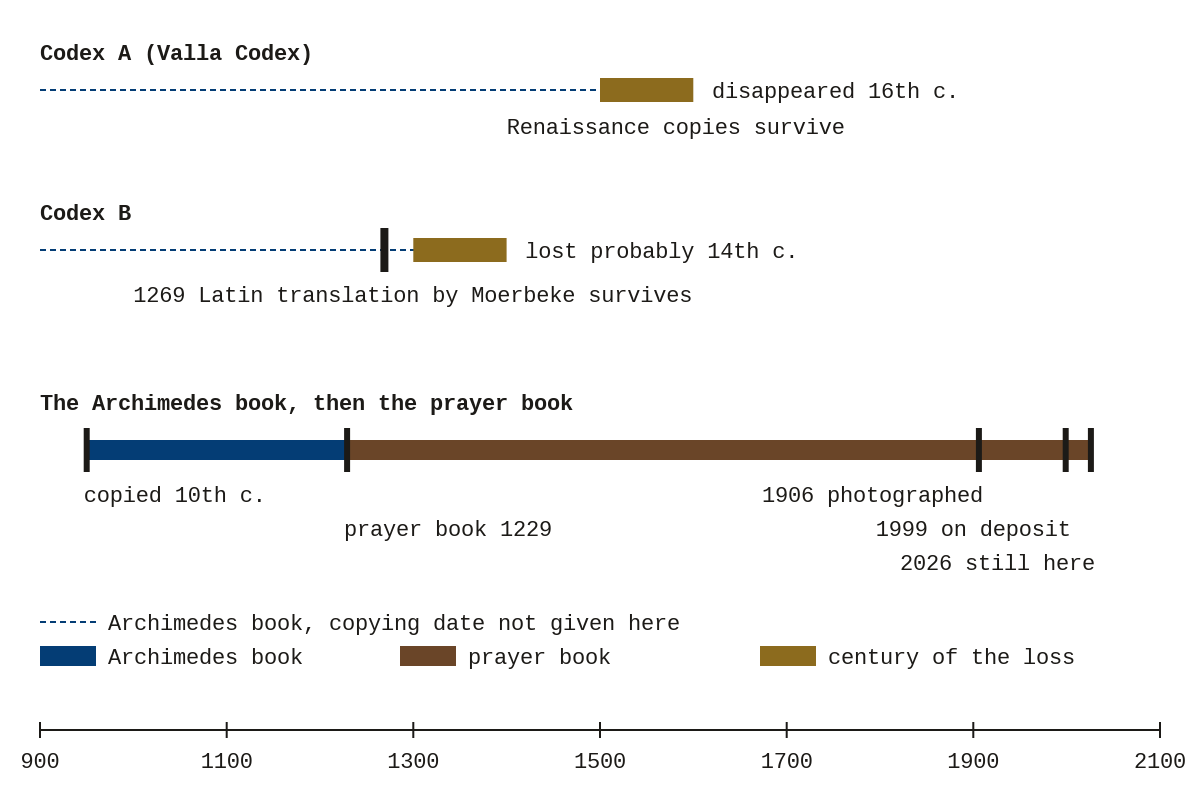
Follow the other two books. According to Netz, most of Archimedes was already known before 1906 from Renaissance copies of a Byzantine manuscript called Codex A, or the Valla Codex, which disappeared in the 16th century. A second, Codex B, was the source of William of Moerbeke's Latin translation of 1269, and was probably lost in the 14th century.
Credit line to copy
"Three Byzantine Archimedes Manuscripts on One Time Axis" by Spine & Watermark, https://spineandwatermark.com/lost/archimedes-palimpsest/, licensed under CC BY 4.0 (https://creativecommons.org/licenses/by/4.0/).| Manuscript | What the sources report | When | What remains |
|---|---|---|---|
| Codex A (Valla Codex) | disappeared | 16th century | Renaissance copies |
| Codex B | lost, probably | 14th century | Moerbeke's Latin translation of 1269 |
| The palimpsest | Archimedes text copied; prayer book written over it and completed | middle or later 10th century; 13 or 14 April 1229 (sources differ) | the book itself, minus three numbered leaves |
Both stayed in use as mathematics books, copied and translated, and both are gone. The project's account offers no reason the prayer book outlasted them, and neither does this page. What the record shows is narrower: the one copy that stopped being a mathematics book is the one that remains.
The copies made from those lost books still matter, and this page treats them as evidence, not as second-best. Codex A is known through its Renaissance descendants, and Heiberg's 1906 photographs now preserve leaves the original no longer has.
Netz also warns against overstatement: some reports online, he notes, claim that nothing of Archimedes was known before 1906, or that whole treatises surfaced in 1998. Among the gains he lists are hundreds, if not thousands, of corrections to Heiberg's text, and the diagrams, which Heiberg never published. In Heiberg's text, Eudoxus was the first to discover a certain proof; the palimpsest has him as the first to publish it.
What is still hidden in the Archimedes Palimpsest?
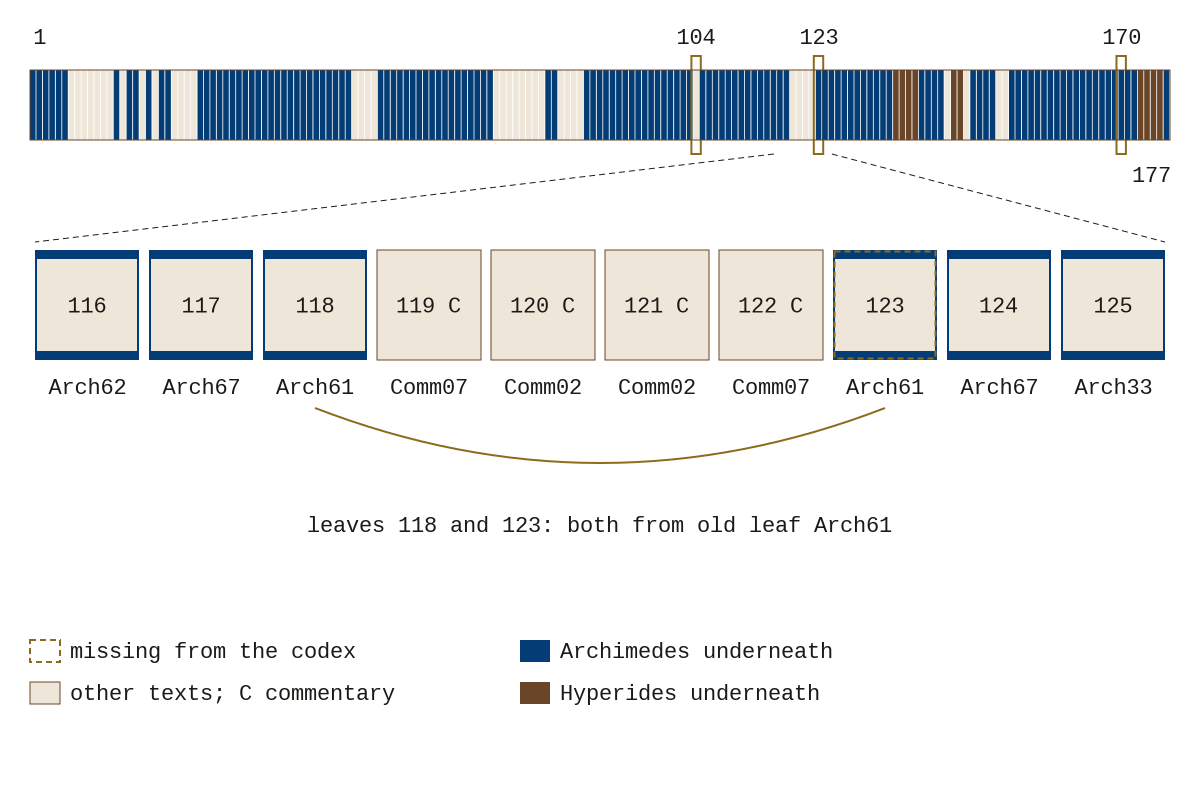
Go back to leaf 123. The Folio Index joins it to leaf 118, still in the book: both came from one old leaf, Arch61.
Credit line to copy
"Where Leaf 123 Sits in the Prayer Book" by Spine & Watermark, https://spineandwatermark.com/lost/archimedes-palimpsest/, licensed under CC BY 4.0 (https://creativecommons.org/licenses/by/4.0/).| Leaf | Underneath | Old leaf | Joined to | Status |
|---|---|---|---|---|
| 116 | Archimedes | Arch62 | 111 | in the book |
| 117 | Archimedes | Arch67 | 124 | in the book |
| 118 | Archimedes | Arch61 | 123 | in the book |
| 119 | Categories commentary | Comm07 | 122 | in the book |
| 120 | Categories commentary | Comm02 | 121 | in the book |
| 121 | Categories commentary | Comm02 | 120 | in the book |
| 122 | Categories commentary | Comm07 | 119 | in the book |
| 123 | Archimedes | Arch61 | 118 | missing from the book; at Blois, per CNRS (March 2026) |
| 124 | Archimedes | Arch67 | 117 | in the book |
| 125 | Archimedes | Arch33 | 132 | in the book |
One side of leaf 123, under the prayers, still shows geometric diagrams and Archimedes' text, much of it legible. The other side lies under the painted Daniel, and CNRS reports that conventional methods of examination cannot reach the text beneath it. Heiberg photographed that side in 1906, before the paint. How much of that text survives beneath it is the question the leaf has not answered yet.
Turn it over:
The colophon, folio 1 verso: a scribe's closing note, which Cambridge's record reads as a later hand's copy. It gives 13 or 14 April 1229 (sources differ) and, per Cambridge, a scribe who was probably Ioannes Myronas.
- Sappho: a text that survives through other books' quotations: In Wharton’s edition, her fullest poem is whole because a later critic quoted it.
- Beowulf manuscript: another book that kept changing after its worst damage: The edges went on crumbling long after the fire.
Sources
- Cambridge University Library, MS Add. 1879.23, "Archimedes Palimpsest" (single leaf), catalogue record. cudl.lib.cam.ac.ukRead: catalogue record, last checked 2026-10-07; images not used
- The Archimedes Palimpsest Project (Walters Art Museum), "The History of the Archimedes Manuscript." archimedespalimpsest.orgRead: full page, last checked 2026-10-07
- The Archimedes Palimpsest Project (Walters Art Museum), "The History of Archimedes." archimedespalimpsest.orgRead: full page, last checked 2026-10-07
- The Archimedes Palimpsest Project (Walters Art Museum), "The Conservation of the Archimedes Palimpsest." archimedespalimpsest.orgRead: full page, last checked 2026-10-07
- The Archimedes Palimpsest Project (Walters Art Museum), "Capturing Images of the Archimedes Palimpsest." archimedespalimpsest.orgRead: full page, last checked 2026-10-07
- The Archimedes Palimpsest Project (Walters Art Museum), "X-ray Fluorescence Imaging of the Archimedes Palimpsest." archimedespalimpsest.orgRead: full page, last checked 2026-10-07
- The Archimedes Palimpsest Project (Walters Art Museum), "Scholarship." archimedespalimpsest.orgRead: full page, last checked 2026-10-07
- The Archimedes Palimpsest Project (Walters Art Museum), "Scholarship on Hyperides." archimedespalimpsest.orgRead: full page, last checked 2026-10-07
- The Archimedes Palimpsest Project (Walters Art Museum), "Scholarship on Other Texts." archimedespalimpsest.orgRead: full page, last checked 2026-10-07
- Reviel Netz, "Overview: The Importance of the Palimpsest to the Study of Archimedes," Archimedes Palimpsest Project. archimedespalimpsest.orgRead: full page, last checked 2026-10-07
- Reviel Netz, "The Diagrams as Floating Bodies," Archimedes Palimpsest Project. archimedespalimpsest.orgRead: full page, last checked 2026-10-07
- T. L. Heath, ed., The Method of Archimedes, Recently Discovered by Heiberg (Cambridge University Press, 1912), pp. 6–7, 12–13. wilbourhall.orgRead: sections only (introductory note and opening letter), 2026-11-07
- Reviel Netz, Fabio Acerbi and Nigel Wilson, "Towards a Reconstruction of Archimedes' Stomachion," SCIAMVS 5 (2004), 67–99, at pp. 67–70. sciamvs.orgRead: sections only (introduction and section 2), 2026-11-07; reported, not quoted
- Will Noel and Doug Emery, "Archimedes Palimpsest Folio Index" (31 October 2011), Archimedes Palimpsest data set, OPenn, University of Pennsylvania Libraries. openn.library.upenn.eduRead: full file, last checked 2026-10-07Text license: CC BY 3.0
- Mike Toth and Doug Emery, "Archimedes Palimpsest Digital Release README Document" (29 October 2008), OPenn. openn.library.upenn.eduRead: full file, last checked 2026-11-06Text license: CC BY 3.0
- CNRS, "Lost page of the Archimedes Palimpsest identified in Blois, central France," press release, 9 March 2026. cnrs.frRead: full press release, 2026-11-07; reported, not quoted
- Victor Gysembergh, "A leaf from the Archimedes palimpsest rediscovered in Blois," Zeitschrift für Papyrologie und Epigraphik, 6 March 2026, as reported by CNRS. cnrs.frRead: bibliography only, as reported by CNRS
Image credits
- "Archimedes Palimpsest, folio 1 verso, pseudocolor" by Rochester Institute of Technology, Equipoise Imaging and Boeing LTS — https://commons.wikimedia.org/wiki/File:001v_pseudocolor_(9737597558).jpg — CC BY 3.0 (https://creativecommons.org/licenses/by/3.0/); privately owned, housed at the Walters Art Museum per CNRS, March 2026 (accession no.: n/a)
- "Archimedes" by Luca Giordano — https://commons.wikimedia.org/wiki/File:1652_Giordano_Archimedes_Gem%C3%A4ldegalerie_Kat.Nr._453_anagoria.jpg — Public domain (Luca Giordano died in 1705; painted 1650–53. United States published before 1931. European Union author dead more than 70 years. Photographic reproduction of a two-dimensional painting (PD-Art); the photographer is anagoria (own work on Commons).); Gemäldegalerie Berlin, 453; modified: scaled from 4,032 px to 1,600 px wide and saved as JPEG; not cropped
- "What Lies Under Each Leaf of the Prayer Book" by Spine & Watermark, https://spineandwatermark.com/lost/archimedes-palimpsest/, licensed under CC BY 4.0 (https://creativecommons.org/licenses/by/4.0/).
- "How One Archimedes Leaf Became Two Prayer-Book Leaves" by Spine & Watermark, https://spineandwatermark.com/lost/archimedes-palimpsest/, licensed under CC BY 4.0 (https://creativecommons.org/licenses/by/4.0/).
- Illustration: Spine & Watermark. Generated schematic illustration — not a photograph or historical record. © Spine & Watermark, all rights reserved; not licensed for reuse (see /image-use/).
- "Archimedes Palimpsest, folio 21 verso, optical pseudocolor, stitched" by Rochester Institute of Technology, Equipoise Imaging and Boeing LTS — https://commons.wikimedia.org/wiki/File:021v-optical-pseudocolor-stitched_(9734397049).jpg — CC BY 3.0 (https://creativecommons.org/licenses/by/3.0/); privately owned, housed at the Walters Art Museum per CNRS, March 2026 (accession no.: n/a)
- "Three Byzantine Archimedes Manuscripts on One Time Axis" by Spine & Watermark, https://spineandwatermark.com/lost/archimedes-palimpsest/, licensed under CC BY 4.0 (https://creativecommons.org/licenses/by/4.0/).
- "Where Leaf 123 Sits in the Prayer Book" by Spine & Watermark, https://spineandwatermark.com/lost/archimedes-palimpsest/, licensed under CC BY 4.0 (https://creativecommons.org/licenses/by/4.0/).
Cite this page
Spine & Watermark. “Archimedes Palimpsest: The Erased Book Outlasted 2 Others.” Spine & Watermark, published November 7, 2026. https://spineandwatermark.com/lost/archimedes-palimpsest/. Accessed [date].
How sources are ranked · All corrections · Contact · Report an error (contact@spineandwatermark.com)