Voynich Manuscript: Carbon Tests Dated the Skin, Not the Ink
Published · Revised
TL;DR: The Voynich Manuscript is a parchment book at Yale, per René Zandbergen, written in a script with no accepted reading. Radiocarbon tests in 2009 dated the parchment to between 1404 and 1438 with 95% probability, per his summary. That range dates the skin, not the writing, and iron gall ink can't narrow it further.
Collation: handwritten on parchment, with drawings · approximately 225 × 160 mm (8.9 × 6.3 in), about 5 cm (2.0 in) thick, per Zandbergen · image/text unknown / object parchment 1404–1438 (radiocarbon, 95%, per Zandbergen) · Beinecke Rare Book & Manuscript Library, Yale University, MS 408, per Zandbergen
Full credit
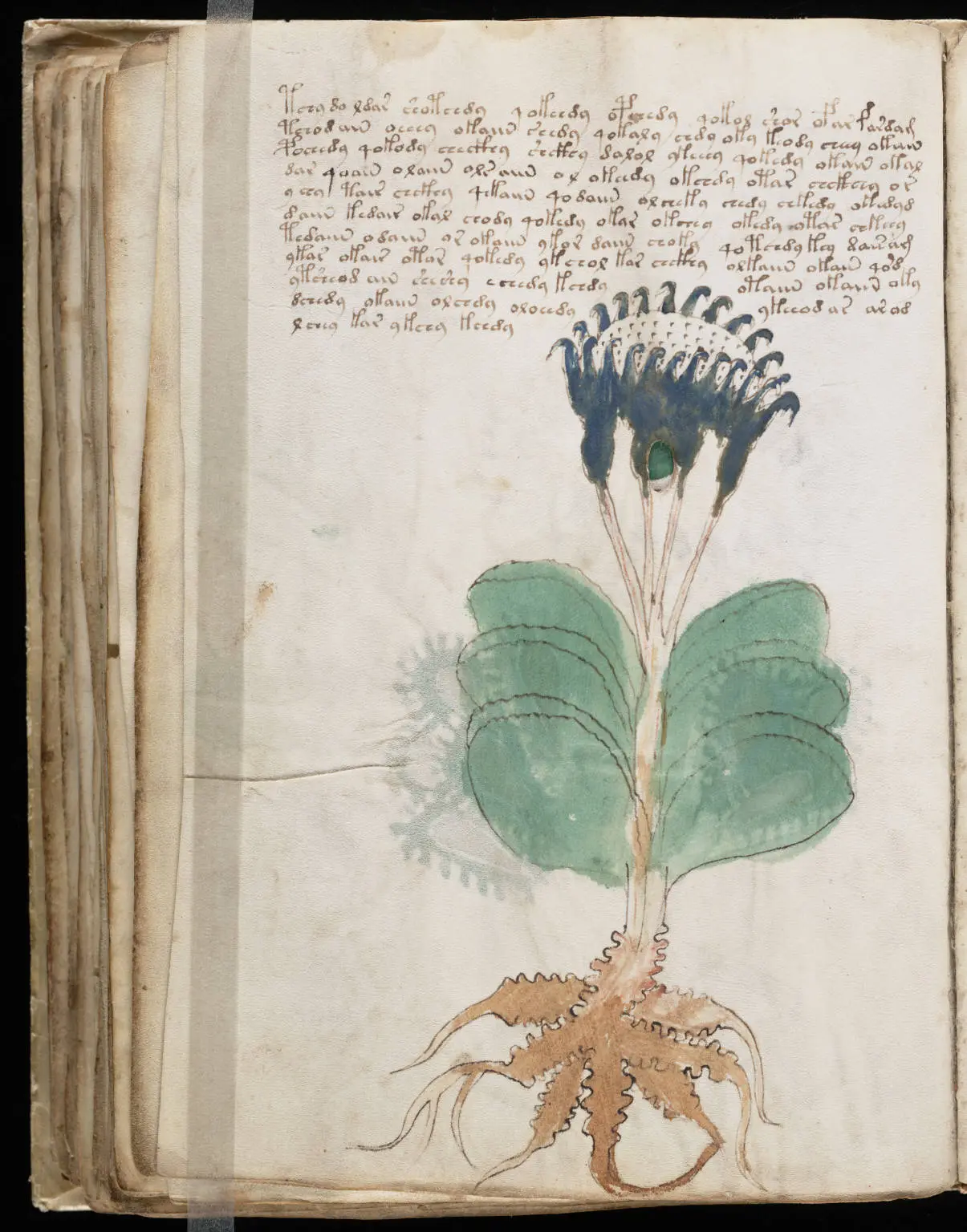
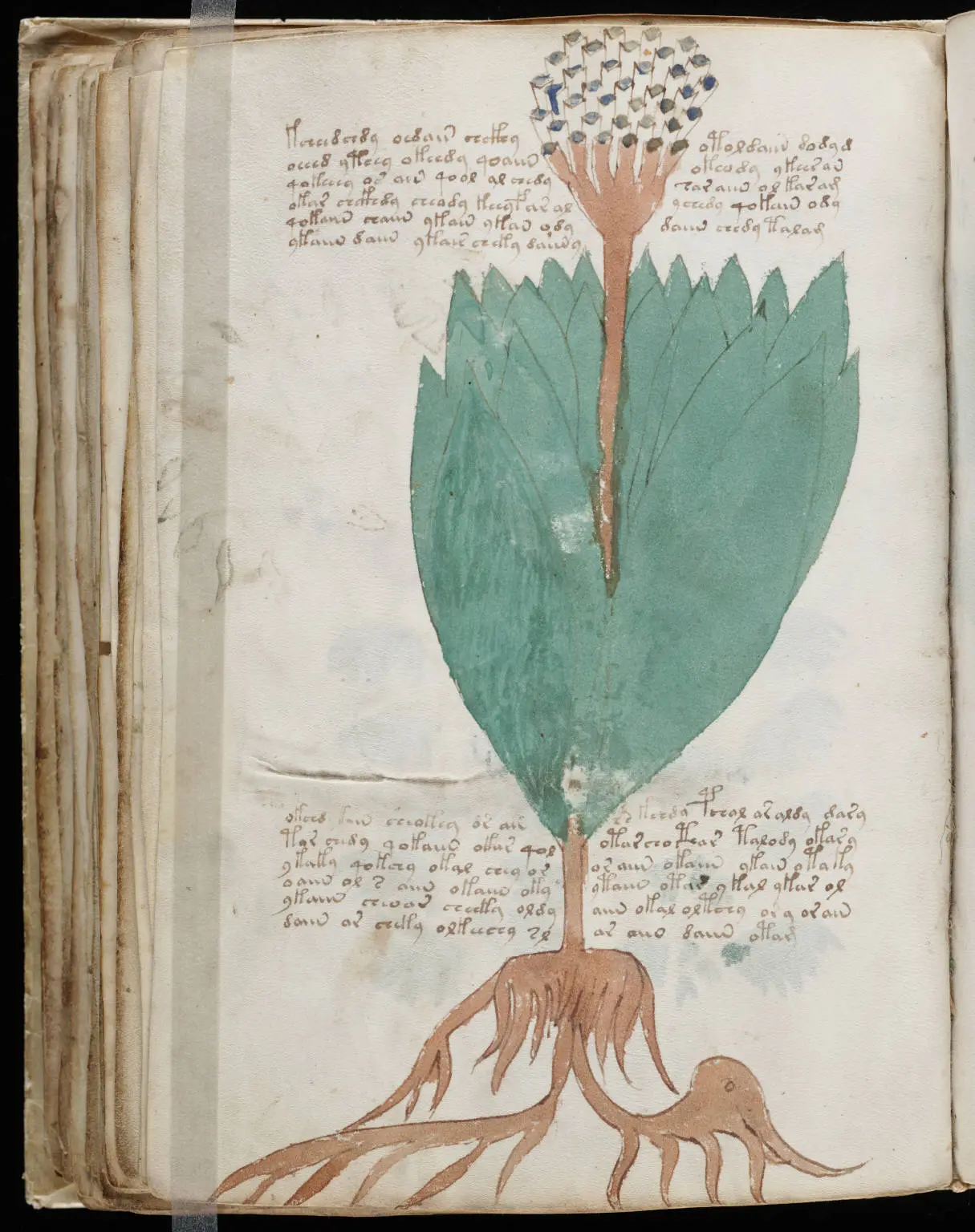
"Voynich Manuscript, plant drawing, leaf number not confirmed" by Unknown author — https://commons.wikimedia.org/wiki/File:Voynich_Manuscript_(100).jpg — Public domain (Author unknown. A letter of April 1639 already mentions the book, per Zandbergen, so the text and drawings are at least 387 years old, far beyond any copyright term. US: an anonymous work of that age is out of term whether or not it was published (Commons tags PD-1923). EU: anonymous work, 70-year term long expired. The file is a faithful flat reproduction (Commons PD-Art; EU DSM Directive art. 14).); Beinecke Rare Book & Manuscript Library, Yale University, MS 408
Collation card, all fields
- Object
- Voynich Manuscript voynich.nu
- Type
- manuscript voynich.nu
- Process
- handwritten on parchment, with drawings voynich.nu
- Format & size
- approximately 225 × 160 mm (8.9 × 6.3 in), about 5 cm (2.0 in) thick, per Zandbergen voynich.nu
- Material
- parchment, calf skin per Zandbergen voynich.nu
- Made
- image/text unknown / object parchment 1404–1438 (radiocarbon, 95%, per Zandbergen) voynich.nu
- Held at
- Beinecke Rare Book & Manuscript Library, Yale University, MS 408, per Zandbergen, collections.library.yale.edu voynich.nu
- Date basis
- Literature: radiocarbon on the parchment, per Zandbergen voynich.nu
Skip the strange writing and look at the skin it sits on. Each standard leaf measures about 225 by 160 millimeters (8.9 by 6.3 inches), a little longer than an adult hand, and protein tests in 2014 identified the material as calf skin, per René Zandbergen. So when someone says the Voynich Manuscript has been carbon dated, the question is which part of it has a date.
Most facts below come from Zandbergen's reference site voynich.nu, a personal site and not a library record, so they carry his name. Yale's catalogue record is linked in the sources but could not be read for this page.
What did the carbon test actually date?
Radiocarbon dating measures how long ago a living thing died. Parchment is animal skin, so a test on parchment reports when the animal died, as Zandbergen and the University of Arizona's 2011 release both explain.
The test dated the calf, not the author.
Credit line to copy
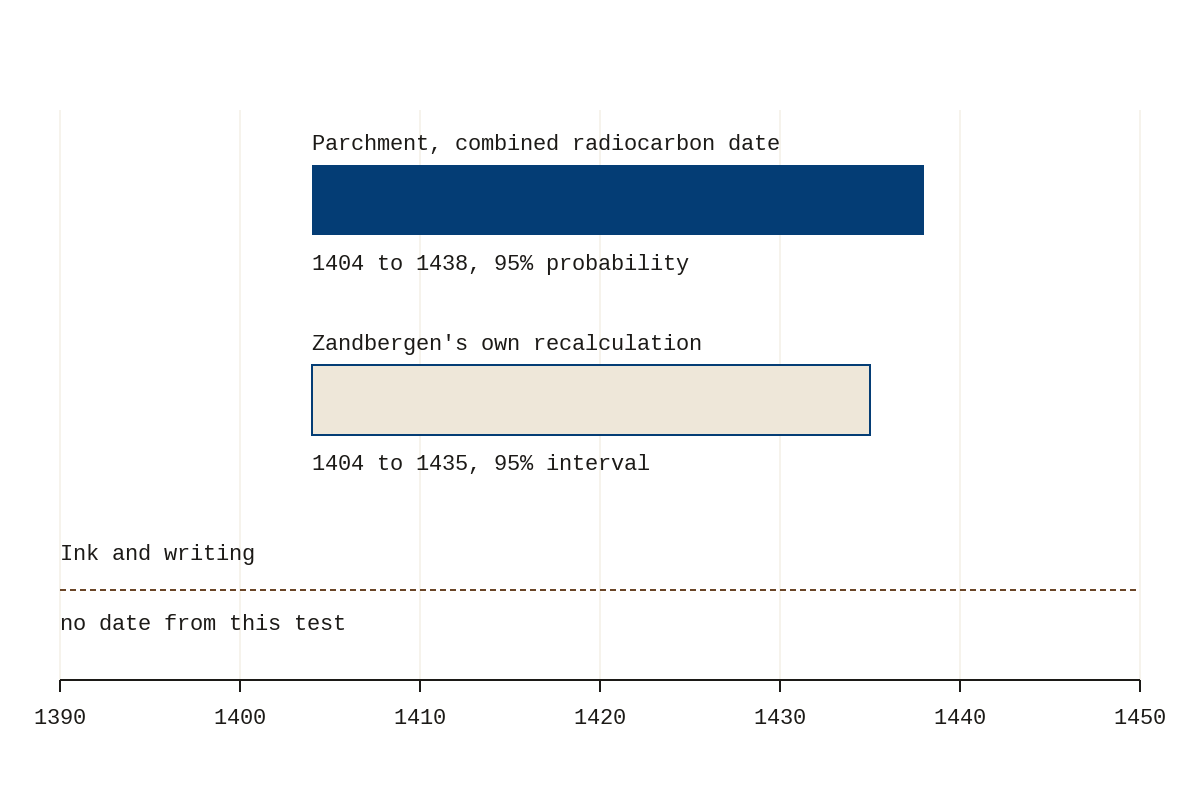
"Voynich Manuscript: the Parchment Range and the Undated Ink" by Spine & Watermark, https://spineandwatermark.com/lost/voynich-manuscript/, licensed under CC BY 4.0 (https://creativecommons.org/licenses/by/4.0/).Per the release, Greg Hodgins of Arizona cut four samples from four page edges at Yale. The release gives each as about 1 by 6 millimeters, set against a leaf 225 millimeters tall, though its inch figure does not match that metric size. Zandbergen names the leaves as folios 8, 26, 47 and 68: the two hands recognized then, thin and thick parchment, and one foldout, picked to catch any spread in age.
The four results were consistent with one another. Per Zandbergen, the combined date runs from 1404 to 1438 with 95% probability, a band 34 years wide, which leaves a 5% chance the date falls outside it. His own recalculation ends at 1435; his page says it differs somewhat from the Arizona figure.
The release's headline speaks of the “age of book,” yet its own text says the parchment pages were what got dated. Zandbergen also says he knows of no published paper on the test (page updated June 2025). The result has reached readers through talks, an internal report and the release.
What does the date leave open?
The ink. Hodgins said in the 2011 release that ink sits on the page in trace amounts, can't yet be sampled free of the parchment beneath it, and sometimes contains no carbon at all.
Zandbergen adds that a 2009 press-conference statement, that the ink went on right after the parchment was made, was wrong: the analysis gave no such information. Analyses by McCrone Associates in 2009 and by Yale from 2014, as summarised by Zandbergen, found iron gall ink throughout. That type stayed in use over many centuries, so it adds nothing to the date.
So the book has the double date in its plainest form: text unknown, object parchment 1404–1438.
Skin does set a floor, since writing can't be older than the thing it's written on. It sets no ceiling. Zandbergen counts two unknown spans, from making the parchment to the first ink and from the first ink to the last.
He still places production in the 15th century’s first half, and calls long-unused parchment not impossible but very unusual. That's his reasoning from all the evidence, not a measurement.
Credit line to copy
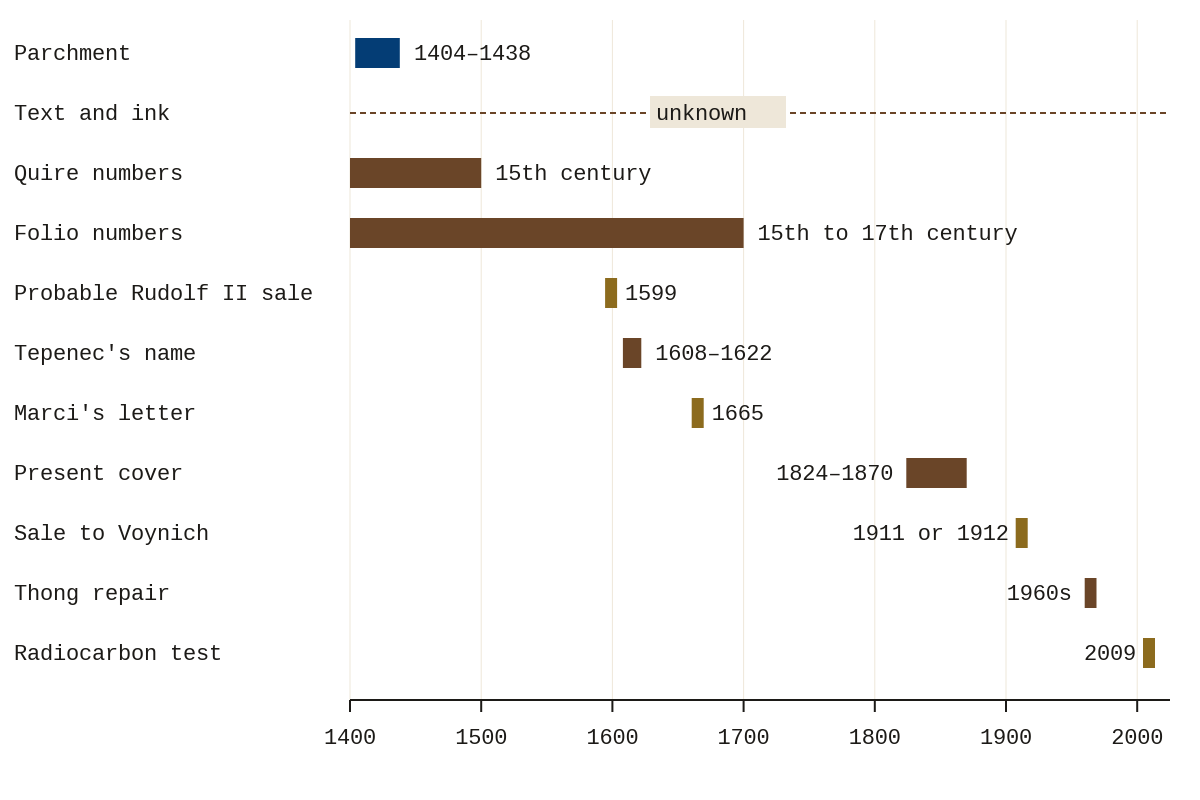
"Voynich Manuscript: What Each Date Actually Dates" by Spine & Watermark, https://spineandwatermark.com/lost/voynich-manuscript/, licensed under CC BY 4.0 (https://creativecommons.org/licenses/by/4.0/).| What is dated | Date or range | Evidence, per Zandbergen | How firm, per Zandbergen |
|---|---|---|---|
| Parchment | 1404–1438 | radiocarbon, four samples, 2009 | 95% probability |
| Text and ink | unknown | iron gall ink, used over many centuries | no direct date |
| Quire numbers | 15th century | style of the numbers | almost certainly |
| Folio numbers | 15th to 17th century | style of the numbers | could be either end |
| Month names, zodiac section | unknown, after creation | placement and language | most probably later |
| Sale to Rudolf II | 1599 | court and family records | reasonably confident |
| Tepenec's name, folio 1 | 1608–1622 | his noble title; his death | seen only under UV |
| Marci's letter | 1665 | the letter itself | year sometimes misreported |
| Present cover | 1824–1870 | covers on sister manuscripts | almost certain |
| Sale to Wilfrid Voynich | 1911 or 1912 | Jesuit list of items for sale | complete by July 1912 |
| Leather thongs on the sewing | 1960s | binding description | stated as a repair |
Download the data (voynich-date-evidence.csv) · source and license notes
Made: drawn and written one folded sheet at a time
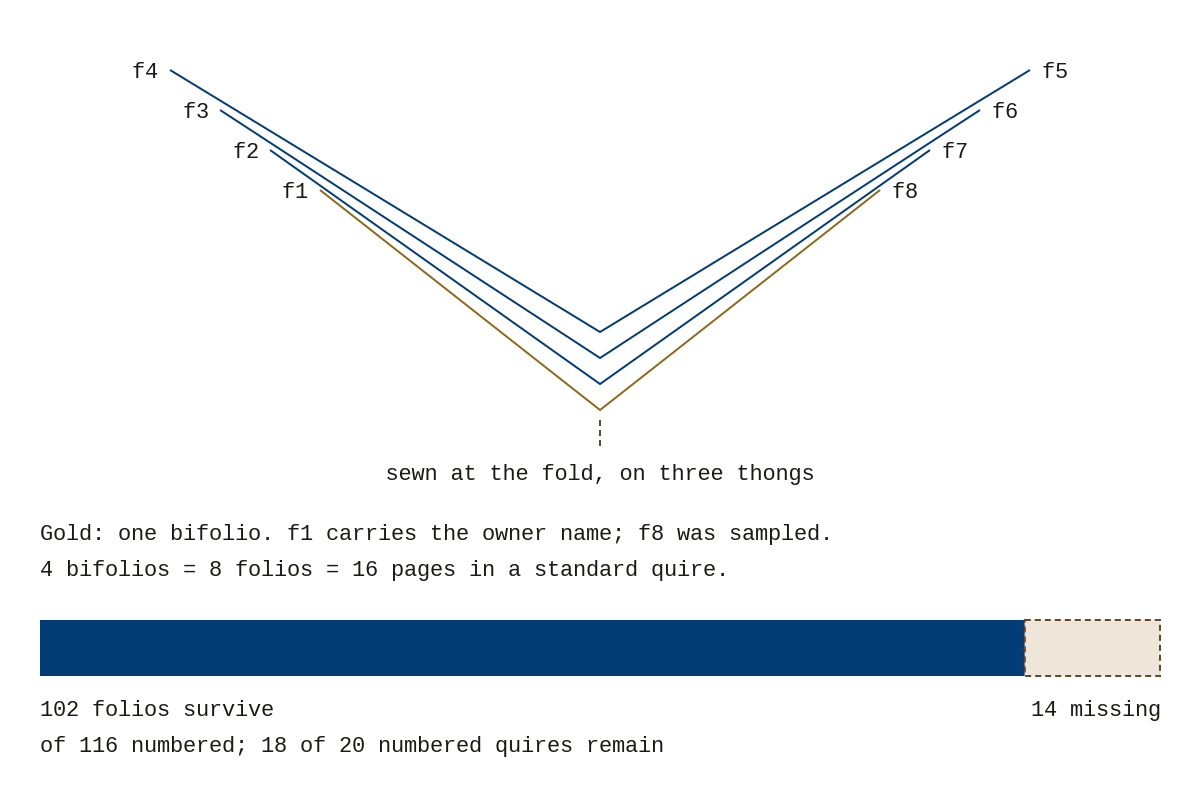
Zandbergen's collation counts 102 surviving folios out of 116 numbered, about 88%, in 18 of 20 numbered quires. This page uses quire, bifolio and folio as he does: a bifolio is a folded sheet, and a standard quire nests four of them into 8 folios and 16 pages. For how such stacks worked in general, see how medieval books were built from folded quires and what folding does to a sheet.
Credit line to copy
"Voynich Manuscript: a Standard Quire and the Folio Count" by Spine & Watermark, https://spineandwatermark.com/lost/voynich-manuscript/, licensed under CC BY 4.0 (https://creativecommons.org/licenses/by/4.0/).A standard bifolio runs roughly 32 centimeters wide and 23 high (12.6 by 9.1 inches). Zandbergen sees no ruling or pricking, so many lines wave across the page, and the parchment shows no earlier writing. Outlines came first, he reports, with text set carefully around them and the color added later. Lisa Fagin Davis has identified five scribal hands, as Zandbergen reports it.
Full credit
"Voynich Manuscript, plant drawing, leaf number not confirmed" by Unknown author — https://commons.wikimedia.org/wiki/File:Voynich_Manuscript_(110).jpg — Public domain (Author unknown. A letter of April 1639 already mentions the book, per Zandbergen, so the text and drawings are at least 387 years old, far beyond any copyright term. US: an anonymous work of that age is out of term whether or not it was published (Commons tags PD-1923). EU: anonymous work, 70-year term long expired. The file is a faithful flat reproduction (Commons PD-Art; EU DSM Directive art. 14).); Beinecke Rare Book & Manuscript Library, Yale University, MS 408
Turn the pages and the subject seems to change. Zandbergen, following older cataloguers, lists herbal, astronomical and cosmological, zodiac, biological, pharmaceutical and recipes sections, nearly all with drawings. The script looks alphabetic, with word-like groups and spaces, but no other document written in it has ever been found, per Zandbergen. A would-be reader has no second text to compare it with.
In 1976 Prescott Currier showed that the text splits into at least two statistically different parts, which he called languages A and B while saying he had no evidence they were separate languages. That split is one reason the samples came from both.
Zandbergen concludes with high confidence that the present leaf order is not the one first planned. By his reasoning, the quire numbers, almost certainly 15th century, came after the reordering, so the sheets were rearranged early in the book's life.
Lived: which marks came from use?
Start with the handling scar, a mark left by use. Hodgins expected finger oils on the margins he sampled, one reason the samples were cleaned so thoroughly; that was an expectation stated in the release, not a measurement. Zandbergen separately lists very significant wear along the folds of the foldouts, without breaking down its cause.
Full credit
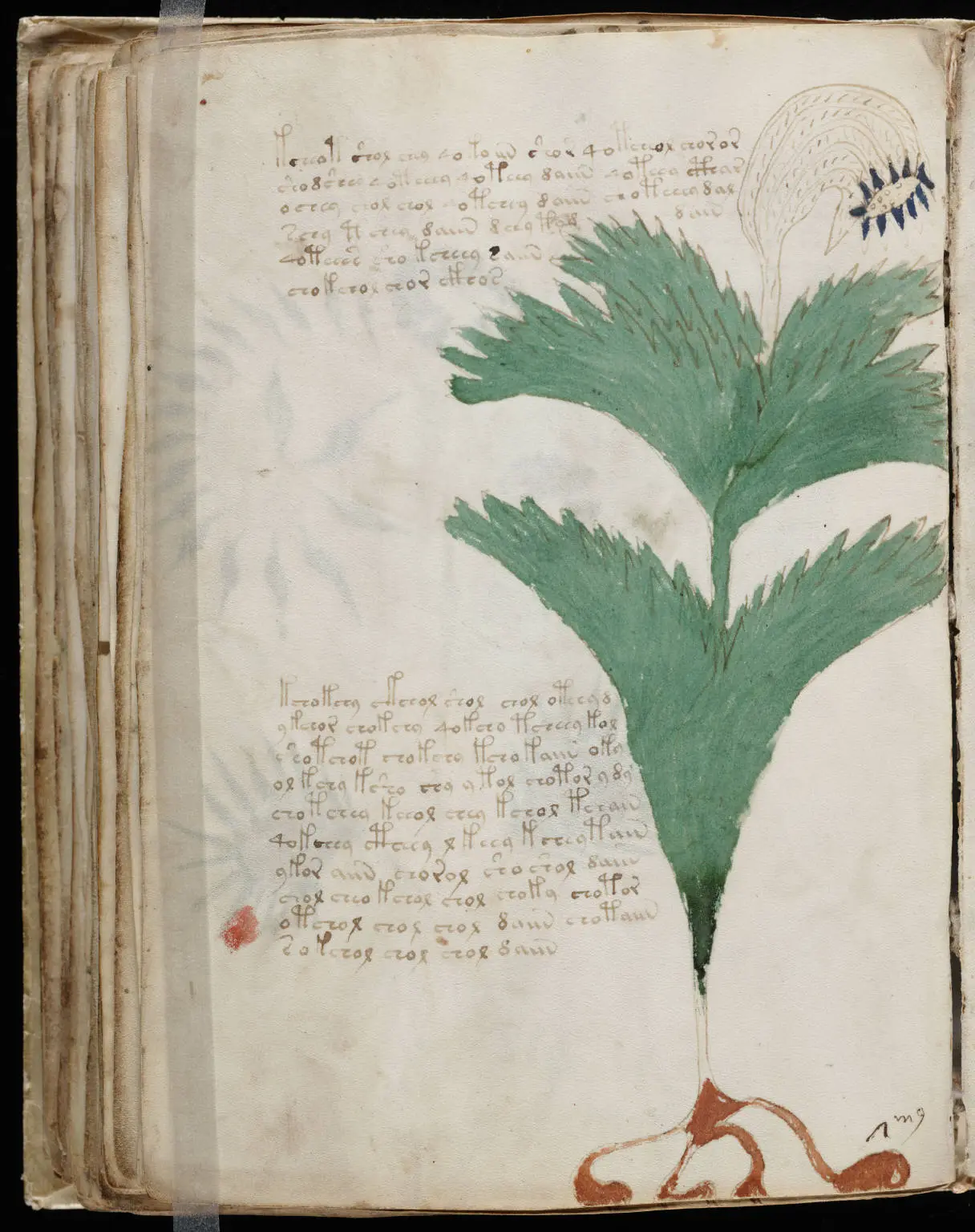
"Voynich Manuscript, plant drawing, leaf number not confirmed" by Unknown author — https://commons.wikimedia.org/wiki/File:Voynich_Manuscript_(112).jpg — Public domain (Author unknown. A letter of April 1639 already mentions the book, per Zandbergen, so the text and drawings are at least 387 years old, far beyond any copyright term. US: an anonymous work of that age is out of term whether or not it was published (Commons tags PD-1923). EU: anonymous work, 70-year term long expired. The file is a faithful flat reproduction (Commons PD-Art; EU DSM Directive art. 14).); Beinecke Rare Book & Manuscript Library, Yale University, MS 408
Other marks need more caution. Pale ghost shapes sit beside the plant on this leaf; Zandbergen reports paint transferring to opposite pages in general, but for this leaf the cause is not established. A translucent band also runs down the left of all three leaves shown here, and the file page says nothing about it, so its cause is not established either. The small mark at lower right sits where he says quire numbers usually go; this page can't confirm that it is one.
Folios 12 and 74 were cut out after binding, per Zandbergen, leaving stubs, and the Zandbergen pages read for this entry don't say who cut them or why. Insect holes on the first and last folios led conservators to infer an earlier wooden binding, per Zandbergen, but worm damage isn't use. As the Beowulf manuscript's crumbling edges show, damage and use can be hard to separate.
Who owned the Voynich Manuscript, and where is it now?
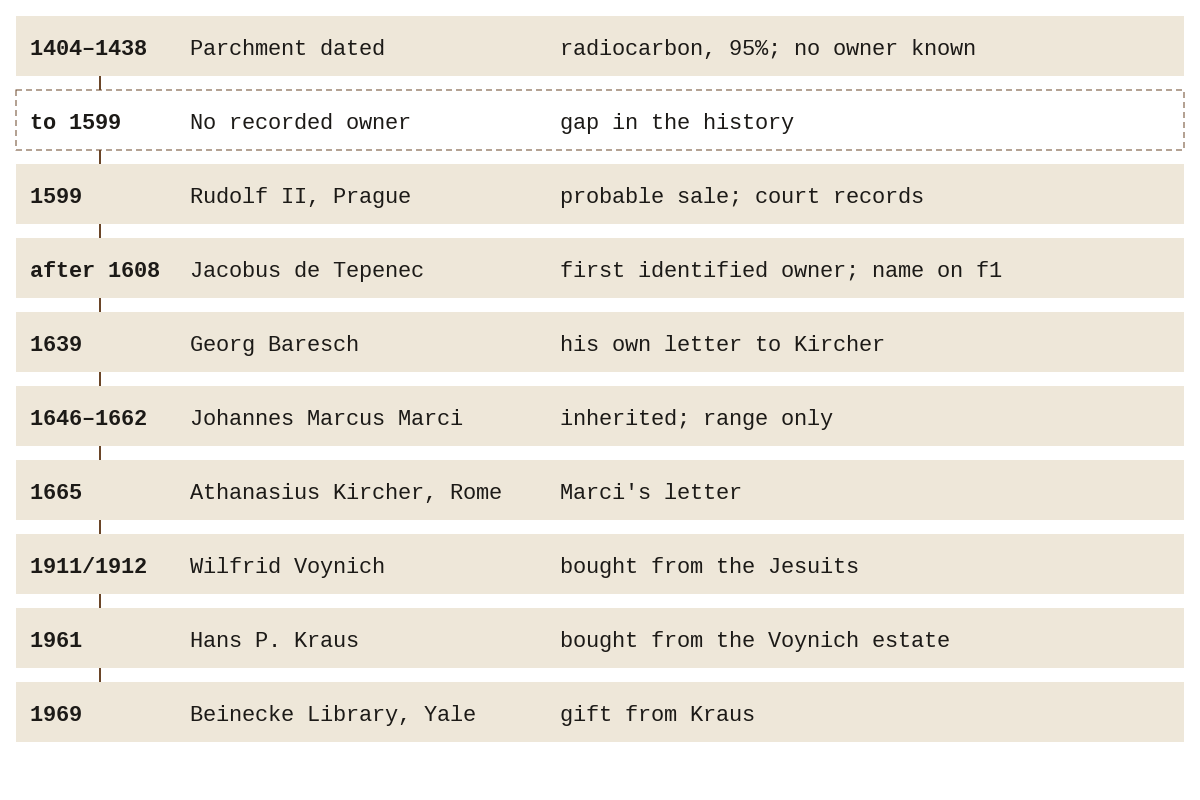
It is held at the Beinecke Rare Book & Manuscript Library at Yale as MS 408, a gift from the dealer Hans P. Kraus in 1969, per Zandbergen. Before that, the chain has one long break: from the end of the parchment band to the probable sale of 1599 is 161 years with no recorded owner.
Credit line to copy
"Voynich Manuscript: the Chain of Owners" by Spine & Watermark, https://spineandwatermark.com/lost/voynich-manuscript/, licensed under CC BY 4.0 (https://creativecommons.org/licenses/by/4.0/).| When, per Zandbergen | Owner | Evidence |
|---|---|---|
| 1599 (probable) | Rudolf II, Prague | court and family records of a book sale, price matched to Marci's letter |
| after 1608 | Jacobus de Tepenec | his name on folio 1; the first positively identified owner |
| 1639 | Georg Baresch | his surviving letter to Athanasius Kircher |
| 1646–1662 | Johannes Marcus Marci | inherited from Baresch; range only |
| 1665 | Athanasius Kircher, Rome | Marci's letter |
| 1911 or 1912 | Wilfrid Voynich | bought from the Jesuits in secret |
| 1961 | Hans P. Kraus | bought from the Voynich estate |
| 1969 | Beinecke Library, Yale | gift from Kraus |
The name itself is modern. Voynich bought the book in 1911 or 1912, at least 473 years after the parchment band closes, and showed it as the Roger Bacon cipher manuscript, per Zandbergen.
Sources split on where Voynich found it. The 2011 Arizona release says Villa Mondragone near Rome. Zandbergen reports that newer research places the collection at Villa Torlonia in Castel Gandolfo, and that Voynich's own story of a chance discovery covered a promise of secrecy.
Is it a hoax, and has anyone read it?
No accepted reading exists. Zandbergen wrote that the text has defied every attempt at decoding (page updated December 2022), and that word statistics give arguments both for and against meaning. His bibliography lists proposed solutions; this page doesn't track them.
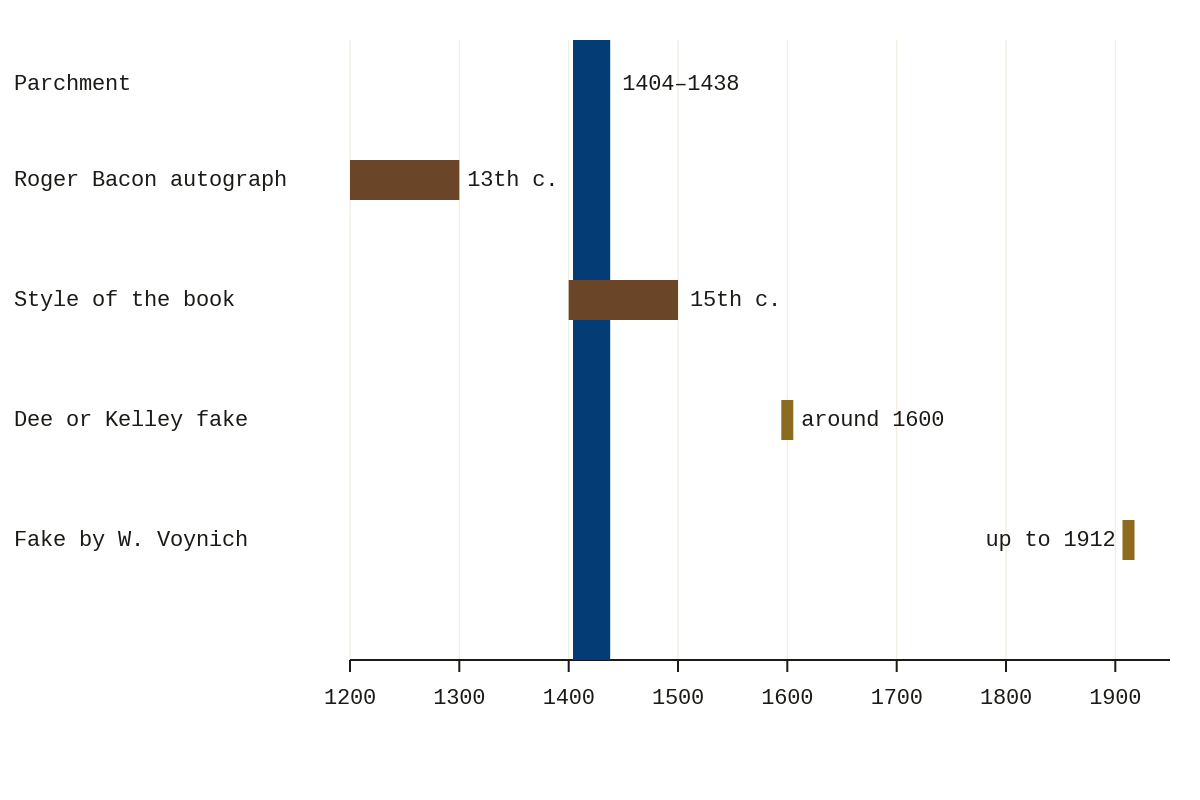
Whether it's a hoax is a separate question that the skin date can't settle alone. This page lists the positions and doesn't rule on them. A writing date before the band conflicts with the skin. A date well after it would mean parchment sat unused for years, and there the argument has to turn to other evidence.
Credit line to copy
"Voynich Manuscript: Proposed Dates Against the Parchment Range" by Spine & Watermark, https://spineandwatermark.com/lost/voynich-manuscript/, licensed under CC BY 4.0 (https://creativecommons.org/licenses/by/4.0/).| Who proposed it, as listed by Zandbergen | Claim | His answer |
|---|---|---|
| Wilfrid Voynich, Newbold | Roger Bacon wrote it, 13th century | largely rejected |
| Gordon Rugg, 2004 | Text made more or less at random by a 16th-century method, pointing to Edward Kelley | method so far reconstructs no real section; too late for the radiocarbon date |
| Andreas Schinner, 2007 | Text statistics suggest it could be meaningless | not yet properly assessed |
| M. Barlow, 1986 | Modern fake by Voynich | untenable; 17th-century letters mention the book |
| William Friedman | An early synthetic language | can't be disproved; chronologically difficult |
Hodgins, in the release, sets out a middle case: some ciphers hide meaning inside gibberish, so much of a text could mean nothing without all of it meaning nothing.
No test reported here has given a date for the moment ink met this skin. No reading of the text has been accepted.
Turn it over:
A letter kept with the book, per Zandbergen: in 1665 Johannes Marcus Marci sent the manuscript to Athanasius Kircher in Rome and passed on a report that it once belonged to Rudolf II. Marci gave no opinion on a further report naming Roger Bacon as the author. The letter dates a handover, not the making.
- Archimedes Palimpsest: another book whose layers carry different dates: Its underlayer is 10th century; its prayers are from 1229.
- Dead Sea Scrolls: fragments whose later handling is part of the record: Repairs by the first scholars left marks of their own.
Sources
- René Zandbergen, "The Radio-Carbon Dating of the Voynich MS," voynich.nu, last updated 11 June 2025. voynich.nuRead: full page, 2026-11-07
- René Zandbergen, "The origin of the Voynich MS," voynich.nu, last updated 24 February 2026. voynich.nuRead: full page, 2026-11-07
- René Zandbergen, "Description of the Voynich MS," voynich.nu, last updated 29 December 2022. voynich.nuRead: full page, 2026-11-07
- René Zandbergen, "The history of the Voynich MS," voynich.nu, last updated 18 July 2025. voynich.nuRead: full page, 2026-11-07
- René Zandbergen, "Why the Voynich MS is not a modern fake," voynich.nu, last updated 25 February 2026. voynich.nuRead: full page, 2026-11-07
- René Zandbergen, "History of research of the Voynich MS," voynich.nu, last updated 26 May 2025. voynich.nuRead: sections on Rugg and Schinner, 2026-11-07
- René Zandbergen, "The Voynich MS: Bibliography and references," voynich.nu, last updated 7 October 2026. voynich.nuRead: section: bibliography entries for Rugg 2004, Schinner 2007, Barlow 1986, Clemens 2016, and the list of proposed solutions, 2026-11-07
- University of Arizona, "University of Arizona experts determine age of book 'nobody can read'," news release on EurekAlert!, 10 February 2011. eurekalert.orgRead: full release, 2026-11-07, paraphrased only
- Beinecke Rare Book & Manuscript Library, Yale University, MS 408 (catalogue record). collections.library.yale.eduRead: link only; not readable for this page
- Raymond Clemens, ed., with an introduction by Deborah Harkness, The Voynich Manuscript (New Haven and London, Yale University Press, 2016). voynich.nuRead: bibliography only, as listed by Zandbergen
Image credits
- "Voynich Manuscript, plant drawing, leaf number not confirmed" by Unknown author — https://commons.wikimedia.org/wiki/File:Voynich_Manuscript_(100).jpg — Public domain (Author unknown. A letter of April 1639 already mentions the book, per Zandbergen, so the text and drawings are at least 387 years old, far beyond any copyright term. US: an anonymous work of that age is out of term whether or not it was published (Commons tags PD-1923). EU: anonymous work, 70-year term long expired. The file is a faithful flat reproduction (Commons PD-Art; EU DSM Directive art. 14).); Beinecke Rare Book & Manuscript Library, Yale University, MS 408
- "Voynich Manuscript: the Parchment Range and the Undated Ink" by Spine & Watermark, https://spineandwatermark.com/lost/voynich-manuscript/, licensed under CC BY 4.0 (https://creativecommons.org/licenses/by/4.0/).
- "Voynich Manuscript: What Each Date Actually Dates" by Spine & Watermark, https://spineandwatermark.com/lost/voynich-manuscript/, licensed under CC BY 4.0 (https://creativecommons.org/licenses/by/4.0/).
- "Voynich Manuscript: a Standard Quire and the Folio Count" by Spine & Watermark, https://spineandwatermark.com/lost/voynich-manuscript/, licensed under CC BY 4.0 (https://creativecommons.org/licenses/by/4.0/).
- "Voynich Manuscript, plant drawing, leaf number not confirmed" by Unknown author — https://commons.wikimedia.org/wiki/File:Voynich_Manuscript_(110).jpg — Public domain (Author unknown. A letter of April 1639 already mentions the book, per Zandbergen, so the text and drawings are at least 387 years old, far beyond any copyright term. US: an anonymous work of that age is out of term whether or not it was published (Commons tags PD-1923). EU: anonymous work, 70-year term long expired. The file is a faithful flat reproduction (Commons PD-Art; EU DSM Directive art. 14).); Beinecke Rare Book & Manuscript Library, Yale University, MS 408
- "Voynich Manuscript, plant drawing, leaf number not confirmed" by Unknown author — https://commons.wikimedia.org/wiki/File:Voynich_Manuscript_(112).jpg — Public domain (Author unknown. A letter of April 1639 already mentions the book, per Zandbergen, so the text and drawings are at least 387 years old, far beyond any copyright term. US: an anonymous work of that age is out of term whether or not it was published (Commons tags PD-1923). EU: anonymous work, 70-year term long expired. The file is a faithful flat reproduction (Commons PD-Art; EU DSM Directive art. 14).); Beinecke Rare Book & Manuscript Library, Yale University, MS 408
- "Voynich Manuscript: the Chain of Owners" by Spine & Watermark, https://spineandwatermark.com/lost/voynich-manuscript/, licensed under CC BY 4.0 (https://creativecommons.org/licenses/by/4.0/).
- "Voynich Manuscript: Proposed Dates Against the Parchment Range" by Spine & Watermark, https://spineandwatermark.com/lost/voynich-manuscript/, licensed under CC BY 4.0 (https://creativecommons.org/licenses/by/4.0/).
Cite this page
Spine & Watermark. “Voynich Manuscript: Carbon Tests Dated the Skin, Not the Ink.” Spine & Watermark, published November 7, 2026. https://spineandwatermark.com/lost/voynich-manuscript/. Accessed [date].
How sources are ranked · All corrections · Contact · Report an error (contact@spineandwatermark.com)